
Kinolime Fix It: Fixing the Michael Biopic Script in One Sitting [Podcast]
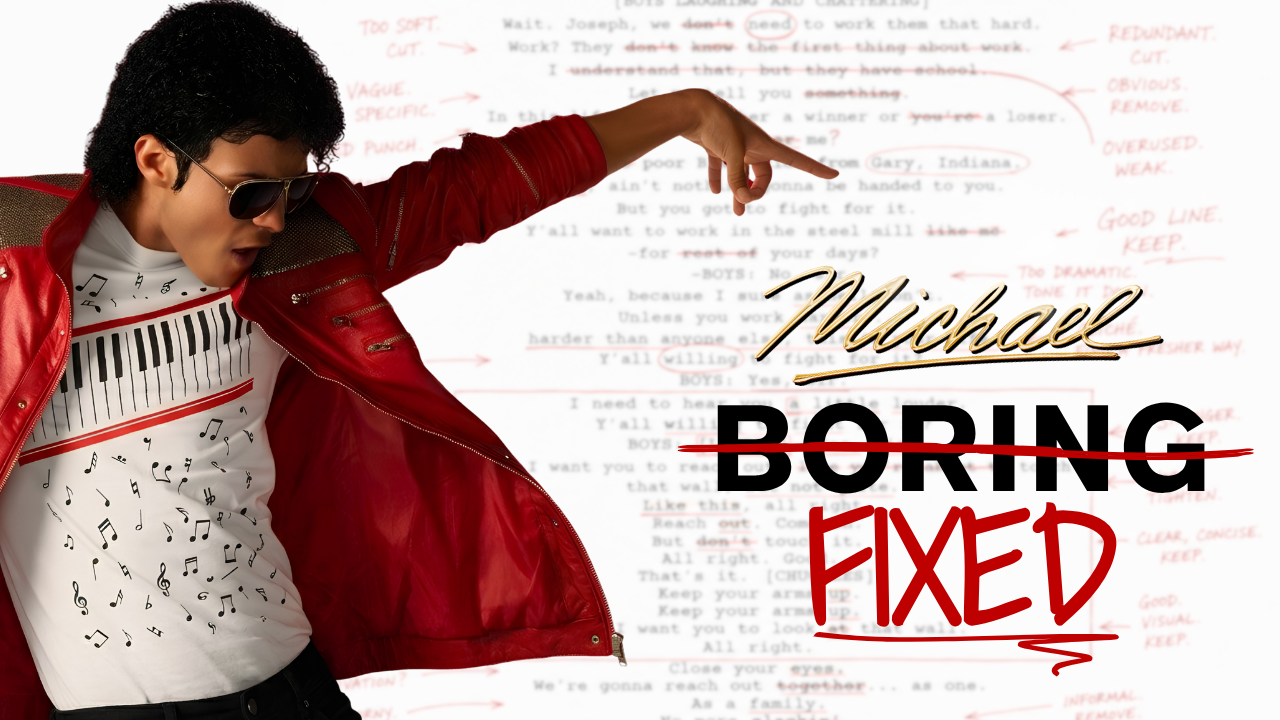
In this episode of the Kinolime Podcast, our CE Danny breaks down the story structure of Michael, the new Michael Jackson biopic directed by Antoine Fuqua.
While Michael is on track to become one of the highest-grossing music biopics ever made, critics have been far more divided. So instead of simply reviewing the film, Danny reconstructs it from the ground up to explore a bigger question: Why do so many modern biopics struggle to tell compelling stories?
Using screenwriting principles, story structure analysis, evaluating character arcs, narrative causality through Trey Parker and Matt Stone's famous "But and Therefore" storytelling technique from South Park, Danny examines why the film's portrayal of Michael Jackson (Jaafar Jackson) and Joe Jackson (Colman Domingo) falls short of its full dramatic potential—and how stronger character decisions could have created a more powerful emotional journey.
Full Transcript: Kinolime Fix ItEpisode 1: Obsession: Why the Michael Biopic Doesn’t Work and How to Fix It
Participants
Danny Murray - Creative Executive, Kinolime
Danny: Welcome to the Kinolime Screenwriting Podcast. I’m Danny, and today we’re talking about Michael.
Michael is probably the weirdest movie of the year so far. It is on track to become one of the highest-grossing biopics of all time. It has stellar audience reviews, but it has also been critically panned as one of the worst movies of the year.
So today, instead of simply complaining about the film or critiquing it, we are going to fix the story of Michael.
The Problem With the Film’s Perspective
Danny: I was curious to see how this film would make me feel. Would I hate it? Would it become a guilty pleasure? Would it somehow, maybe, actually be good?
There is so much to explore in the world of Michael Jackson. I was beyond curious to see how Antoine Fuqua would angle his perspective. Would this be a portrait of all-consuming celebrity culture? Would we focus on Michael’s family in Gary, Indiana? His relationship with his brothers? His relationship with Quincy Jones? His relationship with himself?
When I left the theater, I couldn’t believe that the answer was: we focused on nothing.
The film is terrified of taking a subjective or challenging stance on any aspect of Michael Jackson’s life. My overarching problem with Michael is also my problem with most musical biopics. We all know Michael the myth. We know Michael’s greatest hits. We know the general synopsis of how he got there.
What we do not know is Michael the man. Why did he get there? What did it take from him? How did it make him feel?
This movie is great fan service for Michael Jackson superfans who want to turn their brains off and enjoy a storyless concert about their favorite artist. But it just is not a strong film.
So, to the whole point of this episode: how do we fix Michael?
The “Wikipedia Page” Biopic Structure
Danny: Michael follows what I like to call the “Wikipedia page biopic” structure. That means almost every scene can be described as: “and then, and then, and then.”
Instead of actual conflict and obstacles forcing the character into new decisions, the story simply moves from one event to the next. The South Park writers famously describe good story structure as needing “but” and “therefore” between beats. Obstacles should get in the character’s way, forcing them to pivot and move into different avenues within the story.
These beats are basically the beats of your outline. If the words “and then” belong between those beats, you probably have something pretty boring.
What should happen between every beat is either “therefore” or “but.” So instead of saying, “This happens, and then this happens,” it should be: “This happens, therefore this happens. But this happens, therefore this happens.”
In Michael, the structure pretty much looks like this every thirty minutes or so: Joe makes Michael feel bad. Michael gets lonely. Michael performs. Michael meets a famous executive or producer who tells him he has the stuff. Michael plays with an animal or helps a sick child so we feel bad for him.
Then the movie repeats that cycle five times until we end with a big dance number, the movie closes, and everyone in the theater wearing Michael Jackson attire moonwalks in front of the screen.
That can be great fun, but it does not make for a great story.
Michael as a Passive Protagonist
Danny: There is not much in the film that highlights Michael’s strengths as an artist, his unstoppable dedication, or the tough decisions he makes. We get highlights without legitimate obstacles in his way.
Michael Jackson is the first true contemporary pop star. He is an infantilized adult who was never allowed to have a childhood. But in the film, his ascent is largely propelled by day-player cameos: Quincy Jones, Miles Teller as his manager, and other people who give him his next break on his climb to superstardom.
All of these moments are given to Michael. They have very little to do with the protagonist we have been following. He accepts these steps passively and sits around his house waiting for someone to give him something to do.
He is a passive, reactive protagonist.
Michael does not really make a decision in the film until he decides to split away from his family at the climax. Since we do not get to see Michael explore his wants and needs through obstacles, we do not get a dynamic way to reveal character through subtext or decisions.
Instead, we listen to him talk about his feelings to a guy on a stoop or a cliff, then watch him nod his head while the movie makes a sympathy plea to the audience.
That gets us into his family and Joe.
Joe Jackson and the Need for Deeper Conflict
Danny: Joe largely drives all the conflict in the film. There are brief moments early in the movie that give us a window into his wants and needs, and what drives him into this mania to force Michael into superstardom.
But after the opening dinner scene, Joe largely becomes a boogeyman without much complexity or motivation outside of insatiable greed.
Diving deeper into Joe’s internal conflicts, his own life, and his actions toward his family would give the conflict more depth. It would also give us a window into why Michael might feel manipulated by his father, but still continue to put up with him after he gets his big break.
The Clearest Fix: Make the Family the Source of Conflict
Danny: I think the clearest fix this movie needs is that all conflict should stem directly from Michael’s family.
There are a lot of elements on screen that could make for great drama: a five-year-old who becomes the breadwinner for his family, brothers who are largely tight-knit but alienated from Michael, and a mother who is his best and only friend.
This film does not have to be a searing drama. But exploring these familial factors would give the story a stronger emotional engine.
Michael wants to be a kid, then a teen, then a young adult, but he is never given that ability, even within his own family. That is enough conflict to drive this movie forward, especially if we see the stress, the obstacles, and the dedication involved in becoming the greatest of all time.
We hear Michael say he wants to be the GOAT, and then he just kind of is.
But watching the doubters, the hurdles, the relentless dedication, and the scrutiny he is under from every facet of his life would give this character decisions, obstacles, wants, and needs.
Currently, the film does not clearly articulate those things.
Michael’s want should be to become the greatest artist of all time. His need should be to feel wanted, supported, and seen by his family and by himself. His obstacles should clearly be his father, the industry, and his own insecurities.
A Stronger Structure for Michael’s Story
Danny: If we identify those elements clearly, the structure changes.
The old version is: Joe makes Michael feel bad. Michael is lonely. Michael performs. Michael meets an executive. We feel sympathy for him. Repeat.
The new structure would be: Michael wants to be the best. In doing so, he alienates himself from his family at a young age. By alienating himself from his family, he becomes self-conscious. He dedicates himself to his craft. Maybe he does not know who he is outside of it.
The industry, and largely his father as well, present enormous obstacles to his goals. Michael chooses to take a leap, or maybe he chooses not to and is forced to anyway.
This drives further wedges between Michael the man and Michael the myth. It thrusts him into a new stage of his career.
We watch him write. We watch him put together songs. We watch him build his team, say no to opportunities, take big risks he is too young to understand, and most importantly, perform - the only place where life makes sense.
This gives us a story that feels similar on the surface, but is flipped so that Michael is the one making the decisions. He finally becomes the protagonist of his own film.
The Jackson Brothers Need Individual Identities
Danny: Another issue that hinders the entire structure of the movie is that all of Michael’s brothers operate as a hive mind. It almost feels as if the film itself is ambivalent to the fact that Michael’s family is important to him, while also being completely alienated from his story.
We do not see the brothers unless they are all merged together. They are either dancing, playing basketball, or stuffed into a car.
The Jackson brothers have no tangible identity and are almost useless to the story. The same goes for Michael’s sister.
We need to give them a stronger reason to ignore Michael. Maybe Joe seals Michael off from them. Maybe Michael’s drive forces him to reject their fun in order to focus on his future.
We cannot start with them already a thousand feet away emotionally. We need to see Michael make choices with these brothers as individuals that lead us there.
Michael has been shaped by a father who molds him into an otherworldly force destined to change music and culture forever. He sets out with the belief that his mission in life is to be the greatest act in the history of not only music, but culture. He wants to be something larger than himself.
The only two people who truly believe this is possible are Michael and Joe. But as Michael continues to be worked into the ground by his father, more people begin to believe that this kid might actually be who he says he is.
Michael jumps to the front of his brothers and knocks the shoes off everyone in the building. He is taking control of the band and his family’s destiny, something Jermaine and the rest of his brothers may not want.
That would leave them feeling betrayed, jealous, and conflicted in their relationship with Michael. He is no longer just their little brother. He is now in control of their destinies and their livelihoods.
Their baby brother has as much control over their lives as their abusive father.
Michael’s Isolation and Escape Through Music
Danny: As Michael loses his relationship with his brothers, his father’s hold only strengthens.
We watch him fail to build real relationships with kids his own age. We see how overwhelming his life is at every turn and how his development has been internally arrested. He is an employee of the family brand every waking moment.
His only escape from his family, outside of his mother, a relationship that is also, in some way, marked by transaction - is to dive even deeper into music.
We watch him write. We watch the Off the Wall recording sessions. We watch him find Quincy Jones. We watch the magic of their work together.
Then Michael explodes into a megastar in his own right.
This is finally his way out. It is his chance to become a megastar, but more importantly, his chance to escape the prison his talent has boxed him into. He wants to be Michael Jackson, not just one of the Jackson Five.
He demands to get out from the grip of his family, and his family and father have no choice but to give it to him.
As he becomes not only alienated from his family, but a complete outcast from them, Michael hides away in his music, his publicity, and his ability to capture the world. He can make everyone love him and stand in awe of him, even when he feels none of that in his personal life.
Reframing the Animals, Children, and Childhood Motifs
Danny: This reframes the moments where we see Michael with his animals as his only friends, or reading his favorite childhood books.
They are no longer cute, endearing moments. They become tragic sequences about Michael’s need to be loved, the profound pain of never having had a childhood, and the beginnings of his physical transformation through surgery and vitiligo.
His scenes helping kids at the hospital are no longer sappy moments designed to make us like him. Instead, they become windows into everything his lack of childhood and fame robbed from him.
He wants to be loved for Michael, not MJ. He wants to be able to act like a kid among other kids.
The Making of Thriller and the Fight for Control
Danny: We should spend large sequences of this isolation engulfed in the making of Thriller.
Instead of watching studio executives give Michael opportunities, we should watch him fight for those opportunities.
The film never truly explores how profound Michael Jackson’s stardom was in the context of him being a Black man from one of the poorest parts of the country. He starts developing vitiligo in 1982 and demands to be treated fairly by MTV in 1983.
Let us watch him fight against the racist structures that want to limit his success as a Black artist. As his body literally begins erasing his melanin, he fights for himself.
That is much stronger than having a groveling executive do the heavy lifting for him because of his talent.
We can still keep the massive Thriller set pieces that lead to a moment where Michael truly has everything externally that he ever dreamed of.
He is the greatest of all time.
The Victory Tour as the Collapse Point
Danny: Then that hubris comes crashing down when Joe gives him a carrot: do the Victory Tour, and you will finally be free of me.
Michael wants to do it, but if he does, he will truly have everything he ever asked for. He will have his internal want: a family that loves him. And he will have his external want: to be the star he knows he is.
The rehearsals go awry. Michael’s body is destroyed, and he loses everything he had been building toward.
We can cut much of his recovery, but we should see him largely alone in the hospital, with no one but his mother. We begin to hear rumblings of rumors about Michael that no longer show him as the golden boy. We see the beginnings of drug abuse and a looming internal ultimatum about what to do with his family.
The Final Break
Danny: Then we have the Dodger Stadium tour.
We watch Michael permanently sever himself from Joe and from his brothers’ band. He leaves with one last stand, alone on stage, but with far more complicated internal questions looming over him.
Now we have a version of Michael that probably still gets greenlit by the estate, but allows the character to be complicated by clear goals and motivations that are in direct conflict with his internal needs.
Michael becomes a film not just about a recap of career highlights, but about the tragedies, conflicts, and flaws that created a figure unlike anyone else in human history.
Closing Thoughts
Danny: That is how I am fixing Michael today.
If you hate Michael Jackson, this probably is not helping. If you love Michael Jackson and thought this was the best movie ever, and you called me like John did after he got out of the theater saying it should sweep the Oscars, this probably hurt your feelings. I am sorry about that.
I hope this helps you start thinking about story, and maybe helps fix a few things about boilerplate biopics in the future.
If you liked this, leave a comment. Tell me what I missed, what you liked, and what you hated about these fixes.
I liked doing this, so I will probably make a few more in the future. There are other movies where I loved the concept and am still thinking about what could have been done differently.
Thanks for watching. I forgot that part, so we are going to cut it in really abruptly, and you will be able to tell that someone told me to say it.
See you later. Thanks. Bye.