
Kinolime Fix It: Why Doesn't Odysseus Make Us Feel More? [Podcast]
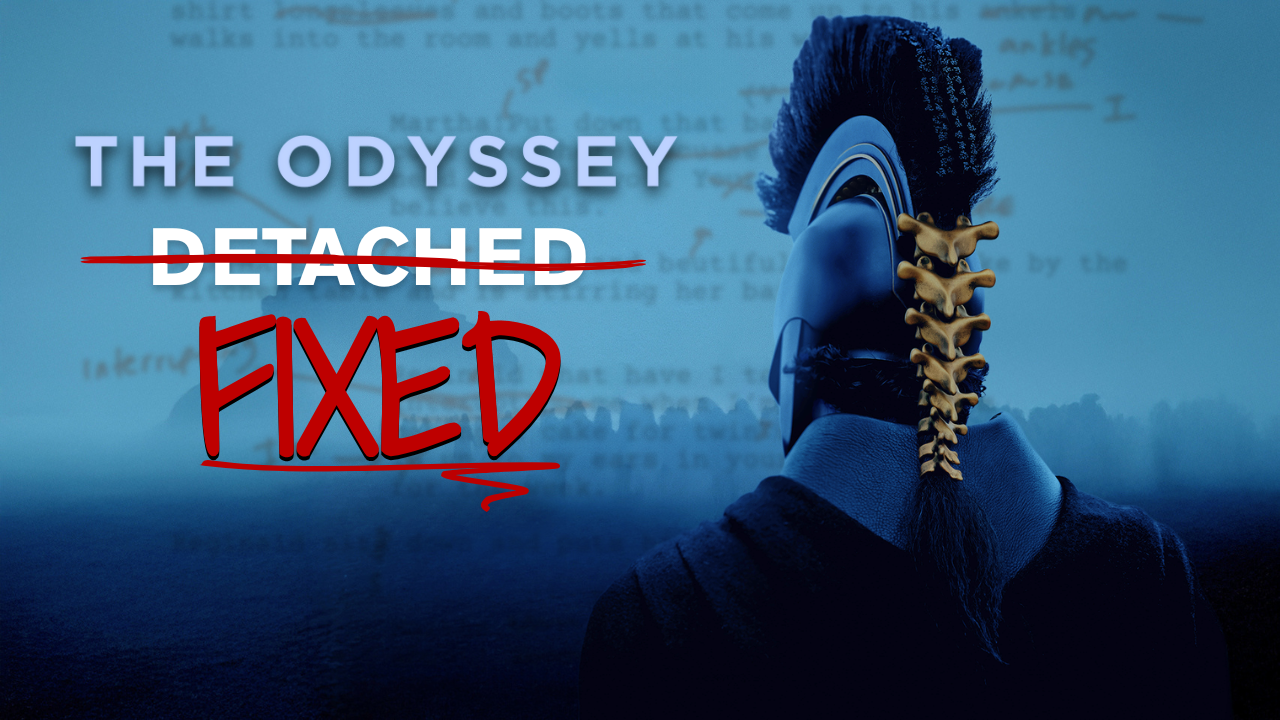
Nolan finally made his Odyssey. So why does his Odysseus feel like a stranger?
The reviews have been rapturous: the scale, the cast, the tension that only Nolan can wring out of a wide shot. But strip away the spectacle and ask a simpler question: do you actually feel anything for the man at the center of it?
In this episode of Fix It, Meara argues that the answer is no, and that the problem isn't Matt Damon, it's the writing. Nolan's Odysseus isn't chasing home, glory, or his own cunning; he's fleeing a guilt the film never earns and can't resolve. A hero built to conquer gods has been quietly rewritten into a man society just happens to. So what would it take to fix him — without abandoning Nolan's vision entirely? Meara rebuilds the myth from the siege of Troy to the halls of Ithaca, and finds that one small, ruthless addition could change everything.
A must-listen for anyone who's ever made a single change to a script and watched it upend the whole story.
Full Transcript: Kinolime Fix ItEpisode 4: Why Doesn't Odysseus Make Us Feel More?
Participants
Meara Owen-Griffiths - Creative Executive, Kinolime
Meara: Hey, do you say Telemachus or Telemachus? Let's start an argument about it in the comments section and boost the algorithm a little.
Christopher Nolan's 2026 adaptation of The Odyssey is receiving plaudits from critics and fans alike. The A-list cast, the natural lighting, the sprawling set pieces, and those moments of asphyxiating tension. You've heard all that praise by now, I'm sure, so there's no point in us beating that dead Trojan horse. We're not here to talk about any of that superficial stuff. We're talking about character and story.
Particularly, I want to look at why Matt Damon's Odysseus is nobody's favorite part of this blockbuster, and how we can trace that all the way back to Nolan's writing decisions. Why does Odysseus not engender stronger emotions? Why does he fail to capture the imagination required of this Homeric adventure?
This video will argue that it's because he's been shifted from an agent of his own destiny to a victim of society — this vague and nebulous force that you can never truly overcome. It positions Odysseus as a tool for Nolan to direct, rather than someone with the self-determination required to actually challenge the gods.
I'm Meara, screenwriter and creative executive here at Kinolime. Welcome to Fix It.
Guilt, Trauma, and the Weight of Translation
Meara: Perhaps the greatest singular change to the source material is Nolan's transposing of guilt and trauma onto the King of Ithaca's character for his actions in Troy. Rather than strengthening Odysseus's character, I feel that this decision weakens his motivations.
Translators and authors Emily Wilson and Daniel Mendelsohn have speculated that Nolan's desire to make a Christopher Nolan movie led to unfortunate shortcomings in the adaptation. It's ironic in a way, when Wilson herself has been criticized for her highly contemporary translation of the text and consequently, her work seems to be the foundation for Nolan's interpretation. Everything is a copy of a copy of a copy.
In the dog-eared Robert Fagles print I've maintained since my school days, the conclusion of the Trojan War is described like this: Odysseus marched right up to Deiphobus's house like the god of war on the attack, with Diehard Menelaus. There he fought the grimmest fight he had ever braved, but he won through at last thanks to Athena's superhuman power. This makes it seem like there's some valor in it — no pleasure, but no regret either. It was the task at hand, and the gods aided his victory.
Now compare Wilson's translation of the same passage: Odysseus, with Menelaus, rushed to find Deiphobus's house, and there he won at last through dreadful violence, thanks to Athena. So the poet sang.
"Dreadful violence" is loaded language indeed. Was Odysseus a brilliant wartime leader of men — this badass who performed as Troy burned? Or was he ashamed of what he did? Is "dreadful violence" the experience of the man himself, or the opinion of the external third-person narrator? His intent is fundamentally changed by this interpretation, and it has knock-on effects that reverberate through every facet of his character.
From Proactive Hero to Reactive Victim
Meara: The original telling of Odysseus's return depicts him as someone almost singularly driven by his desperation to return home to his family. Each obstacle he encounters — be it a god, a monster, an ally, or an enemy — reveals a little bit about his character beyond his objective: resilience, cunning, loyalty to his men, pride in excess. Each encounter tests his humanity. Vitally, he learns to overcome the hubris that afforded him the advantage in Troy.
Nolan's alterations position Odysseus's defining character moment as past tense — something that has already occurred when the story begins — shifting him from a proactive hero to a largely reactive one. The siege of Troy is more defining than the return to Ithaca. His past informs his present, rather than the future he wants informing his actions.
The hubris he's known for is wavering from the very moment we meet him, except for when the plot necessitates its inclusion. During their journey, he has not completely abandoned his ego and bloodlust, as evidenced by the juvenile shot he takes at the Cyclops as they flee.
Odysseus is also stripped of his silver tongue and his guile — the archetypal contemporary witty hero. Think Iron Man. Think Captain Jack Sparrow. These owe a lot to the character, but Nolan's version couldn't feel further away. Instead, as Mendelsohn says, this tormented, guilt-ridden Odysseus, stripped of humor and wit, seductiveness and cleverness, is a sibling of Memento's anguished amnesiac, of Batman, of Oppenheimer — men tormented by pasts they wrestle with in different ways.
Nolan giving Odysseus the Oppenheimer treatment feels particularly apt, whereby the protagonist achieves something great, but something also terrible, and they're unable to put the cat back in the bag. But unlike inventing the atomic bomb, we never really see the spiraling consequences of the siege of Troy. Odysseus is not Paul Atreides unleashing a holy crusade.
Does the Guilt Even Track?
Meara: Let's be clear: many great tales have been told about the ethical consequences of war, and many more are yet to be spun. Does this ancient epic make for suitable terrain? The effects that the violence of Troy would have on a man are undeniable. Pillaging the city, executing the citizens — yeah, these factors could all feasibly contribute to an unshakable guilt and mental instability.
Yet we're forgetting that Odysseus is already a seasoned warrior before he leaves for Troy. Remember the quote about the grimmest fight he had ever braved? Homer never describes these experiences in detail, and Nolan doesn't bother at all. But how does he become such a capable and cunning leader if not for trials and tribulations of the past? This should not be his first rodeo, effectively. Even if he doesn't wield the blade himself, he has experienced wanton violence, including, in likelihood, against women and children.
The fact that the people of Troy were fooled by a trick Odysseus dreamed up weighs heavy, because he is a just man — this is reflected in his habit of giving foes a fair shot by alerting them with the twang of his bowstring. Remorse tends to twist in one's gut and cause people to see connections where there are none, and Odysseus's assumption that he is somehow responsible for the apocalyptic fall of a beautiful age of peace feels exaggerated beyond belief.
But okay — let's say his prior campaigns were clean and cheerful. Everyone went home friends and the population somehow increased. Let's say Troy is the first time Odysseus truly experiences the horror of war. That's right, we're going to stick with it. So how can we now position this change so that it feels complementary to his objectives, rather than antithetical to them?
Reframing the Race Home
Meara: For one, Odysseus should want to control his own narrative. In a story about stories, retaining authorship of your own tale is vital. Odysseus is introspective, yes, but his men are not — they're already singing songs about his heroics, and about how he gave them free rein to do as they pleased, which he fears will reach Ithaca long before he does.
Racing against his fast-traveling legacy could be a powerful alteration. He wants his wife, and the son he barely knows, to hear that he's done these terrible things — because he can't bear the thought of them idolizing him for the very things that keep him up at night.
Yet an obstacle with Nolan's adaptation prevails, and it's one that this change doesn't really fix: Damon's Odysseus overcomes the trauma he received through this mass execution by, yeah, executing a heap more people. I'll be honest, this does not track with me whatsoever, and the twang of his bow doesn't make this any less of a trick than his tactics in Troy.
The Missing Threat: The Suitors
Meara: The film completely fails to depict the suitors as the den of lions and thieves that it really must be, and it never bothers to establish the fast-disappearing, unadulterated world of the Bronze Age we're told about. Right now it feels as though the suitors' transgressions are minor compared to the Ithacans who torched Troy. If Nolan is making an argument for a return to a kinder, more romantic era of virtue, then why is it entirely theoretical on screen — and how can it be achieved by the slaughter of a hundred men?
Penelope has patiently waited twenty years for her husband's return, and in that time she's acquired a pantheon of suitors to replace Odysseus. Chief among them is Antinous, a sleazy, power-hungry draft dodger who is prepared to kill Telemachus, Penelope's son, for a clear shot at the throne. But it's all theoretical. Antinous has waited twenty years to seize power, and he's got this "any day now" approach that doesn't feel threatening to me in the slightest. We don't see him, nor any of the suitors, as any real threat to Telemachus or Penelope. As such, what is Odysseus's big rush home?
In the text, these suitors are truly detestable, as they should be — gluttonous, insolent, entitled. They're parasitic young aristocrats who come from far and wide, taking advantage of Penelope's hospitality. Nolan fails to depict them as truly feral and hedonistic beyond Antinous and his sidekick. They're annoying, sure — they're pressuring and inconveniencing Penelope and Telemachus — but compared to the mass executions in Troy, what's effectively a social violation feels like a pretty minor offense. Odysseus returns and slays them unarmed, because they maintain the hubris he literally just overcame.
The Fix: Give the Guilt a Face
Meara: It would be very easy for me to just say this could be improved by sticking closer to the source material, but to do so would hinder Nolan's vision. I'm not as condemning of his modern moralizing as some, so I'm willing to play ball.
However, one must always be careful: if a "fix" — air quotes you can't see — requires more fixes, you risk spinning out of control, constantly accounting for the domino effect you created by removing a piece of the puzzle. But changes beget changes. So if we're reinterpreting the story, let's do that. Homer be damned.
Imagine that Antinous now joins Odysseus in the siege of Troy, and he personifies the issues that horrify Odysseus. He rapes, pillages, executes. He's the one who beheads the unnamed priestess played by Zendaya, unprompted. He's gleeful in conquest — a genuine physical and ideological threat. And to make it worse, he seems to thank Odysseus for affording him this opportunity, metastasizing Odysseus's guilt.
Following their victory, Odysseus, disturbed by the behavior of the men he conscripted, defects. He gathers a few loyal men who share his sentiments, and they take their own ship, choosing to travel independently of the larger legion — in part because he wants to return home directly without stopping for a victory tour along the way, and in part because Odysseus wants to control the narrative about what orders he gave: what he commanded versus what his men did of their own accord.
Now Odysseus and his men are diverted by events — prevailing winds, shortages of provisions — as it is at the moment. Antinous and his band of war criminals, however, make it back to Ithaca without delay. Even if it takes him, say, a year, he's now got roughly a nine-year head start on our hero. What difference is there between nine and twenty, really, when he doesn't do anything anyway?
Antinous as Ithaca's Slow Poison
Meara: On returning, Antinous initially showers Odysseus with praise and eagerly awaits his return. Telemachus and Penelope are delighted to hear he survived, and he's being celebrated. But quickly, everyone begins to fear the king shall not return. Antinous is now a yardstick by which we measure Odysseus's delay, and, newly accustomed to just taking whatever he wants, he begins to make a play for the throne.
With each passing month, he becomes more obsessive, and his narrative morphs. While at first he portrayed Odysseus as a heroic war general, now he's cowardly, hiding behind Agamemnon, the true leader of the men. "He probably remained in Troy," Antinous tells his audience, "or cast himself into the sea out of guilt." This now feels like psychological warfare on Penelope, and it means Telemachus's opinion of his father's legacy is almost entirely based on equivocated tales.
Antinous is now a much more personal antagonist, too. He represents Odysseus's failings, and shows what Odysseus could become if he decided to take pride in his actions rather than regressing into his guilt. Giving the societal structure that Nolan injects into the story a face means we have something to punch.
Antinous controls information, and the audience sees the effects this has on both Penelope and Telemachus. There's dramatic irony in knowing Odysseus is actively returning while Antinous convinces himself he isn't — this psychological warfare he's waging is a much more pointed attack than the current "oh, you drank all of Penelope's wine."
Do you see how all of this complements Nolan's changes, but channels them into a narrative purpose? Now Odysseus has additional motivation to return home posthaste. Every second he's delayed, he's left his throne open for Antinous to steal. He knows what Antinous is capable of firsthand, and he fears Ithaca could devolve into barbaric pillaging if he doesn't provide proof of life. If the island does burn, what then? They invade the next one. They become the marauding sea people that everyone fears so much — from afar, the fear of this escalation should really light a fire beneath him.
Furthermore, if we know that Odysseus's crew are the morally just among his army, he now has extra reason to want to protect them — something he cannot actually accomplish. This further racks him with guilt.
A Homecoming Worth Fighting For
Meara: Finally arriving home, Ithaca is depicted as much worse off than in the current iteration, with lawlessness spreading like wildfire — not just within the chambers of the castle, but from shore to shore. The hedonism that Odysseus allowed, even encouraged, has proliferated. Dissenters are executed, Zeus's law is laughed at. In the same way he tricked Troy into inviting him within its walls, men have weaseled their way into his castle. They sleep in the corridors, abuse the maidservants. It's fallen into a den of gambling, prostitution, fighting. It's unsafe. Those under Penelope's employ are victims, not co-conspirators.
Antinous is a less scheming figure now, because he's one who is effectively already ruling — his ascension is merely a formality, and Penelope's existence is made miserable by his presence. Odysseus now positions himself as a beggar to infiltrate the castle, working his way up through the rungs of society to determine the damage: what truths have made the voyage home, and what fables have already usurped them.
In order to stop the rot spreading, Odysseus challenges the suitors. Importantly, this can no longer be a massacre. If Odysseus carries tremendous guilt, he needs to offer some opportunity for redemption — otherwise, why does he deserve it himself? He allows Antinous and his cronies the opportunity to repent, and kills them only when they refuse. We read this as an acknowledgment that he left the door ajar for them to sneak through; once the mare is bolted, it's too late to lock the stable, so only now does he feel forced to employ violence to prevent violence.
To borrow from another Greek myth, Odysseus opens Pandora's box when he teaches his men that treachery can be employed to give oneself an advantage in war. And now, if you'll excuse the continual references, he has given fire to humanity like Prometheus before him — he has to strip it from their greedy hands and reassert himself so that some morals can prevail. He is an imperfect ruler, but one fit to set a good example for his son.
Now Athena — or more accurately, the manifestation of Odysseus's guilt — can be let go because of this conclusion. Rather than just disappearing the second Odysseus shares the weight of his guilt with Penelope, Odysseus has closed the loop he began in Troy, bringing this edition to a much tidier conclusion.
Closing Thoughts
Meara: So, what do we think? Do we like the changes? I feel like they maintain what Nolan has already changed, but offer a more cinematic conclusion. I truly believe that even if these alterations make a 1% improvement to Odysseus as a character — how human we find him, how much we can connect to him on a personal level — then they've got to be worthwhile.
The lesson I'd like you screenwriters at home to take away from this video is that when you make a change to your screenplay anywhere along the timeline, it has ripple effects that permeate throughout. If you don't justify your alteration and all of its knock-on effects, it's not going to feel like a worthwhile addition. Take that as you will, and see how you can apply it to your own writing.
So, what were your thoughts on the Odyssey? Do you like the changes we made today, or are you strictly in the "Bravo, Nolan" camp? Either way, let us know in the comments below. See you next time.
If you got something out of today's podcast, please share it with your filmmaking and screenwriting community and hit subscribe. It genuinely helps us keep making these — we need them. And we'll see you in the next one.