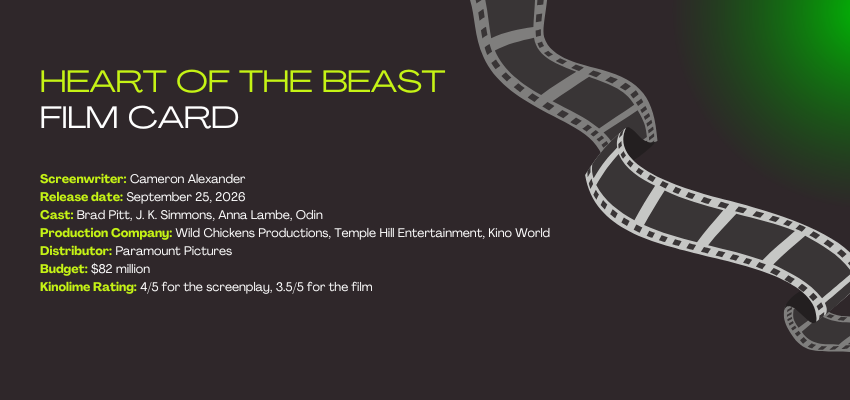
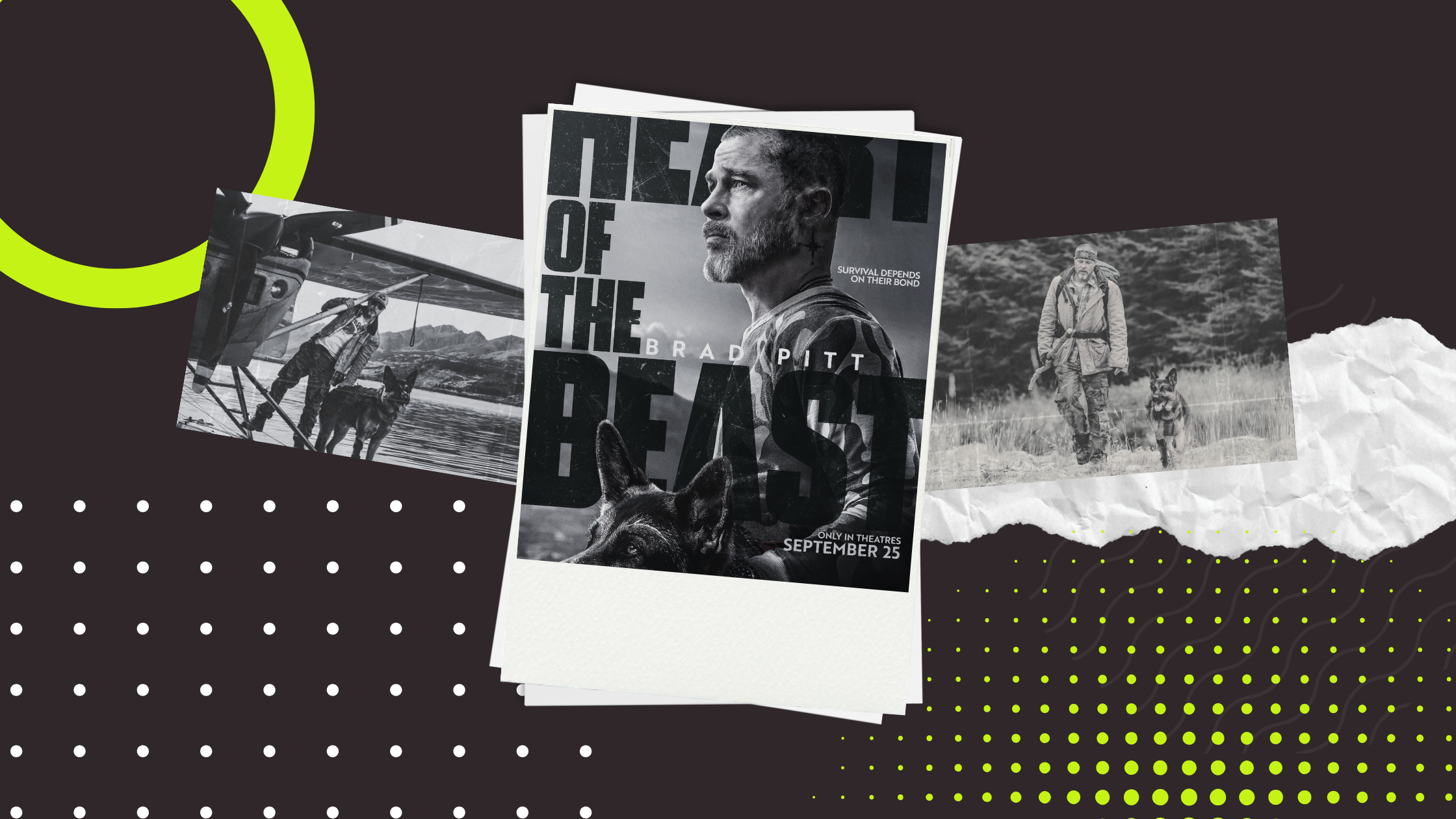
Heart of the Beast is a great example of a simple story told well. Starring Brad Pitt and with a screenplay by Cameron Alexander, this recent September release tells the story of James, a retired Special Forces veteran, and Odin, his combat dog suffering from PTSD, being stranded in the Alaska wilderness. The film shows them navigating a grinding 58 miles back to civilization. With barely any dialogue and only two other characters outside James and Odin, Heart of the Beast is still able to keep me raptured throughout the watch and to tear me up at the end.
I was even more pleasantly surprised when I read the screenplay. In fact, I might even say that I love the script more than the film. The writing is beautiful, from its description of the forest to its packed and impactful action lines. It is able to build up the intimate connection between James and Odin within the first ten pages, and makes a powerful choice with its ending (more on that later).
P.S. If you’re the kind of person who wouldn’t see a movie like this unless the dog survives – he does, and the film lets you know that right from the beginning.
Opening Image
Amber, an Alaskan Koyukon native, “beautiful, somber, has the look of someone whose life has been hard,” drives down the road. She stops at the sight of Odin, “a black, hefty, and imposing German Shepard.” She gets out of the car and takes a good look at him.
Set Up
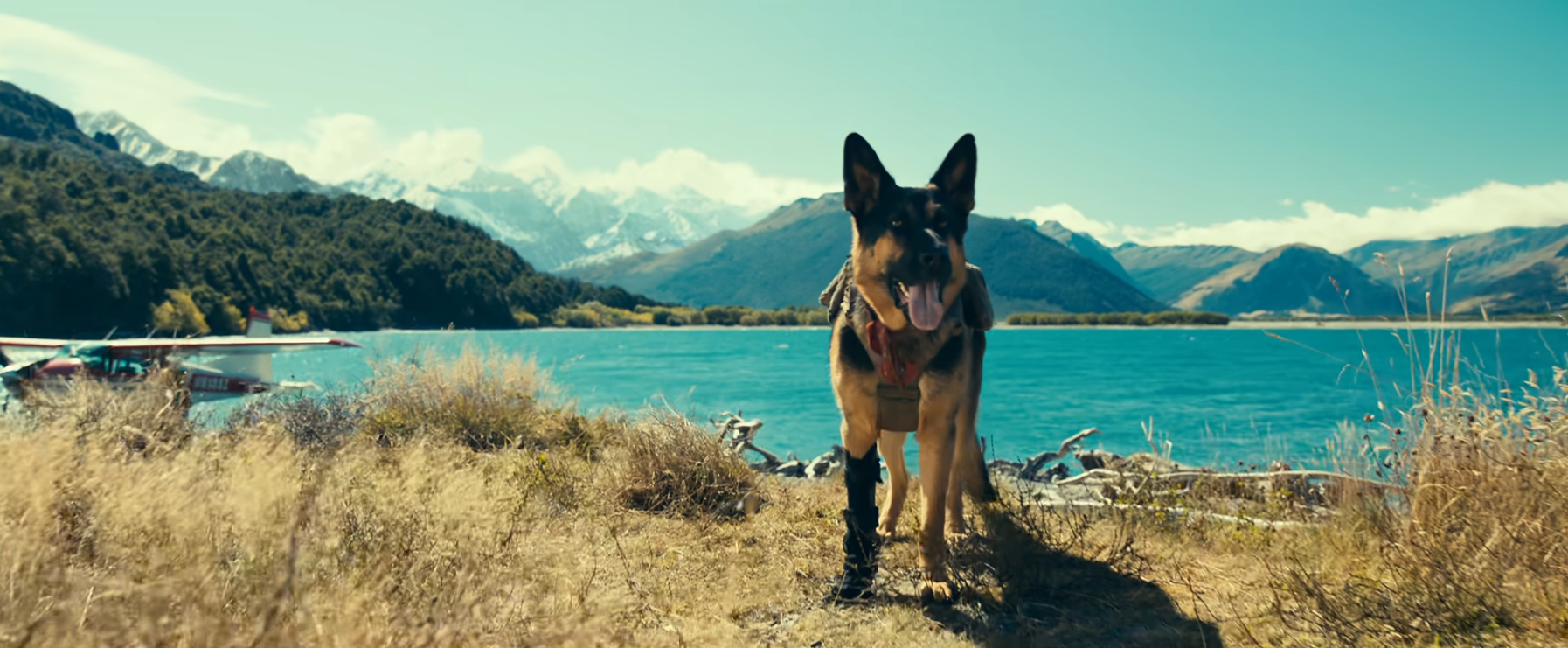
Time goes back to about a week ago. James and Odin take James’s own plane and land together by a beautiful riverside. Both have a war-torn look. Odin has half of his front right leg replaced by a prosthetic, and several of his teeth replaced by titanium. James sets up camp by the river.
The next ten minutes of the film are dedicated to showing James and Odin spending a pleasant day together at the camp. It builds up their connection – the way that Odin always eagerly awaits James’s command, and the way that he is James’s “only companion in this lonely world.”
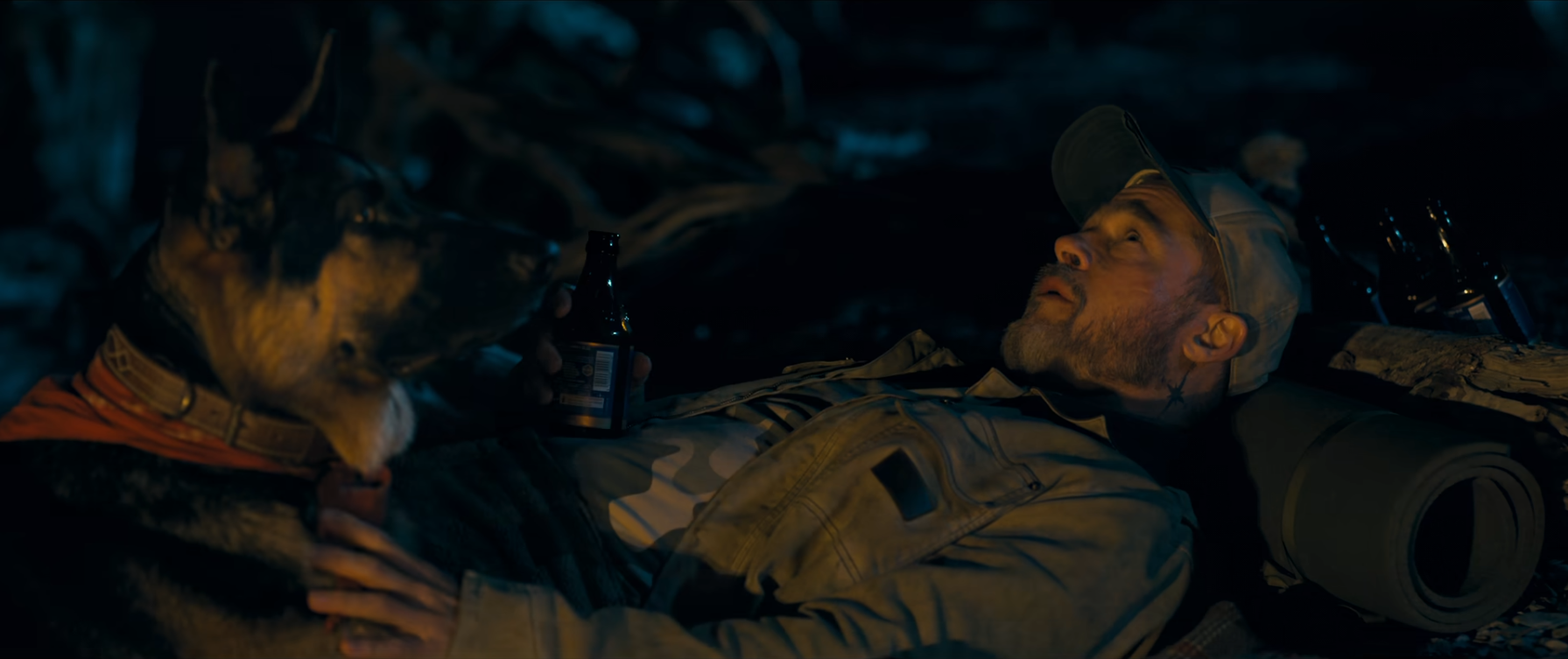
It is often said that, to make the audience fall in love with a character, you show the character being loved by someone around them – and that’s exactly what James and Odin are doing for each other.
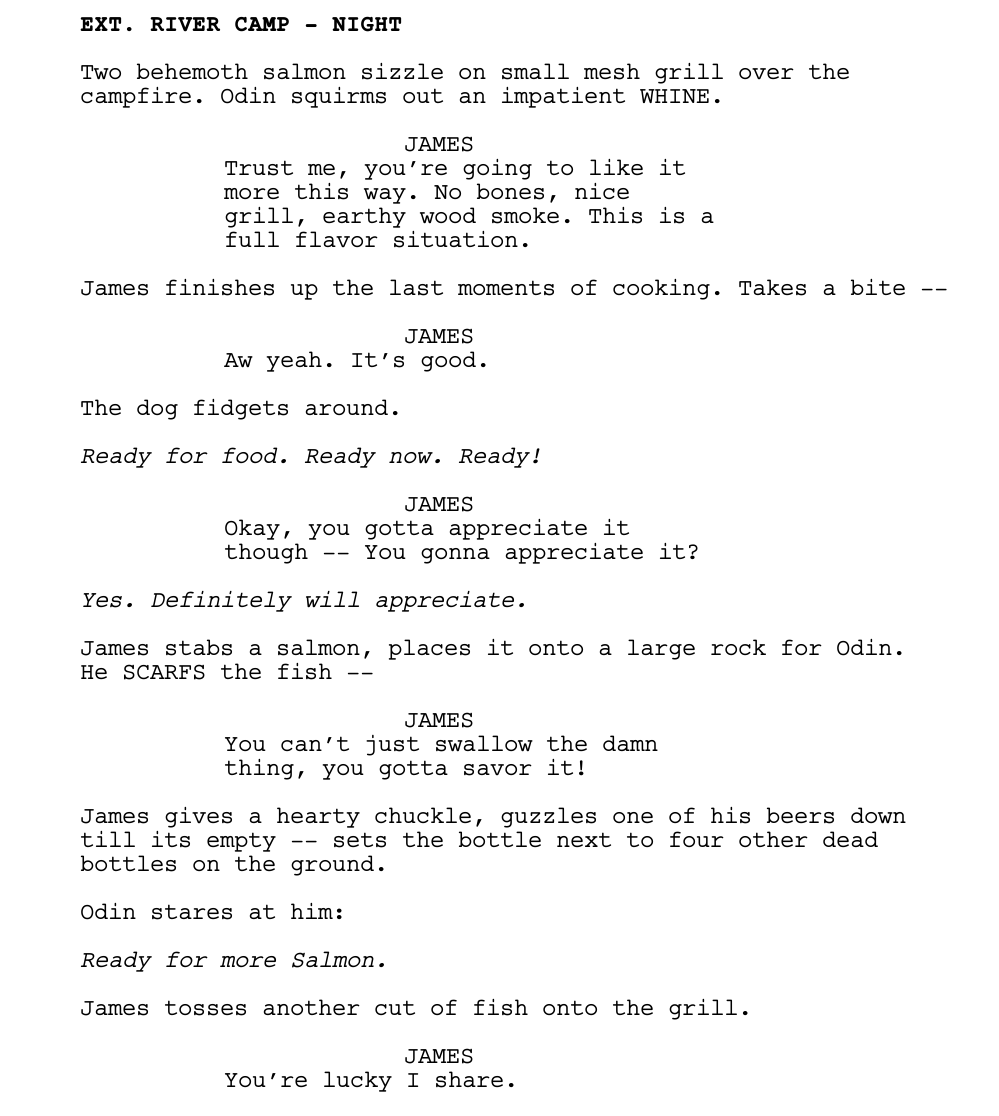
One thing that the script does which cannot be directly translated to the screen is how it spends time in both James’s and Odin’s perspectives. It shows their thoughts in italicized action lines, and draws the audience close to them instantly.
Inciting Incident
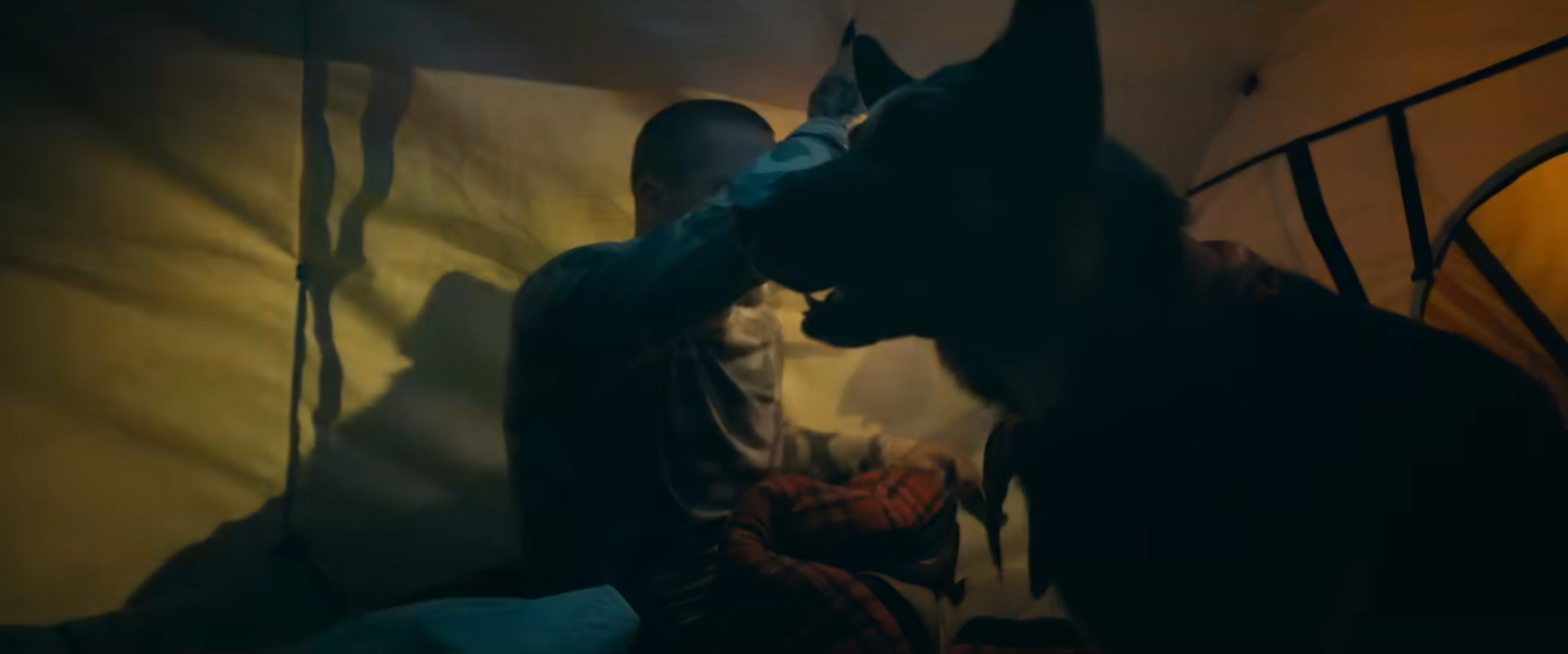
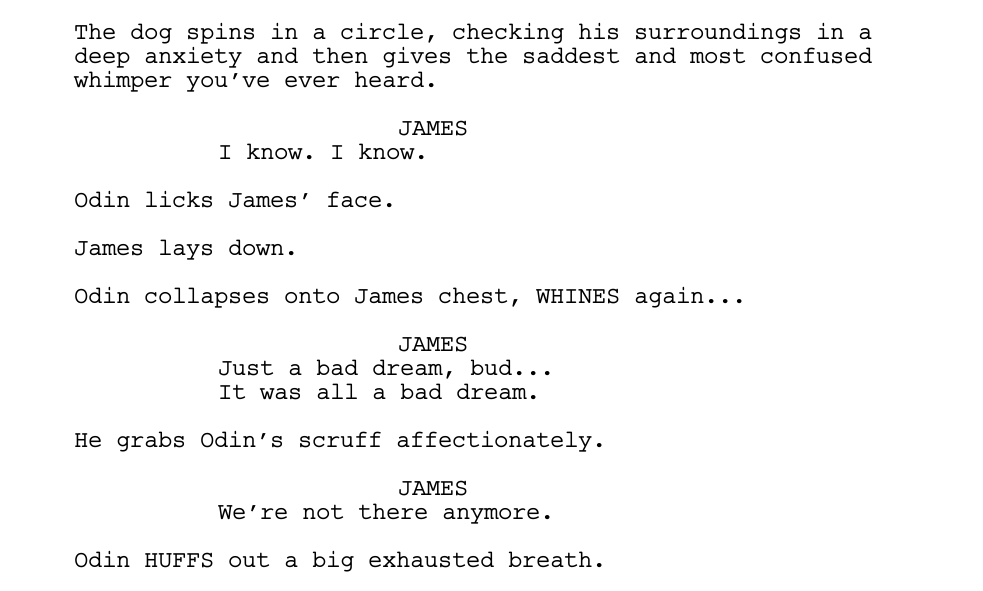
At night, Odin suffers from a full-blown PTSD panic attack. He wakes up frightened, barking, racing around the tent – “No one escapes the memories of war. Not even dogs.” James hastens to comfort him.
Debate
The next day, during a hike, James and Odin run into Watkins, an old man and “a real kook, well intentioned though.” Despite James and Odin’s initial guardedness towards him, Watkins sets up camp right next to theirs and spends an evening chatting with James and sharing James’s beer. Through this dialogue, the writer is able to let some of the exposition come through.
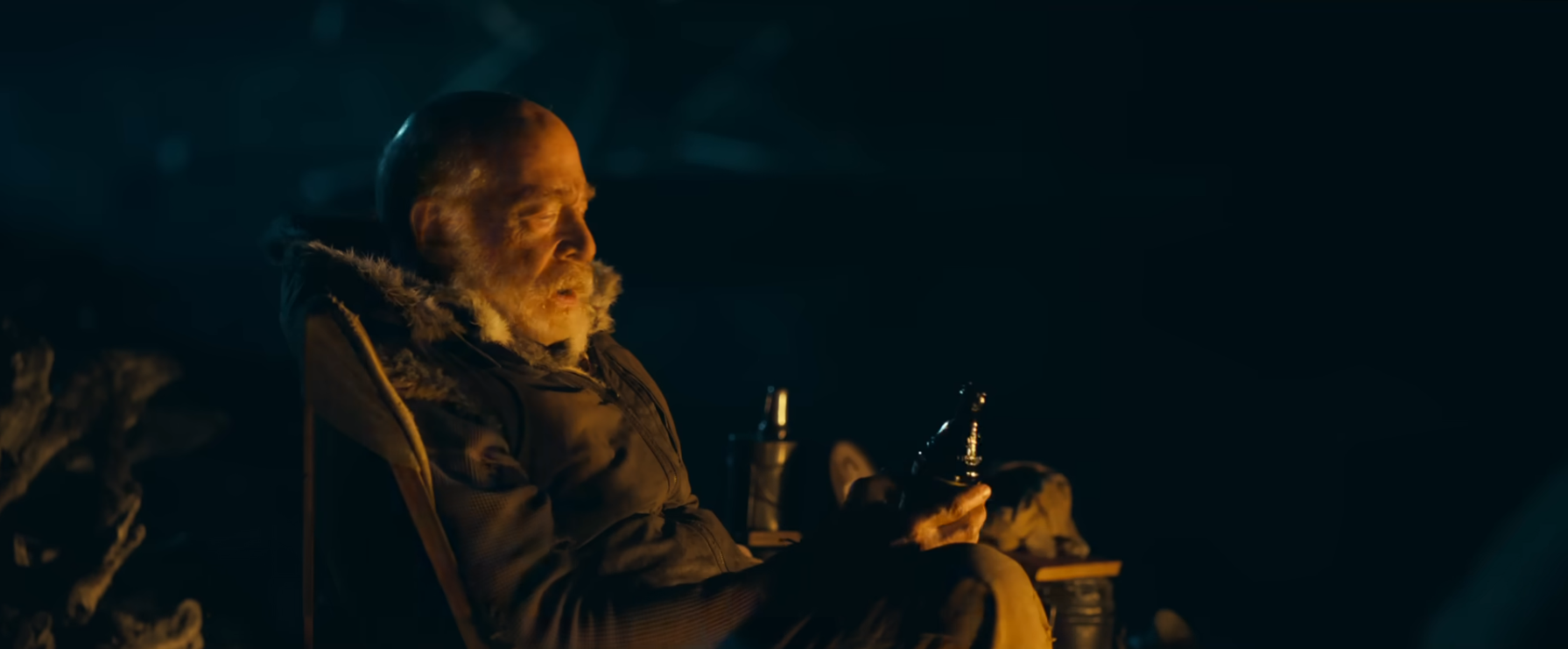
Watkins departs the next morning, leaving behind a book with a line that he thinks fits Odin well: “He had survived the worst the world could throw at him. He had known the cruelty of men, but he had survived. And love for man had taken root in his heart.”
Break Into Two
James and Odin head out on their plane. As they are soaring over the forest, James suddenly suffers from a heart attack and loses consciousness.
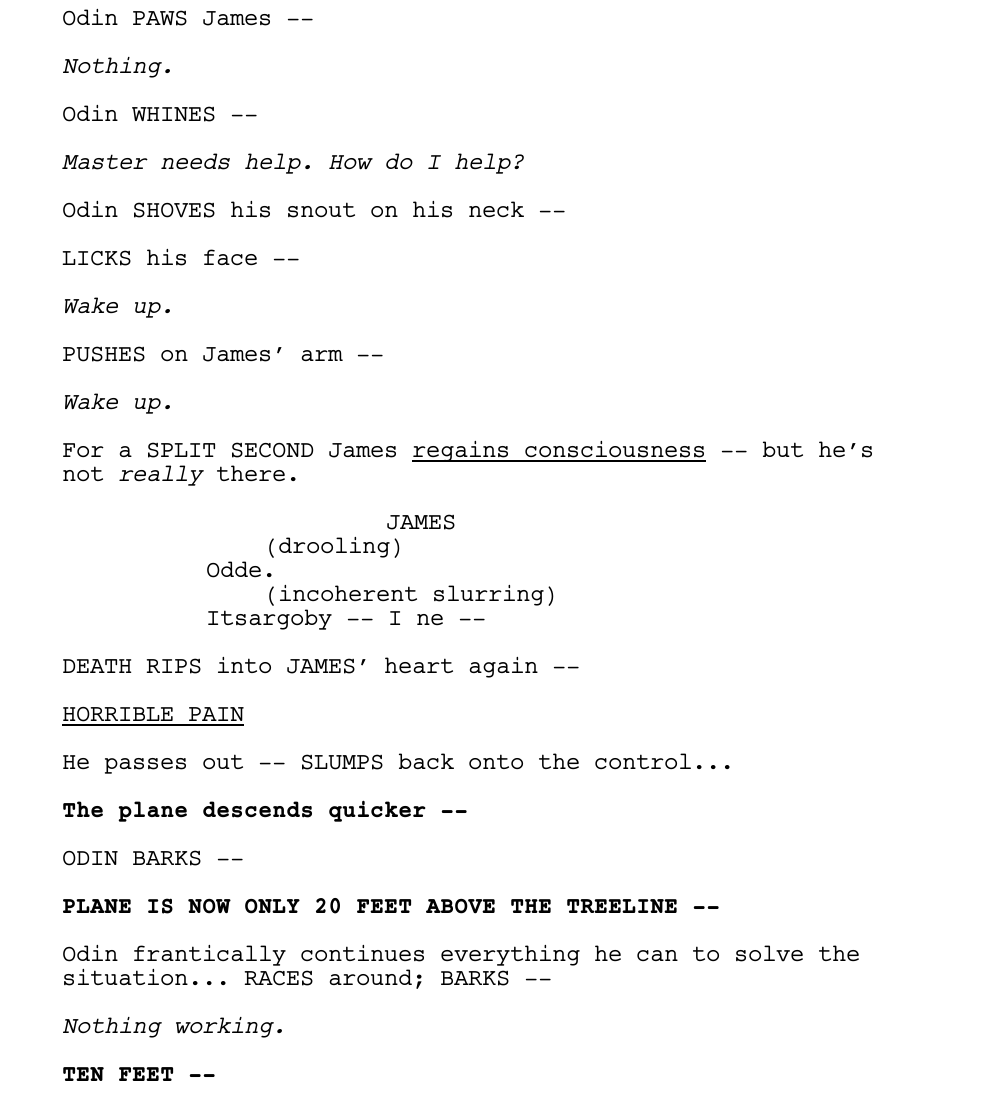
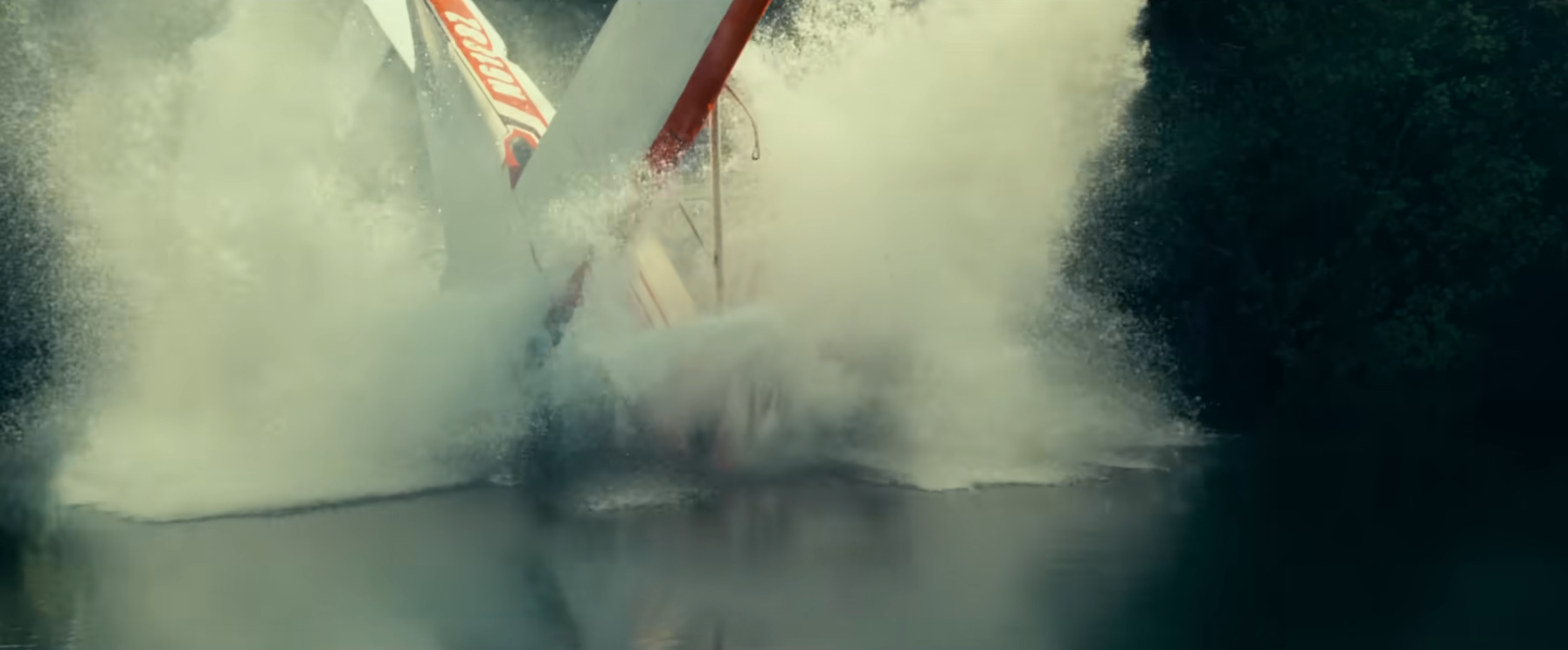
After Odin tries and fails to wake James up, the plane crashes into the forest below. Odin is thrown out of the plane, while James and the plane sink into the bottom of a lake.
At the last moment, James wakes up and pulls himself out of the water. In a panic, he goes searching for Odin and finds him, lying in the forest, unmoving.
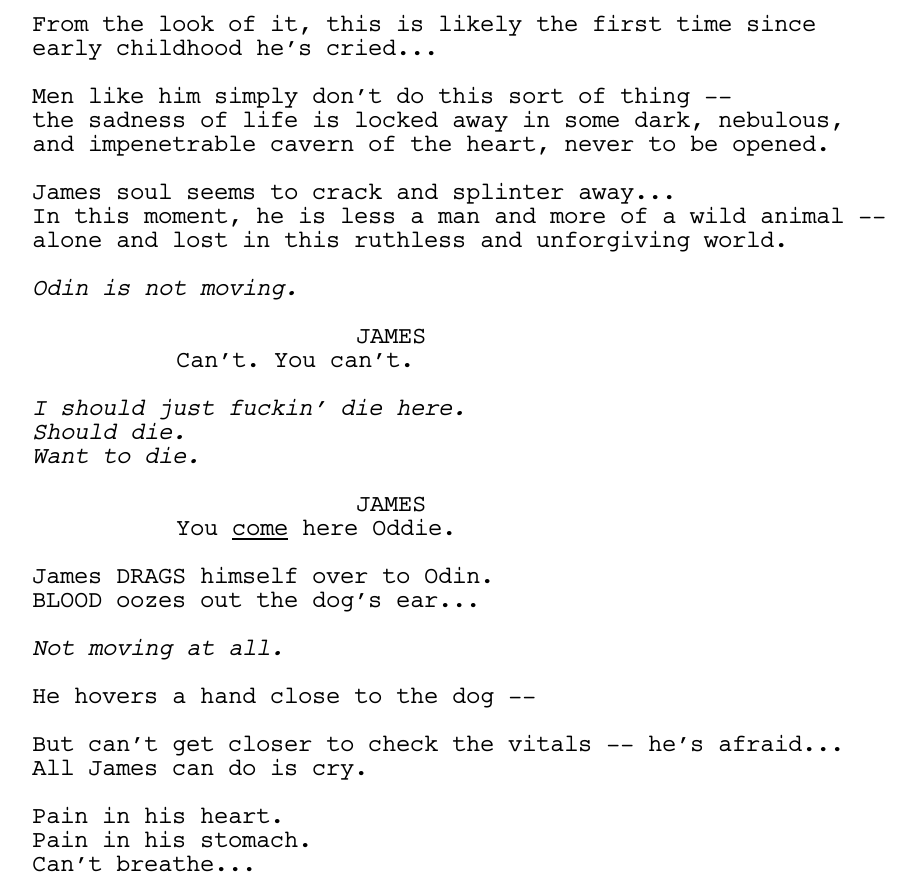
Thankfully, although Odin has a concussion, he is alive. James sets up a fire next to Odin before returning to the bottom of the lake and retrieving the bins containing their essentials from the water.
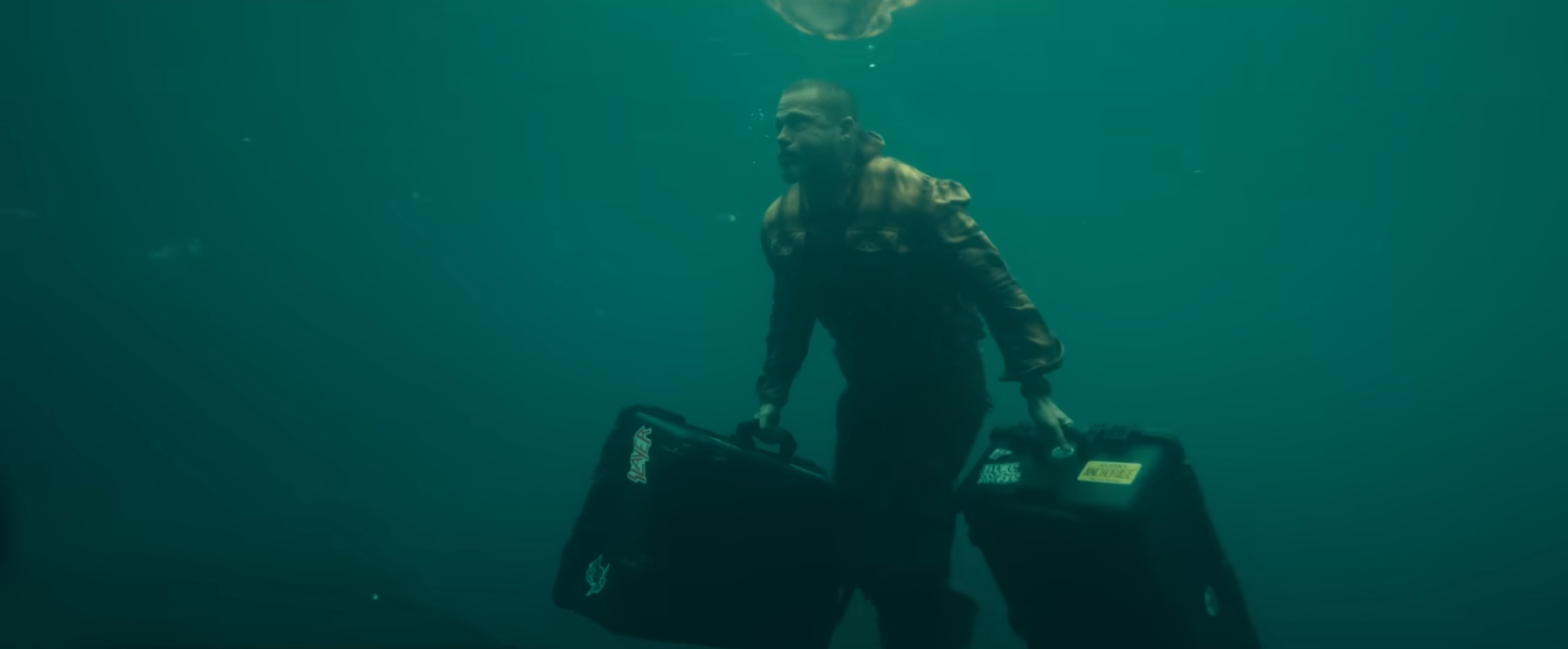
Fun and Games
The next morning, James wakes up to find Odin awake and recovered from his injury. After sharing a lovely moment, James pulls out a map of Alaska and searches for their way out.
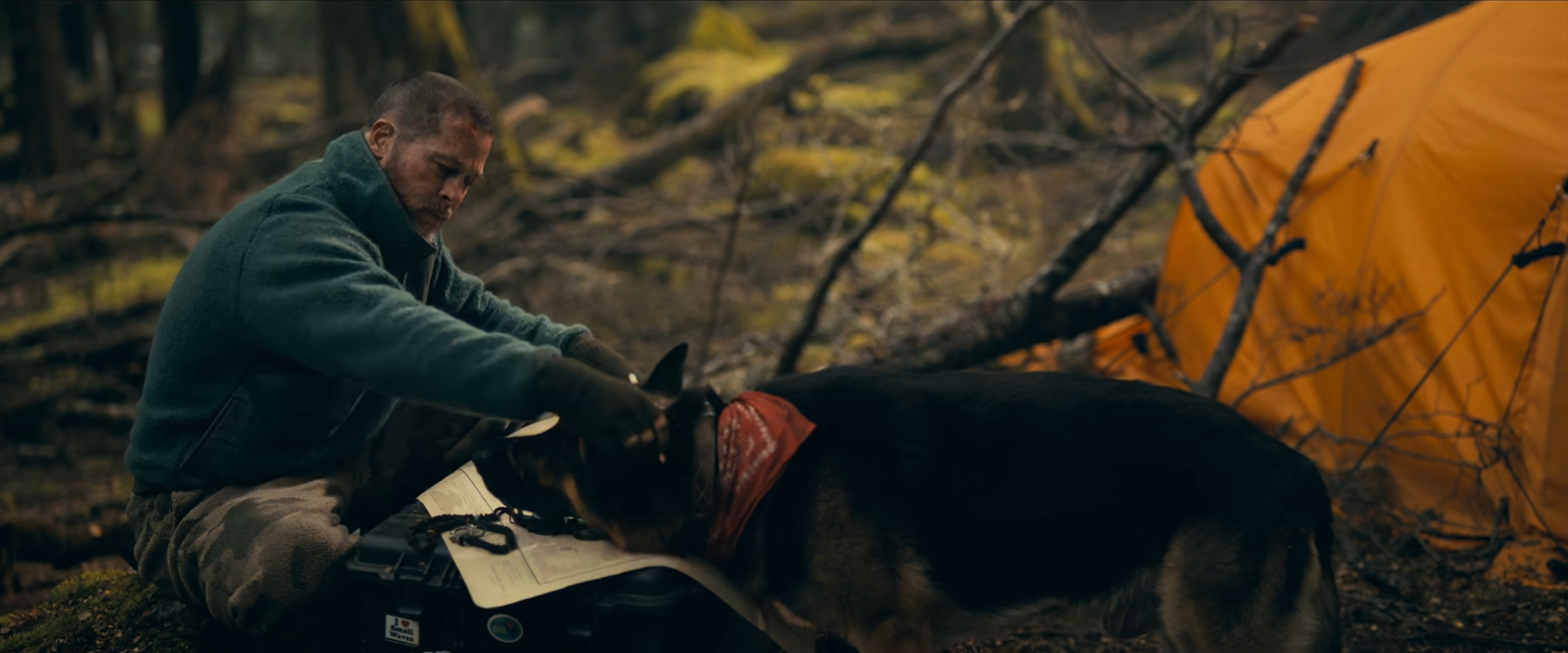
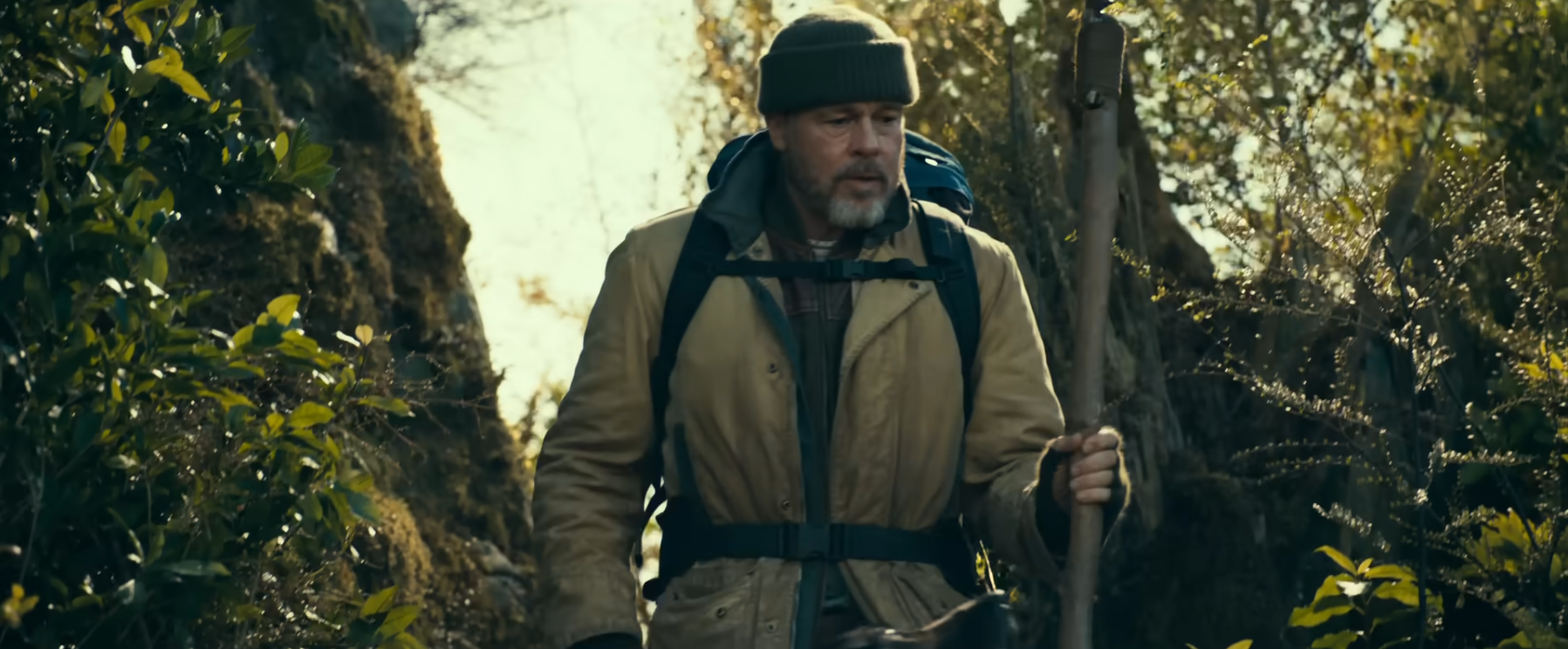
The shortest route is 58 miles to the road. Together, they carry only what they most need, and set off onto their long hike through complete wilderness.
Things are tough. Carrying a heavy load, with the after-effects of the heart attack still lingering around his chest, his only weapon a knife tied onto the top of a stick, and his Aspirin pills running low, James finds the journey hard to bear. But with Odin beside him, he trots on.
Midpoint
On the second day of the hike, Odin senses a plane flying over their heads. James fires a flare but the plane fails to spot them.
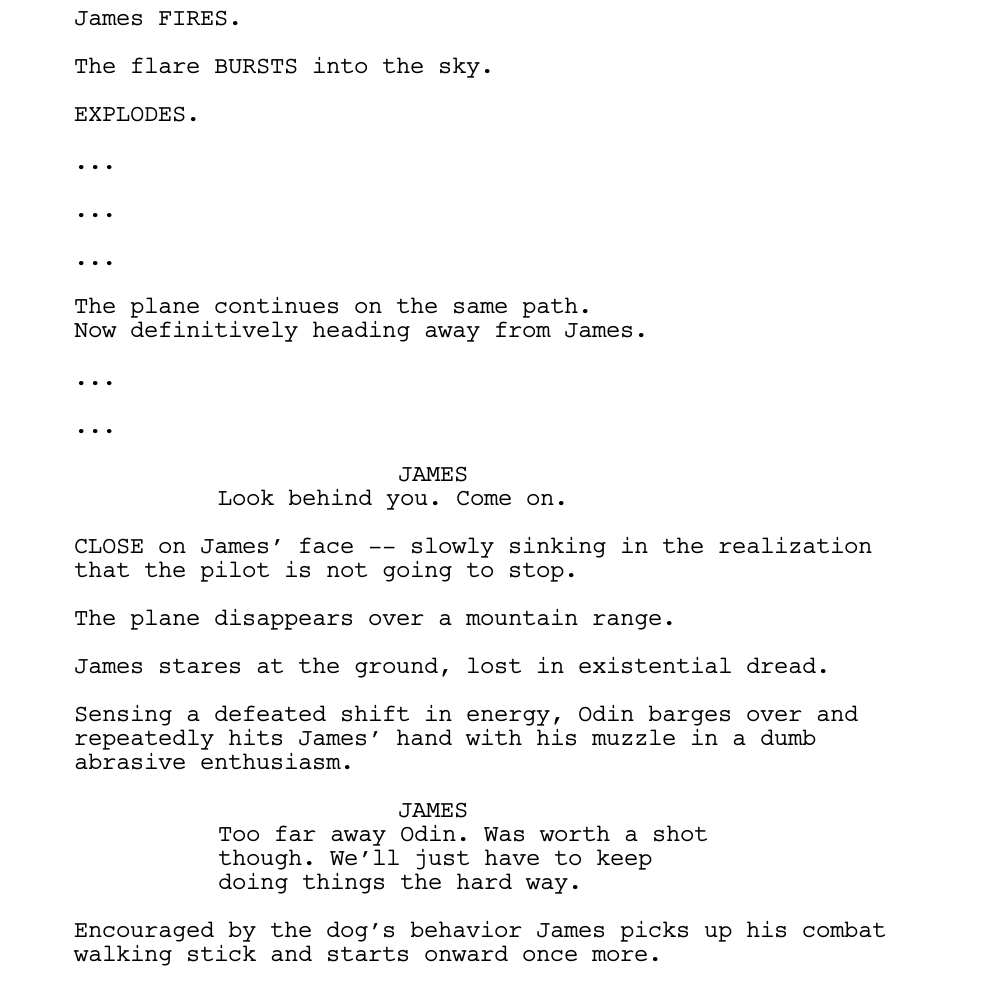
This is the first biggest moment of hardship in their journey and changes the energy of the film from positive to defeated. Soon after that, a pack of wolves fighting cuts off the route through an open field that James was planning to take. James and Odin take a detour through a heavy forest, where they run into a bear. James tries to get Odin to look away from the bear, but Odin persists in confronting it until it retreats.
Bad To Worse
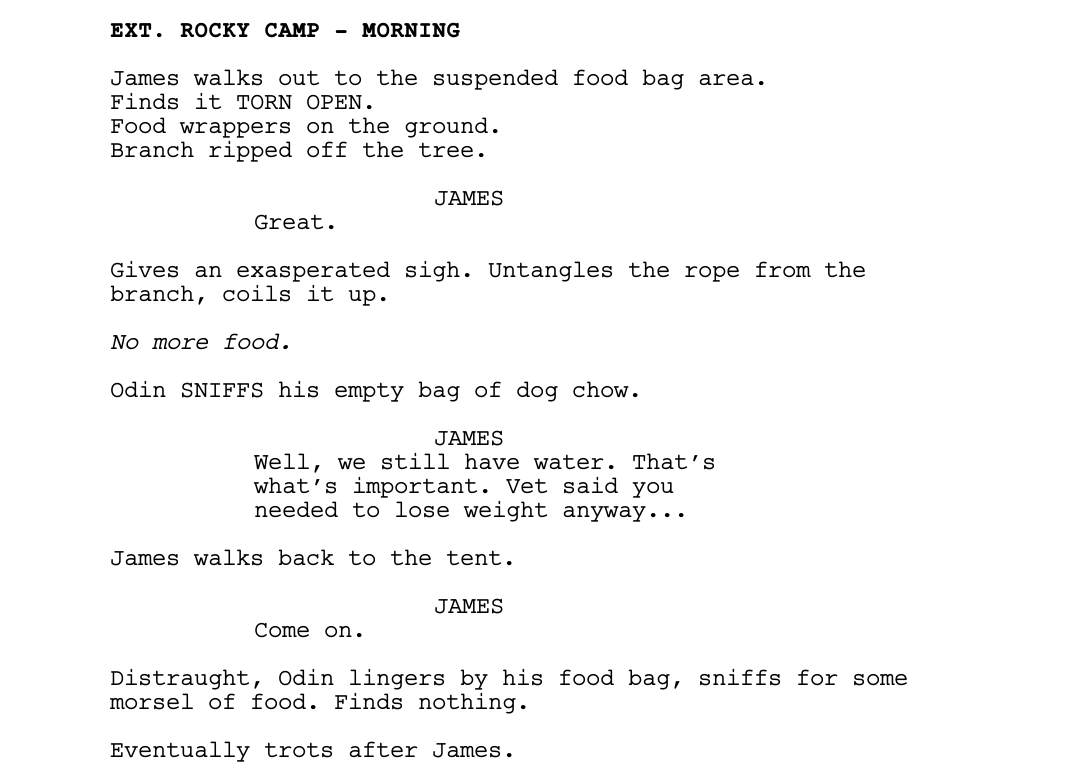
The second morning, James and Odin wake up to discover that all their food has been stolen by forest animals. The only thing they have left is water now.
Upon reaching a canyon river, James crosses it on a bridge made by two fallen trees. It is difficult for him to navigate the tree trunks, but it is nearly impossible for Odin with only three legs.
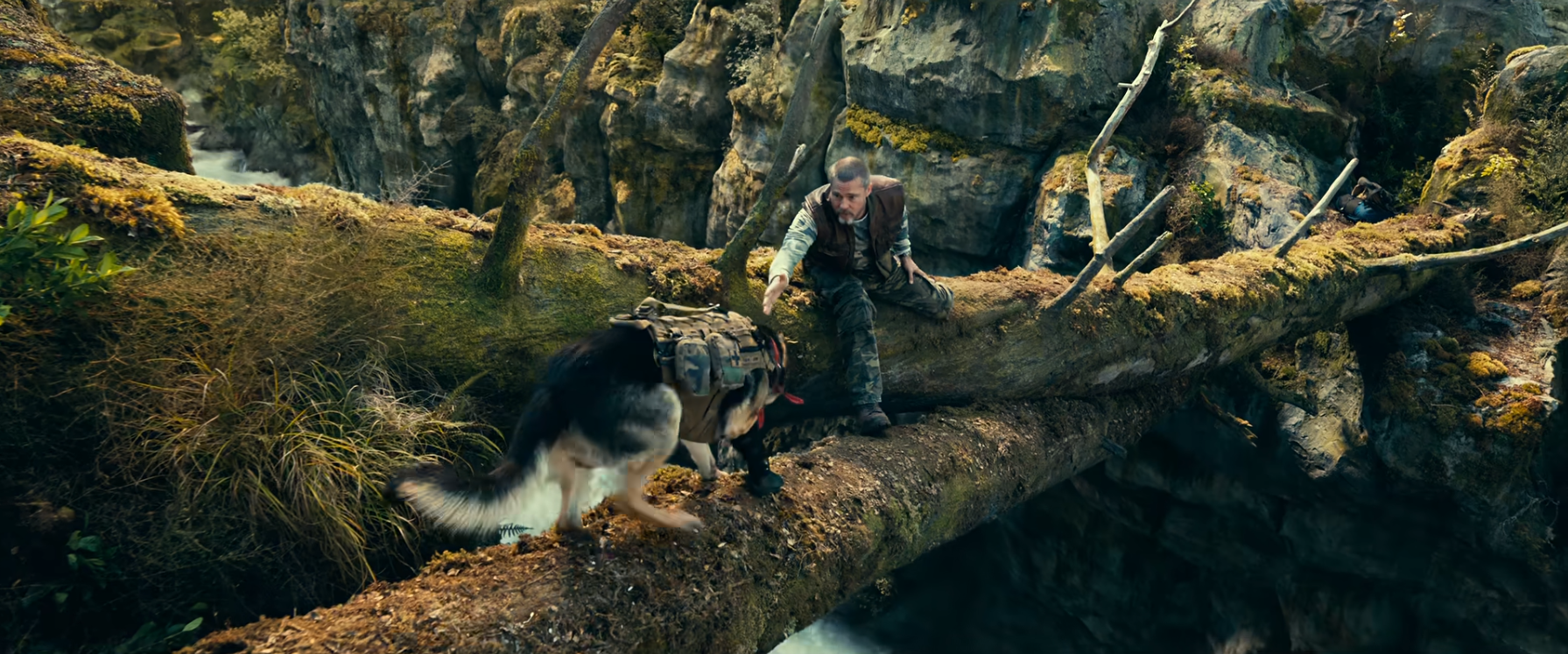
As Odin tries to cross, he slips and nearly falls off, only caught in time by James. However, James’s heart attack returns in that moment, making him fall off the bridge and into the turbulent river below.
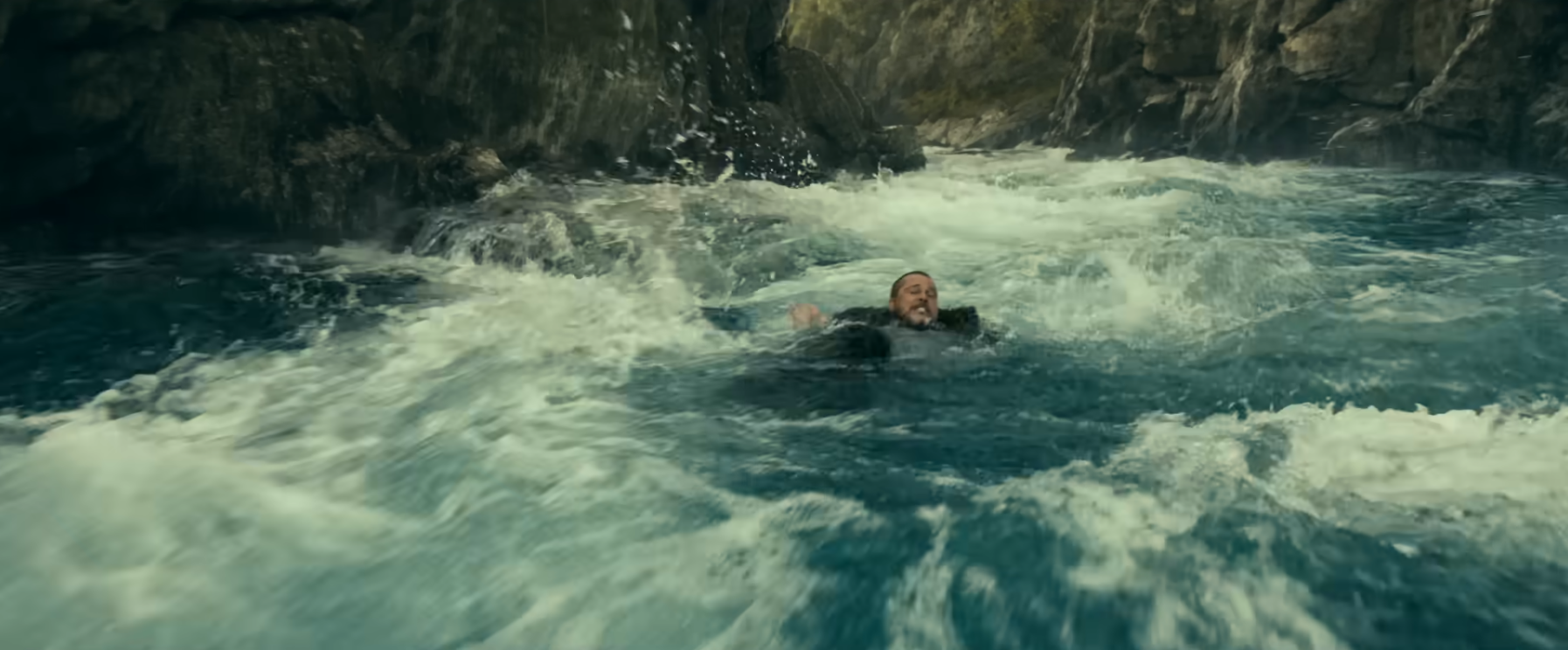
Odin races down the river after James, who is unable to fight the impossible current and breaks his arm against a rock in the water and hits his head.
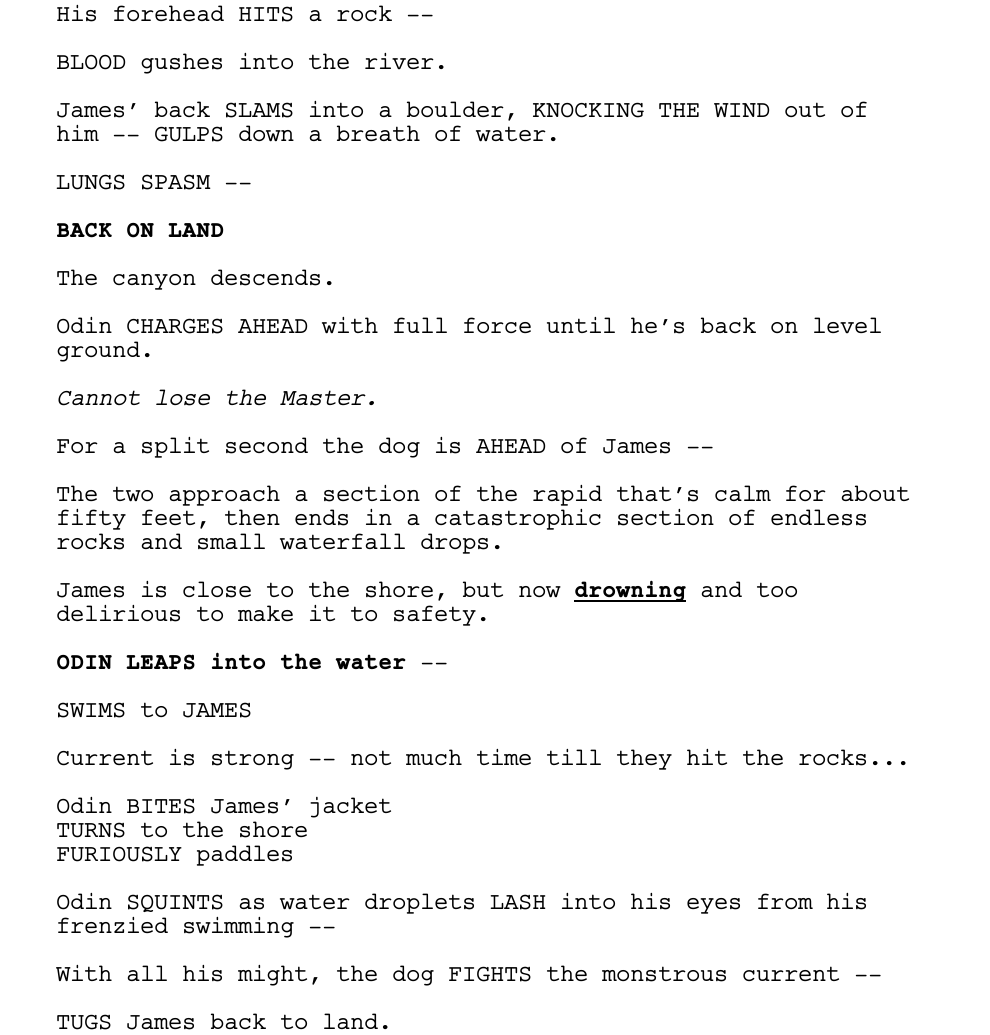
Odin rescues James at the last moment. With Odin’s help pulling the bandages, James resets the bone in his limp left arm with an awful pain. After letting out a frustrated roar, he makes a splinter for himself and gets back onto his feet.
Break Into Three
In the darkness that night, Odin senses danger. James is unable to spot anything in the dark, but he trusts Odin’s judgement and leaves camp early.
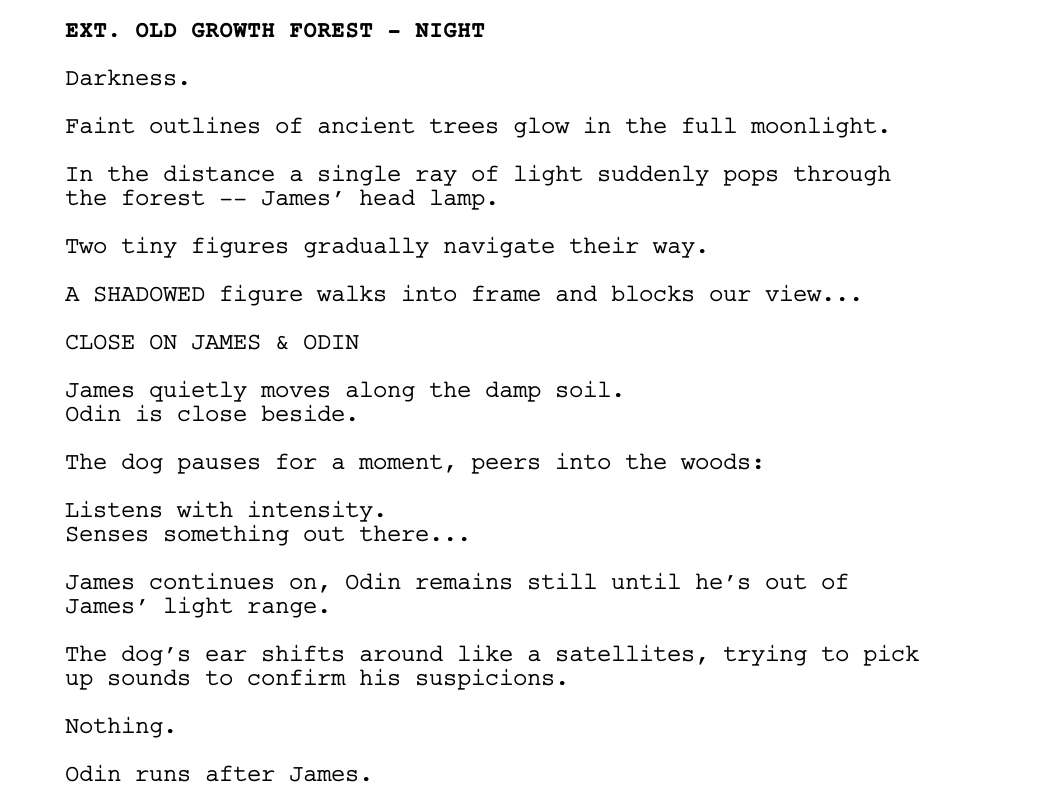
In a moment like this, it is not only James depending on Odin, but the audience as well – because we, like James, cannot sense the danger out there in the dark, so we are relying on Odin’s reaction just like James is.
And this is one thing that I like particularly about this script: how James clearly depends on Odin. Usually, dogs are depicted as reliant on humans in cinema, but, in this case, their roles are reversed. Throughout the film, it is clear that Odin navigates through the forest much more easily than James does, and he saves James’s life more times, if not as much, as James saves him.
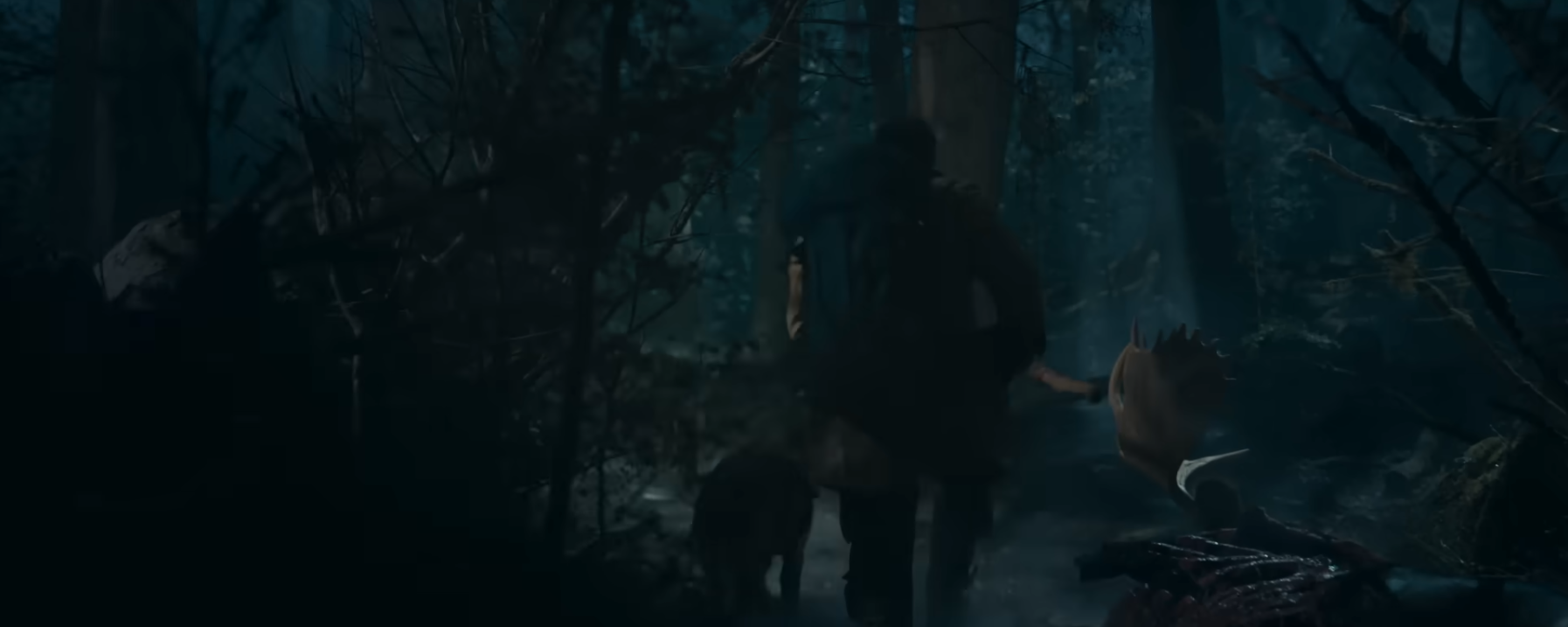
James and Odin find themselves at the heart of a wolf pack’s ambush. With nothing but a knife tied to the top of a stick, James and Odin fight the wolves side by side.
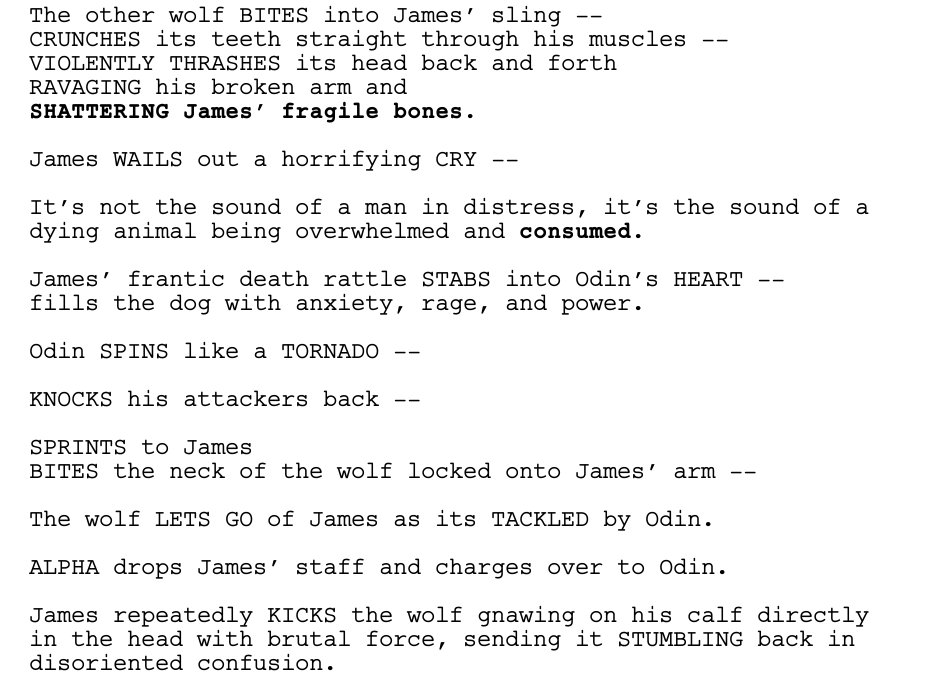
After saving each other and both sustaining injuries, they are at the end of the fight, having killed the Alpha wolf and chased away the others.
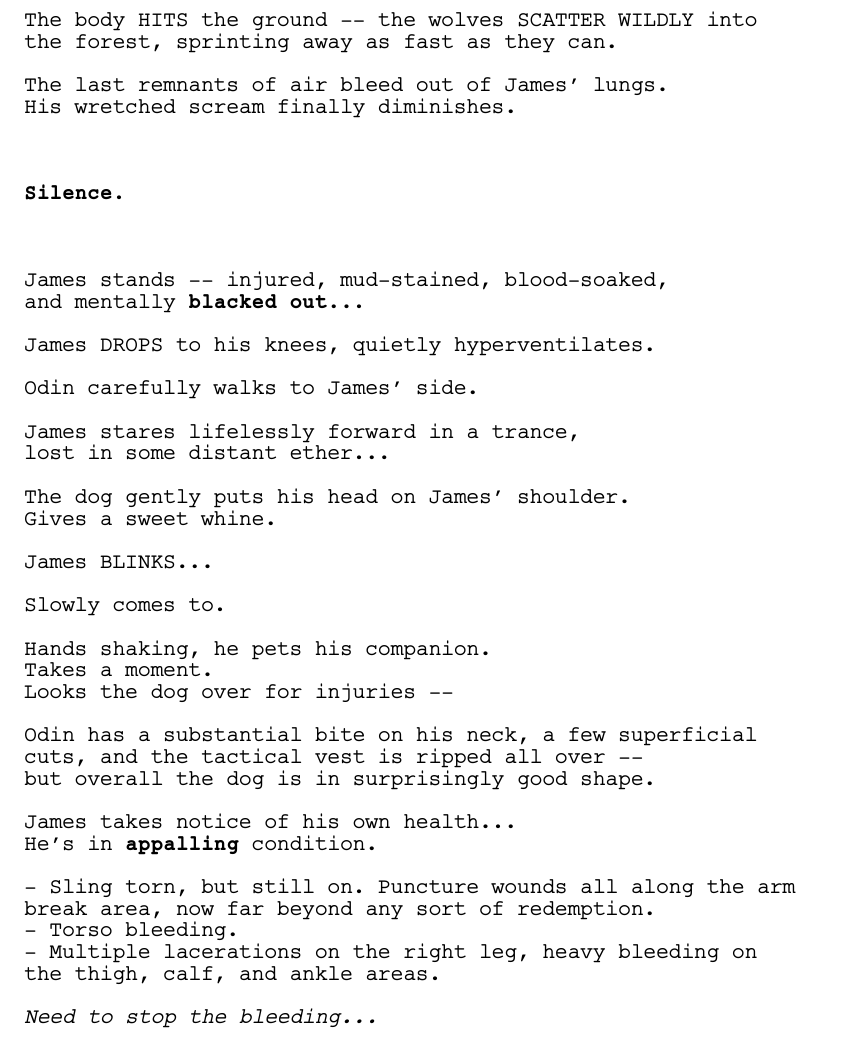
James is in a particularly bad shape. His left arm is now completely useless, and there are deep wounds on his stomach.
Finale
They keep moving forward, but James is now barely staggering. This only worsens when he finds a swamp where there is supposed to be a field. Without another route, he has to sink his wounds into the muddy water to get through.
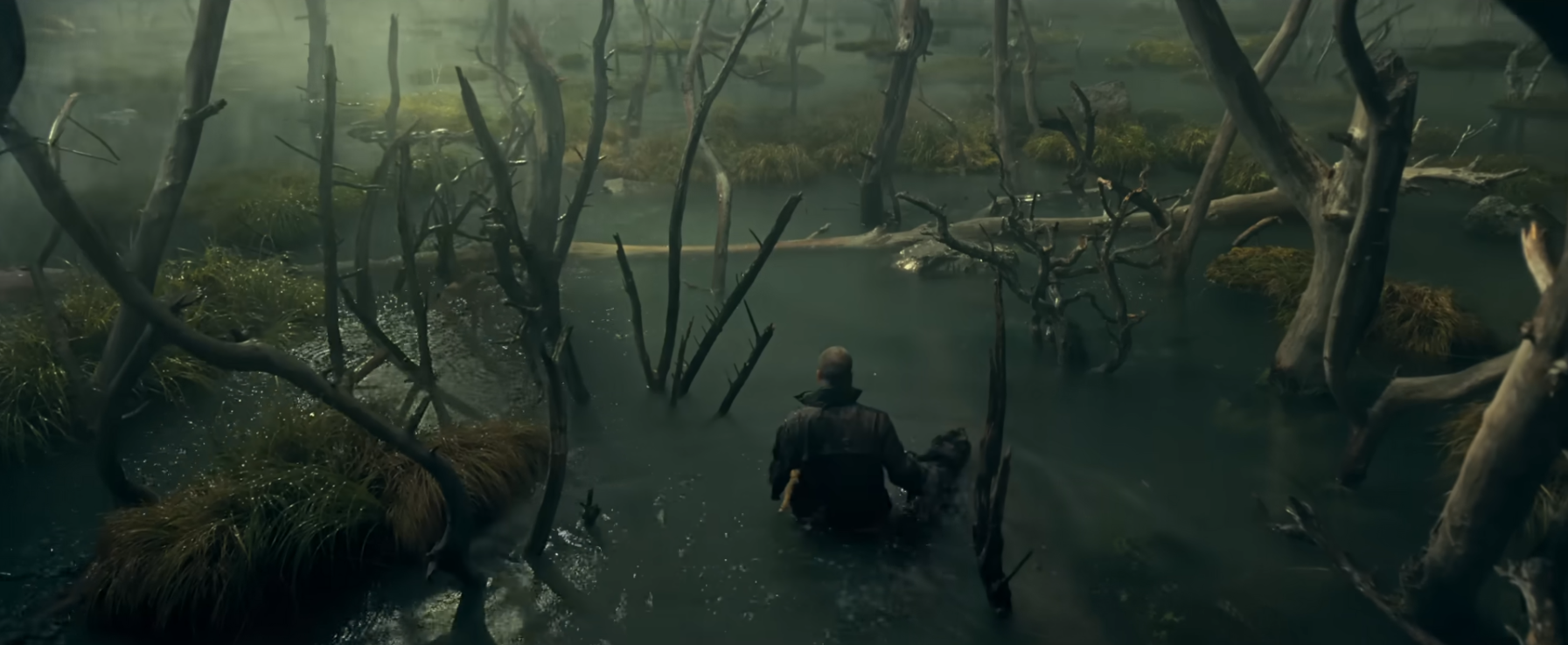
When a log appears on their way, it becomes apparent how difficult it is for James, in his fragile state, to get around a small obstacle like this. After barely making his way under it and reaching dry land, there is now an uphill climb in front of them.
James tries again, and again, and again; he falls again, and again, crashing into the dirt below. When at long last, they are at the vantage point, looking out to the gorgeous open field leading to the road, James knows – he is dying and can’t make it the whole way.
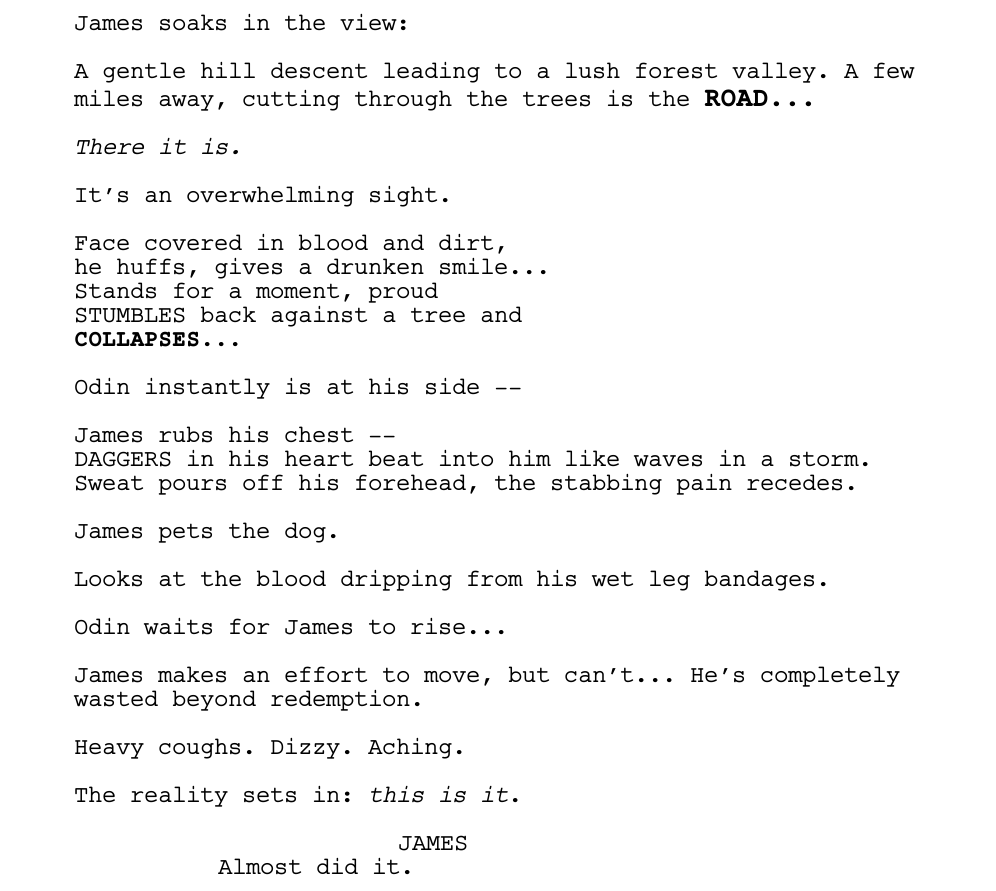
James writes a letter that he seals into Odin’s vest for whoever finds him. He gives Odin one last mission: to get to the road on his own.
Odin doesn’t move. He stays by James’s side, until the Northern lights fill the sky, until James sees it and closes his eyes forever.
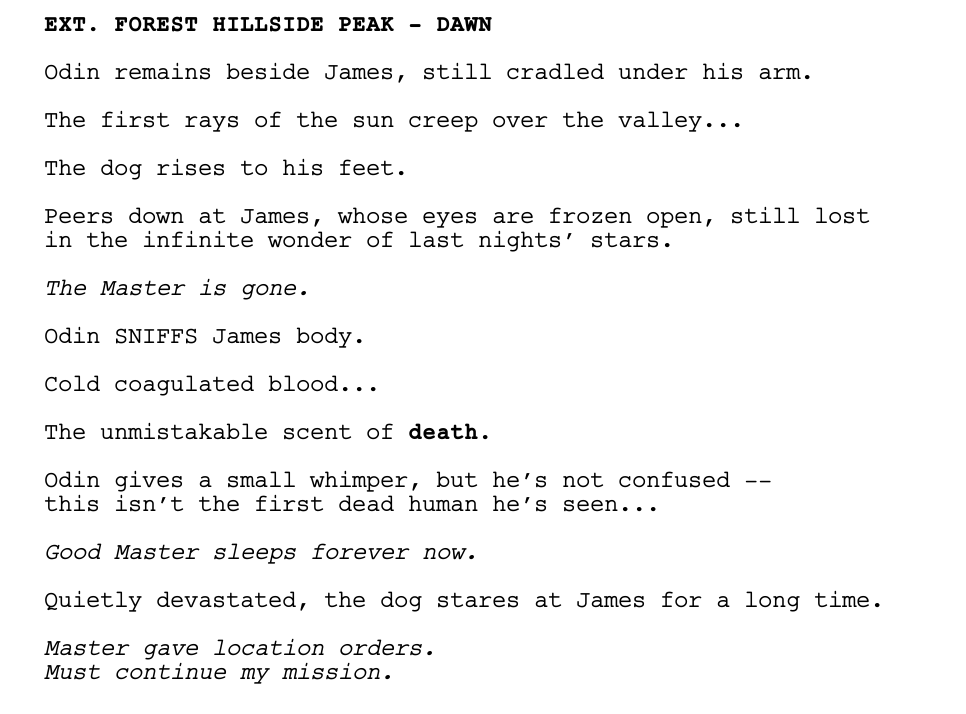
Here are my two favorite things about this film’s writing. One is the choice that James dies while Odin lives. In films, we usually find animals and their deaths as a driving force for the human characters, motivating them to change and to grow. Therefore, many members of the audience approach the film with the expectation and dread that something is going to happen to Odin. The film’s twist, to let James die instead, makes this story as much Odin’s as it is James’s. It treats Odin as his own character, rather than a driving force in the human character’s growth.
My other favorite thing is the line “this isn’t the first dead human he’s seen.” This is when the fact that both James and Odin are veterans hits me the hardest, when I feel their experiences for real: the fact that, yes, Odin has seen so many dead humans before; and he knows exactly what to do right now precisely because he has.
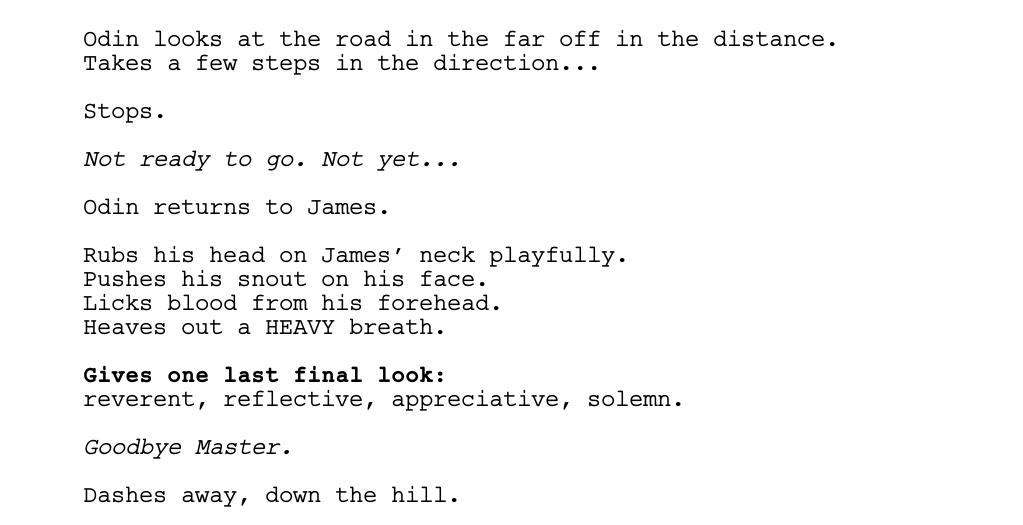
Odin bids James his last goodbye and leaves, sprinting across the beautiful open field.
This is when I began crying when I saw the film in theaters. It feels freeing to watch him. It feels freeing to know that Odin is still capable of running like that, even with only three legs and the pain of his past on his back.
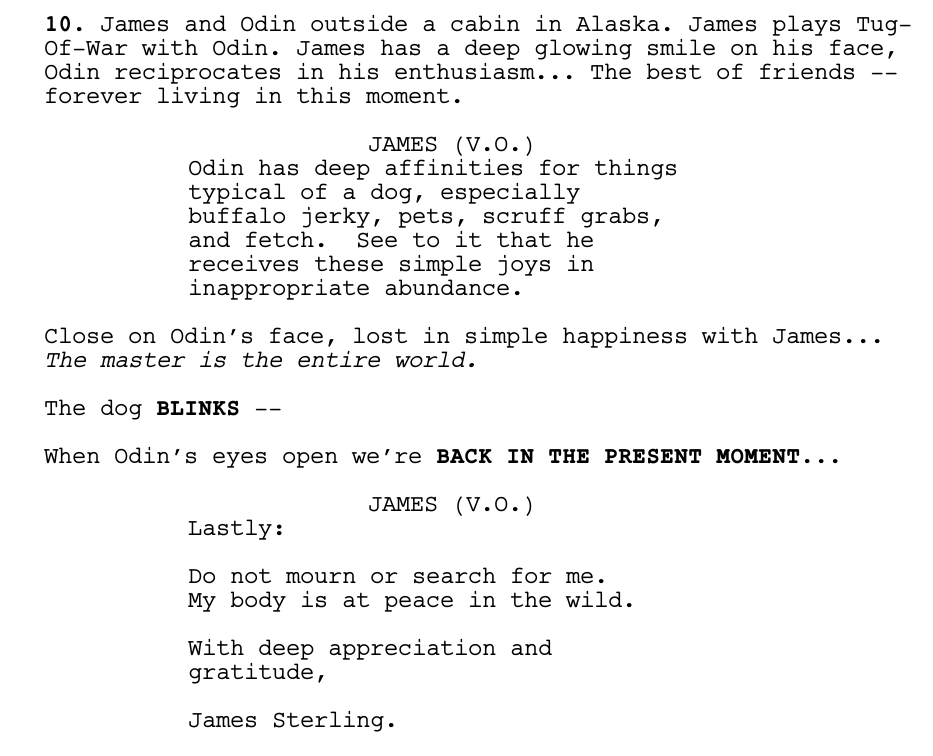
We’re back at the scene in the beginning of the film. Ambert steps out of her car and approaches Odin. She tries to look around for Odin’s owner, but cannot find anyone. She discovers the letter from Odin’s tactical vest. We see a flashback of James and Odin’s past, from the moment they first met, to the time they spend on the battlefield together, to Odin’s injury, to their last days at the camp. Over these images, James’s voice narrates his instructions for whoever finds Odin, and his plea for Odin to be taken care of.
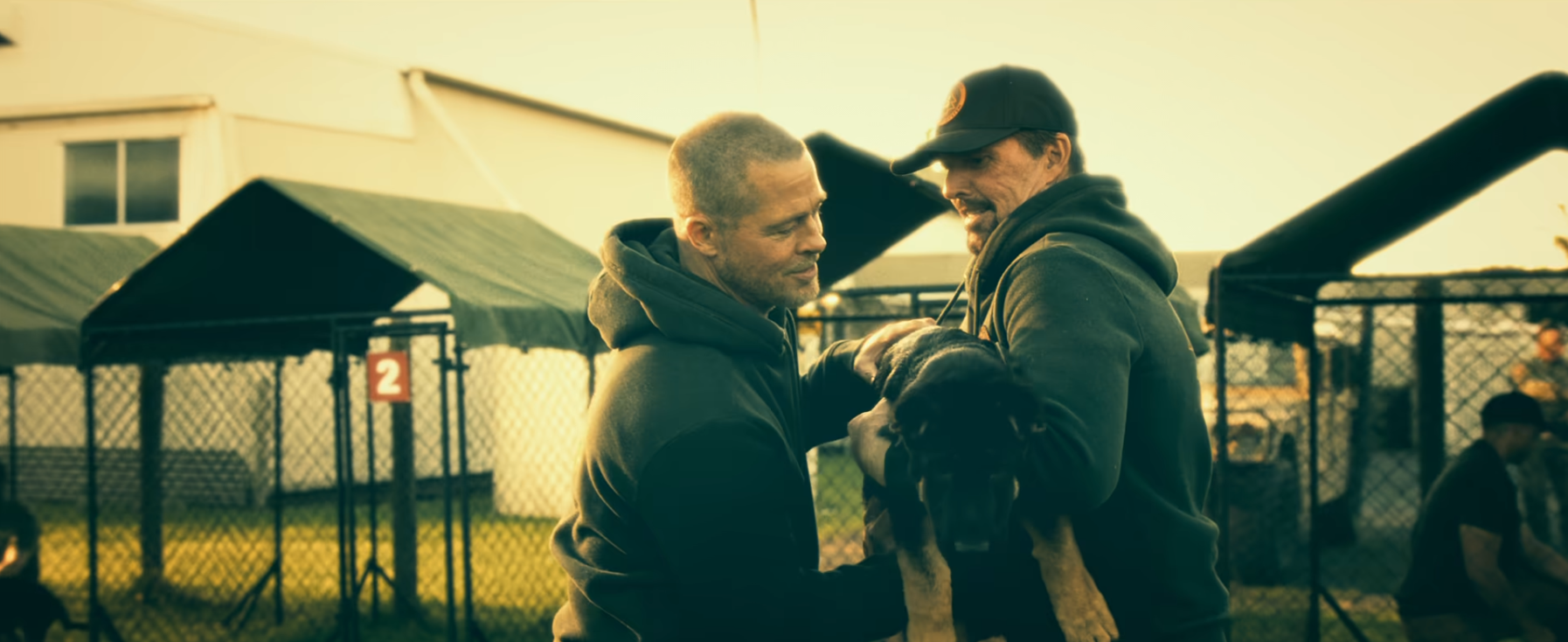
One difference between the film and the screenplay is that, in the film, we’ve been seeing flashbacks of the war since the moment of Odin’s PTSD attack, but in the screenplay, we don’t see their past until this moment. Personally, the screenplay’s version hits me harder: to see them both young after James is already gone, to see what’s been haunting them throughout the story at the end of the line.
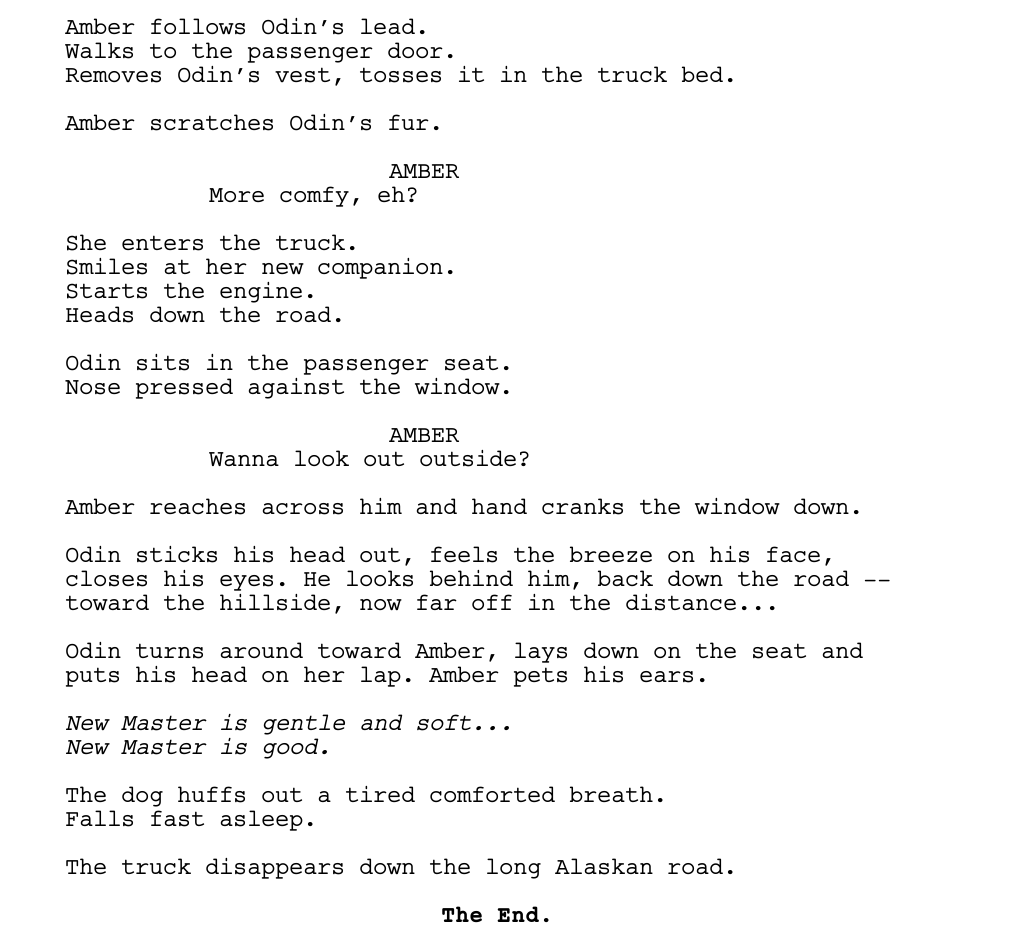
After reading the letter, Amber decides to take Odin in. She brings Odin into her truck. The car drives away from the mountains where James now forever lies.