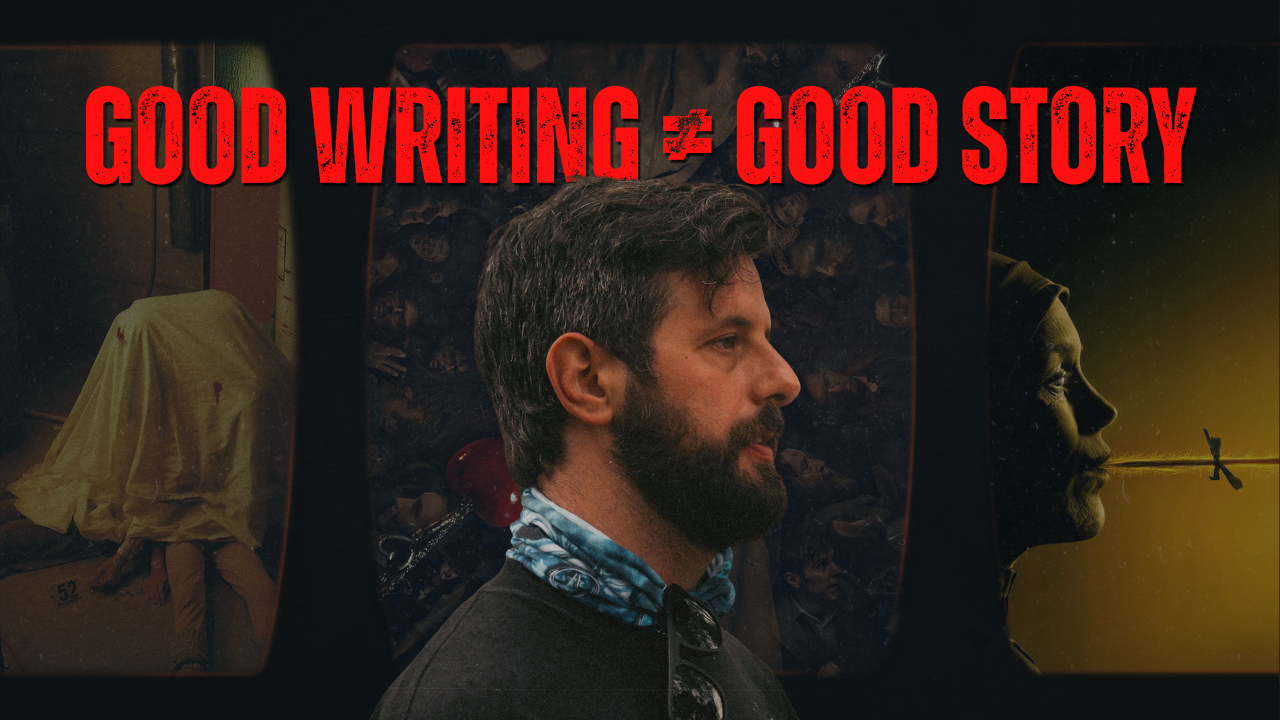
Dan Kagan has spent the last fifteen years moving through the studio system, from a PA guarding door number 18 on the set of Angels & Demons to senior VP at Orion. When Orion shut down during the 2020 layoffs, he bet his savings that he could get a movie made within a year and kept betting on himself from there. That gamble produced Significant Other, Azrael, and Long Legs, and eventually led to The Yeti, the Netflix film starring Chris Pine.
In this episode, Dan talks with John and Danny about growing up in New York on a steady diet of Kubrick and Tarkovsky, why defining a niche can be a superpower, and how a producer’s real job is to be the filmmaker’s first audience. He also explains what separates a page-turning screenplay from a good story, why he’s drawn to surrealism in horror, and why he believes the independent film world is about to get a lot more interesting.
Full Transcript: Kinolime Podcast Episode 61: Good Writing Isn’t Enough to Make a Great Movie
Participants:
John Schramm - Head of Development, Kinolime
Danny Murray - Creative Executive, Kinolime
Dan Kagan - Producer (Longlegs and Netflix's Yeti)
John: All right everybody, welcome to the Kinolime Podcast. I say this maybe every other podcast, but this is my favorite podcast of the year. I’ve been stoked for it. We only had to move it once, and here we are. I’m not going to name the guest yet, because I want the suspense to build. To my right is Danny Murray. Welcome, buddy. How are you doing?
Danny: Doing great. So excited for this interview. The Fiddler on the Roof, I mean.
John: Yeah, there’s a lot going on in life, right?
Danny: Lots going on in the movie.
John: Not watching that. Not gonna watch that. Okay, cool. Anyway, today we have, coming in from Los Angeles, Dan Kagan, producer extraordinaire and great human being. Look at his shirt, everyone. He knows how to butter me up. Dan Kagan, welcome to the Kinolime Podcast. How are you?
Dan: Thank you, I’m doing so well. Thank you for having me. So nice to see you.
The Wired Headset
John: I have to comment right off the bat. Besides the Heat shirt, which he’s done to me once before, it’s my favorite film of all time, and I can’t buy that shirt anywhere. But besides that, dude, you’re rocking a wired headset, which I love. Is it because you don’t want Bluetooth in your ear? Is it clearer for you? Why the wired headset?
Dan: It’s the microphone. You can hold it up to your face. It’s easy, it’s good for calls, it’s good for Zooms, it’s good for everything.
John: Do you ever tuck in the shirt so it doesn’t get wild, or not?
Dan: I used to when I was a kid. Now I just don’t care, caution to the wind. Still tucked here, though.
Danny: Look at him, he’s tucked.
Dan: It’s very much a Danny thing. What’s his story going on, Danny? You want to talk? Yeah, yeah, yeah.
Origins: Growing Up in New York
John: Dan, thanks so much for joining us. We have so much to get into. For y’all who don’t know, just go look up Dan Kagan, because he’s the mind behind credits from Long Legs to Hocum. He just finished the hundred-million-dollar Netflix production of The Yeti with Chris Pine, my favorite actor with blue eyes. But anyway, Dan, we’re going to get into everything, including how you became producer extraordinaire. Let’s start with the origin story, act one. Where’d you grow up? How did you get into film? Give us the laydown, man.
Dan: I’ll give you the short story and the long story. Basically, I grew up in New York City. My mom raised me there by herself. We’re a family of immigrants, and with that comes a lot of alone time as a kid. As far back as I can remember, she would plop me in front of the TV and start playing movies for me, probably movies I was too young to fully understand. Tarkovsky when I was too young, Eisenstein when I was too young, Kubrick when I was way too young.
But I started to want to figure out how to work in the movie business. The only thing kids my age knew was directors, right? Kubrick was a director, Tarkovsky was a director. In my mind, it’s just: they have a camera, there are a couple of actors, and they do the thing. That’s how you make movies.
John: So at an early age you had the movie bug. What were some of your favorite movies when you were young, the ones that spoke to you?
Dan: It’s crazy to say, but A Clockwork Orange, Taxi Driver, and of course Pulp Fiction. I saw those when I was, again, way too young, and they completely melted my skin, got in there, and made me terrified of the world, but also galvanized and excited. You know what I mean?
Danny: How old were you when you saw Battleship Potemkin? The Odessa Steps scene?
Dan: I was probably fourteen. I was like, I know what I’m watching. I understand this, you know what I mean?
John: So this is ’90s New York, and you’re watching the classics at this point?
Dan: Yeah, exactly.
John: You’re not watching Teenage Mutant Ninja Turtles.
Dan: No, you’re watching Solaris. I wish I’d been catching up on all of that when I was in my twenties. It was completely reversed. But I was watching Solaris, then going down to Astor Place trying to find bootleg T-shirts of all the movies I loved. That was important, and that obviously continues now.
Education and Early Ambitions
John: So you’re a movie guy growing up in New York City, and then you went to Dartmouth. Did you know you wanted to go into film when you went to university? Tell us how that happened.
Dan: I wanted to direct. I also wanted to get out of New York, so I went to the school that was closest to New York and to my grandparents, who lived in Vermont, and was the best school that would accept me. That was Dartmouth. They didn’t have as advanced a film program then as they do now. They’d hand you a 16-millimeter camera, teach you theory, and you’d watch a bunch of silent films. You got a degree in film, and that was about the extent of it.
But my junior year, I took my spring semester off, so I had a good chunk of time, about six months, and I decided to come to LA and figure out how to either PA on a movie set or find work through a website called Mandy.com. I don’t know if it still exists, but it was a job board, and it was a vibe.
John: And were your parents supportive, or were they more like, “Go be an economist or an accountant”?
Dan: I did get a double major in economics, because, yes, you can guess, there’s no avoiding it.
John: Okay, it’s a great school for economics.
Dan: Totally. I cheated my way through every single econ test just to get the degree. Maybe I shouldn’t say that, but it just didn’t work.
John: But they were supportive of you exploring your creative outlet?
Dan: Yes, for sure. Any parent of a kid who goes into the film business doesn’t understand that there’s a business behind it. So it was a little more like, “Explore your dreams for a little bit, and then let’s get realistic.”
Early Career: From Intern to Studio Executive
Dan: So my junior year I came out to LA and got an internship at Sony, at Columbia Pictures. The interns weren’t paid, but they said they’d put me on as a PA on one of the movies they had shooting, and that ended up being Angels & Demons, the prequel to The Da Vinci Code. They were going to shoot at the Vatican, and the Vatican said absolutely not, this is a damn Dan Brown novel. So they rebuilt the Vatican brick by brick in a parking lot in South Central. It was incredible.
I did two weeks of night shoots on that. My job was to go around the parking lot and make sure there weren’t extras sleeping in their cars, and when there were, I’d shuffle them back to set. The rest of the time I was sitting next to door number 18 of about 26 doors onto the set, making sure people didn’t walk onto the set while we were rolling. I think they forgot I was there, so I’d just sit there all night.
Right before I started that PA gig, one of my bosses at Sony had optioned the Goosebumps franchise and the books. She’d tasked me with reading every Goosebumps book and writing a report on the DNA of Goosebumps, what the movie needed to have. So I was sitting next to door number 18 reading all these Goosebumps books, and in that moment, in the path it set me on, there was a clarity: I’d rather be doing this, analyzing story and understanding its place in the cultural conversation, than sitting at door number 18 with no understanding of what was actually getting made on the other side.
John: Very metaphorical. Beautiful.
Dan: Exactly. That propelled me into the studio system. I went back to school and finished up. The assistant to the executive I’d been working for had become an executive at Paramount, and she brought me out to LA to be her assistant. I did two years at Paramount, a year at MGM, then became an executive at Sony for two or three years. For the last couple of years before the pandemic, I was overseeing production at Orion Pictures.
John: You just glossed over some big jumps. We went from PA to overseeing production. For everyone at home, I’m not sure how that happened. A couple of years here, and then you’re head of development on the way to running a studio?
Dan: Sure. I was an assistant to two creative executives at Paramount, then assistant to the president of production at MGM, then a creative executive at a digital company called Break Media for a second. That didn’t last very long, but let’s say creative executive at Break Media. Then creative executive at Sony at Columbia, promoted to director of development, then VP at Orion, then senior VP at Orion.
John: Oh, I love Orion so much, dude. My childhood is everything.
Dan: It’s the greatest logo of all time.
John: Literally the greatest logo of all time.
Finding a Niche
John: So what was your skill set? What got you up these ladders? There are a million of y’all out there grinding. Some got nepotism, some got drive. What was your thing? I think I know what it is, but I want to hear it from you.
Dan: The thing that set me apart from everybody else in my cohort, or the folks going after the same jobs, was that I tried to develop a niche as early as possible. When I first got to LA, I was at Paramount, which had a division called Paramount Insurge that became Paramount Players and doesn’t really exist anymore. It was the low-budget division of the studio, doing everything for five million and under, maybe up to ten. From my perspective, this was a place where you could do things that were left of center, unique, and filmmaker-driven, but with the reach of a studio, the marketing resources of a studio, and the distribution mechanism of a studio.
At the time they were doing Paranormal Activity, Devil Inside, and the Jackass movies. Something really cool was happening there, so I leaned into it. That became what defined me on the studio side: this is the guy who wants to make filmmaker-driven, left-of-center movies. Those were all happening in the horror space at the time. You had Blue Ruin coming out, The Guest, Cheap Thrills, all these amazing, loud, so-good movies. They were noisy and different, and it was a moment. So I asked myself how I could do that within the traditional structure of the studio system. I started reaching out to a lot of those filmmakers and building relationships with them. At Orion we did Gretel & Hansel with Osgood Perkins, and we were developing projects with E.L. Katz and Simon Barrett and a lot of filmmakers doing really exciting work. That’s what defined my place in the business.
What’s important is defining your place in the business. A niche can feel reductive and restrictive, and it can create walls around you, but it can also be a superpower. What’s your thing that people associate with you, that gets them excited about sending you something or talking to you about it?
John: I want to hit on that point for everyone at home, because it’s great advice. Find your niche. You might think you’ll get caged in, like, “Oh no, I don’t want to be the five-million-and-under guy.” But a niche can give you wings and freedom to explore other things. It doesn’t have to be what’s been done before. Dan’s saying, “This was the model, this is the box he was playing in, but I’m going to make it my box. I’m going to create my own sandcastle.” I think that’s a great way to think about it. Everybody wants to do the big epics, or whatever their thing is. You wanted to be a director, you pivoted, you found your niche. I always think about football, like a running back finding the hole. The play might be to go off right tackle, but whatever opens up, you hit that hole and run with it. It doesn’t always go according to plan.
I’d say your skill set, besides being very calm (we’ve had a couple of development calls, and you’re very easygoing, which is a big asset), is that you’re a great story guy. You have a really good sense of story, which goes into the niche and how you got your footing: looking for interesting stories first. That would be my guess.
Dan: I appreciate that. The niche is a muscle. There’s the thing that distinguishes you from everybody else, and then there are the muscles you train and keep building.
Going Independent
John: You’re at Orion running that. When did you decide to break off and become your own thing? When did the Kagan brand begin?
Dan: It was the pandemic, 2020. Orion, in that iteration, was shuttered during a series of layoffs at MGM, May of 2020, I want to say May or June. I’d always felt I wanted to be closer to the process. As a studio executive, you have an incredible amount of oversight and ability to be creatively involved, but you’re still the studio executive. Everyone still treats you that way, and you have a different set of motivations and a different job. So when Orion shuttered, we were isolated in the middle of the pandemic, and I saw it as an opportunity. I had to commit right now and figure out how to get movies made. I’d saved up about a year’s worth of flexibility and a safety net. My thinking was, if I can get a movie made in a year, I’ll buy myself another year, and then I’ll keep buying years that way.
In that first year I made a movie called California King with John Glickman. Then we made Significant Other at Paramount, which bought me another year and a half or so. The following year was Boy Kills World, then Azrael, then Long Legs. At that point I was like, okay, that was it. Long Legs was what gave me the ability to keep being an indie producer for a while longer.
John: Looking back up to Long Legs, what was your big break? It could be a PA job or a CE job. If you had to define a moment, what was it?
Dan: It’s an interesting question, because I never really saw any job I was doing as the title. When I was an assistant, even an intern, the things that got me really excited were watching as many movies as possible, reading as many scripts as possible, and finding new filmmakers and new voices online or elsewhere. Whether that was as an assistant, a CE, a VP, or now as a producer, that’s never really changed. I feel like I’ve been doing the same job for fifteen years. The opportunities afforded to me are different because of title or previous success, but the number of people you have access to grows more than the job changes. So it’s hard for me to pinpoint a moment when I finally could do the job, because I never really stopped. It was naive in a lot of ways, and maybe stupid at certain moments in my career, but the blind feeling that this is what I need to be doing led me down this road. All of a sudden, I’m here. It’s incredible.
John: James Cameron talks about that. He says if he’d known the statistical probability of making it in the business, he never would have done it. He was just like, “I’m going to be a filmmaker, I’m just going to do it.” He didn’t know how.
Story and the Producer’s Role
Danny: I’m pretty interested in this. You spent an entire career within the confines of a studio structure. In 2020, when you decide to start producing independently, how do you start building your own structures as an independent producer for the first time?
Dan: It was a two-pronged strategy. The first was what I said earlier: be as definitive about the niche as possible. If I just went out to friends and colleagues and said, “Send me good scripts,” I’d never get anything, because they wouldn’t think of me. So I defined it in genre terms, because that’s what I’d been doing and wanted to keep doing. I was looking for middle ground between what existed at the time between A24 and Blumhouse. A24 was maybe a little too conceptual, or commercial, or broad for them, and Blumhouse was a little too filmmaker-driven and cerebral for them. I say that with respect to both companies and everyone running them. That niche has since been filled with a lot of competition, but six or seven years ago there was still opportunity there.
The second was figuring out what resources I had to start building a slate. I attacked it from three directions. First, I reached out to the agents and managers I had relationships with and asked, “What are the scripts everybody has passed on that you still love and think should be produced, but just need someone working on them?” Second, I asked the producers I knew, “What’s the development you have that just needs someone to reinvigorate it?” Third, I went to the writer-director relationships I had. There’s always an opportunity to sit down and talk about stories and develop something together. That approach and thought process led to the foundational slate I built from.
John: I’ve noticed you roll up your sleeves with story. Has that always been something you gravitated toward, wanting to get into the DNA of story? Or are you just good at it?
Dan: I often say a producer’s job, outside of the technical, financial, and everything else, is fundamentally to be the first audience. You try to be as objective, or as representative of a greater or niche audience, as possible. Whether that’s the pitch phase, script phase, packaging, production, or post, I see the role as being there for the filmmaker and giving creative feedback in conversation. I’m the first person who’s going to respond, so I love doing that in the script phase. Some of the highlights of my career have been those meetings, where you’re getting under the hood. You’re digging up things that are on the page or not on the page, or rearranging things like puzzle pieces. There’s something so satisfying about that.
With something like Long Legs, Oz and I were deeply entrenched in that script. We knew every single detail, and at points, days before production started, we were rearranging things and finding clues in there to bring it to life. It’s the best feeling.
Horror: The “Secret Sauce”
Danny: For horror specifically, is there a special sauce you see recurring in scripts that end up being successful? Is it writer habits, specific story structure, what usually lends itself to successful films in the genre?
Dan: I’ll give two answers. The first is a bit more cynical. There’s a growing discrepancy between good writing and good storytelling. The craft of writing a screenplay that’s fast, digestible, and a real page-turner has been maximized and streamlined. We know what has to be in caps and bold, what looks cool on the page, and that’s now the expectation for a lot of executives: that’s what they read for. But that doesn’t make a good story, and it doesn’t mean it will make a good movie. The balance is difficult to find, and it’s not always there in one form or the other.
I did a movie called Azrael, a Simon Barrett screenplay. When he sent it out, it was maybe sixty pages long, because it was one unbroken action sequence with no dialogue in a post-apocalyptic future. The storytelling was remarkable, but it’s not the type of screenplay people are used to reading. So many people passed on it. Then we figured out how to make it, and we had an amazing experience doing it, with a financier named Dave Caplin, who runs C2.
The second answer is about genre. A lot of producers say a horror movie needs a jump scare every ten minutes. That’s not the kind of horror I generally gravitate toward. For me it’s much more about atmosphere: how strange is it? I’m drawn to surrealism, and I think audiences are too, because it’s the antithesis of AI and everything on our phones. That’s what excites me and makes me want to jump into a project. Generally speaking, though, the one golden rule for horror is: is there a character the audience can relate to? Do we have a way into the story? Then are we taken on a journey that goes in so many directions, dark, exciting, funny, whatever, that we enjoy the ride? That’s pretty much the secret sauce.
John: So zig when you got to zag.
Dan: Zig when you got to zag. Some people want you to zag, and there’s always opportunity to zag, but I’m more of a zig guy.
Reading, Balance, and the Grind
John: Your slate is always full, and you have a lot going on. Are you still reading a ton? I know you dig in. You’re still reading every night, probably on weekends?
Dan: Yeah. Listen, I haven’t had a full weekend in probably ten years. Every Sunday is reading day, no matter what, even on vacation. It gets exhausting, and I’d be lying if I said otherwise. But every time I read a good script or see a good movie, it refills the coffers for months. It’s like constantly trying to find a little piece of treasure in these pages. It’s an exciting process, and it’s hard. It’s not easy. A lot of other things have to go on pause.
John: We say this all the time with our competition. We get thousands of submissions, and we’re reading like crazy. For those weeks of hell reading screenplays, when you get the one good one, it jolts you. It’s about that creative spark. It’s like seeing life on the page, and you think, “Oh wow, this thing pops.” It’s a war of attrition.
Dan: It’s a war of attrition.
Producing The Yeti and the Shift to Bigger Budgets
John: So you’re making all these great horror movies, and The Yeti is your biggest movie today. It’s a Netflix movie with Chris Pine. What was your experience going from indie-scale productions to this?
Dan: The job doesn’t change. I’d be lying if I said more money doesn’t afford you a lot of peace of mind. The last nine features I’ve done were extremely scrappy, even when we had budgets around $20 million. It still felt indie. We needed to do eighteen or twenty setups a day, we needed to move quickly, we needed to shoot five pages a day, whatever it was. When you get to a certain budget level, it’s buying you time more than anything else. The ability to say, “We’re in the middle of production, something went wrong, let’s figure out how to adjust it with second unit, or find another day,” is something only money can buy in this business.
On The Yeti, we have incredibly beautiful, massive sets, and the VFX budget is astronomical, as you’d assume for a yeti movie. But it’s the same job. It’s still a creative outlet and a conversation with the filmmaker and director, and making sure the studio is happy and getting what they want, excited about the dailies they’re seeing. Ultimately, it’s overseeing everything and making sure it all flows smoothly, which that one definitely did.
Advice for Filmmakers
John: What’s your advice to filmmakers, whether a writer or a filmmaker like me right now? You’ve reached a level of success as a producer, and you can look back.
Dan: I think we’re entering a moment where taste and perspective supersede everything. Whether you talk about it cynically, with AI or otherwise, or look at how the industry is shifting toward massive movies and then the indie marketplace, the only thing that cuts through is a person’s taste: how they see the world, what they write about, how they shoot things, and ultimately the stories they want to bring to the screen.
I’m much more optimistic than most. There are incredible resources in the independent space. As a business, we’ve figured out how to make movies cheaply and how to market movies cheaply. We haven’t quite figured out distribution yet, because we have either streaming or wide release. The companies looking at platforming or more curated distribution are either growing too big and having to chase the same things, or they haven’t found their flow yet. But I think it’s fundamentally an issue we’re on the way to fixing, and it will create an incredible business and an incredible entertainment system in the next couple of years. I think we’re heading back to the late ’60s and early ’90s, with the amount and variety of storytelling. It’s awesome, and it’s really cool, the place we’re in right now. I don’t think a lot of people say it, because we all like being fatalistic about everything. But it’s fine. Everything’s great. People are still entertained and want to be entertained. There’s no reason something like a documentary can’t cut through and do incredible box office, if it’s culturally minded.
John: People are craving something different, whether it’s the monotony of stories shoved down their throats. Anything interesting or with a perspective, people jump on it. It’s fascinating, because I love David O. Selznick. He’s my producing hero. He’s a producer from the ’30s, the guy who made Gone with the Wind and discovered Hitchcock, among other things. He wrote a book called Memo from David O. Selznick, and he famously wrote memos through his secretary. He was saying in the ’30s that people were complaining the business was dead, that foreign sales were gone. It’s almost a hundred years later, and we’re still talking about the same doom-and-gloom mentality. It just never happened. Make interesting stories and put them out there. Now’s the time. Literally, now’s the time.
Dan: Hollywood loves this story. Our theaters are dying, what are we going to do? Then theaters come back. We saved theaters, look at us. It doesn’t need to be that way. We are storytellers, I get it, we want to tell stories. But I think the constant negativity wears on the process and makes it hard for people to see the light in what we do. There’s a lot of opportunity to just be excited about what we’re doing, because there is a lot of opportunity right now.
John: You make horror movies, but you’re optimistic. Look at that.
Dan: Exactly.
Favorite Films and What’s Next
John: Before we let you go, Dan, thank you so much for your time. It doesn’t have to be in any order, but I need five of your favorite movies. Whatever comes to mind.
Dan: Evil Dead II, The Texas Chain Saw Massacre, the first Green Room, Lethal Weapon, and Apocalypse Now.
John: Wow, awesome, great picks. Now, what do you want to do going forward? The Kagan empire is growing. What kinds of movies do you want to make now?
Dan: I just want to keep doing what we’ve been doing. High-concept, left-of-center, filmmaker-driven stories that feel unique and different, with perspectives and stories you haven’t seen. It’s genre-agnostic. We’re getting into more arthouse prestige stuff, we’re doing a few comedies, and we’re doing a secret movie you should have talked about, but there’s a lot of opportunity right now, and I just want to keep doing things that make people say, “Oh my god, what is that movie?” That’s the exciting thing for me.
John: Dan, you’re one of the good guys in the business. Thanks so much for hopping on and giving us your time. We’re definitely going to have you on again, and we wish you nothing but success going forward.
Dan: Thanks for having me. This is awesome. Real pleasure.
John: If you got something out of today’s podcast, please share it with your filmmaking and screenwriting community and hit subscribe. It genuinely helps us keep making these. We need them, and we’ll see you in the next one.