

Stopping the love of your life from marrying the wrong person and getting her to run off with you is a storytelling staple. It’s usually depicted as a triumphant declaration of love. If someone changed the channel to see the ending of The Graduate (1967), they’d see a woman leave her fiancé for another man. It’s quite the dramatic scene, with Dustin Hoffman’s character using a large wooden cross to lock the wedding guests in the church.
If you changed the channel there, you’d be left thinking you’ve seen that before–with the newly-minted couple ready to live their lives on their terms. But that’s not the end of The Graduate. The final shot lingers on their faces as they sit on the bus. Their exhilarated and exasperated faces slowly melt away toward consternation. The viewer is left to wonder what’s going through their heads.
The emotionally charged ending comes from the restraint in this final shot. Static camera. Static blocking. The actors simply look ahead, with just their demeanors changing. And the audience is left to interpret what Benjamin and Elaine are thinking about their impetuous actions. Learning how to write subtext in screenwriting is a skill that can be honed just like every other part of the craft, it’s not some ineffable ability only masters know how to wield. This is part 1 of a 4-part series on Subtext, how to use it in dialogue, in action lines, and how to do a diagnostic test for it in your own writing.
What Subtext is and is Not
Learning what subtext is not helps clarify what subtext is because the definition is so broad that many people apply the term differently. A good illustration of what subtext is in dialogue, paradoxically, comes from this scene at the end of Zootopia 2 (2025). Nick and Judy reconcile after almost dying and explicitly state their feelings and vulnerabilities.
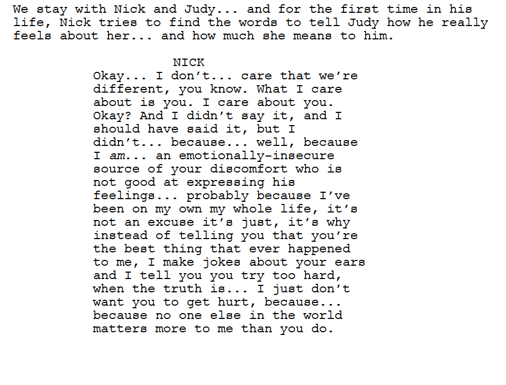
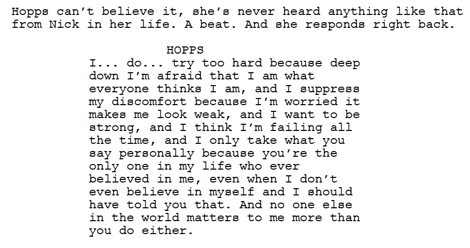
It goes on like that for another page. It’s so sincere it plays like a joke toward the end of their back-and-forth, topped off with another character lampshading, “now that’s what we call an overshare.” It’s played like a joke because it feels like it's going to end and then keeps going, but more importantly, humans, and by extension the characters we create, rarely ever reveal our vulnerabilities and insecurities so explicitly. We are self-protecting creatures, which results in dancing around topics (both consciously and subconsciously) that we think may hurt us.
Storytelling is about what is unsaid just as much as it is about what is being said. Stories convey meaning on multiple levels–on explicit terms, but also on implicit and metaphorical terms. Subtext is a literary device that conveys the underlying meaning within the story. That meaning can manifest in a variety of ways, but it is the area between explicitly and implicitly that subtext lives. Cranking the difference between the two all the way results in irony–when someone states the opposite of what they mean. Irony can overlap with subtext, but subtext is much broader in scope.
A common misconception is assuming that subtext is accomplished through vagueness. Deliberately obscuring the dialogue in ways that don’t layer onto the existing themes and characterizations can lead to confusion instead of recognition by the audience. In addition to vagueness, subtext is often conflated with subtlety, but subtext does not HAVE to be subtle. When a couple is fighting about some benign object or prop, the prop is often just a stand-in for the nature of the relationship. It’s not that subtle.
Types of Subtext, and The Three Conditions that Build It
Some writers hold subtext close to the chest, while others shout it from the rooftops. Some build out the characterization and trust the subtext will follow,, and some deliberately weave it into their work. And that deliberate weave is what this series on Subtext will focus on.
Subtext can present itself in a variety of ways.Thematic subtext is the meaning built upon throughout the story that is implicitly conveyed without ever directly declaring the theme outright. Thematic subtext was often employed to tell stories about themes that would’ve been seen as scandalous to a general audience if the theme was explicit. In The Children’s Hour (1961), the two women who run an all-girls’ boarding school have their lives upended when one of the students starts a rumor saying the head-mistresses of the school had an “unnatural relationship.” This is a remake of the 1936 film, These Three, where queer topics were so taboo, the rumor was changed to cheating. Even in the Children’s Hour, scenes were cut to tone down the fact that Shirley Maclaine’s Martha did actually love Audrey Hepburn’s Karen, even if the rumor itself was a lie.
Thematic subtext is about setting the stage and letting the audience fill in the gaps with their imagination. This principle remains constant on the granular level as well. If characters don’t want to reveal something, but still need to get it out, they might speak in code by abstracting their own meaning by talking in the third person, by role-playing as another person, substituting themselves for a “friend.” If a person just cannot explicitly state they like someone, they might say, “I have this friend who likes you.” That small amount of abstraction, even if the characters and the audience know exactly what’s being said, can ease the burden of being honest, being vulnerable.
This granular level is what the focus of building the craft will center on. Part 2 will focus on Subtext through dialogue (more reading on how to write dialogue here), and part 3 will focus on dialogue through action lines. Visual subtext and metaphorical subtext will be centered more in the action lines. Film Local's write-up on subtext identifies the three conditions upon which good subtext hinges.
The first variable in the equation is the hidden want of a character. That character’s feelings, desires, what’s their goal at the moment. The want is hidden due to the second variable, some sort of societal or inter/intrapersonal pressure that is stopping them from expressing the want outright. The final variable is the contextual understanding the audience has to spy what’s not being communicated on the surface. These three variables, when applied cohesively, create a deeper meaning. They help the audience engage with the story on multiple levels. On what’s communicated and what’s not. What’s stated and what’s only alluded to. Why something is only alluded to is the deeper meaning.
In an interview with NPR, Greta Gerwig talks about the complicated nature of Mother/Daughter relationships that are on display in Lady Bird (2017). On pages 29-31, Lady Bird slinks home late after a school dance and catches her mom’s ire, except the ire is thrown at how messy Lady Bird’s room is:
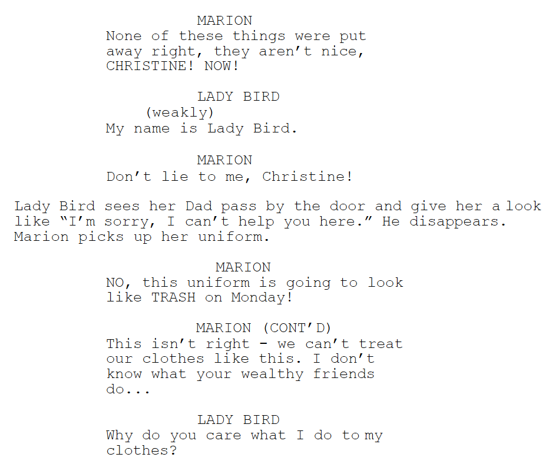
Just before Lady Bird fails at sneaking into the house, we see her mom and dad stressing about their financial situation. Her mother, Marion, is losing control of the stability in their lives just as Lady Bird’s burgeoning independence is driving a wedge between her and her mother. In the NPR interview, Gerwig states that Marion is terrified at this moment. She can’t control her husband losing his job, she can’t control Lady Bird making reckless decisions, but she can control how clean Lady Bird’s clothes are.
The hidden feeling in this scene is Marion’s fear of losing control. She’s masking her fear with anger. The pressure preventing her from stating her true feelings are multifaceted. To gain an advantage in the argument, Marion does reveal part of her reason.
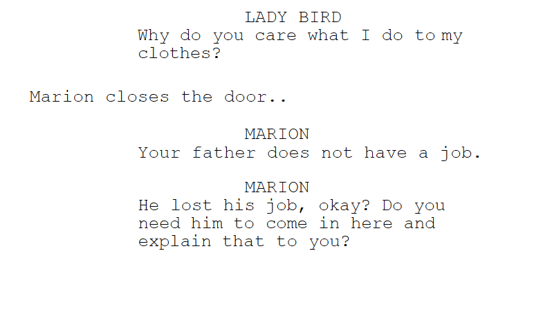
Revealing this stops Lady Bird in her tracks, and she doesn’t have a retort. Though this was hard to admit, it’s also the easier thing to admit to her daughter. The other reason being that she feels Lady Bird slipping away from her as she becomes more independent, and is scared that she cannot protect her daughter from making big mistakes (like going to a college that they can’t afford).
The contextual awareness for this scene is planted for the audience in the opening sequence of the film, wherein Lady Bird and her mother fight about the prospect of going to college on the East Coast which culminates with Lady Bird jumping out of a moving car. The dramatic action reinforces what their dialogue just told us: Lady Bird feels stifled in her controlled environment (the car in the scene/her life in Sacramento) and is trying to break out, no matter if it's reckless. This mother/daughter dynamic is reinforced throughout the film, and the audience reads these fights through this push-and-pull lens.
What Happens When One Condition is Missing
Contextual awareness is often targeted toward the intended demographic of who will likely read/watch the story. One small hazard when watching a foreign language film is missing some of the complexity that is implicit through a cultural contextual lens. The cultural context may be universal inside a given demographic, but go over the heads of someone outside said demographic. That’s simply a small limitation of watching cinema from storytellers around the world, because the meaning is still there to be found if you gain the cultural context for a repeated viewing. If the contextual awareness is simply not supplied by the storyteller, however, no amount of rewatching is going to help the story. There just won’t be anything deeper for the audience to engage with. And, to be sure, even without fully being aware of different cultural context, the viewer can still intuit that a deeper meaning is there, even if it cannot currently be grasped.
A lot of the humor went over my head in Three Colors: White even if I understood that the scenes were intended to be funny. Because what’s intuitively funny in Poland may not resonate at all with a different audience. For example, there’s a lot of context about why making pictures of Pope John Paul II look yellow is funny in Poland, but I’ll let you look that up yourself.
Missing one of these variables for our subtext equation can lead to flat dialogue, mute the tension in a scene, and strip the viewer from giving their full attention to a story. Often, extremely blunt dialogue can break the immersion for the audience, making them wonder, “Who talks like that?”
Part 4 of this series will provide a thorough diagnostic analysis that you can apply to your own writing to see if the conditions are all met in your scenes. For now, ask yourself what the purpose of each scene is on a character or thematic level, not just on a plot level. What is the want for your characters in each scene? Why must they hide it? Does the audience have the proper tools to fill in the gaps?
Why This Framework Matters More Than “Show Don’t Tell”
Show, don’t tell is the most popular maxim within storytelling advice circles. It’s a sound principle, but it is also as nebulous as telling someone about to go on their first date to just be themselves. That was not actionable advice for me when I first heard it even if I now know it to be true and useful. This framework for subtext, which is often the outcome of showing and not telling, is actionable and provides a framework from which applying the maxim can begin.
The rest of Kinolime’s series on subtext will flesh out the application of the formula.
This article, part 1, built the vocabulary that encapsulates subtext and the craft formula that can be used to hone your skill. Part 2 applies the formula specifically to dialogue. Part 3 applies it to action lines and physical behavior (more reading for writing scripts with attention to action lines here.) And part 4 will provide an in-depth diagnostic rewrite exercise so you can apply these techniques to your craft and weave deeper meaning into your storytelling.