
Screenwriting Tips from Professional screenwriters and filmmakers Compilation | Kinolime Original[Podcast]
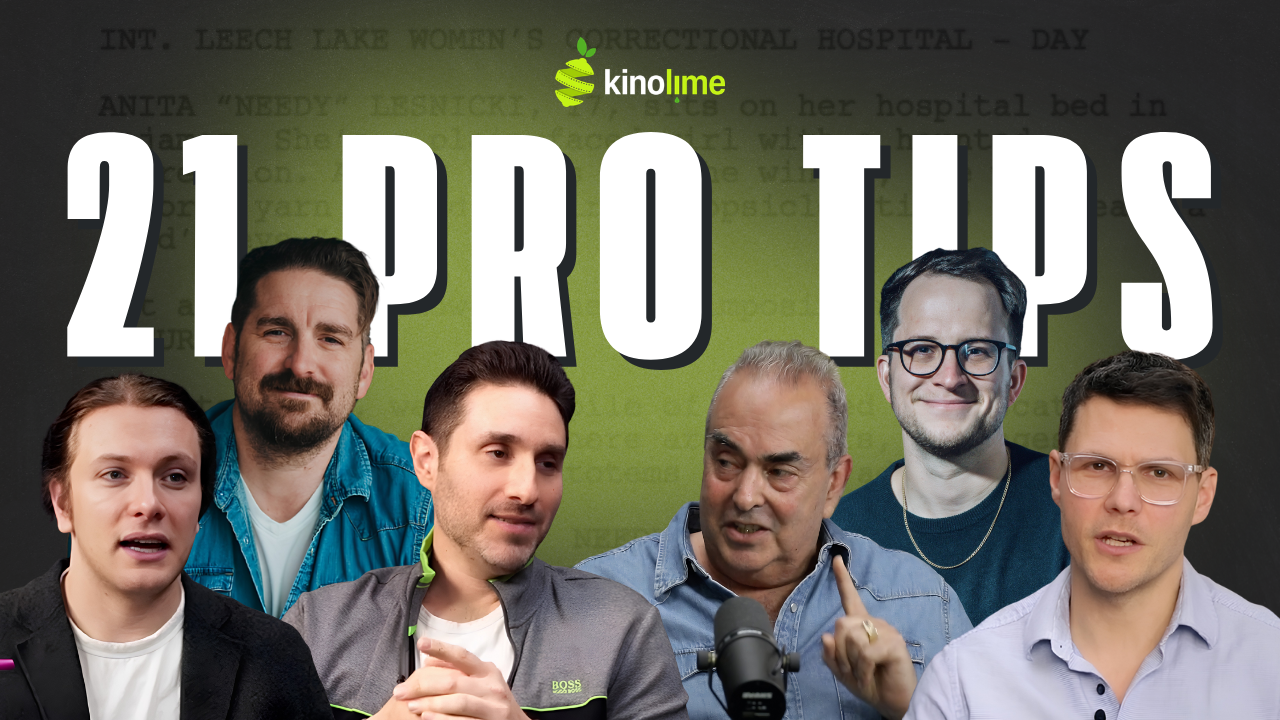
In this Kinolime Original, John, Danny, Kole, Eric Landau, Adam Hampton, Fred Lebow, and other filmmakers and writers dive deep into the real process of screenwriting, from rewriting drafts and building compelling characters to crafting decks, treatments, and unforgettable loglines.
The conversation explores the hidden mechanics of great scenes, why subtext matters more than exposition, how streamers are changing storytelling, and why the first and last ten minutes of your screenplay are everything. Along the way, the guests share personal writing routines, creative exercises, and honest insights into turning instinct, emotion, and raw ideas into stories that actually connect with audiences.
Topics Covered
Writing habits and routines
Rewriting and screenplay development
Character action vs. dialogue
Loglines and pitching
Treatments, decks, and one-pagers
Screenwriting structure
Subtext and hidden conflict
High-concept storytelling and streamers
Writing from emotion and subconscious instinct
Rewriting & The Writing Process
John: I do ten drafts to get my stories done, and I think that’s the key, just keep rewriting, rewriting, rewriting. Polish that stone, chip away at that marble, and eventually the Statue of David comes out.
Austin Kolodney: Do whatever job you’ve got to do, but then try to reinvest a little bit back into your own writing.
Writing Through Action
John: Start with action and purpose first. Have your character pick up a glass and throw it against the wall, that’s where character comes to life. If you rely too much on dialogue as a safety net, it can block the creative juices. Make your characters make physical choices.
Writing Routines
Eric Landau: Yeah, a coffee with half-and-half.
John: Okay.
Eric Landau: And I use Final Draft on a Mac computer.
John: But you never write at home? Always out of the house?
Eric Landau: Yeah. I rotate between several coffee shops. They all know me, I’m a regular. At a couple of places, I even have the same seat every time.
Bret Raybould: For the most part, I just like writing with a friend. I love having someone to write with because it makes the process feel less lonely.
Finding Ideas & Character Studies
Adam Hampton: It’s never just one idea. Usually, I have a few ideas floating around in my head. I’m fascinated by civility and social norms. You can approach that comedically, like Curb Your Enthusiasm. It’s funny when people don’t follow the rules of polite society.
But it’s not that far of a leap to make that scary instead of funny. Everything doesn’t have to be big. I like intimate stories. I find people fascinating. I find characters fascinating. I really wanted to do a character study.
Decks, Treatments & Pitching
Danny: If you can write a really strong screenplay, then you also have the capability to make a great deck, a great one-pager, and a great treatment. If you’re going to be proactive enough to become part of the less than 1% of people who actually sell their screenplay or get their movie made, then you need to be proactive in every aspect of the pitch.
Breaking Down The Logline
John: When you have a logline, there are elements to it. It’s kind of like an equation: A plus B equals C. D, Why don’t you tell us what that magical equation is?
Danny: Essentially, in two sentences, you’re trying to articulate your story as succinctly as possible. You want to establish where we meet the story, who the main character is, who the antagonist is, and what the stakes or central conflict are.
John: So basically: protagonist, goal, and conflict.
Danny: At the core of every great brief pitch are the main plot points. In Act One, people want the inciting incident, the setup, and the turn into Act Two. Then the midpoint, the turn into Act Three, and eventually the climax. Maybe you reveal the ending, maybe you don’t. But if you can boil your story down to its structure, it becomes much easier to articulate in longer-form documents.
Learning Screenwriting Through Movies
Fred Lebow: Nobody ever made me read a book on how to write a screenplay. You just take ten of your favorite movies and watch them over and over again. Eventually, you develop a muscle in your brain that teaches you how to write. You absorb it without even realizing it.
Then when you start writing, you develop this instinct. I can’t really explain it, but it becomes automatic.
John: Musclememory.
Fred Lebow: Exactly. You instinctively know: “Okay, this has to come next.” You’re not consciously thinking about first act, midpoint, point of no return, it just becomes internalized.
Leaving Space For The Audience
Danny: When you’re trying to grab attention, you want to leave some of the description open to interpretation. That’s what makes stories exciting. Things aren’t spelled out completely, so the audience’s imagination starts filling in the blanks.
Cutting Dialogue & Strengthening Scenes
John: In your first few drafts, it’s okay to throw in extra character moments while you figure things out. But once you start trimming, there’s something I like to do.
I’ll put the main character, let’s call him Michael, in the center of a chart and surround him with every other character. If a character isn’t influencing Michael’s growth, the plot, the obstacles, or the tension, then they’re gone.
You start to see visually which characters actually matter and which ones are just extra weight.
There’s also a great note from director John Hyams. He said when you write a dialogue scene, cut the first two exchanges and the last two exchanges. Everything in the middle is usually the essential part.
A lot of scenes start with, “Hey, how are you? Nice weather today.” Cut it. Get right to the point.
And when it comes to exposition, stop explaining feelings directly. Don’t have characters say, “I feel this way because you did this.” People rarely say exactly what they mean in real life.
One of the best exercises is writing scenes without dialogue. Try to communicate emotion entirely through action.
Of course dialogue matters, but force yourself to write scenes where the characters never directly discuss the real issue. Have two people arguing about dinner, but underneath they’re actually arguing about something deeper -marriage, abortion, resentment, whatever it is.
That hidden conflict is the iceberg beneath the scene.
What does each character want? What’s their intention? What’s the obstacle? And what’s the deeper thematic argument underneath the conversation?
High-Concept Movies & Streamers
John: I love prestige dramas, and there’s absolutely still a place for them. But today, your idea often has to sell in a sentence.
High concept is what streamers tend to want because they value rewatchability and shareability more than prestige. They want endings people talk about. They want twists that make audiences text their friends afterward.
Spielberg once said the two most important parts of your screenplay are the first ten minutes and the last ten minutes. The opening is what hooks people, and the ending is what they leave the theater remembering.
Why Great Pitch Materials Matter
Danny: An amazing story is obviously the most important thing when trying to get a movie made. But a really great deck can communicate your vision to producers and executives.
In this industry, maybe one or two people will actually read your screenplay. Everyone else is hearing about it through someone else. After that, it becomes a sales job moving up the ladder.
Writing From Emotion & Subconscious
Kole Lyndon Lee: Instead of thinking, “Okay, I have this idea now how do I turn it into a beginning, middle, and end?” I started meditating on the feeling of the idea instead.
I thought more about visuals and emotions. What do I see when I think about this idea? What emotions do I feel? How can I make other people feel that same thing?
Rather than leading with intellect and logic, I tried leading with my subconscious. Instead of logically deciding what should happen next, I just wrote whatever image or feeling came to me.
I wrote the first scene, and then instead of plotting the next logical step, I followed instinct. Whatever idea came into my head next, I wrote it down. Then afterward, I shaped it into something that made narrative sense.