
How to Fix a Directionless Screenplay | OBSESSION [Podcast]
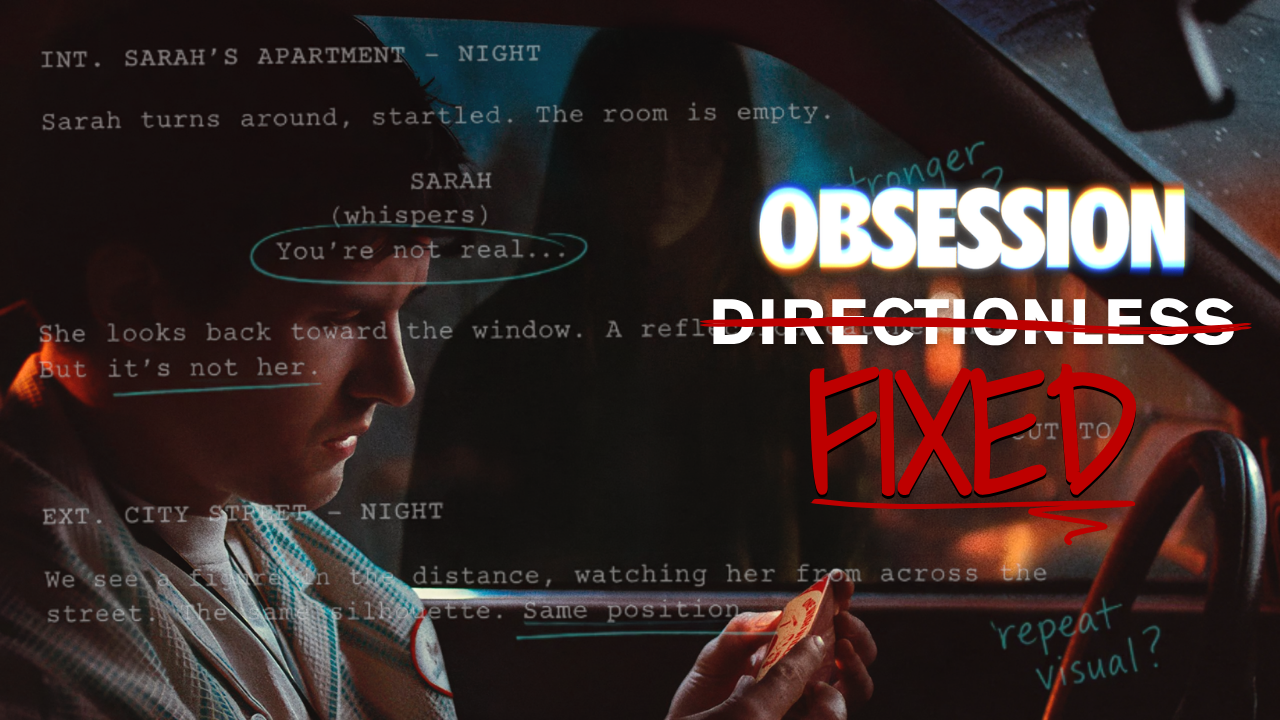
Everyone has an opinion on Obsession, and most of them come with a hot take. Ours is a little different: we didn’t love it, and we’re going to explain exactly why, then roll up our sleeves and see what happens when we try to fix it.
Be careful what you wish for is an old story, and it’s been told a thousand times. So what happens when you give it a sharper heart? We look at the screenplay through a creative executive’s eyes, asking who this story is really about, what Nikki is fighting for, and whether Bear is the villain the film thinks he is.
Working within the film’s tiny budget, we’ll keep the scenes you love and try to turn a fun premise into something that truly bites. Pull up a chair, grab your favorite snack, and let’s get to work on Kinolime’s Fix It.
Full Transcript: Kinolime Fix It Episode 7: How to Fix a Directionless Screenplay | OBSESSION
Participants
Meara Owen-Griffiths - Creative Executive, Kinolime
Meara: I did not love Obsession. There, I’ve said it, and honestly, it’s a huge weight off my shoulders. There are dozens of us out here who feel kind of indifferent about this movie. Before you raise your pitchforks, I just like you to hear me out on this one. I’d like to examine Curry Barker’s screenplay and the final film through the lens of a creative executive, which is my job here at Kinolime on a day-to-day basis. I’m trying to take effectively the same ingredients that made this film what it is and maybe just bake a slightly better soufflé with them.
I have lost count of how many times people have smugly said to me, “The thing about Obsession is Bear is actually kind of the bad guy.” Of course he is, and I wish you a long and lucrative career in literary analysis with these insights. The thing is, though, I’m not really sure Barker himself truly sees Bear as the villain. It feels to me like he happened upon this reading, and since then he’s just sort of run with it. The last words of the screenplay literally describe this as a tragic love story. Yeah, in a Romeo and Juliet kind of way, in that they both die at the end, but a murder-suicide does not a love story make.
If what you’re saying is correct and Bear is the bad guy, then Nikki must be the good guy, right? That tracks. So tell me this: what are we hoping for her to accomplish in this screenplay? I think with a few small tweaks, we can answer that question, as well as give Nikki the autonomy her character is sorely lacking.
Now, I’m aware that Barker shot this film on a tiny shoestring budget, which is part of this film’s charm and what made it so successful. So I want to work within those budgetary parameters, and any of my changes will be roughly in line with the original film’s budget. And I bet I can convince you that with a little TLC, Obsession could deliver a stronger execution on its premise. I’m Meara. Welcome to Kino Lime’s Fix It.
The Trouble With “Be Careful What You Wish For”
Meara: “Be careful what you wish for” is kind of a boring dramatic argument for a film. It’s been a popular trope since the ancient Greeks were cooking up sizzling fire in the narrative kitchen. King Midas and his golden touch, the Tower of Babel, the fisherman and his wife, Faust and Mephistopheles, the monkey’s paw, The Picture of Dorian Gray, and even The Simpsons. And it gets to a point where it announces itself. It’s a parable rather than a theme. Someone gets a magic wish, and are you ever going to say, “Gee, I bet this is going to go real well for them”?
The only setup I find worse than this is the “you must word your wish carefully so you avoid any loopholes or malicious compliance” idea. It trivializes a setup that usually demands at least some growth from a character, and instead it just turns it into a riddle. It’s all spectacle rather than substance.
So Bear makes his wish, and he gets what he wants, sort of. And the heart of the narrative becomes: how much of this will he grin and bear, if you’ll excuse the pun, before enough is enough? What wacky things will that freaky Nikki do to ruin his day next? It feels more like an episode of an ’80s family sitcom than a horror movie.
A much more intriguing thematic core would posit that you can’t make someone love you without destroying the thing you wanted, or that the fantasy of being someone’s everything is inherently narcissistic. This is a lesson I love to discuss with my clients. Love, war, revenge: these aren’t themes so much as topics. A theme should be a statement that triggers a spectrum of responses, then tries to justify itself throughout the narrative. Barker asks himself, “Why can’t Bear get another one? Wish Willow?” and then inserts a scene that answers that question with only six pages to go.
Nikki Is a Person
Meara: Chapter 2 is called “Nikki Is a Person.” I find it hard to swallow how deeply uninterested the writing is in Nikki as a character. We don’t want to root for Bear because he’s objectively awful, but he’s also the sole perspective of the film. Nikki gets nothing, which is why everyone feels so smug about recognizing that Bear is a real piece of work. Bear sees himself as an unfortunate soul who didn’t deserve this, and the writing does nothing to circumvent that line of thinking.
You may suggest this is a media literacy issue, which Barker is intentionally targeting, but I’d like to share a quick quote from Barker’s interview with Variety India: “I was never trying to make a film about some message about men or anything. I actually wanted most people, men and women, to relate to Bear on the aspect that he’s just a normal guy with a crush.” So, take that as you will.
Nikki’s experience of supernatural coercion is sidelined and underutilized in favor of the relatability of an unrequited crush. The writing sets her up as an object, something to be won, while simultaneously, structurally, treating her as an inconvenience. She’s someone for shock horror to happen to. Even before the possession, she gets so little play that she barely gets the chance to express what she likes or dislikes. The film tells us what Nikki would hate, the citrine necklace. The screenplay tells us what Nikki would love, a one-wish willow.
When she becomes altered by her possession, dialogue has to inform us that she’s acting abnormally and that Bear has never seen her like this before. The writing fundamentally underserves her, to the point where even her most basic traits are explained by Bear rather than coming from the horse’s mouth. And look, Indie Navarretti does a hell of a job. She puts in a really fun performance, but it’s like she’s feeding the 5,000 with five small loaves of bread and two fish. She’s got to do a lot with not very much, and spread it really thin.
Bear Sucks as a Person and a Character
Meara: Chapter 3 is called “Bear Sucks as a Person and a Character.” The writing is at its strongest when Bear is pulled back and forth between wanting his whirlwind romance to be real and being deeply embarrassed that it is not. Naturally, one would not assume that the hokey magic device actually works. You would rather choose to believe that you’re worthy of the love you’re receiving. But Bear has been ignoring the red flags for about 20 minutes when, on page 57 of 99, deep into the story, we’re hit with this nugget. His response reveals a disregard for truth, showing a readiness to ignore darker realities for affection, hinting at a deeply flawed person.
While Nikki is coming in and out of panic attacks, trying to kill herself in front of their friend group, desperate to die rather than remain this prisoner in her own body, Bear is described as frightened and miserable. You see what I mean when I say Barker doesn’t commit to writing Bear as an antagonist. Deeply flawed is one thing, but that’s Mr. Darcy or Captain Ahab or Faramir. Bear possesses a sex slave. He’s effectively a rapist. It takes him a worryingly long time to recognize this, and even when he does, all he thinks about is through the lens of his own miserable misfortune.
And look, I can forgive a character who makes bad decisions. Some of the greatest characters of all time are objectively terrible people. But they must be active in making these faulty choices, and Bear is not. He falls into this weird situation by accident, and then he sits in it like he’s just chilling in a hot tub. He’s never offered an escape route that he turns down. There are functional moments where he’s offered the opportunity to acknowledge that something is not quite right, but so what if he does or doesn’t? It changes nothing. Barker even takes the investigation away from Bear. Why does Ian get so in his head about Nikki’s dad having cancer? Bear is never curious. He never gets to investigate.
If Bear’s motivation never twists into a place of regret and an active desire to free Nikki from her limbo, he should instead try to run away from her. But run where? We don’t know a thing about this guy beyond his fixation with Nikki. So when he tries to escape her love, who knows what he, or the audience, is in fact supposed to be hoping for. Barker sets up this new world but doesn’t give us an old world to return to. What do we know about Bear? He liked his cat, I guess, but the screenplay implies he’s left its corpse on the carpet to start rotting. Who is he? It truly feels like he doesn’t exist beyond his connection to Nikki, and we therefore have a very superficial characterization. He serves the plot. If you wrote a female character like this, you would probably be chastised.
We need to believe that Sarah likes Bear, meaning he has to have at least one attractive quality to his peers. Can you tell me what that is? So, watching Bear flounder is fun for quite a while, but this direction soon gives up on itself. Bear is powerless to the magic spell he cast, and Nikki is helpless within her own body. One of these has to change, right? Which is a good dramatic trajectory. But Bear isn’t magic, and he isn’t seemingly creative enough to pay someone $5 to undo his wish. While Nikki is a passenger and must remain a passenger, there are no tangible goalposts, and we don’t know what any conclusion is supposed to look like. Are we really supposed to hope that she succeeds in killing herself with a bottle, or convinces Bear to kill her in her sleep, in these brief moments of lucidity? So what outcome are we actually pursuing? You can’t promise a collision course and then tell us both outcomes are impossibilities.
Making Changes
Meara: Chapter 4 is called “Making Changes.” Okay. So how can we give Nikki a little bit of involvement, make Bear less reactionary, and communicate to the audience that we’re building towards something?
If Bear’s wish is for Nikki to love him more than anyone else, the part of Nikki that survives in the recesses of her mind, a passenger to whatever it is that’s piloting her, in those brief, brief moments of awareness, should try to eliminate anyone who cares for Bear. That reduces the pool of people who love him and therefore weakens the entity’s demands over her body.
What happens when Freaky Nikki achieves her goal? Does the demon hang around, or does he get to punch out and go home, kick off, have a few beers? Bear doesn’t have a lot of people in his life. In the film, but not the script, he says he inherited his apartment from his grandmother. In the script, but not the film, Bear references his dad working at a Toyota dealership. So my interpretation is that Bear in the film has no immediate family left, because they intentionally left out a reference to his dad and referenced his grandmother only. As such, the only people we know about who love Bear are Ian, which is platonic; Nikki, which is platonic; and Sarah, which is romantic.
So if I was Nikki, you can bet your bottom dollar that Ian and Sarah would be getting murdered the second I could raise a pinky. Now, Nikki reigns supreme. She’s top dog, the person who loves Bear the most in the world, and the wish is fulfilled. The thing is, Nikki already kills these people. She already does that. But if you make it Nikki who does the murder rather than Freaky Nikki, you give her a little tiny sliver of agency. She gets to make interesting decisions out of desperation. Because of the awful half-reality that Bear has subjected her to, now she has to play along with this nonsense magic rule. To become the person who loves Bear more than anyone else in the world, you would just have to take out two people. For me, that’s making the entire situation much more interesting.
Freaky Nikki is weird and unsettling. She gets things wrong, and she doesn’t feel authentic, and we keep all of that. But the demon isn’t doing random stuff to accommodate the trajectory of the plot, like putting a cat in a sandwich or wearing weird makeup at night. The horror is the loss of Nikki’s autonomy. And in the moments when she does shine through, she begins with acts of aggression and rebellion. Now she puts the cat in the sandwich as a middle finger to Bear. She pees on the floor and vomits on herself as a tiny but vital act of defiance. There’s an internal justification in her struggle. She is helpless to prevent Bear from taking what he wants, but she’s going to make it miserable for him.
Freaky Nikki wants to fulfill the particulars of the deal and love Bear more than anyone. But the part of real Nikki that survives hates him more and more, diluting that love. They’re locked in a mental arm wrestle. The key difference with my version of Nikki is that when she manages to break through, she attempts to sabotage Bear’s romance. She deduces that the way to free herself from Freaky Nikki is to complete the parameters of the wish: to inhabit the person who loves Bear most. While Freaky Nikki attempts to accomplish this by loving him more and more, Nikki has her own plan. From inside her own body, she begins eliminating Bear’s loved ones as a desperate ploy to permanently regain control. And as the bodies pile up, Bear becomes increasingly horrified by Nikki’s behavior, initially unaware that the real Nikki is trapped inside, desperately fighting to stop the very thing he wished for.
Now Bear is in a more interesting position. He relishes Nikki’s love and darkly enjoys the increduality of Ian’s situation, because too much attention is better than no attention. But soon he begins to recognize they’re in danger, and we get to see his epiphany. He’s going to make a choice: remain a pathetic, abusive coward, or do something about it.
With these tweaks, we’ve got the groundwork for a more dynamic relationship between characters. We keep all of your favorite scenes, and we transpose a whole new layer of complexity onto the screenplay with only minor changes necessary. It doesn’t fix everything. I still have qualms with the mechanics of the magic, and it doesn’t undo the many plot conveniences, but it elevates what we’ve got into what it should have been.
Now, here’s a fun conclusion. Bear gets what he wanted, Nikki to love him unconditionally, but it only cost him everything, all of his loved ones. And with those parameters fulfilled, Freaky Nikki is out of here. She is gone. Only Nikki remains. Now they look at each other. Bear is horrified by what he’s just been through. Nikki, on the other hand, is euphoric. She’s got her life back. She stares him in the face. He’s in tears. She kills him.
So he wished for what he wanted, and he gets what he deserves. That’s a beautiful ending. I think this in many ways makes the story so much more interesting. It means Bear now really has to reckon with the consequences of his actions, and they are direct consequences rather than implied ones. It means Nikki now has to fight back. She’s actually got some autonomy, even when she’s trapped within that body. It means Freaky Nikki is kind of a tragic character in a way, because she is a demon trying her best to fulfill a wish that is unfulfillable, and Nikki is the one doing the actual murders, which is just a cooler story in so many ways.
Closing Thoughts
Meara: I think Barker, if you’re watching this, and anyone who’s a superfan, of which there are many feral fans out there, don’t mean to upset you, but I hope you’ve given this some thought and used an open mind. Again, finally, no disrespect to Barker, but I feel like he’s being a little bit overrated because he’s a new, fresh voice, which is something that Hollywood desperately needs. Don’t get me wrong, but I’ve seen four films this year, and I’ve now seen my four films. It’s Project Hail Mary, Obsession, Spider-Man: Brand New Day, and The Odyssey. Those are going in your letterboxd top four. There’s nothing I can do to convince you otherwise.
I’ll just sign off by saying, one more time, I didn’t dislike this film. I think it’s got so much going for it, but I think it could have done so much more to really talk about the thematic core, the thematic heart and throughline: losing yourself in somebody else’s fantasy. It’s a fascinating topic that’s really underutilized in this screenplay, which is primed for it. It’s begging for it. And for me, we just never got there. With these changes, I think, without sidestepping any kind of authorial intent or responsibility to the audience, we could really tick those boxes and keep everything you already love so much about it. So it seems like a win-win to me.
Thanks so much, guys, for watching another one of Kinolime’s Fix It. I’ve been Meara. Please subscribe for more Fix It in the future. Let us know in the comments and on our Instagram page what you’d like to see us fix next. See you next time. If you got something out of today’s podcast, please share it with your filmmaking and screenwriting community and hit subscribe. It genuinely helps us keep making these. We need them. And we’ll see you in the next one.