The Breakfast Club Script Analysis: How John Hughes Turns Teen Stereotypes Into Timeless Characters

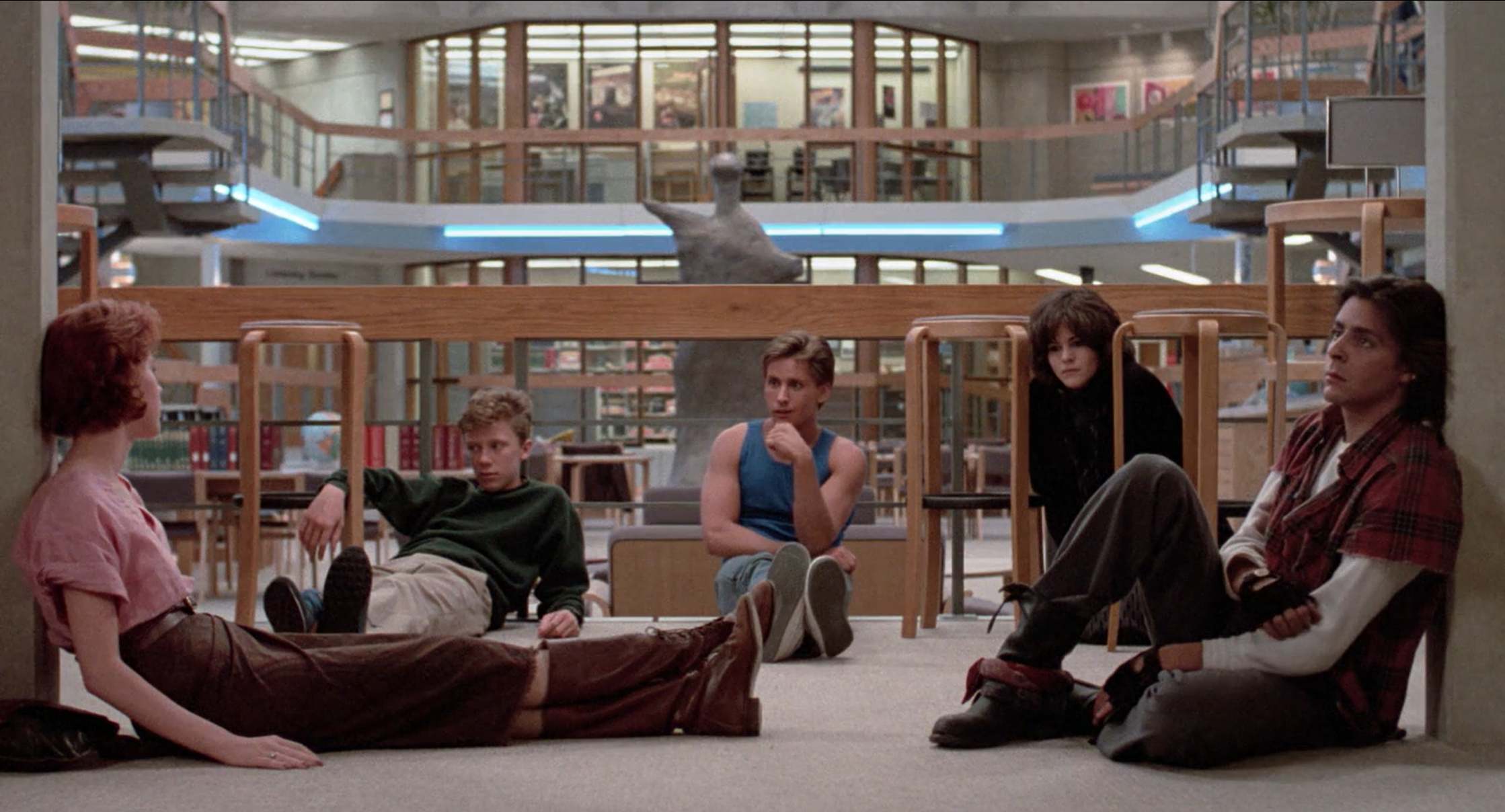
A timeless classic, The Breakfast Club (1985) remains one of the best character-driven films to this day. Set in a high school on a Saturday, the film focuses on five teenagers being thrust into detention together. Over the course of the day, the teenagers discover one another as more than what they expected, and in turn discover themselves.
Some would say that The Breakfast Club doesn’t exactly follow the “Show, Don’t Tell” rule for screenwriters. With most of its scenes taking place in a single library and its primary plot being the five teenagers getting to know each other, it is hard to learn certain things about them without them straight-on telling each other. However, The Breakfast Club pulls off a masterclass in when to tell and how to tell. Its combination of careful details to show and exemplary timing to tell is what creates these five distinctly fascinating characters and makes the movie as great as it is.
There are multiple versions of The Breakfast Club’s screenplays available online, from different stages of writing. I’m going to use two of them in my analysis: the shooting script, and an earlier draft that provides many details that are cut in the final draft yet make their way into the film.
Opening Image
The film opens with a sense of isolation. The word “lonely” appears twice in the descriptions of the first two shots. This relates not only the state of the physical surrounding, but also the mentality of our five main characters.
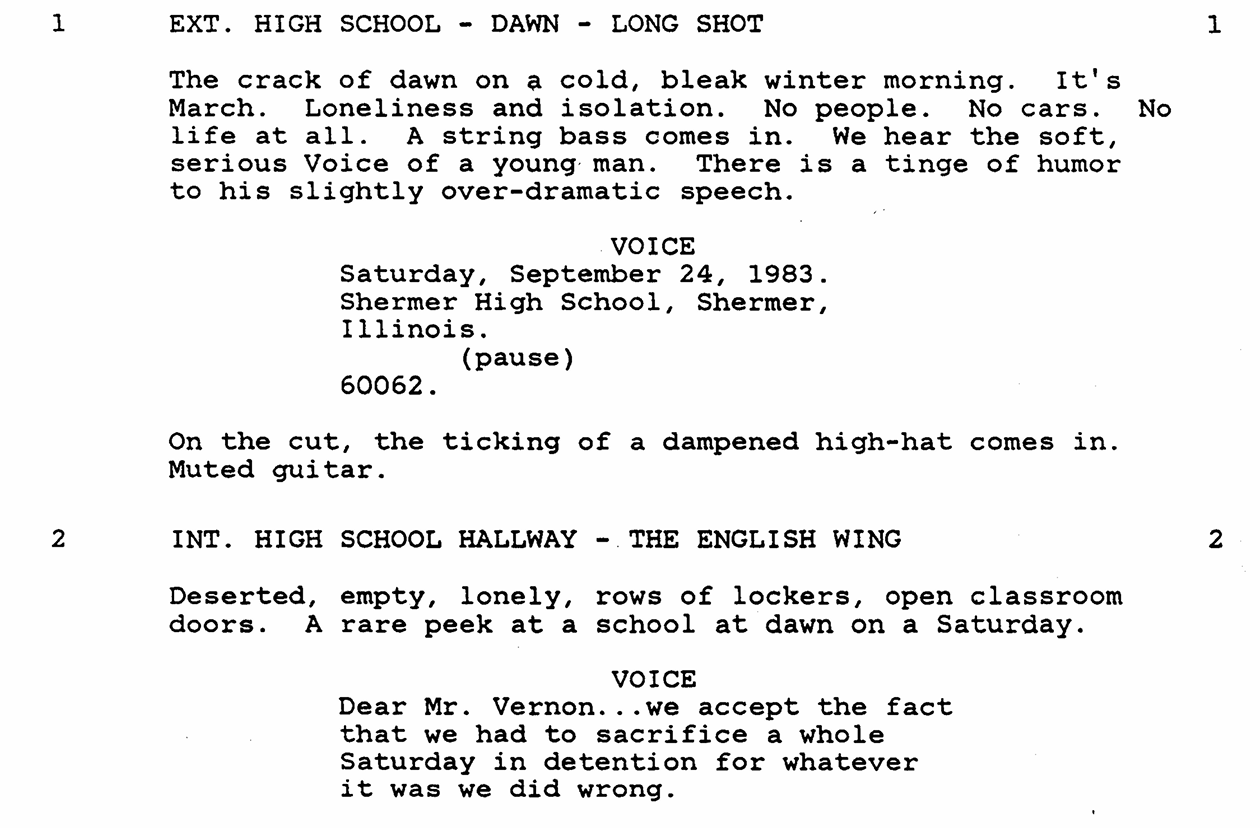
This opening also emphasizes the importance of music in this film. The shots are accompanied by “dampened high-hat” and “muted guitar” – rock and roll, but muffled, suppressed, just like the kids.
Over a montage of the school, Brian’s voice reads the essay that we will return to at the end of the film: “You see us as you want to see us...in the simplest terms and the most convenient definitions. You see us as a brain, an athlete, a basket case, a princess and a criminal. Correct? That’s the way we saw each other at seven o'clock this morning.”
Set Up
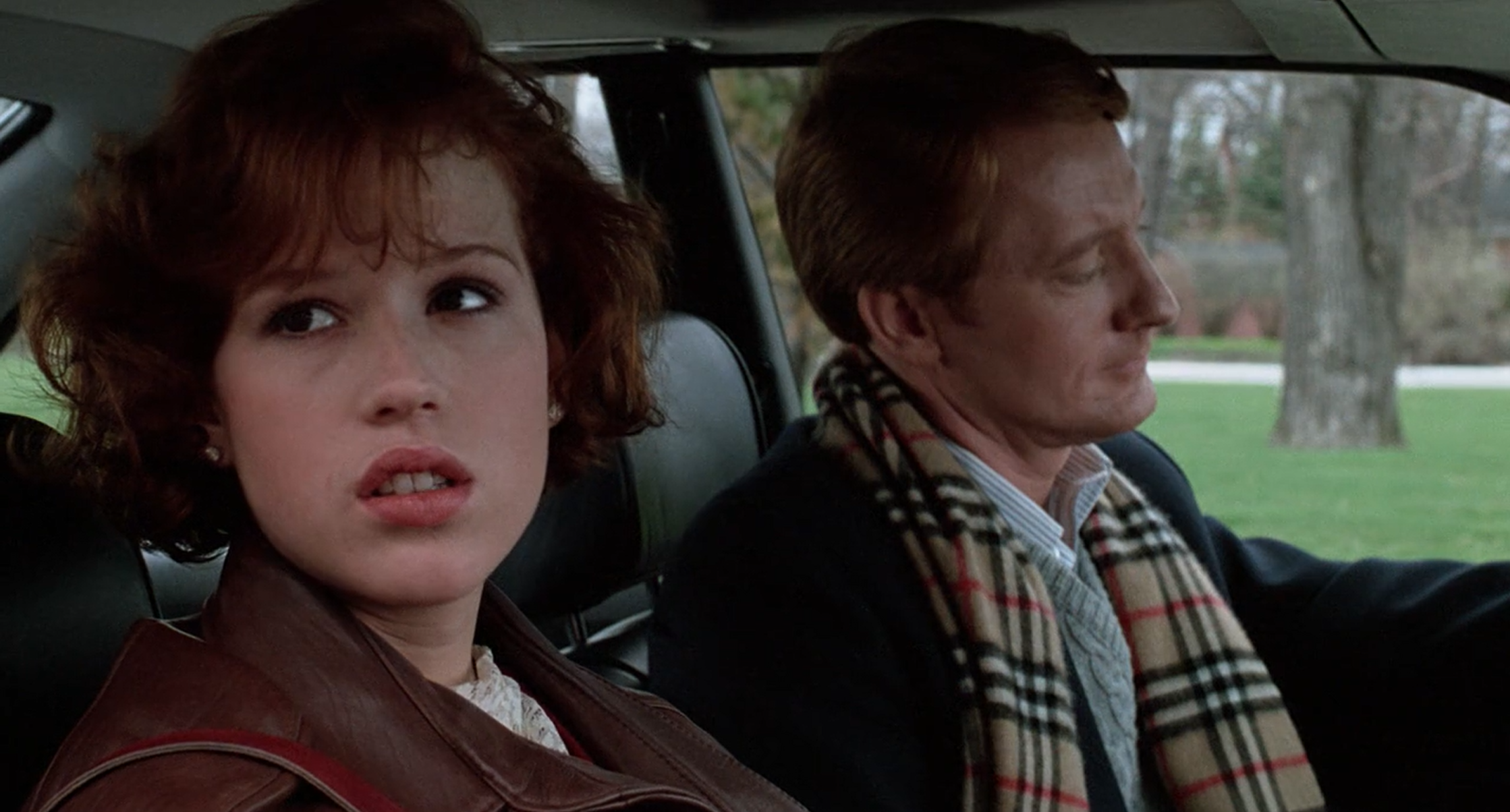
We meet each of the five kids before they enter school: Claire, the prom queen and “clearly a snob,” dropped off by the father who spoils her; Brian, the nerd, dropped off by his mother who treats him like a five-year-old; Andy, the jock, dropped off by his father who blames him for risking his future in getting a scholarship.
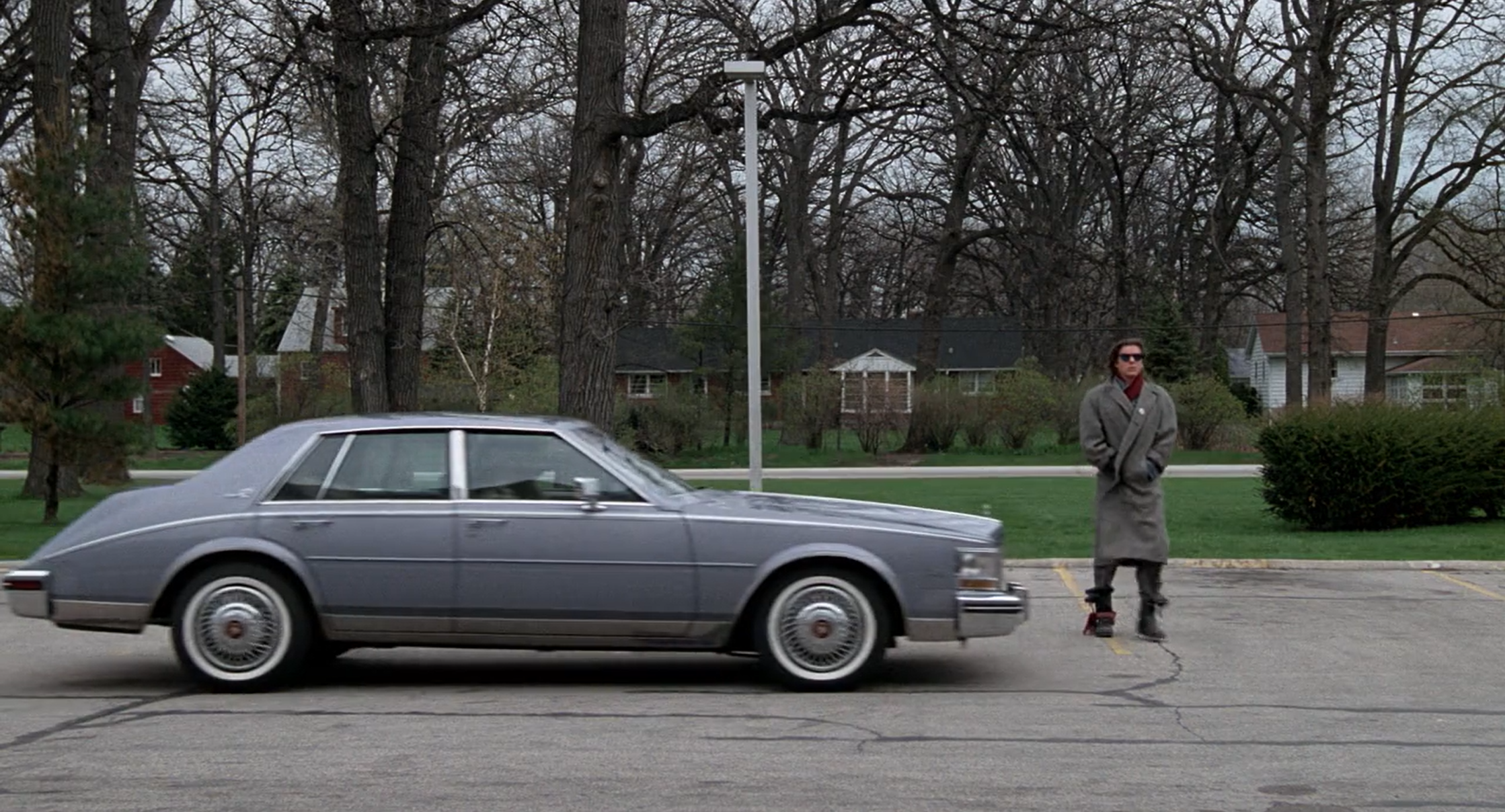
Then, two kids arrive without dialogue: Bender, the rebel, who comes alone; and Allison, the outcast, who tries to speak to her parents, but gets ignored.
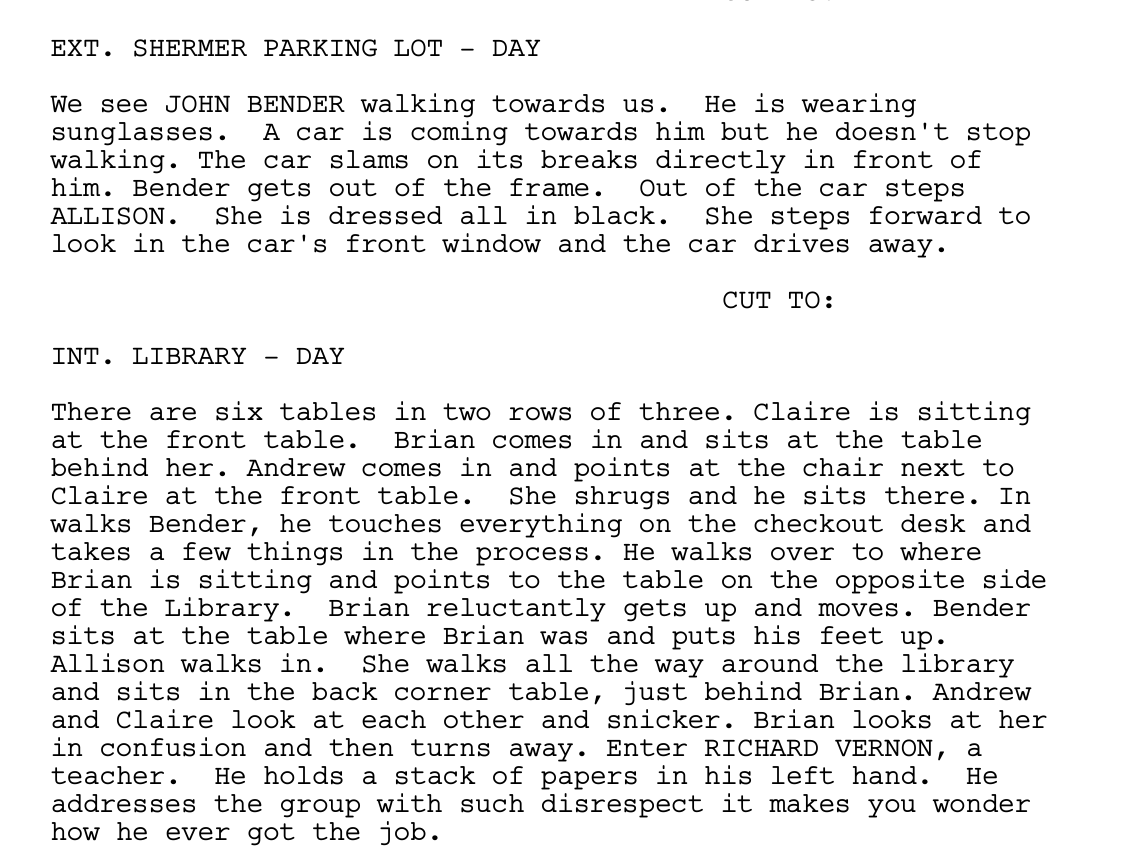
This opening is full of details: the kind of cars that the parents drive, the kind of clothes that they wear, are all indications of who the kids are. And every single detail, from their arrival to their seating in the library, is to make them feel like exactly the stereotype that we expect them to be, that they expect each other to be.
Inciting Incident
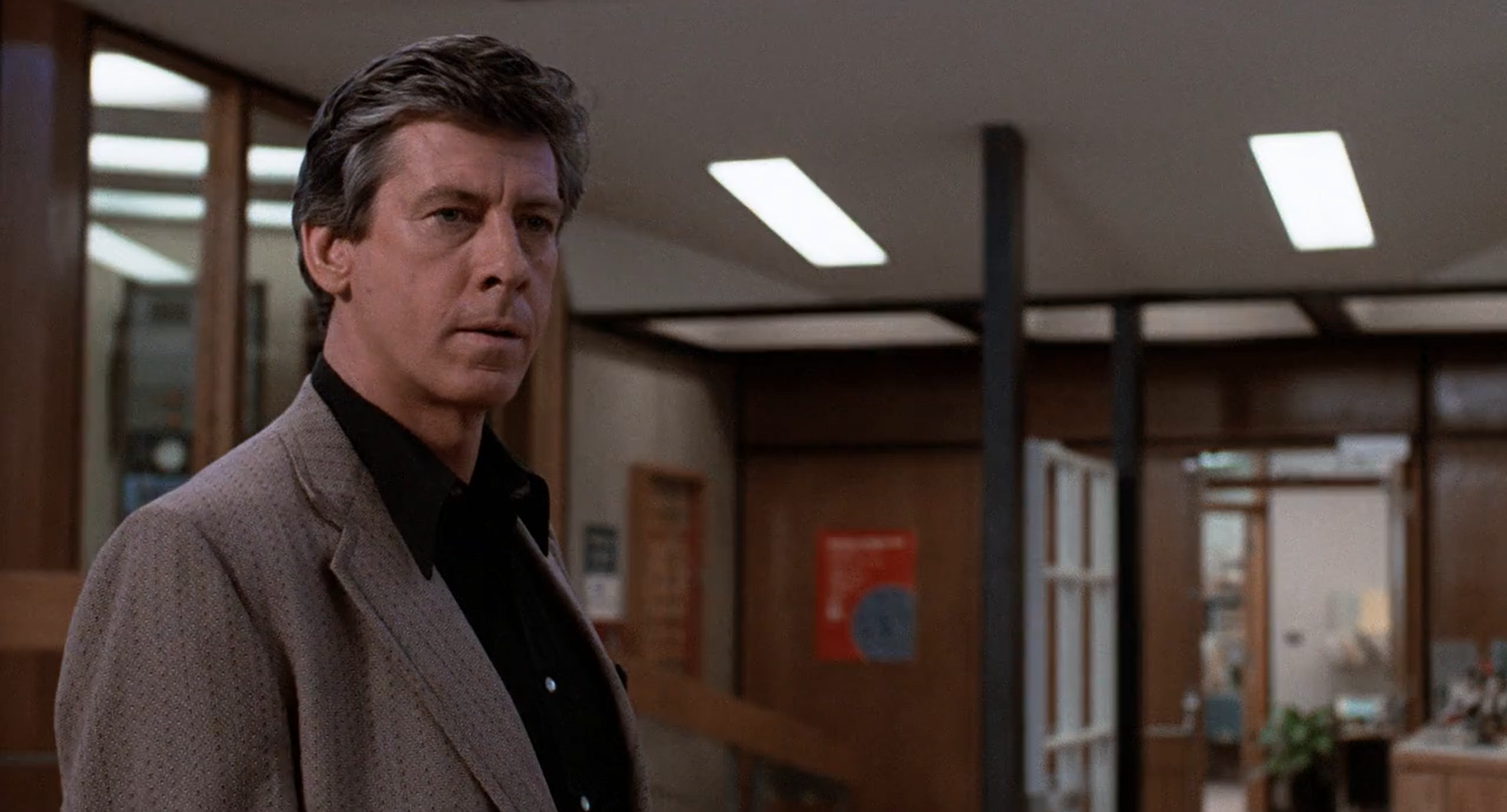
Mr. Vernon, the teacher in charge of the kids today, relays to them the rules. They are each to write a 1000-word-essay about who they are.
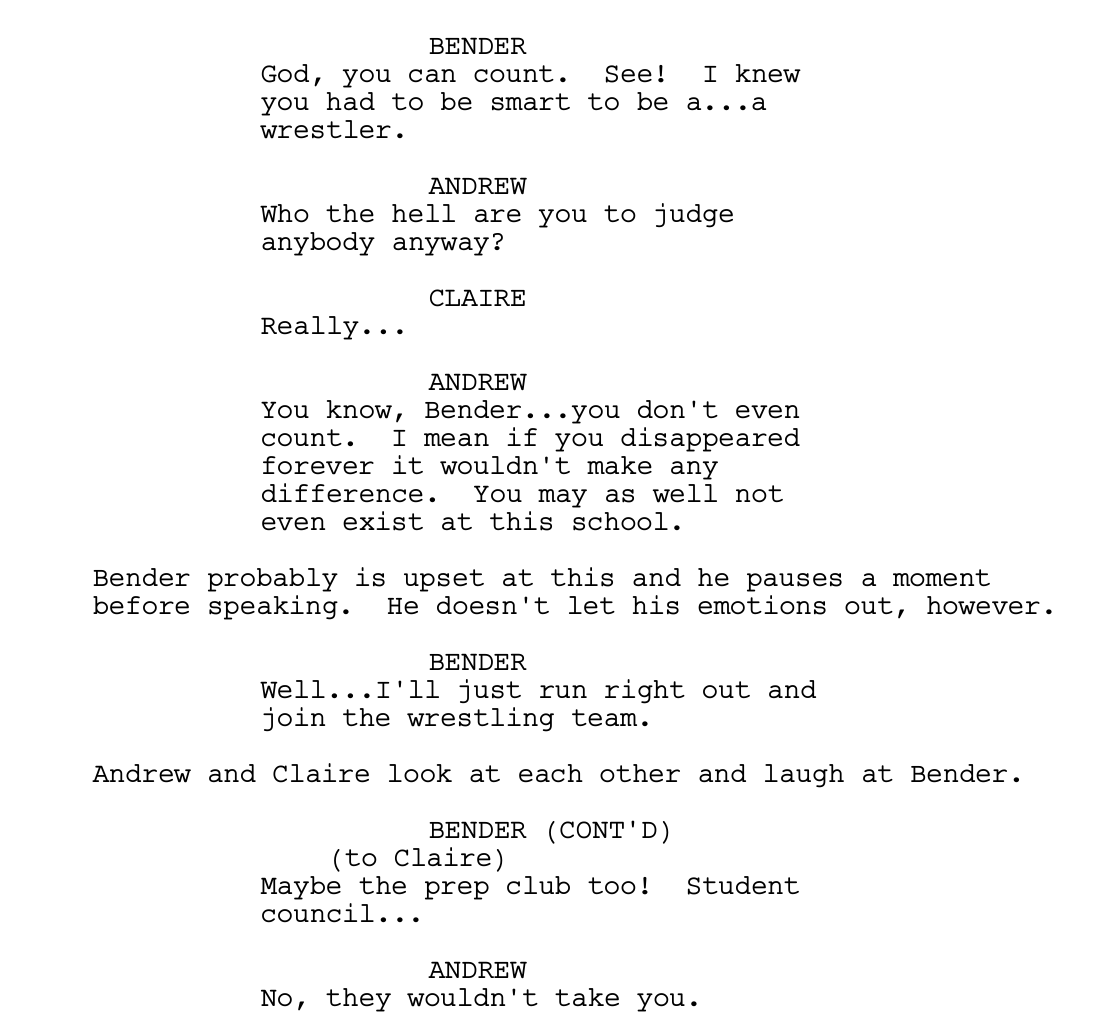
After Vernon leaves, Brian tries to write the essay, Allison starts eating her nails, and Bender begins messing with Claire and Andrew. He pretends to try to pee, asks them if they’re in a relationship, and mocks them for the student groups they are in. This drives Andrew to say to Bender “if you disappeared forever it wouldn't make any difference,” which, although Bender wouldn’t admit it, hurts him.
Debate
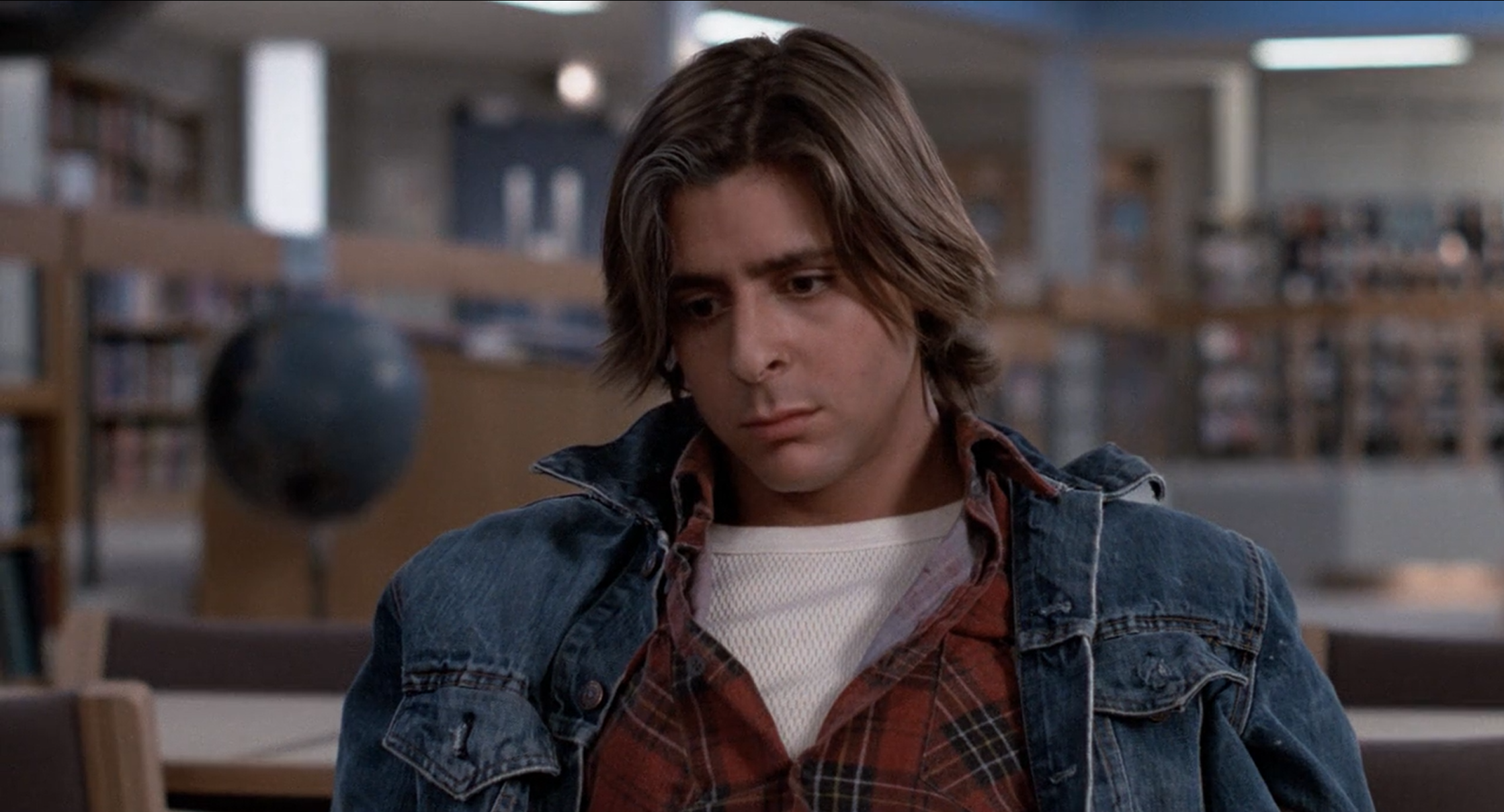
Bender removes a screw from the library door, making it unable to remain open. Vernon comes in, but nobody sells Bender out. Vernon belittles Bender, and Bender retorts, which soon escalates into a fight between them.
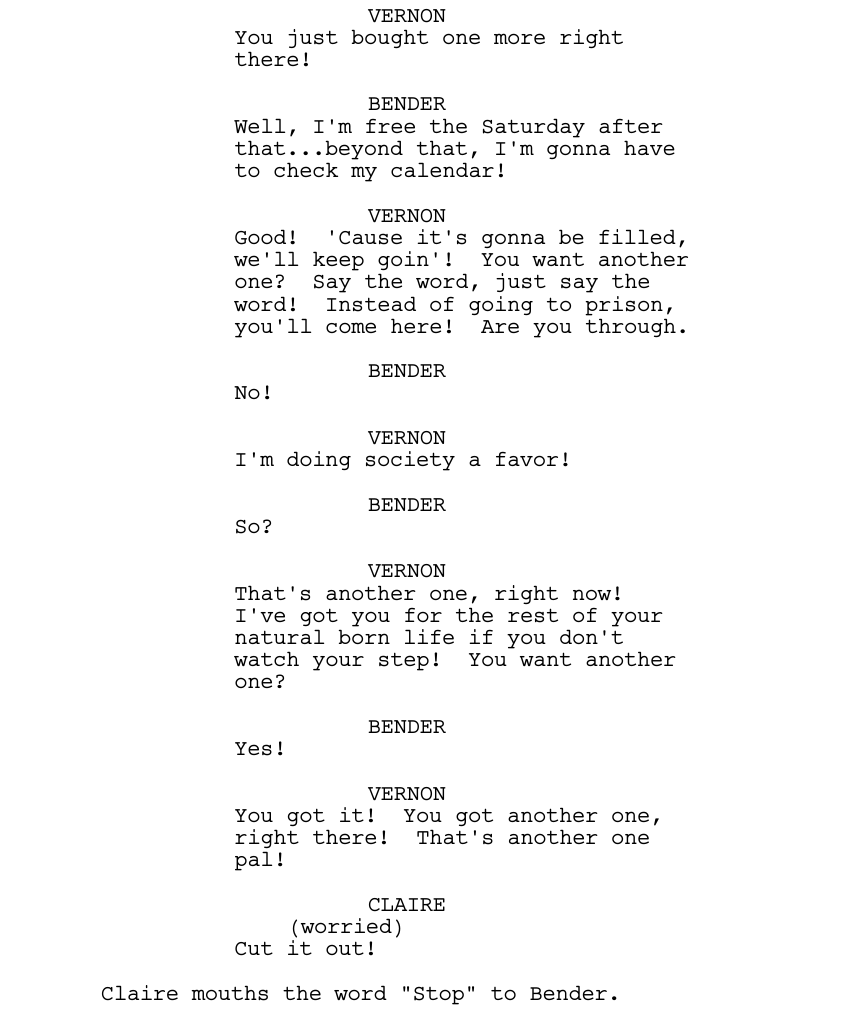
This is the first serious moment of the story. Before this, all the bickering has been lighthearted and humorous, but as Bender tries to rebel against someone with much more power than him, the dialogue turns dangerous, and the audience – like the other kids in the room – begins to feel afraid. It gives us the chance to feel for Bender, this character who has so far been toeing the line between comedic and insufferable. In this moment, however, we, as well as the other kids, see him getting hurt and being vulnerable against his will.
Break Into Two
Andrew asks Claire whether she can come to a party tonight. In her explanation of why she can’t go, Claire reveals that her parents fight constantly, that neither of them truly cares about her.
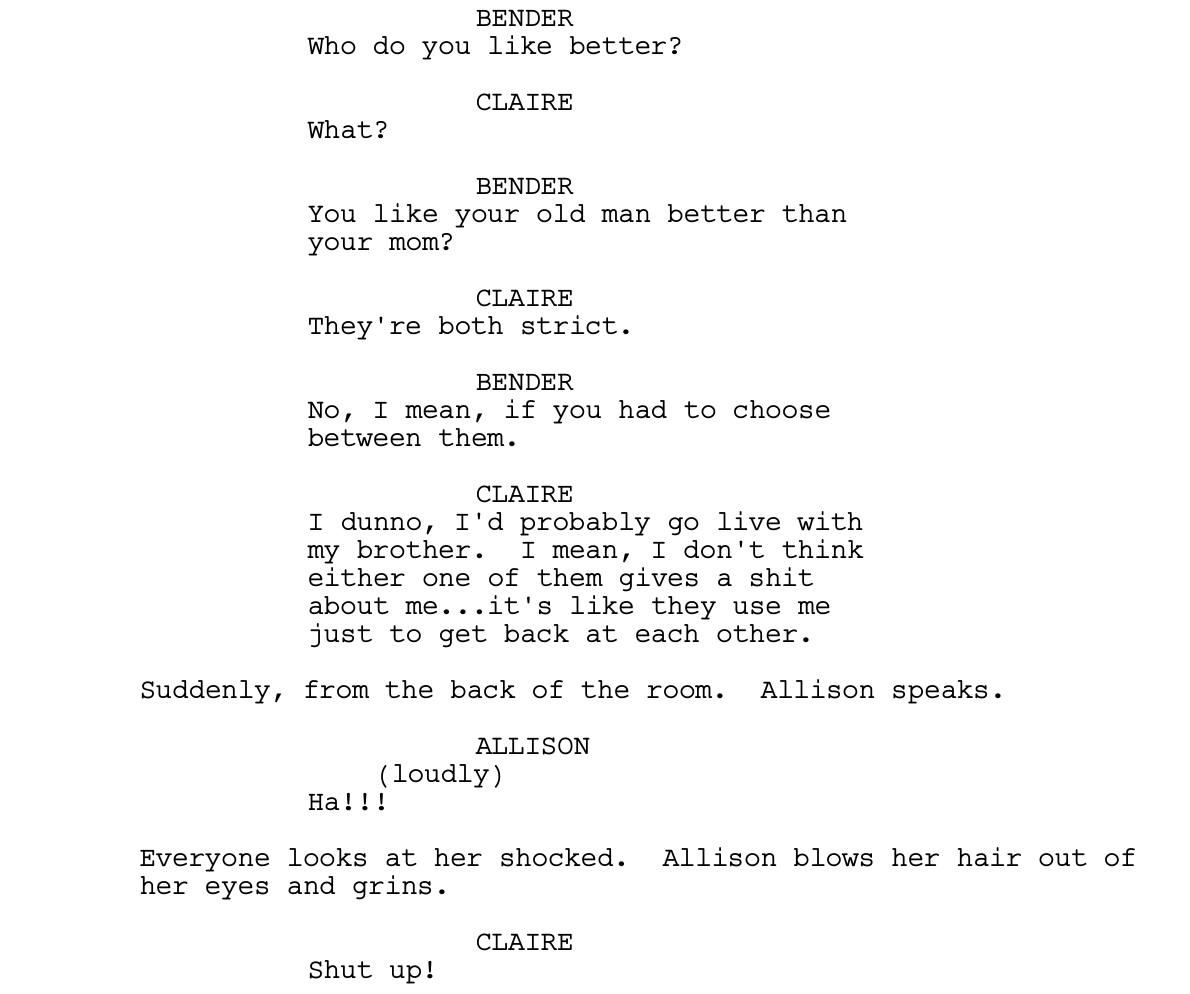
This is the first moment of “telling” in the film. Instead of seeing the fight between Claire’s parents, we hear her talk about it. But this moment is brief, and the vulnerability is buried by Bender’s questions, Allison’s sudden outcry, and Andrew’s “You’re just feeling sorry for yourself.”
Then Bender asks Andrew whether he gets along with his parents, leading to a stand-off between them. Brian chimes in, awkwardly, only to be told that he’s “a parent’s wet dream.”
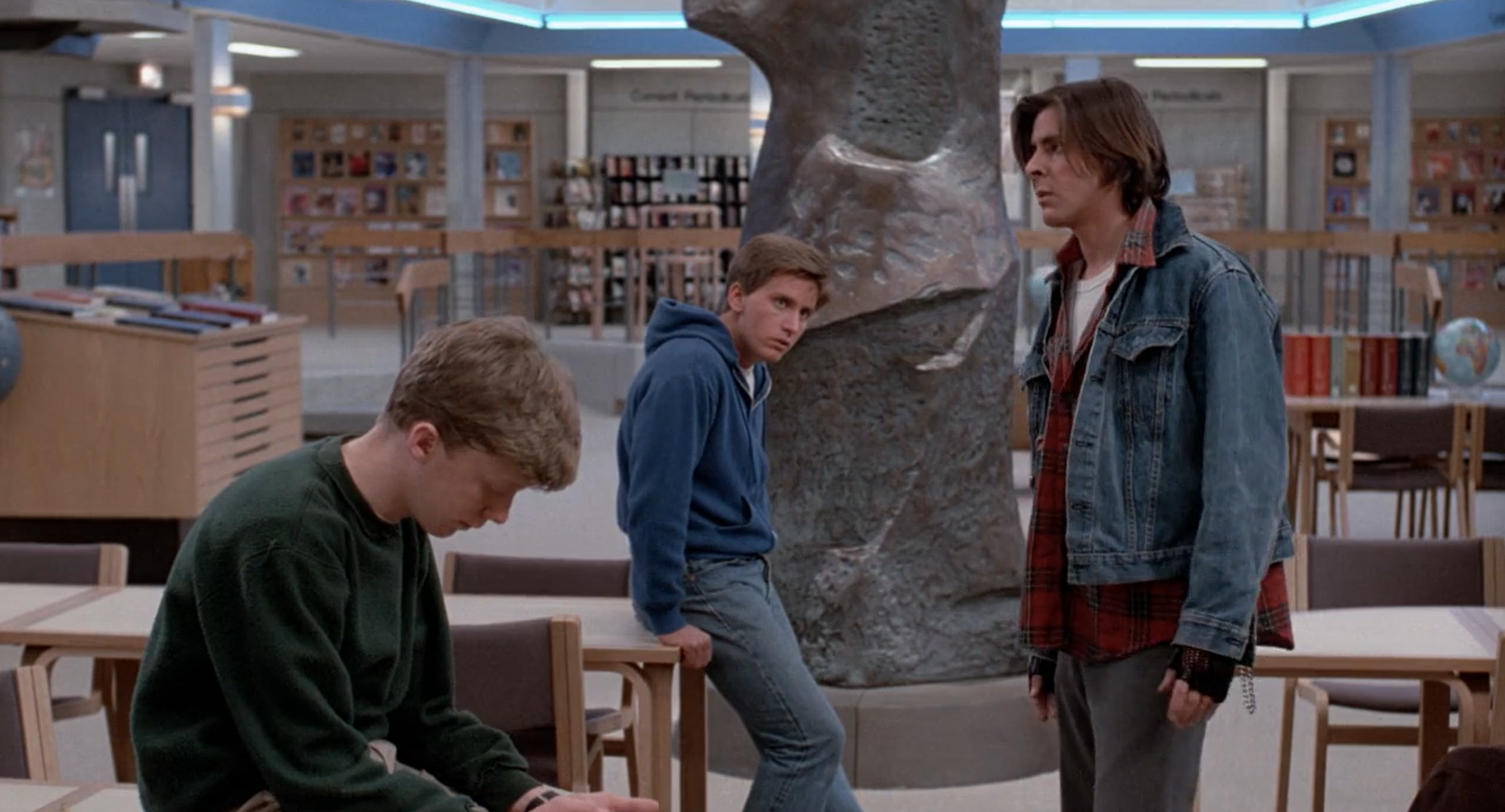
Bender returns to messing with Claire, telling her that she’s going to be fat. Claire gives him the finger, and he begins pressing Claire to tell him whether she’s a virgin. Andrew defends Claire, warning Bender to stay away from her.
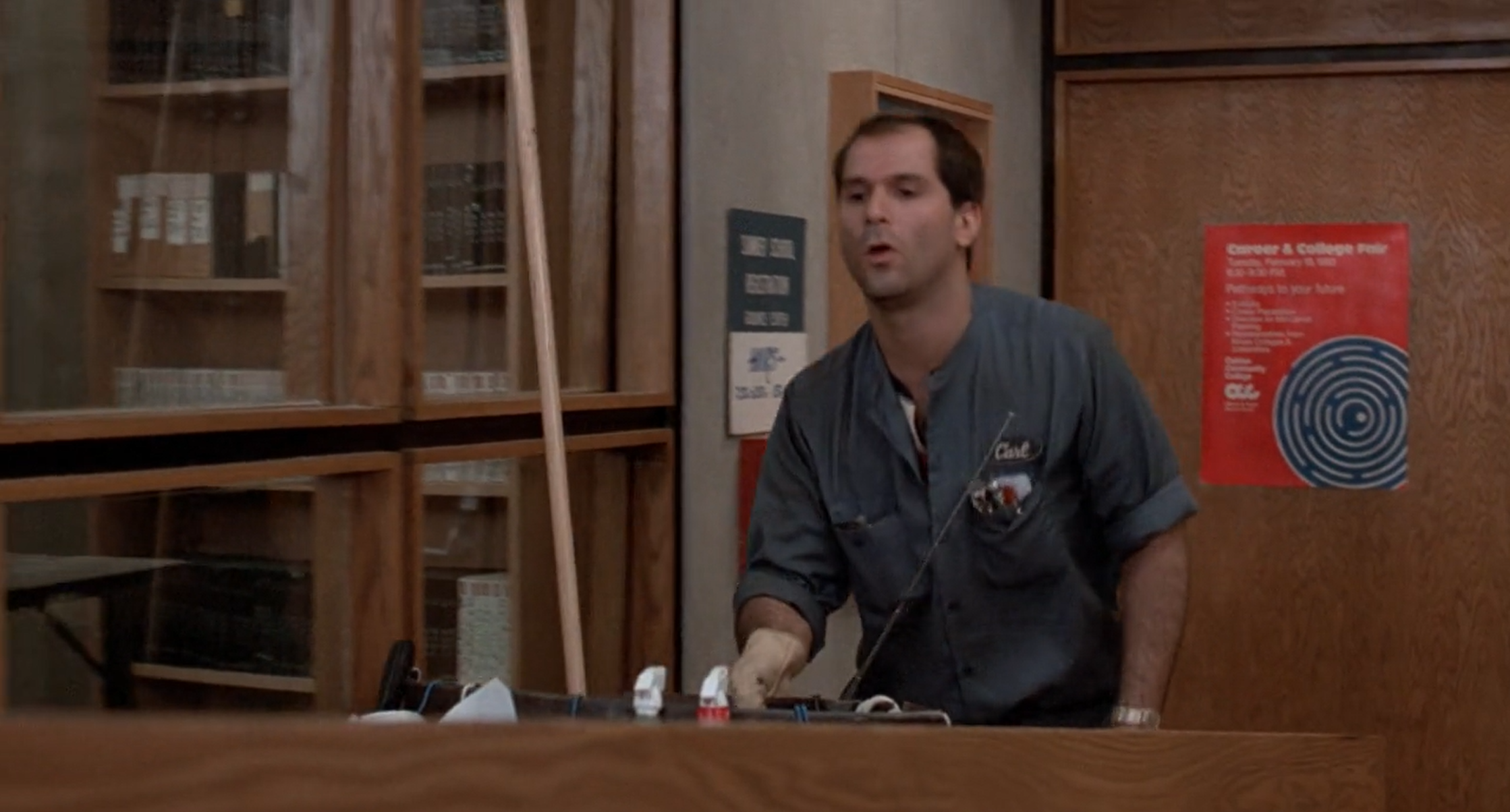
Enter Carl, the school janitor. Bender makes fun of Carl by asking him how to become a janitor, but Carl replies that he knows everyone’s secret in this school.
Fun and Games
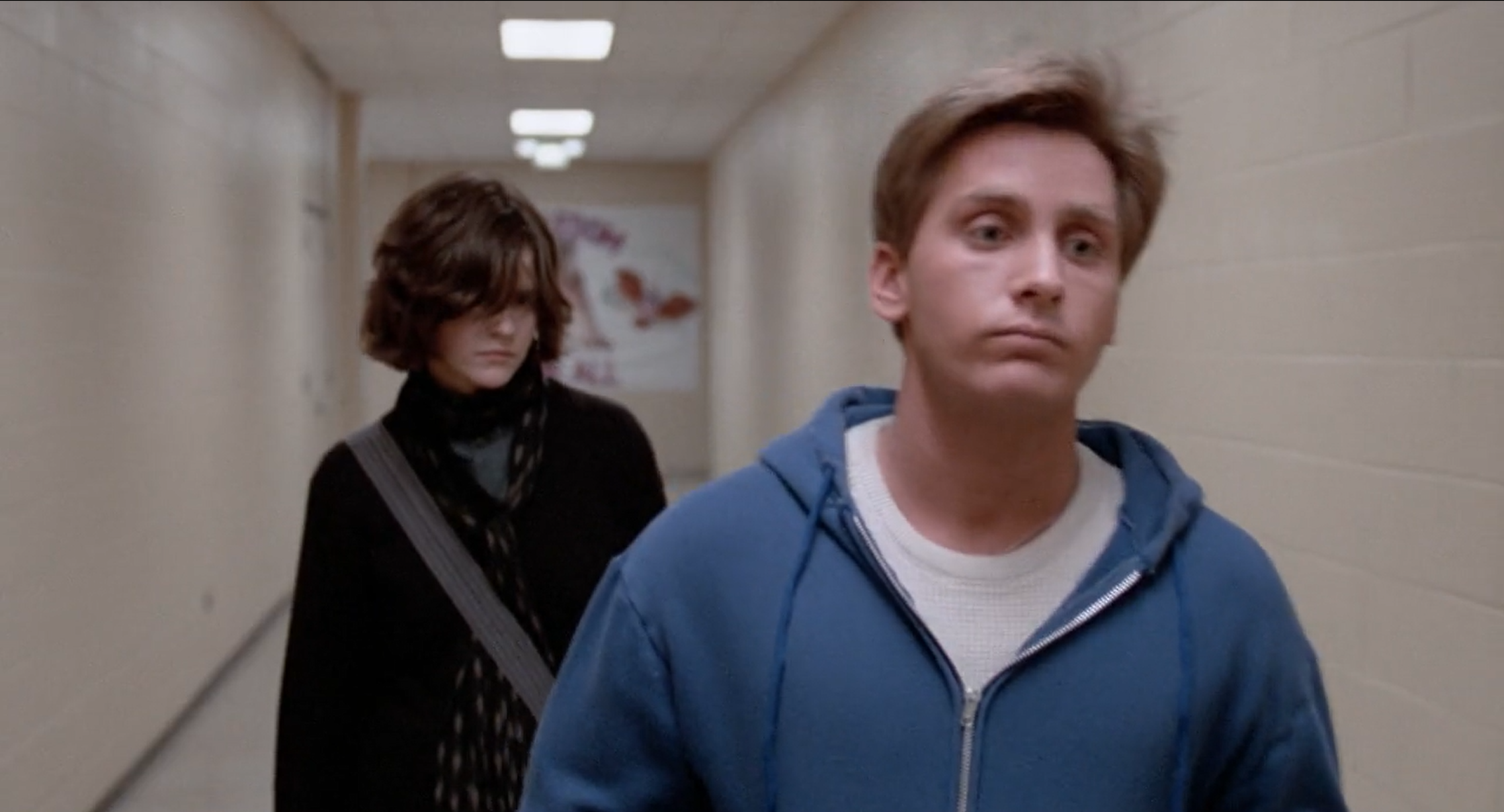
During lunchtime, Vernon picks Andrew and Allison to get everyone drinks. On their trip, Allison tells Andrew that she drinks vodka, and questions Andrew for why he is here. When Andrew tells her he’s there because of his coach and his dad’s high expectations, she says: “Now why don’t you tell me why you’re really in here.”
Back at the library, Bender returns the topic to sex, forcing Brian to admit that he’s a virgin, but Claire says she thinks it’s okay for a guy to be a virgin.
Returning to the library, everyone unpacks their lunches. This is another moment of great “showing” of the characters: Claire eating sushi, Andrew a huge assortment of food, Brian a nutritious package, Allison a sandwich stuffed with cereal and sugar.
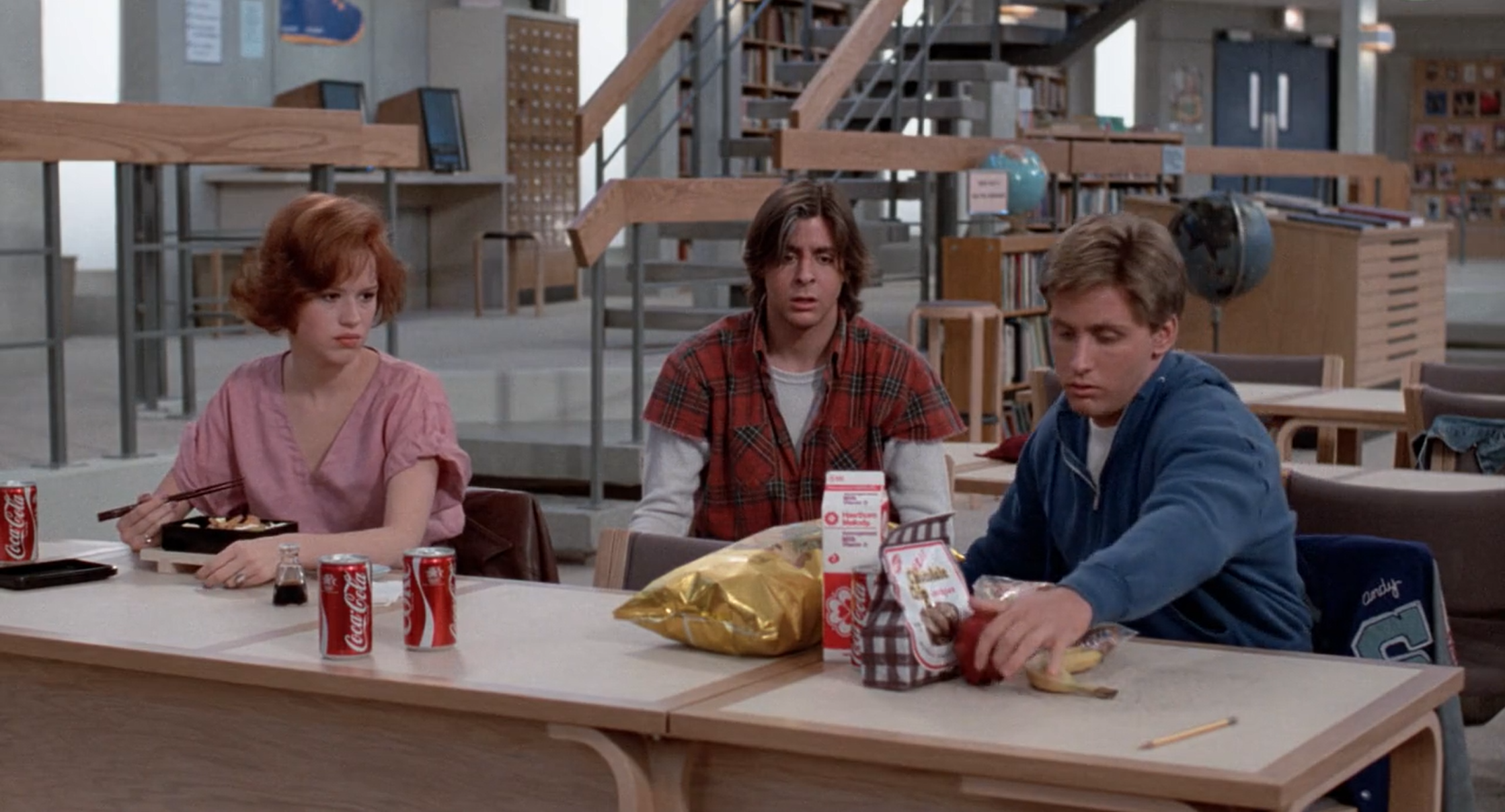
Bender doesn’t have a lunch. When Claire asks him “Where’s yours?” he deflects and says “You’re wearing it.” He mocks everybody else’s lunch, and, when he reaches Brian, mimics what he imagines as an overly sweet scene in Brian’s household. Then, Andrew asks him: “What about your family?”
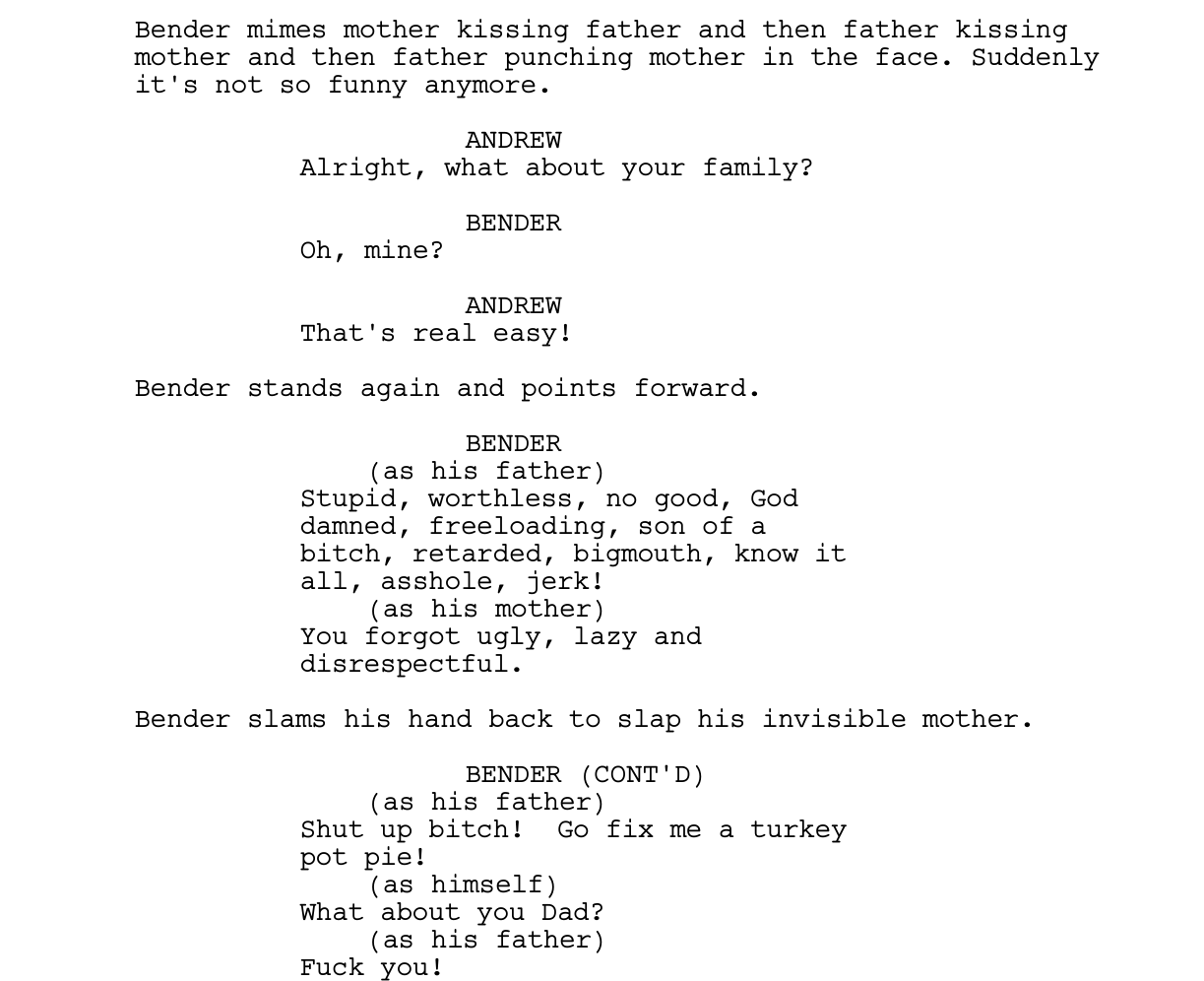
Bender acting out his own abusive, violent household is an incredible mixture of showing and telling. Yet this rare moment of openness is again cut short, when Andrew says “It’s all part of your image, I don’t believe a word of it.”
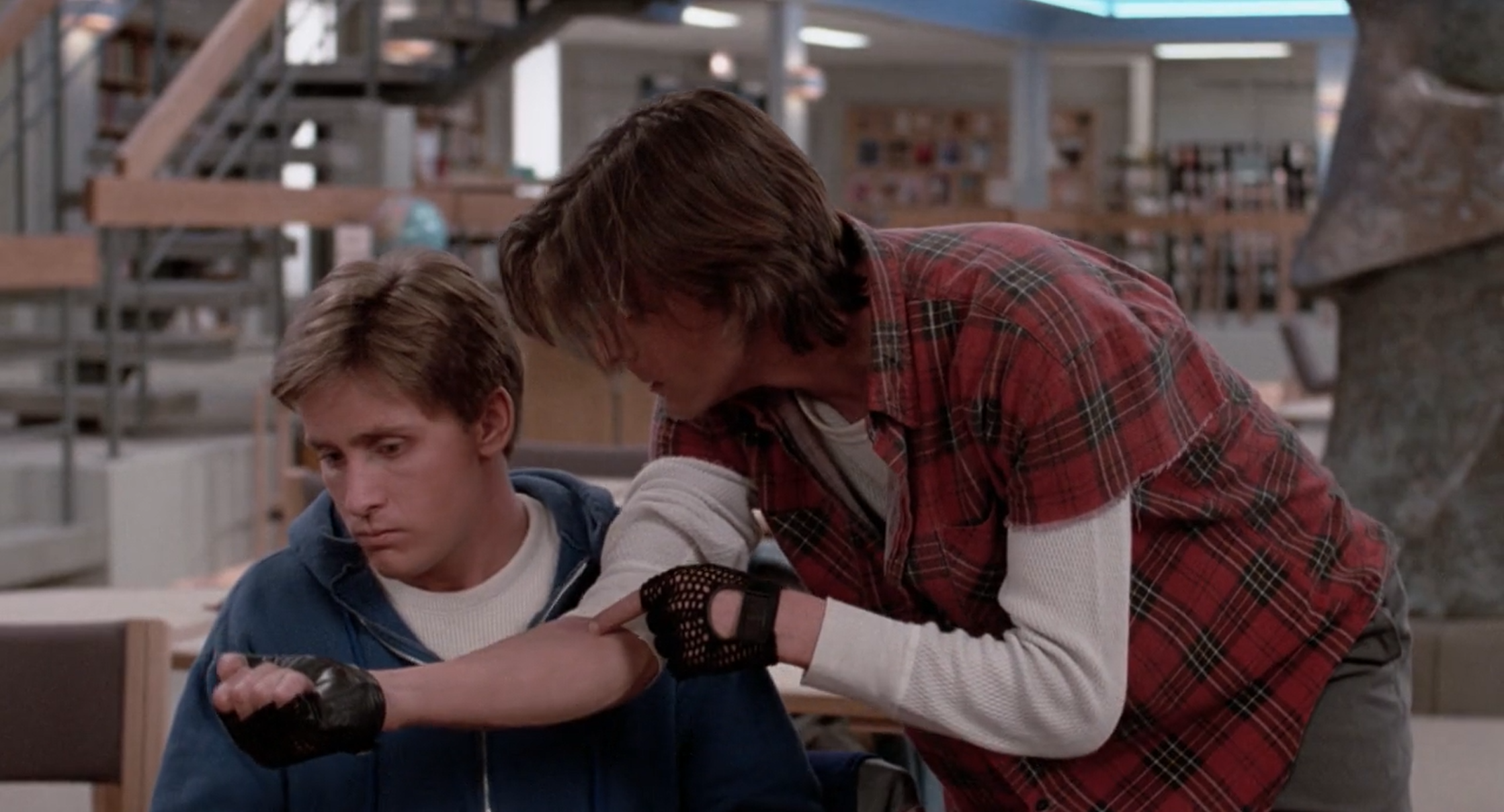
Bender’s vulnerability turns to anger and frustration. He shows Andrew the cigar burn on his arm to prove his story, and storms off.
Midpoint
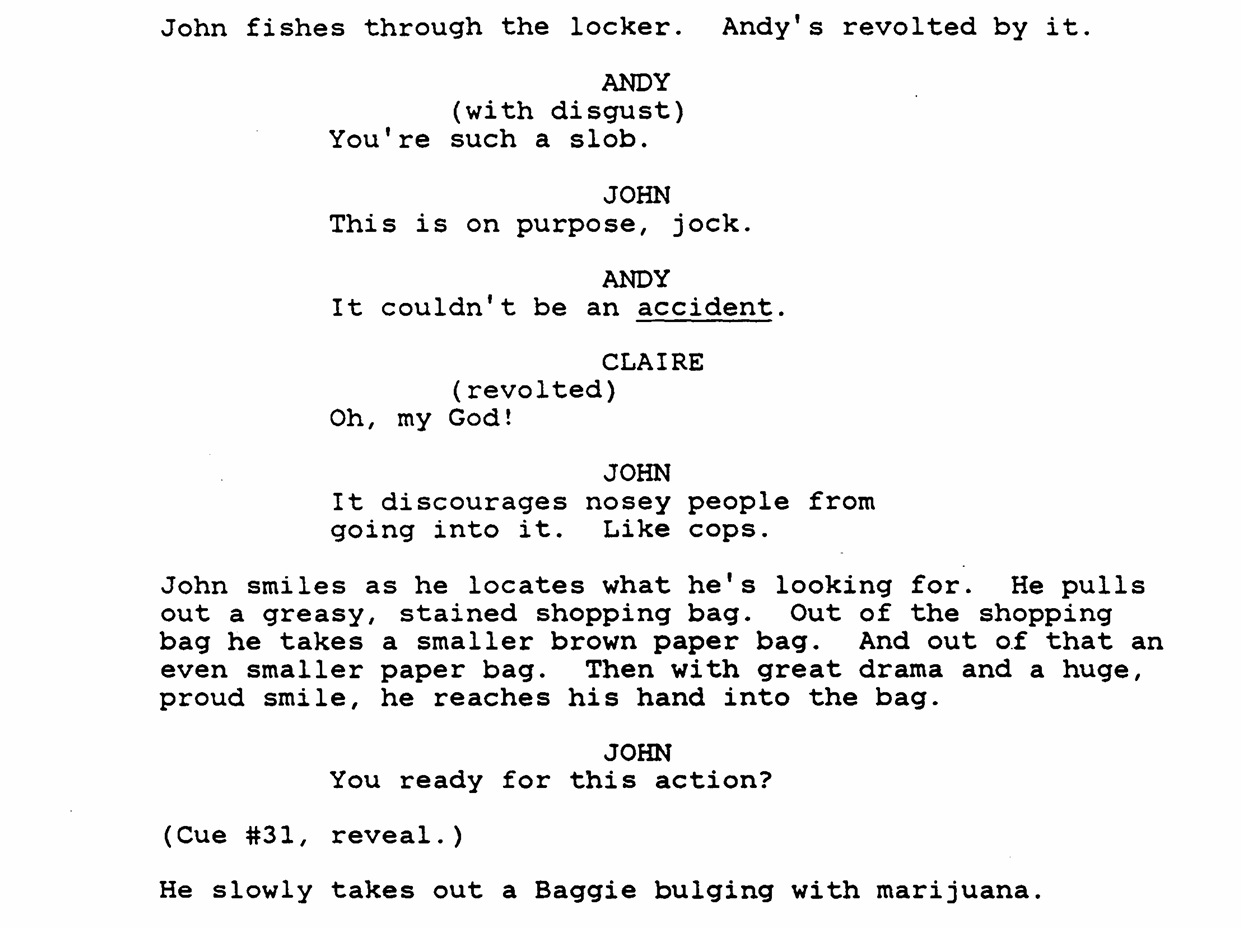
When Vernon leaves his office briefly after spilling his coffee, the kids sneak out to Bender’s locker, where they find a bag of marijuana.
On their way back, the kids keep running into Vernon, and eventually, Bender distracts Vernon by deliberately getting caught, so the rest can return to the library. Vernon locks Bender in a closet, but Bender escapes through the heating duct. When he returns to the library, all other kids hide him from Vernon.
Bender shares his marijuana with the rest. As they get high, the kids let their guards down, and they begin bonding.

Meanwhile, Carl runs into Vernon going through classified files in the basement.
Bad To Worse
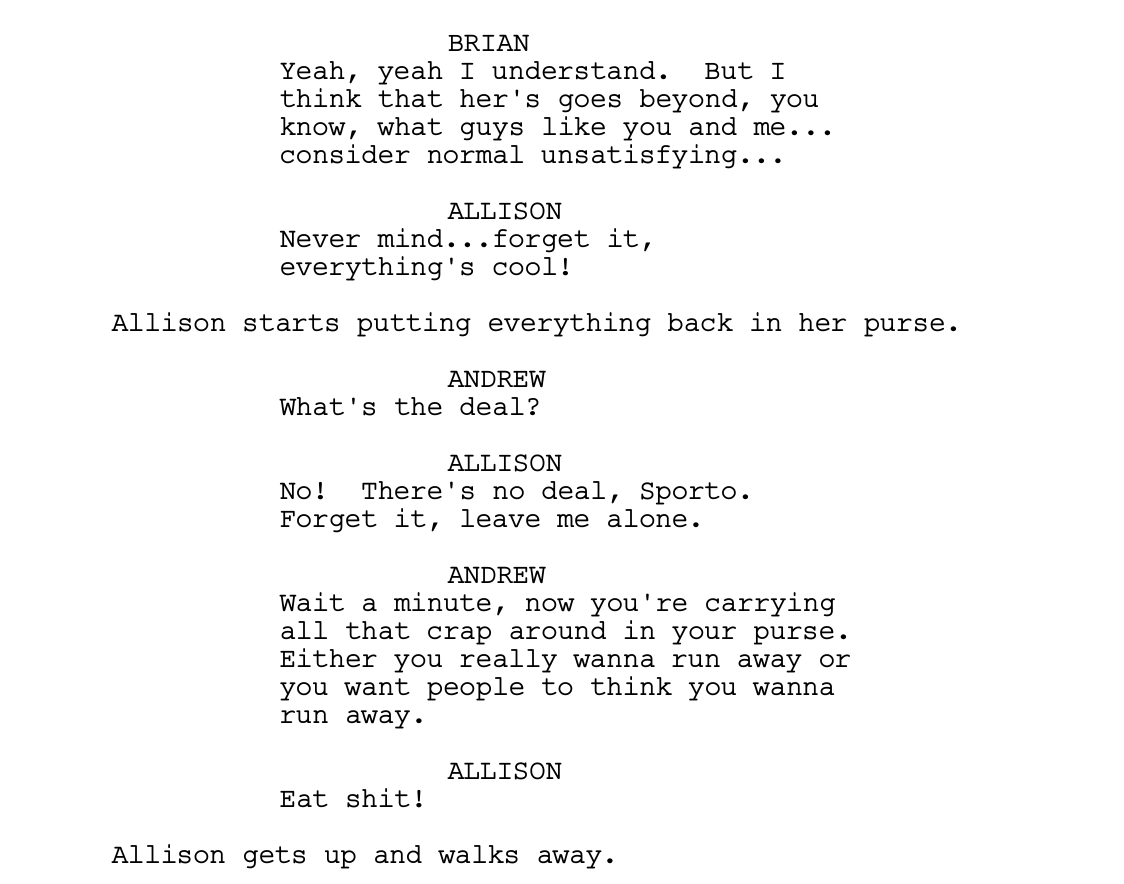
Allison dumps everything in her bag out for Andrew and Brian to see. This is a moment of both “showing” and “telling” for Allison. The contents of her bag – “Traverler’s checks, a birth certificate, socks, a Baggie of underwear, toothbrush and toothpaste, a tiny Teddy bear and a scad of tampons” – constitute the “showing” of her sense of insecurity. The “telling” here is relatively scarce, since Allison talks very little anyway. However, a simple line of “They ignore me” as Allison talks about her parents, is all the telling that we need.
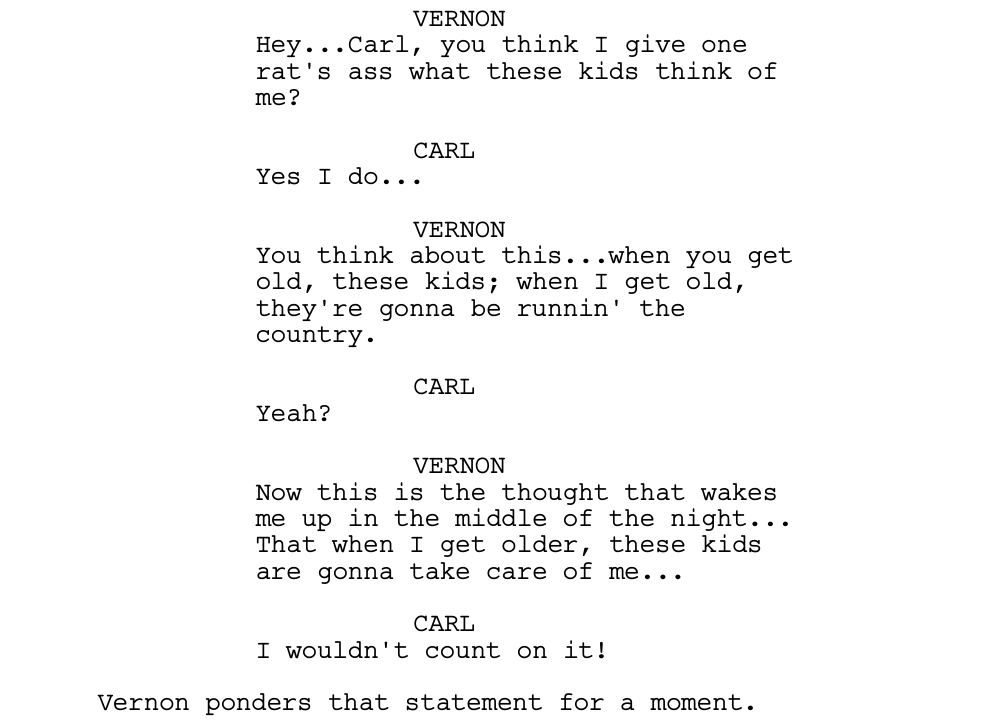
Carl and Vernon, too, have a moment of heart-to-heart. Sitting together in the file room, Vernon talks about how he’s afraid that the highschoolers he’s seeing right now will run the country and take care of him. Carl points out that Vernon cares about what the kids think of him.
Allison lies to the group that she is a nymphomaniac and that she’s slept with her shrink, to push Claire to admit that she’s never had sex before. Allison reveals that she is a compulsive liar.
Break Into Three
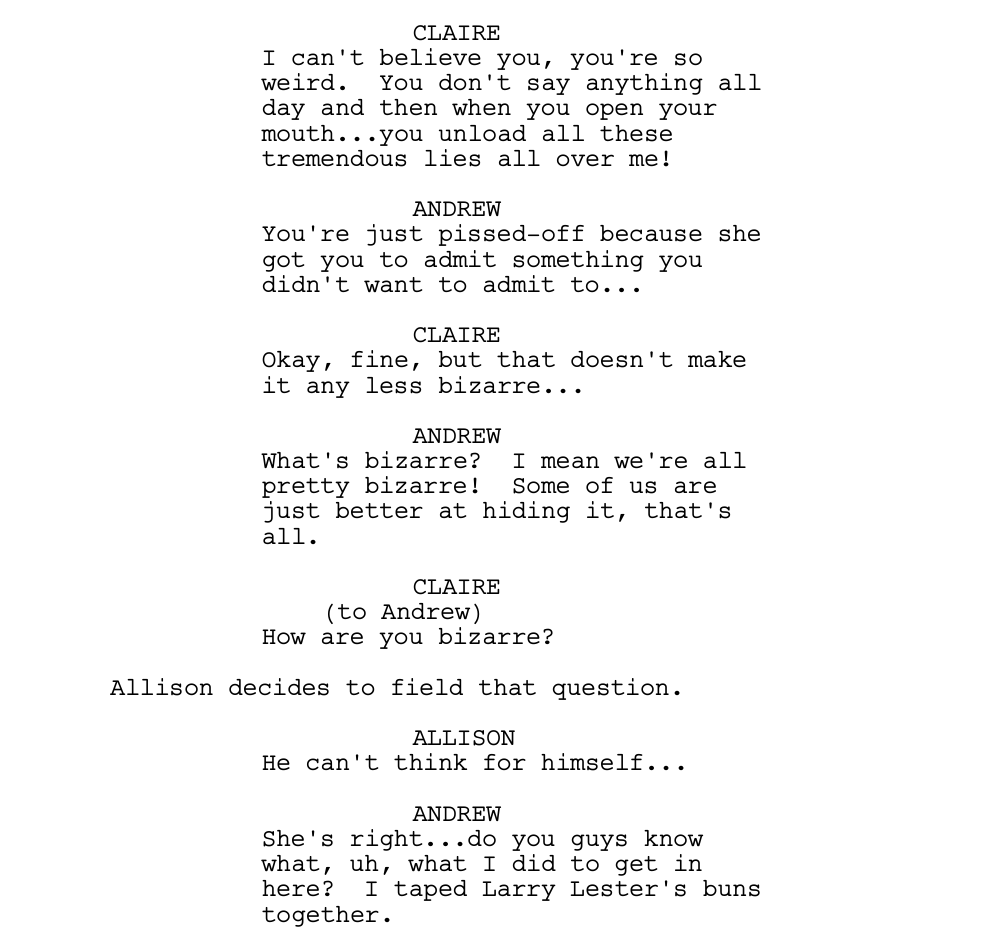
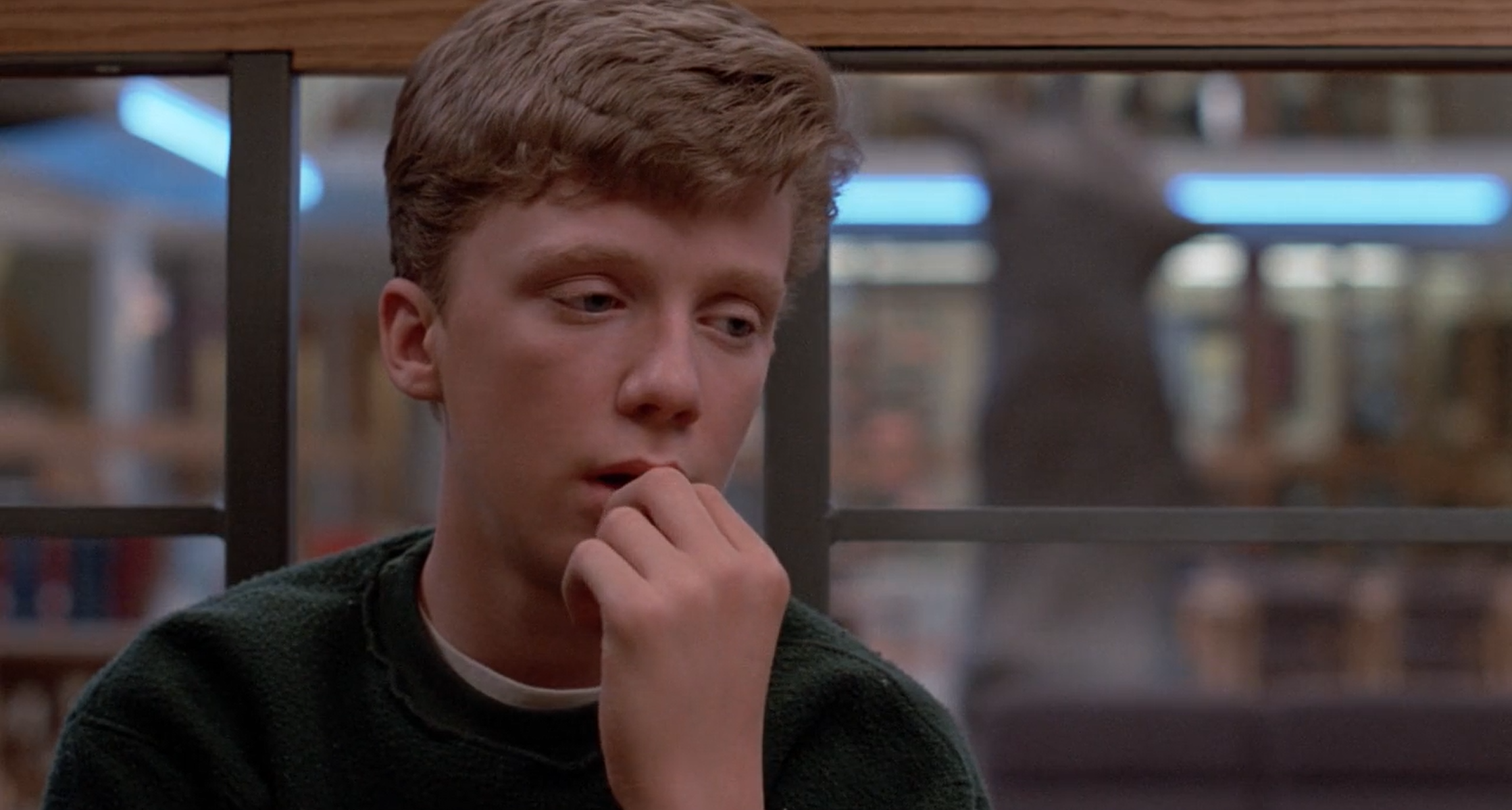
The group begins telling each other how they each got into detention. Andrew, who is the most affected by others’ opinions, and who has so far been the most reserved in sharing about his life, talks in a long monologue about the toxic environment that his father puts him in, where he is never allowed to be weak or lose.
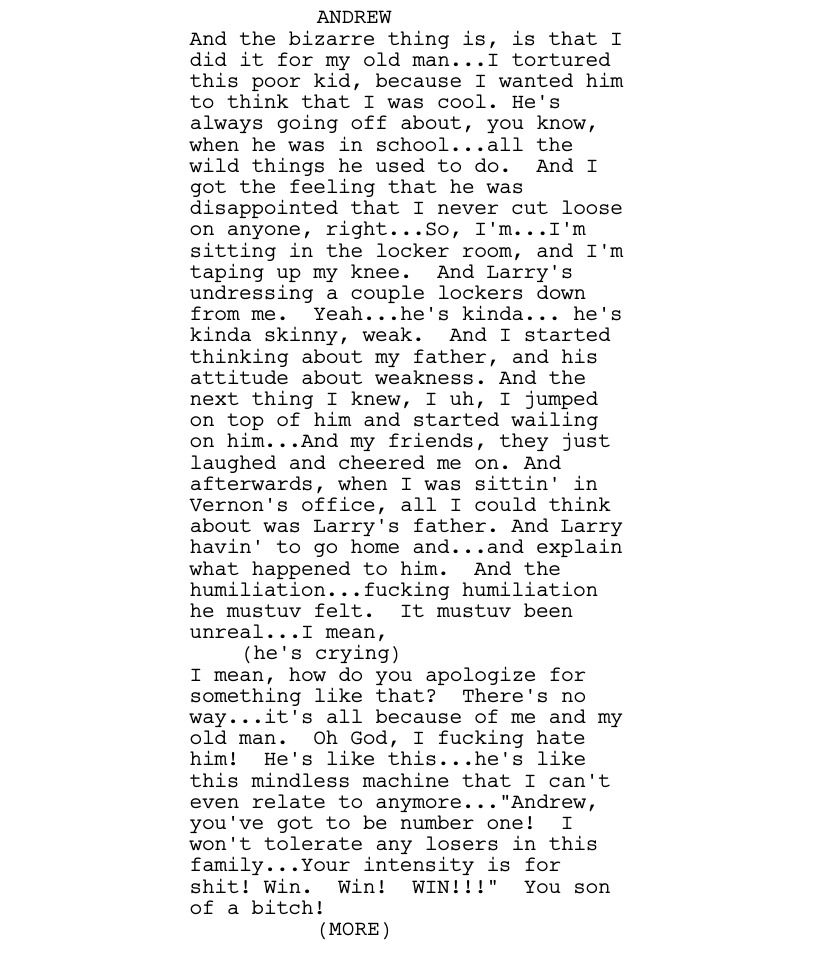
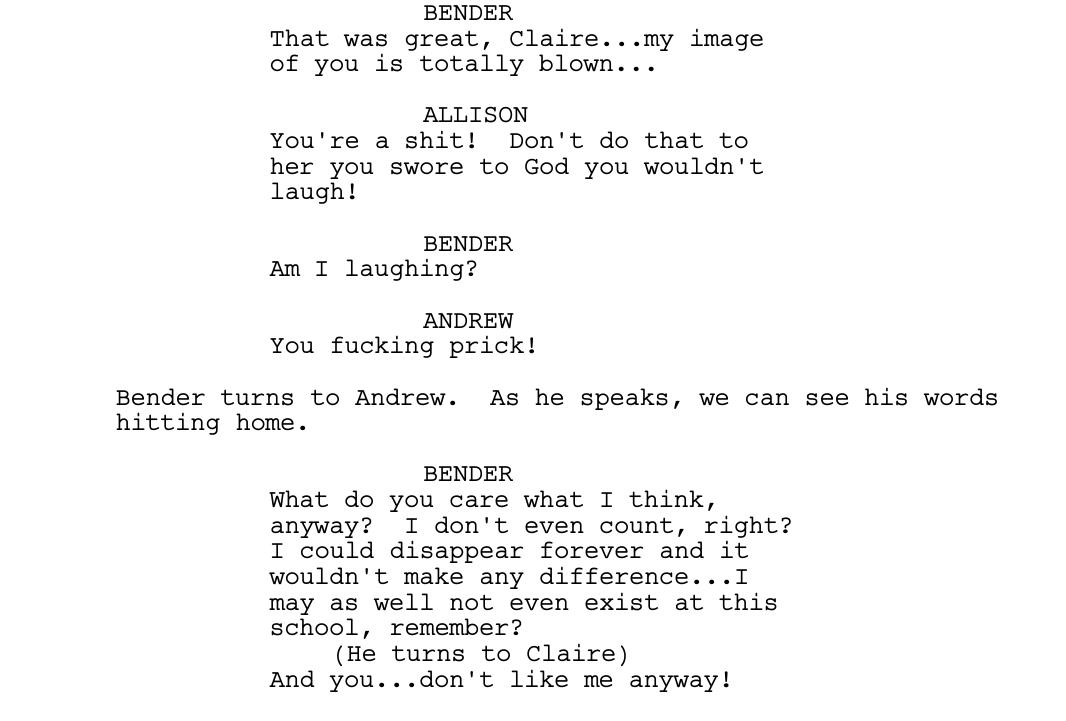
Brian, too, shares about the pressure his parents put on him for getting a good grade. When it is Bender’s turn to be vulnerable, however, he doesn’t go into monologue like the other two. From an audience perspective, we have already learned about Bender’s home life. From Bender’s perspective, he is afraid of putting himself out there, of being vulnerable, so instead he turns on Claire and mocks her life.
When Brian asks the group whether they’ll stay friends on Monday, the truth dawns on them all. They won’t. They are all under so much peer pressure to act a certain way in their friend group that they can never be friends outside this one Saturday.
Finally, Brian burst and tells everyone that he brought a flare gun to school because he wanted to commit suicide. The gun exploded in his locker, and he received detention because of that.
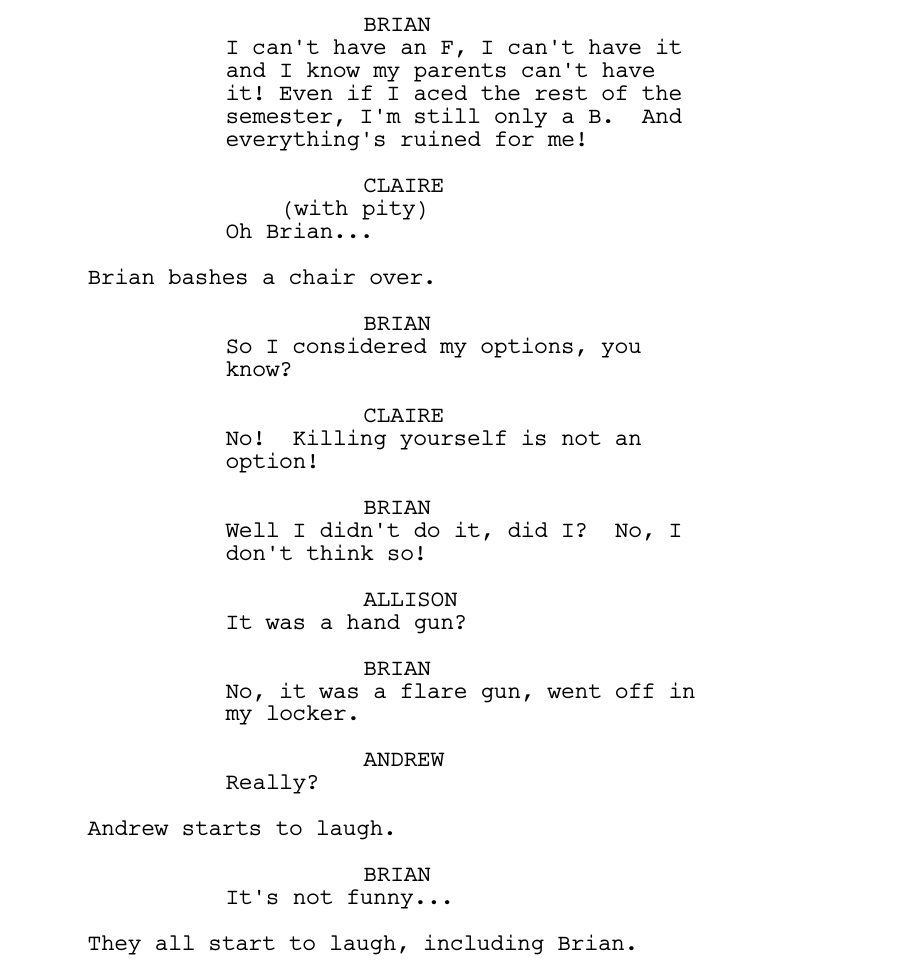
Allison, on the other hand, admits that she didn’t even get detention – she just doesn’t have anything better to do.
Finale
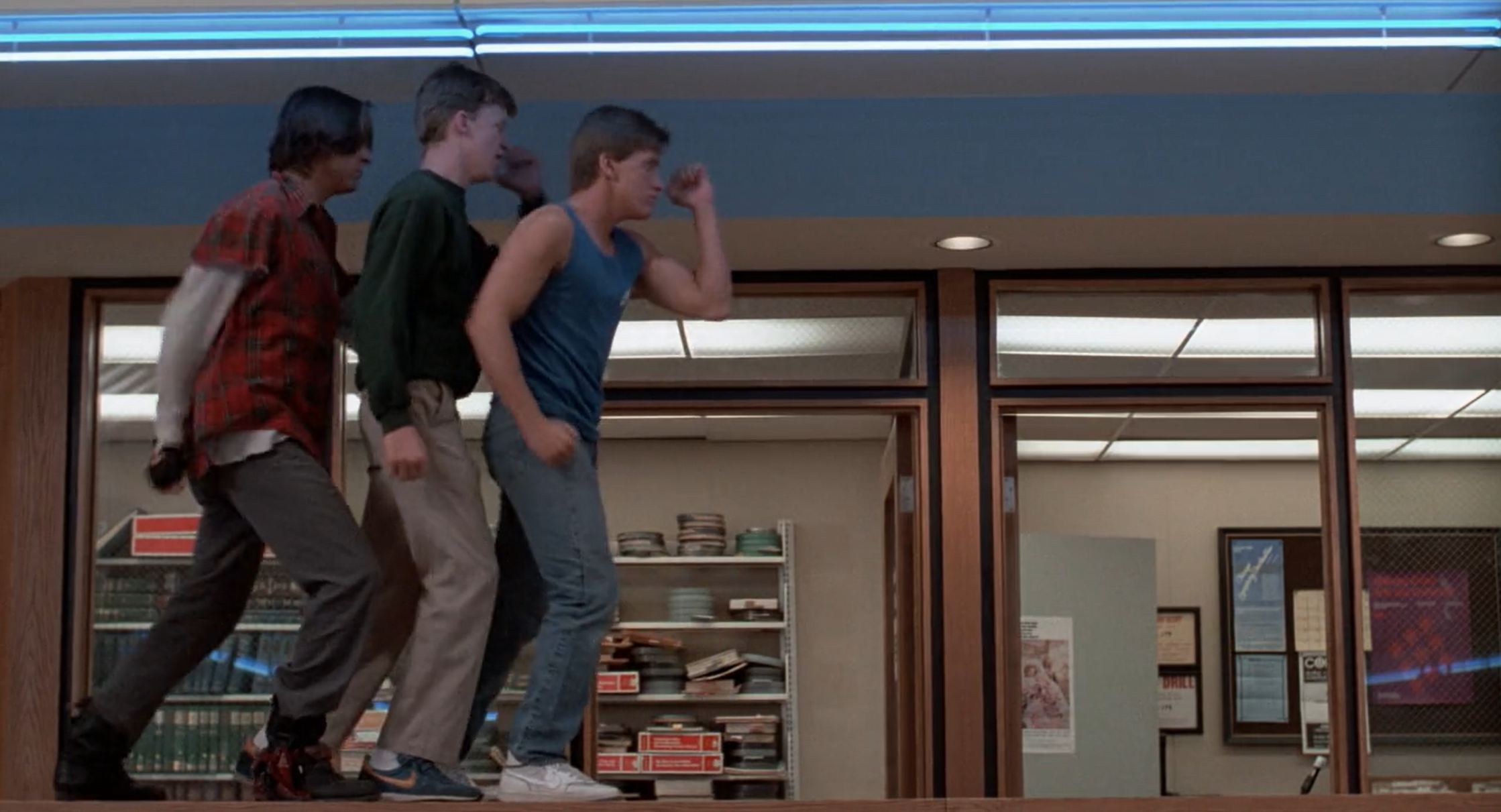
The kids share a last moment of joy and madness before the detention ends. They decide that Brian will write one paper to represent all of them. Meanwhile, Claire gives Allison a make-over, signifying Allison opening up, to let herself accept kindness and love.
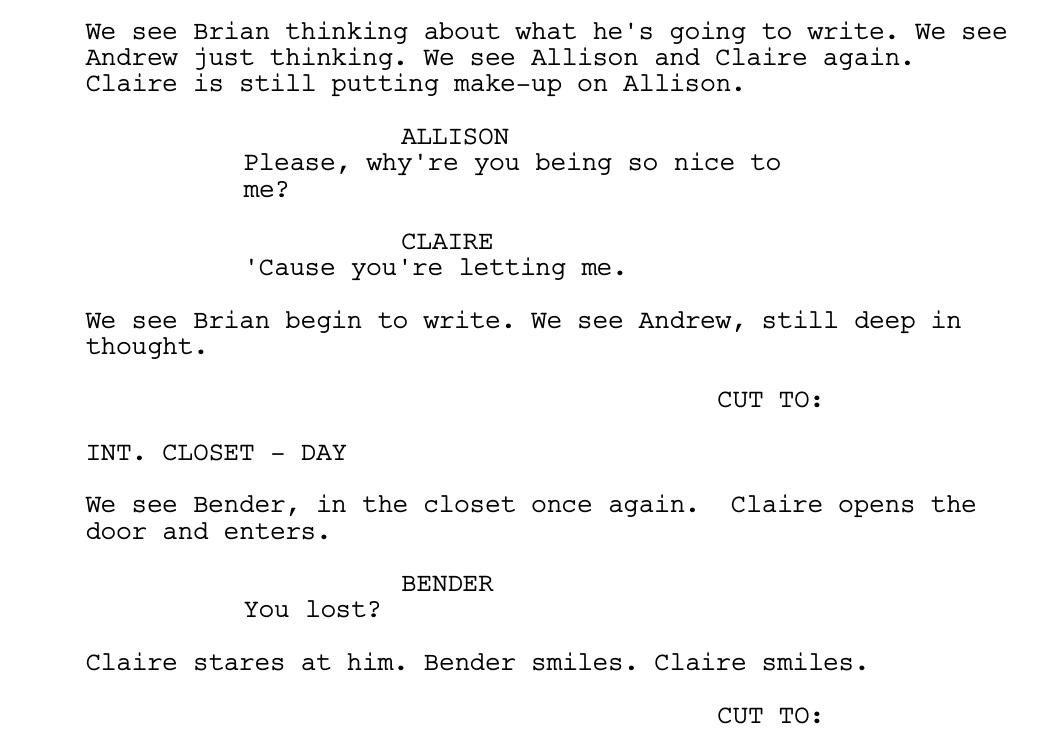
Claire kisses Bender, saying that she knows Bender wouldn’t be the one to do it. Andrew, seeing the post-makeover Allison, says that he can see Allison’s face now that it is no longer hidden behind her hair. They share a kiss as well.
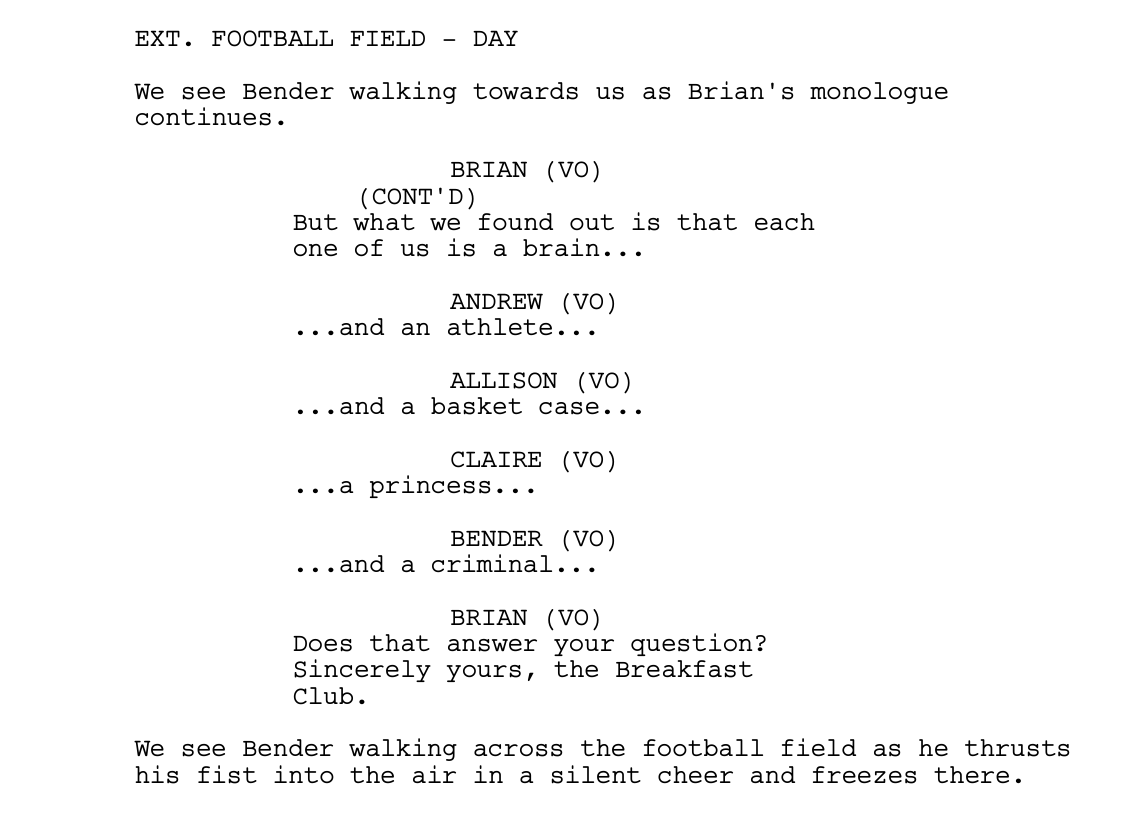
As the kids depart school, we listen to Brian’s voice, once more, reading their joined essay.