
Character Arcs: Mapping Change from Page One to Fade Out
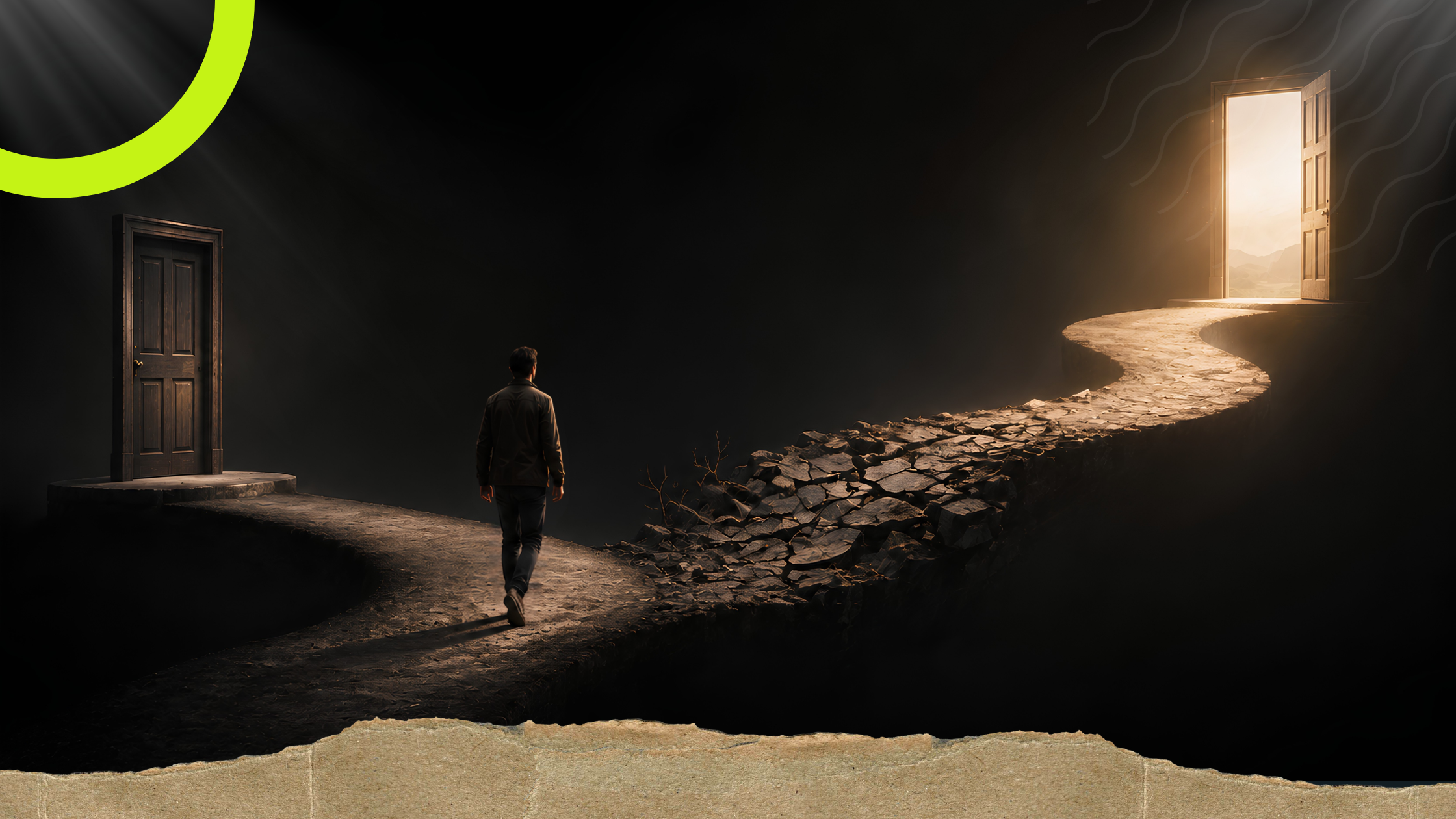
The greatest tool for overcoming the Blank Page is a fully structured outline, and the greatest tool for any outline is mapping a character arc from page one to fade out. The main character that seems crystal clear in a writer’s brain can get bogged down on the page if the outline centers mostly on plot. A writer can correctly label their protagonist's arc as "positive" and still have it fail on the page because nothing marks the change.
Reorienting the outline with the character's arcat the center will help lay the foundation for a stronger, intentional plot where the character’s arc is not just a personality trait sprinkled on top. The arc is the story–it’s why the audience cares what happens to the characters. It is a measurable position that shifts, scene-by-scene, in relation to a fixed structural spine.
The important question to be asking is, “Where on the page is the change actually occurring?” Creating the opening image, the midpoint, the low point, and the final image for your character will be the foundation for the rest of the story to build off of. Let’s dissect character arc examples about each of these checkpoints to better understand how to write a character arc.
The Opening Image
The characters we see on screen have lived their lives before the story starts. We’re just dropping into the middle of a very interesting section of it. As such, the opening image functions as a baseline for the character, not just an introduction. The character’s very first scene establishes the “before” state (a belief, a defense mechanism, a lie they tell themselves) so that later change has something concrete to depart from.
The conflict that follows, and the change forced by that conflict are hinted at by seeing the before state of the character. Something that as of now they’ve been able to live with, but soon an ultimatum will force the character to make a decision that will change their behavior (or suffer consequence if they fail to overcome their flaw).
In The Holdovers (2023), written by David Hemingson, on page 2, and just after the title sequence in the film, we meet Paul Hunham in his natural habitat–fiercely judging the student assignments he’s grading, ridiculing their mediocrity while doing so. A knock on the door draws his gaze and reveals his lazy eye. A colleague stops by with Christmas cookies and offers him a plate full. Paul just takes the plate, merely nods, and closes the door.
It’s a small scene, but it establishes Paul’s world at the start of the story–his abrasiveness and arrogance are on full display, he is inconsiderate to the nice gesture his colleague did for him, and it also clarified that the setting is Christmastime and it’s at a fancy prep school. If the opening image wasn’t sufficient enough, The Headmaster directly states that Paul is hidebound (someone who is traditional and resistant to change” on page seven. The rest of the film then proceeds to poke and prod at Paul to challenge that hidebound presumption. In the climax of the film, on page 101, Paul selflessly shields a student from unjust consequences, names himself as the culprit, and is fired as a result. Decades of hidebound behavior, undone in 99 pages.
The Midpoint
Many stories are daunted by the immensity of the second act. Bisecting it with a structural shift to the character’s world atthe midpoint alleviates stagnation and forces the characters to reckon an altered reality. The false collapse and false victory are two types of midpoints that can be seen in negative arcs and positive arcs, respectively. The false victory would be the highpoint of the character’s flaw being rewarded before it comes crashing down. The false collapse is when the character’s goal is complicated by a seismic story shift. The character’s relationship to their goal and their flaw have to visibly bend at the midpoint; it can’t just be another plot complication that the character overcomes without it affecting the character’s behavioral choices.
Peter Quill is a charming, selfish rogue looking to make a name for himself as Star Lord in Guardians of the Galaxy (2014), written by Nicole Perlman and James Gunn. At the 60 minute mark of the 2 hours and 3 minute film, one of the Guardians, Drax, reveals the team’s location to the villain, Ronan and the encounter does not go the way Drax intended it to. By the 67 minute mark, Drax is defeated, the macguffin is lost to the enemy, another member of his makeshift motley crew, Gamora, is freezing to death in space. He can leave her to die, or try to save her.
The scene preceding this one, at the 57 minute mark, is an exposition dump about the macguffin, The Power Stone. Gamora resolves to bring the stone back to the Nova Corps who will safeguard it. Quill prefers,in lieu of giving the stone to a faction that wants to arrest him, to sell for some nice compensation. The stone has the power to destroy civilizations and Quill is thinking only of himself. In the very next scene, that selfishness is put to the test. He decides to try to save Gamora, and put his helmet on her in open space, risking his own life in the process. When presented with an abstract future potential consequence of a civilization dying, Quill is cavalier, aloof, and only thinking of himself while the very next scene puts that abstract consequence into an immediate threat. And when push came to shove, Quill chose to save another instead of himself.
The Low Point
As a character encounters conflict throughout the first two acts of the story, they’re able to make it through by bending their flaw and their behavior, but the low point is the structural moment where the character’s defense mechanism or other type of flaw stop working, again forcing a real choice rather than another plot complication.
The Low Point is the last place where the old belief or behavior can survive. In Curry Barker’s Obsession (2026), the protagonist, Bear, has a negative character arc. He is obsessed with his crush Nikki and can’t accept her not wanting him. He accidentally puts a possession spell on Nikki to force her to love him. Throughout the film, he keeps denying his actions of taking away her agency and forcing her affection despite her increasingly dangerous and erratic behavior to fulfill the spell's impossible mandate.
The point of no return is on page 85, when Nikki kills their friend Sarah out of jealousy in front of Bear. Just the scene before, on page 81 the real Nikki snatches a piece of autonomy as the possessed entity is sleeping and asks Bear to kill her. He refuses, asking her why it’s so bad to be with him–completely denying the reality of the situation that he has caused and continues to exploit. Only after someone has been killed does he try to lift the possession spell.
The Final Image
A reflection of, and the answer to, the opening image. The strongest arcs can be eligible just from a side-by-side comparison of the first and last scene. That mirroring is the structural spine of the film, not just a poetic flourish. In the last scene of The Holdovers, we see Paul driving away from the school carefree after he was fired. Contrast this with the opening image of him taking satisfaction from ripping his students assignments to shreds in his confined office.
In The Social Network (2010), written by Aaron Sorkin, the final image shows the protagonist, Mark–despite being infinitely wealthy and incredibly powerful-is right where he was at the beginning of the film–alone because he’s a selfish prick. Mark has a flat character arc–he doesn’t change. Flat character arcs still ascribe to the mapping method, the checkpoints of the arc just track the world and supporting cast around a fixed protagonist. In the first scene, on page one, Mark is on a date with Erica where his combative narcissism prompts Erica to break up with him. In the final image, on page 162, Mark sends Erica a friend request on Facebook and keeps refreshing the page to see if she accepts. As he keeps refreshing, titles appear on screen revealing the outcomes of the lawsuits of the multiple people he screwed over, including his friend and co-founder of Facebook, Eduardo Saverin. It ends on the title saying that Facebook has 500 million members, and Mark is the youngest billionaire in the world. But he’s just sitting alone, in a deposition room, refreshing the page over and over, alone. His character arc is flat, his all-encompassing ambition and ego isolate him and there’s no redemption for his character.
WHAT ARC-MAPPING IS NOT (COMMON MISDIAGNOSES)
Confusing incidence with change — a character surviving a plot event isn't the same as the character's belief or behavior shifting. The plot serves as a series of opportunities for the character’s resolve to be tested and for change to occur, the plot itself is not the arc.
Confusing a stated flaw with a tracked flaw — naming a flaw once in the setup ("he's afraid of commitment") doesn't count as mapping unless the piece can point to at least one scene where that flaw visibly costs the character something.
Treating the arc as complete because the plot resolved — plot resolution and character change can land at different points, or not at all (see the flat-arc example). A satisfying ending is often tied to a completed arc, but they are not one-to-one circles. Do not confuse them as interchangeable.
While the plot can enrapture attention, it is the character moments that linger in the mind, creating resonance with the audience. Mapping character arcs is an essential tool for constructing the spine of your story, understanding the character’s motivations clarifies the story’sthemes. If you’re stuck, think about how the contradictions within a character can be exploited for conflict. We all have contradictions.The character’s flaws and goals create dissonance with each other. Mold the plot points around those contradictions to exploit them.
If you’re analysing a script or not satisfied with the arc of your own, ask yourself where exactly is the change occurring on the page and identify it (or its absence).
Can you name, at the minimum, these plot beats of your character’s arcs?
The Opening Image–where the character starts and their belief/flaw is evident.
The Midpoint–where the arc is tested, and is forced to bend.
The Low Point–where it breaks and is forced to change.
The Final Image–where the arc lands, mirroring the Opening Image
For a detailed discussion about a missing internal arc and prescribing a fix, listen to Kinolime Fix It.