The Social Network (2010), the winner of Best Adapted Screenplay at the Oscars, is a fast-paced drama about the founding of Facebook. With witty dialogues and exciting character dynamics, the film animates its audience and remains deeply resonant even to this day. With the recent release of its sequel’s trailer, I would like to return to the original and talk about everything Aaron Sorkin did right in the screenplay that contributed to the success of this film.
In particular, I would like to focus on The Social Network’s use of unreliable narrators (the act of narrators omitting or tweaking with the facts). It is a technique that is more common in novels than movies, since films tend to be strictly third-person, which makes it harder to fool the audience into believing just one side of the story. However, The Social Network not only pulls off having a range of unreliable narrators, but uses this trick to bring the film’s themes to a deeper level.
Opening Image
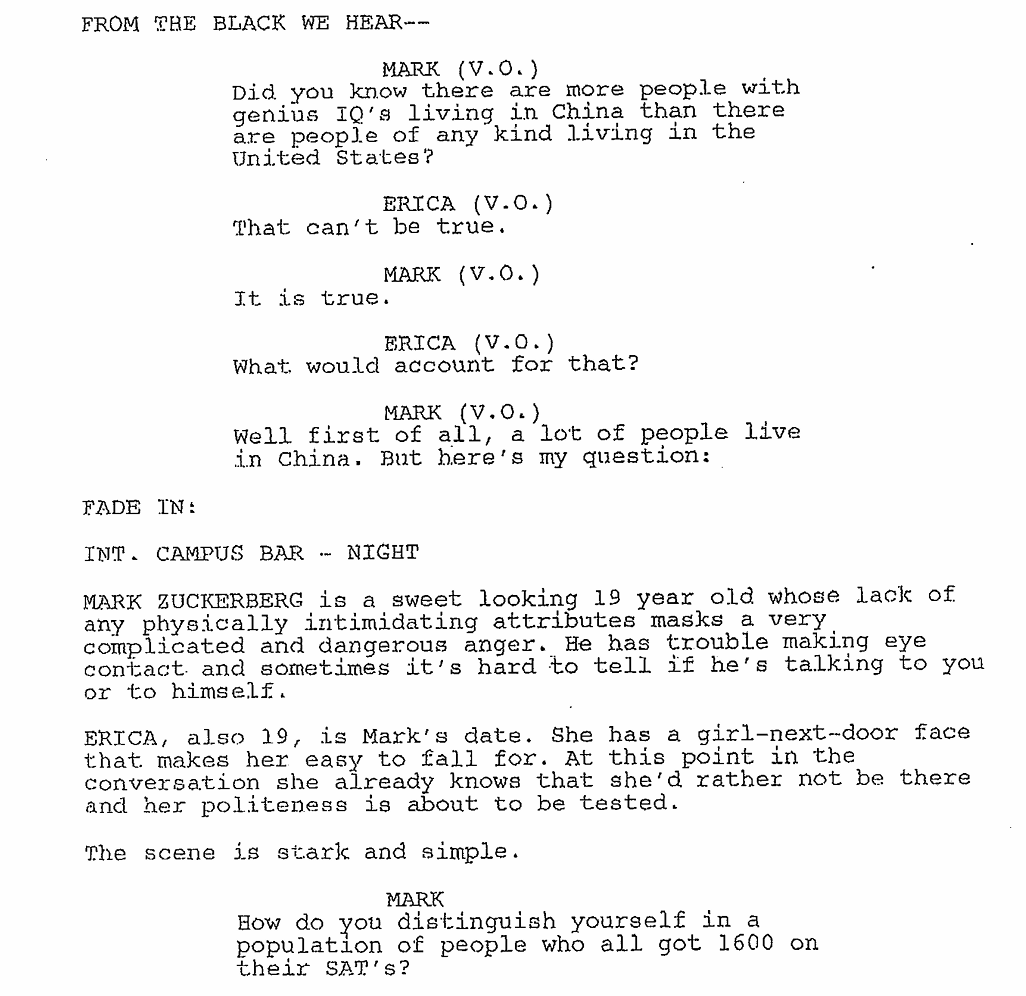
The Social Network is a 161-page screenplay that turned into a 120-minute film, an unusual subversion of the one-page-equals-one-minute rule in screenwriting. One of the biggest reasons behind it is Mark Zuckerberg’s tendency of speaking in fast-paced dialogues that no one can follow. And it is with such dialogues that the film opens: in fall 2003, with Mark, 19 years old, on a date with his girlfriend Erica.
Set Up
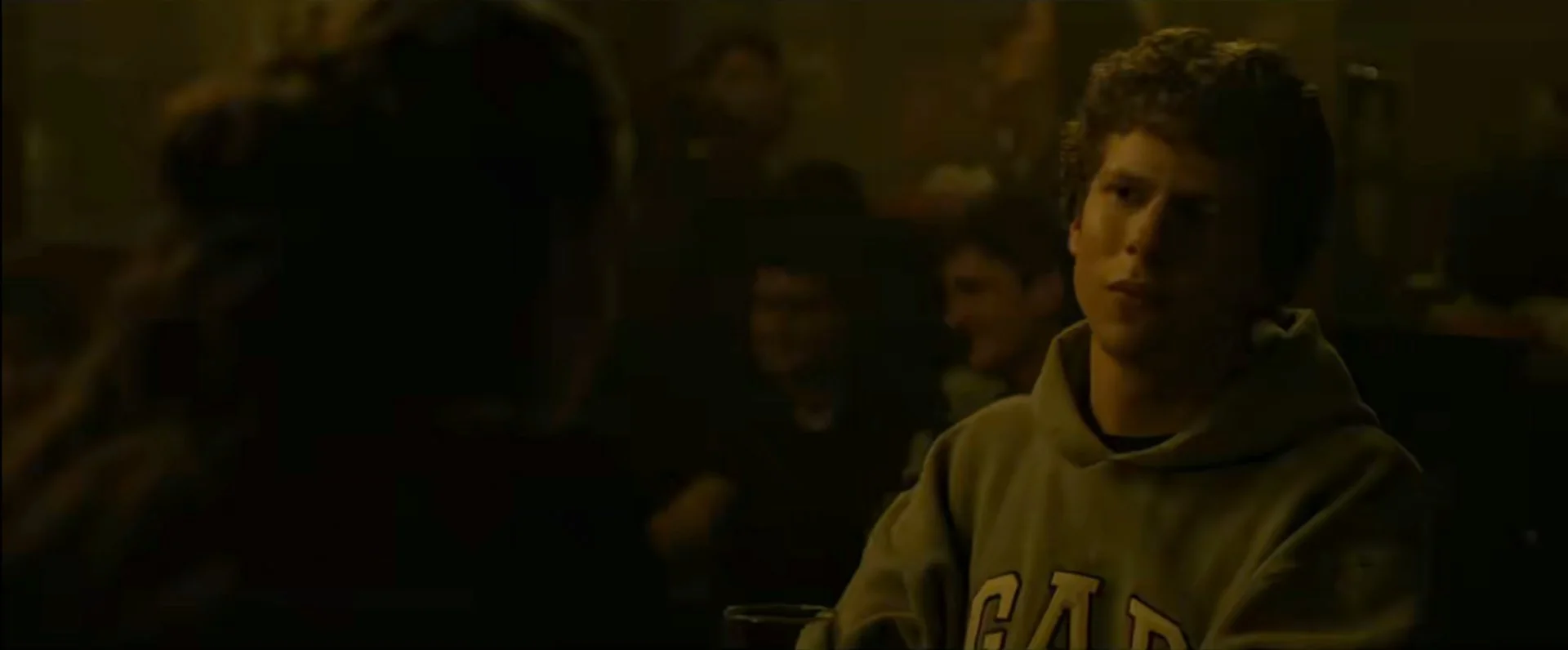
Erica mentions casually that she likes “guys who row crew,” and Mark takes a beat for the first time in their conversation. This pause both foreshadows his relationship with the Winklevoss brothers, who do row crew, and his sense of insecurity when he compares himself against other men who are hotter than him and better at getting girls.
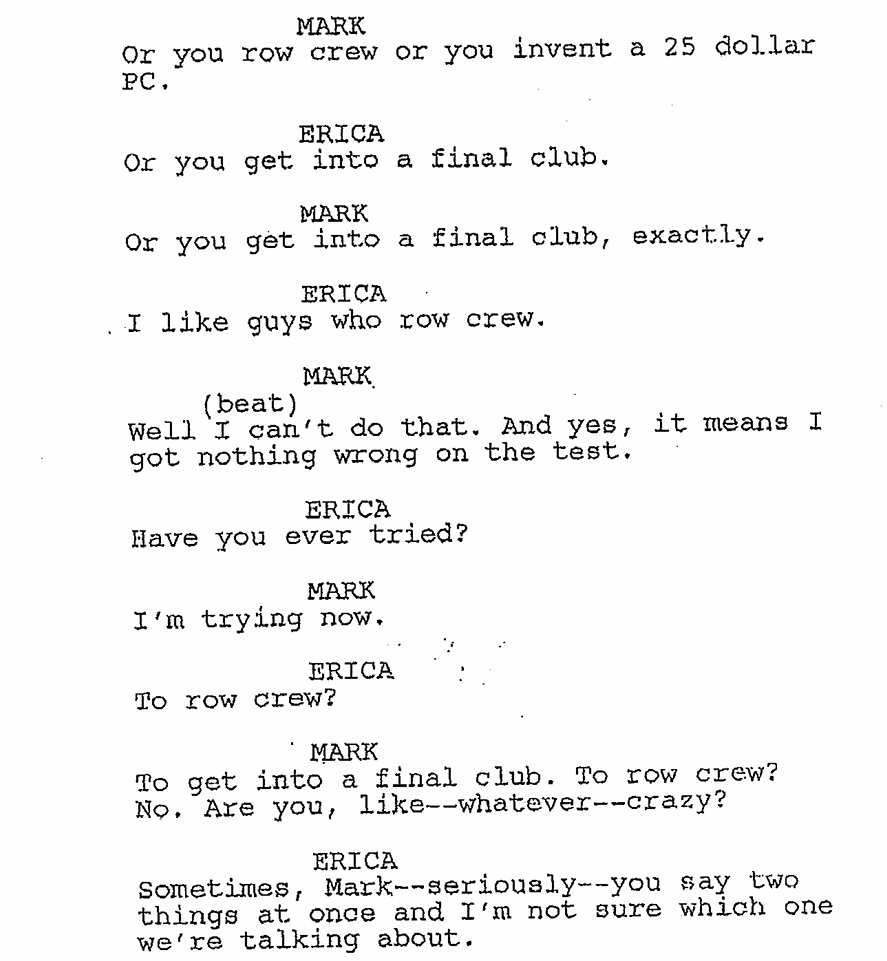
Their date turns into a discussion about Final Clubs, exclusive student societies at Harvard. Erica asks Mark which one is the easiest to get into, and Mark, instead of answering the question, asks her “Why would you ask me that?”
Here, the film is already hinting at the theme of how people’s questions are based on and can in turn build a certain image of you, something that will be return in the deposition room scenes.
As Mark obsesses over how he can get into a Final Club, he tells Erica that “If I get in I’ll be taking you to the parties and you’ll be meeting people that you wouldn’t normally get to meet,” which proves to be quite offensive for Erica, who breaks up with Mark.
Inciting Incident
Feeling humiliated, Mark returns to his dorm room, going the opposite direction as the “(seemingly) happy, well-adjusted, socially adept” people going out for the night. Mark gets drunk and begins blogging, shaming Erica with her name, bra size, and everything in between.
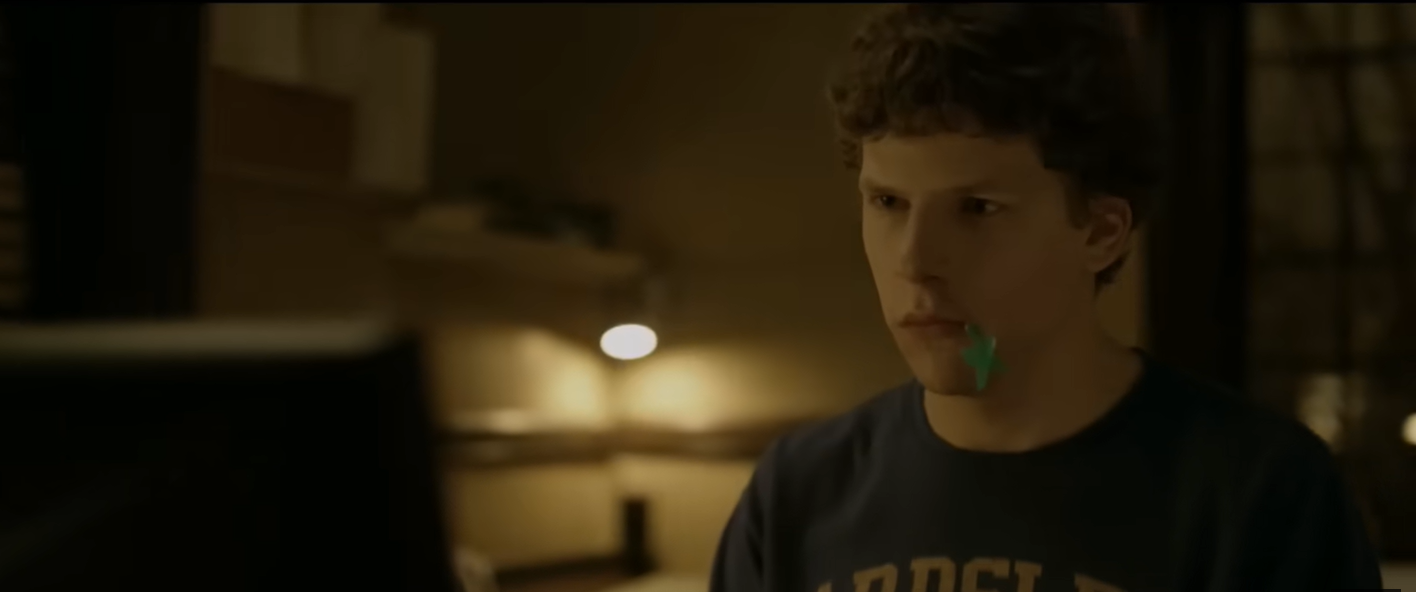
The scenes of Mark blogging are intercut with scenes at the Final Clubs, a stark contrast between Mark’s isolation with the hottest party on campus.
Mark decides to build a website to compare pictures of girls, where people vote who’s hotter, as a way to get back at Erica. He hacks into student houses to find the girls’ pictures. His friend Eduardo Saverin provides an algorithm that he used to predict oil prices, and Mark programs the website according to it.
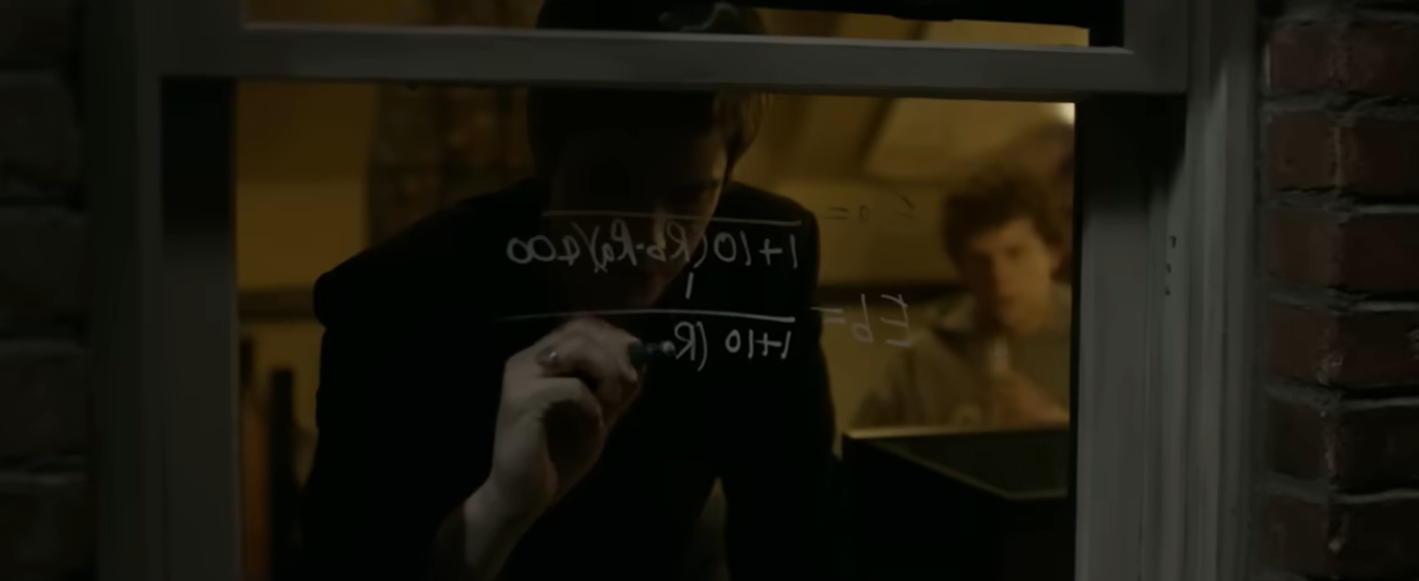
The website Facemash is ready. A montage shows the entire school engaged in picking out the girls who they think are hotter, until the school’s network crashes due to overflowing traffic at 4 a.m.
Debate
We cut to, for the first time, a deposition room.
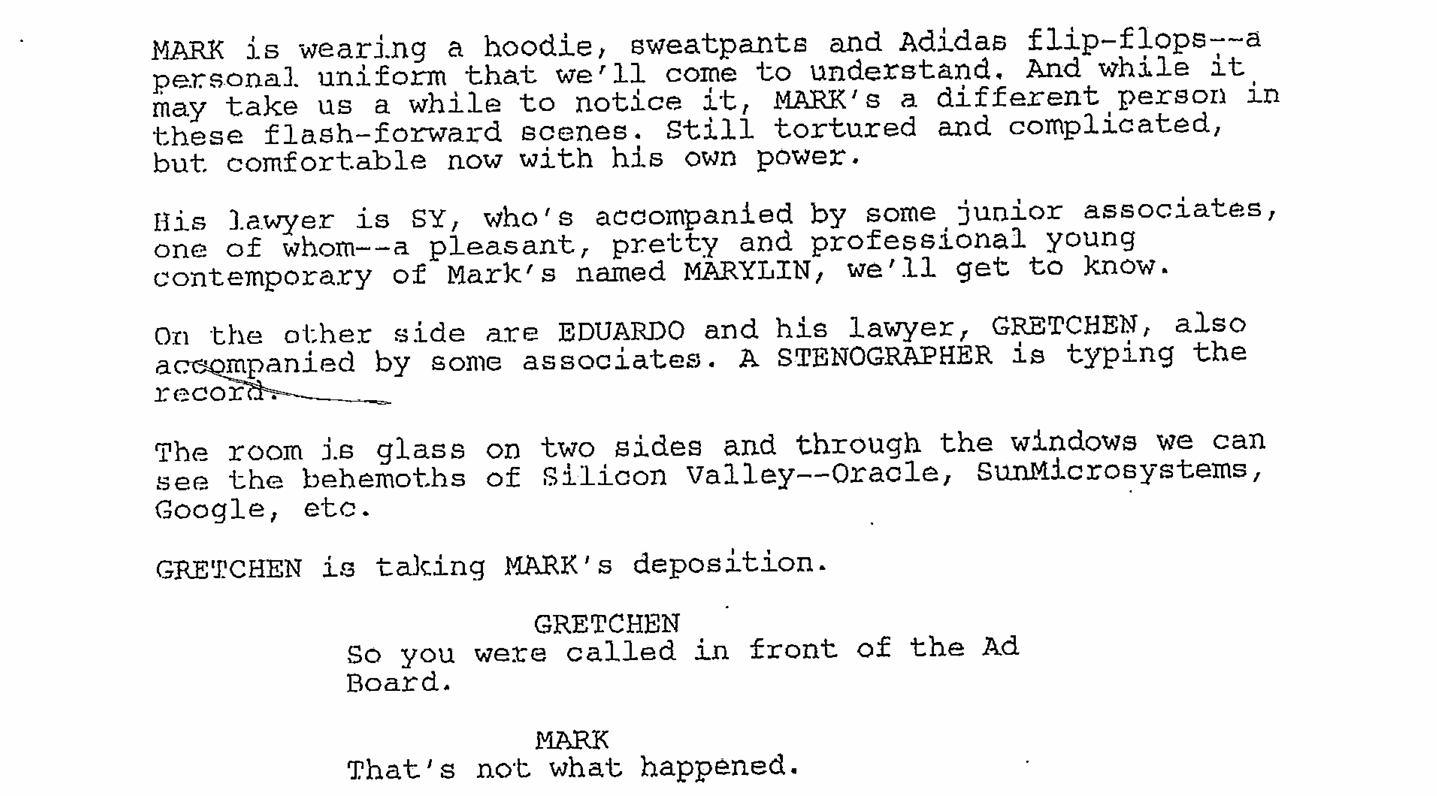
The first thing that Mark says in the deposition room is “That’s not what happened.” And when Eduardo’s lawyer Gretchen says that he was reading from the transcript of Erica’s deposition, Mark says: “You think that if I know she can make me look like a jerk I’ll be more likely to settle, right?”
Within half a page, the screenplay puts everything that the audience just witnessed into dispute. For the first fifteen minutes of the movie, we have thought that we were watching the objective truth, but now we’re not so sure anymore.
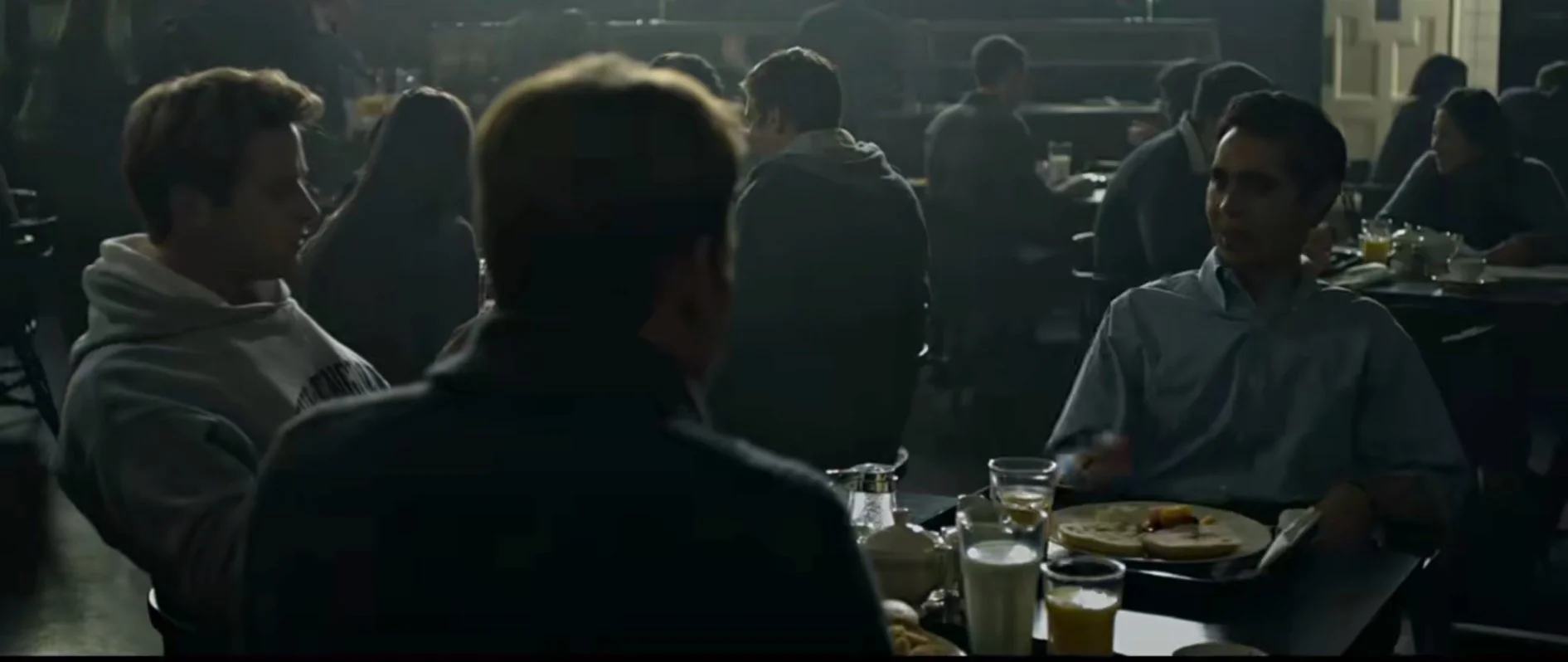
We meet the Winklevoss twins, Cameron and Tyler, highly competitive row boat athletes from an influential family. After hearing about what Mark has done with Facemash, they decide that they want to recruit Mark for their project.
We cut to the second deposition room and learn that, three years later, the Winklevoss twins are suing Mark too. This is a clever bit of writing: establish Eduardo, Cameron, and Tyler all as Mark’s friend or collaborators, before immediately showing that, in three years’ time, they have all become Mark’s enemy. It hooks the audience, makes us want to find out what happened.
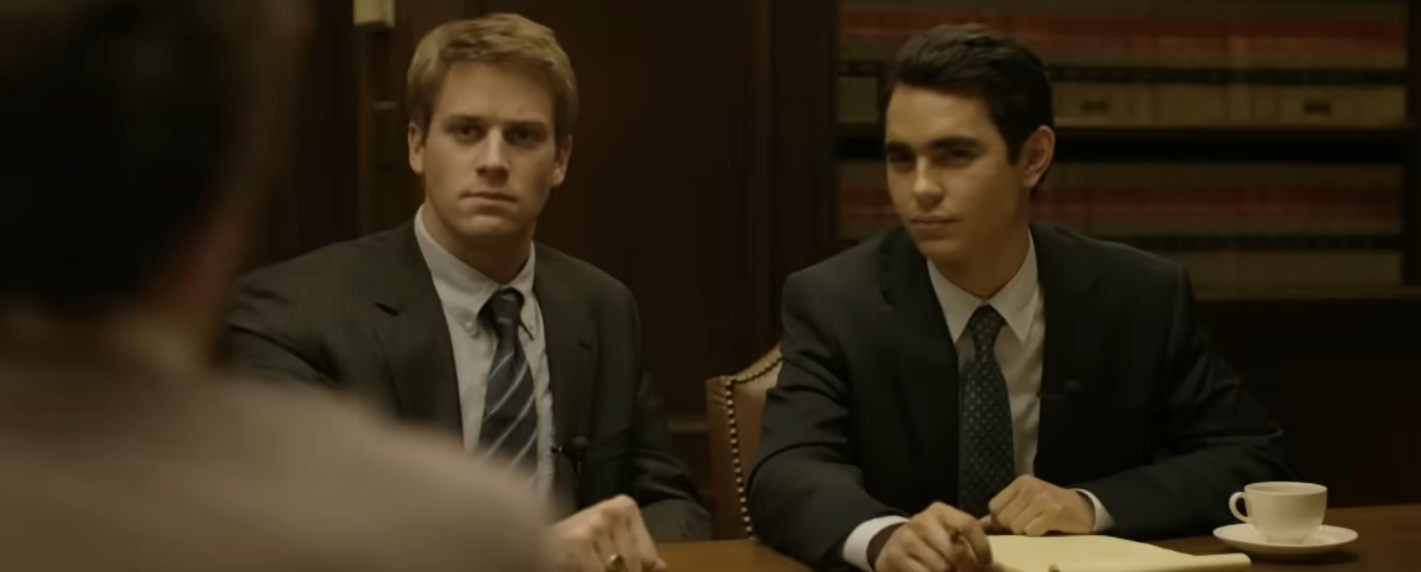
Back in 2003, Mark is receiving administrative hearing from the school. He infuriates the board and receives six months academic probation.
The Winklevoss twins and their partner Divya Narenda approach Mark and bring him to the Porcellian Club, the Final Club that they are a part of. They pitch Mark their idea for an exclusive social network called Harvard Connection. Mark is immediately on board.
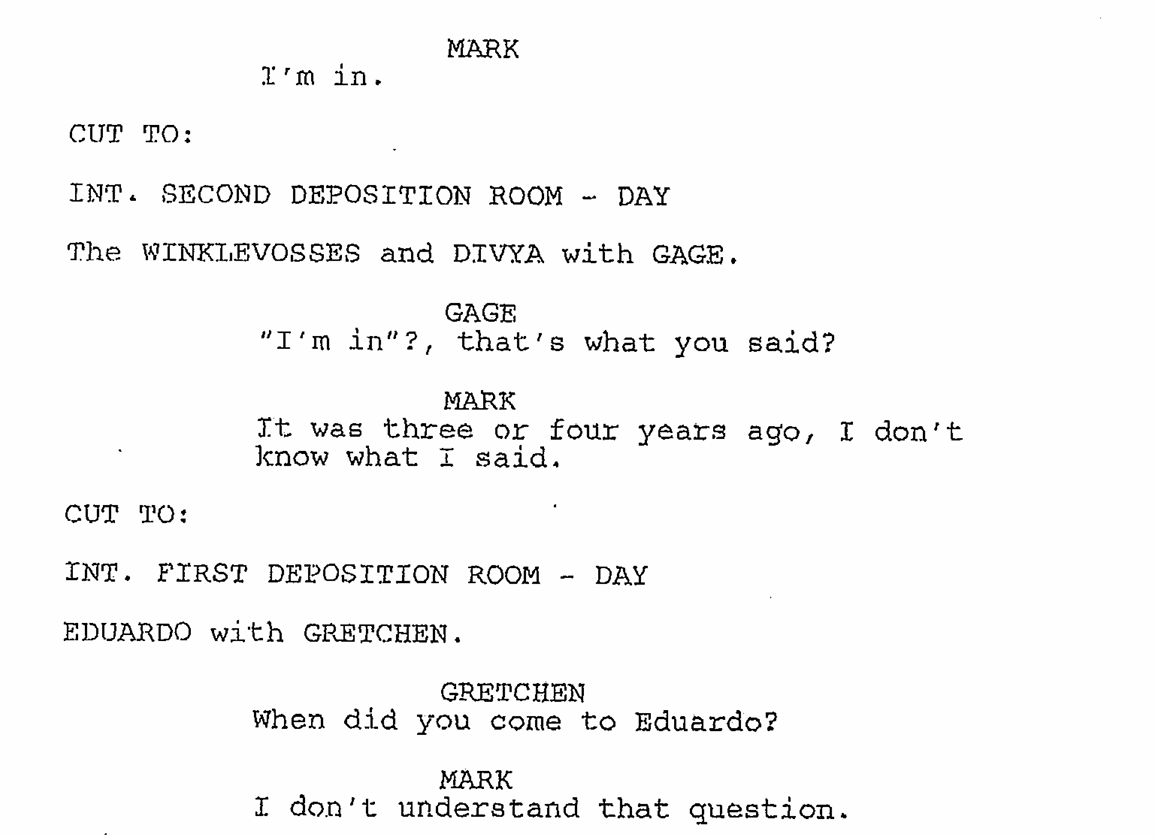
Again, with Mark saying “I don’t know what I said,” the film emphasizes that everything in this story is a narrative constructed by those around Mark and by Mark himself, each person with their own goals for gain.
Break Into Two
It’s Caribbean night at the Jewish fraternity. Eduardo is talking to Mark’s roommates Dustin and Chris about Asian girls.

Asian women is a particularly interesting side to The Social Network’s story. There are many Asian women throughout the film, but they are all very similar in their personality and function: hot and smart, supposed to be out of Mark’s league, but gradually grow interested in Mark as Facebook becomes more important. They are objectified as the prizes for Mark to pursue.
Yet, when we consider that this film is based on unreliable narrators, the way that the Asian women are depicted becomes not what they actually are, but what Mark and the rest of the white male characters, who are the primary storytellers, see them as. In a way, the film simultaneously stereotypes and objectifies Asian women, and criticizes that exact act.
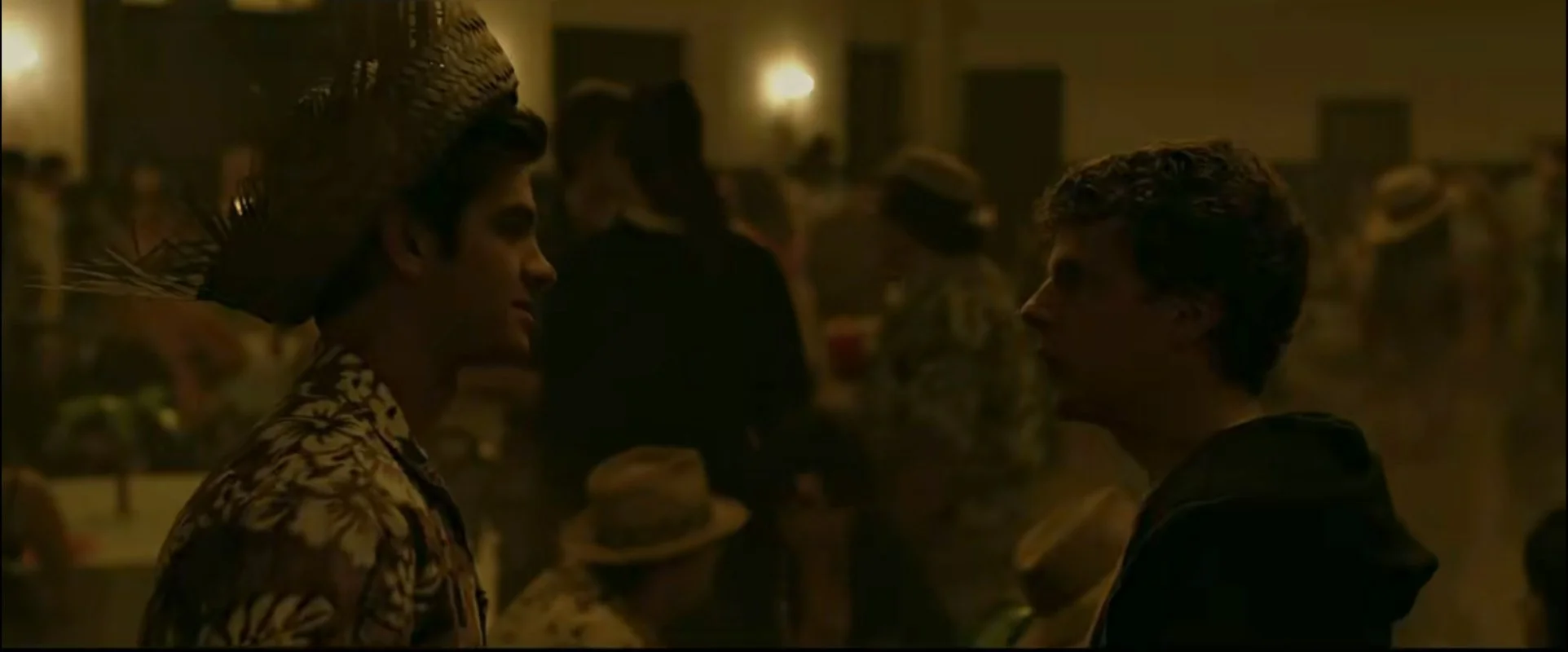
At Caribbean night, Mark approaches Eduardo with the idea of The Facebook: an exclusive network that puts the entire social life of college online. He asks Eduardo to invest $1k and to become the company’s CFO. Meanwhile, Eduardo tells Mark that he’s been punched by the Phoenix Club, one of the Final Clubs at Harvard.
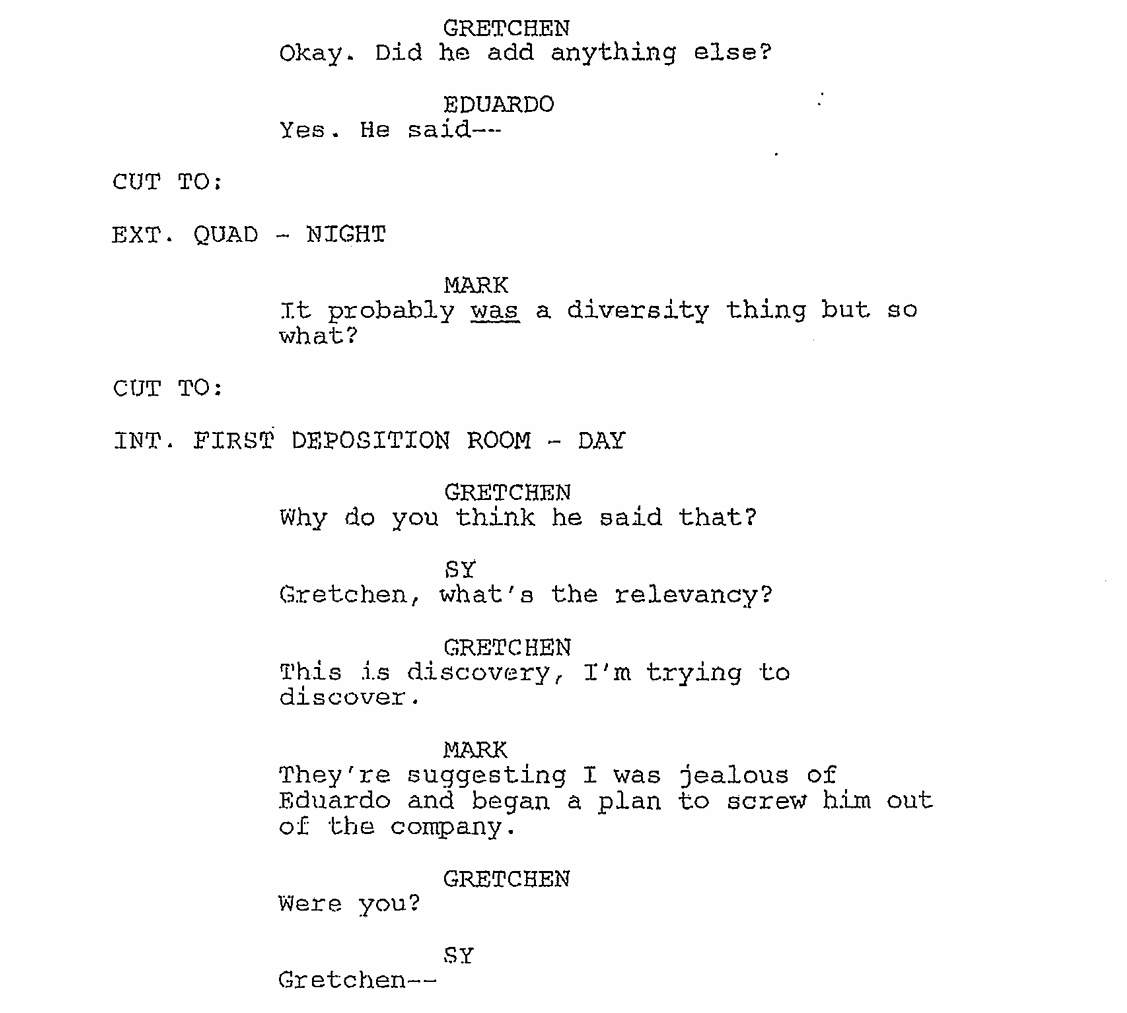
When Mark points out the jealousy-as-motive narrative that Gretchen might be going for, he is in fact reiterating the same act of trying to interpret Mark that is happening in the audience’s heads. In fact, he is asking the audience: If you already know that everything that you see in this film can be a lie, then why are you still analyzing them to understand who I am?
Fun and Games
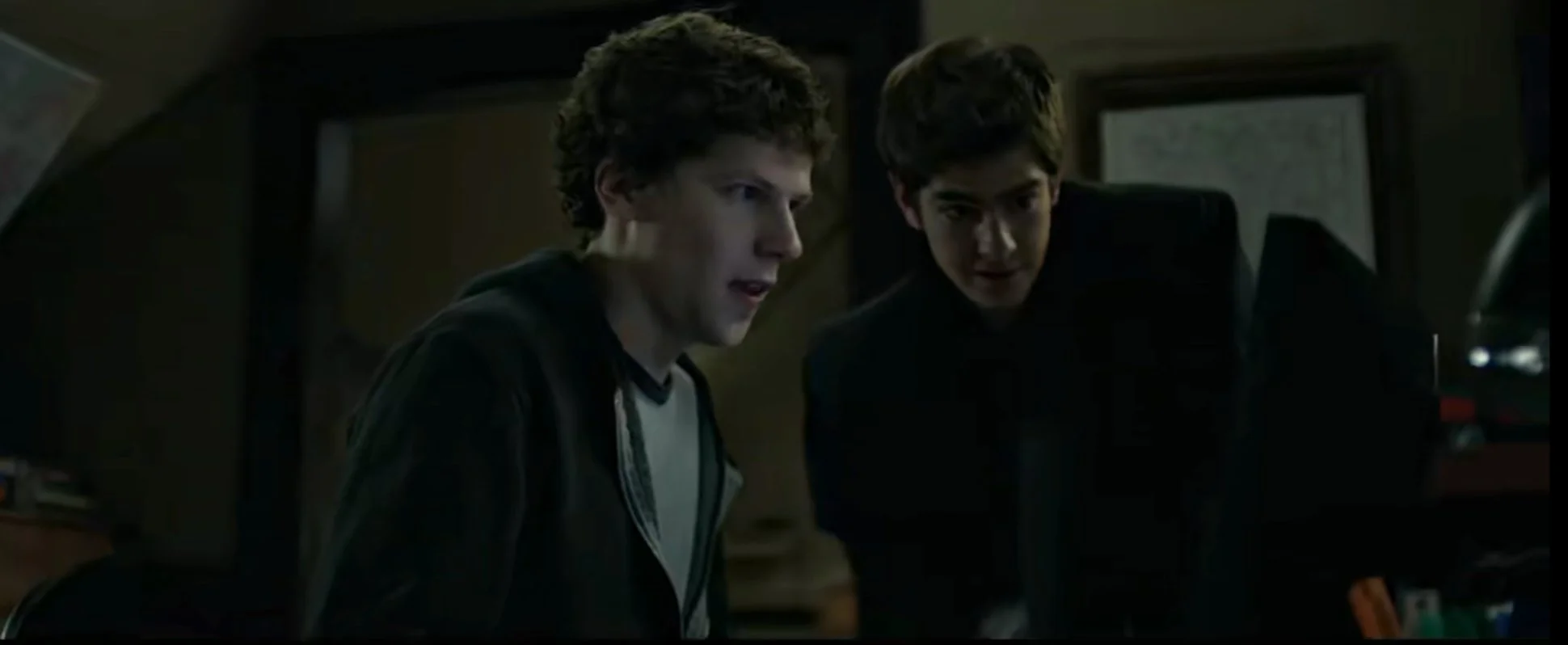
Mark adds a place for people to indicate whether they’re dating and what they’re interested in as the final touch to The Facebook. The Facebook goes live and explodes. Everybody is using it, and soon Mark and Eduardo are getting much more attention from girls.
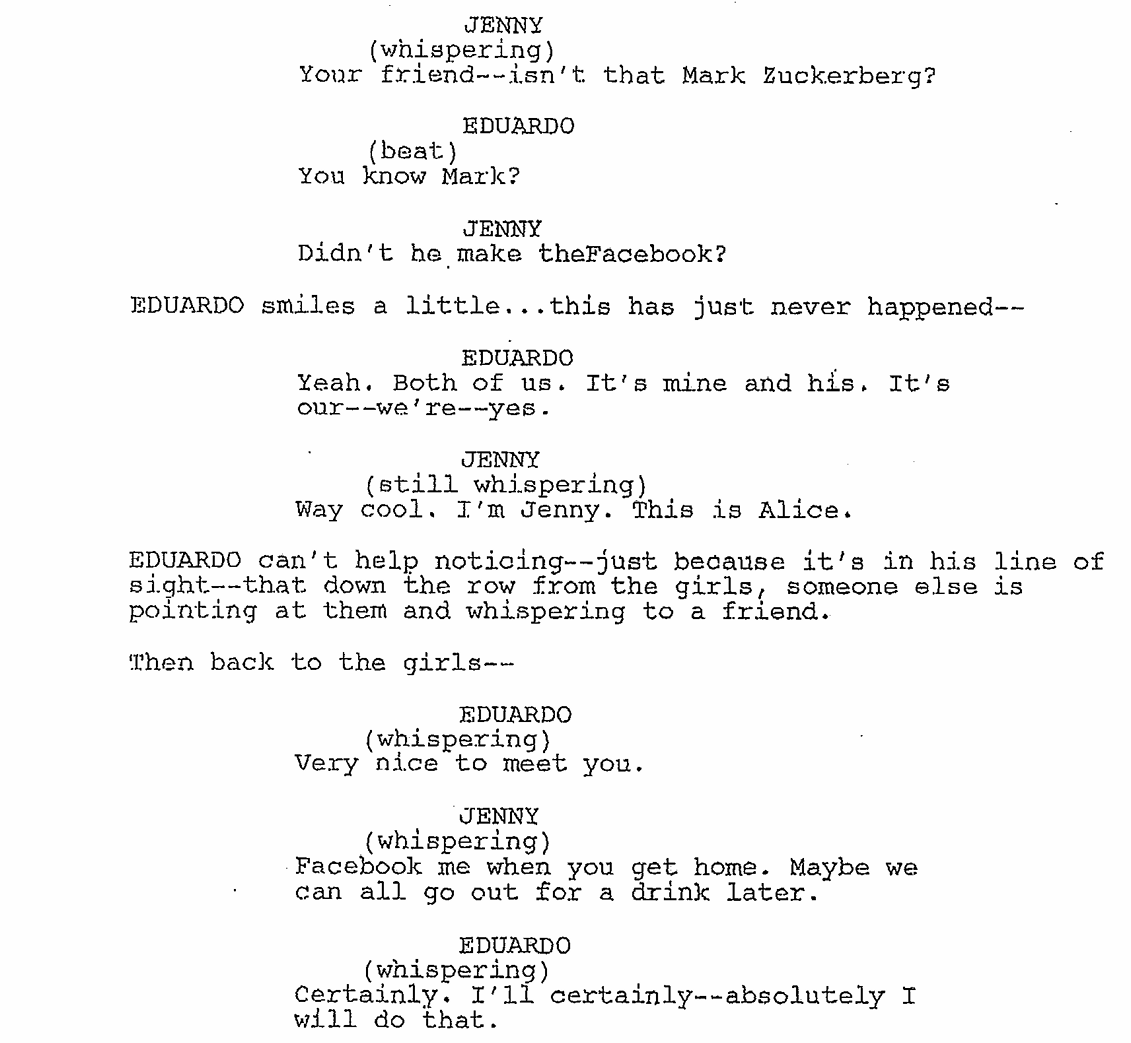
Eduardo wants The Facebook to begin generating revenues by selling ads, but Mark isn’t into the idea. They go out with two Asian girls, one of whom, Jenny, eventually becoming Eduardo’s girlfriend. Mark, however, spots Erica and tries to impress her by what he’s done with The Facebook, but Erica still despises him. In response to the further humiliation, Mark decides to expand The Facebook to more colleges.
Midpoint
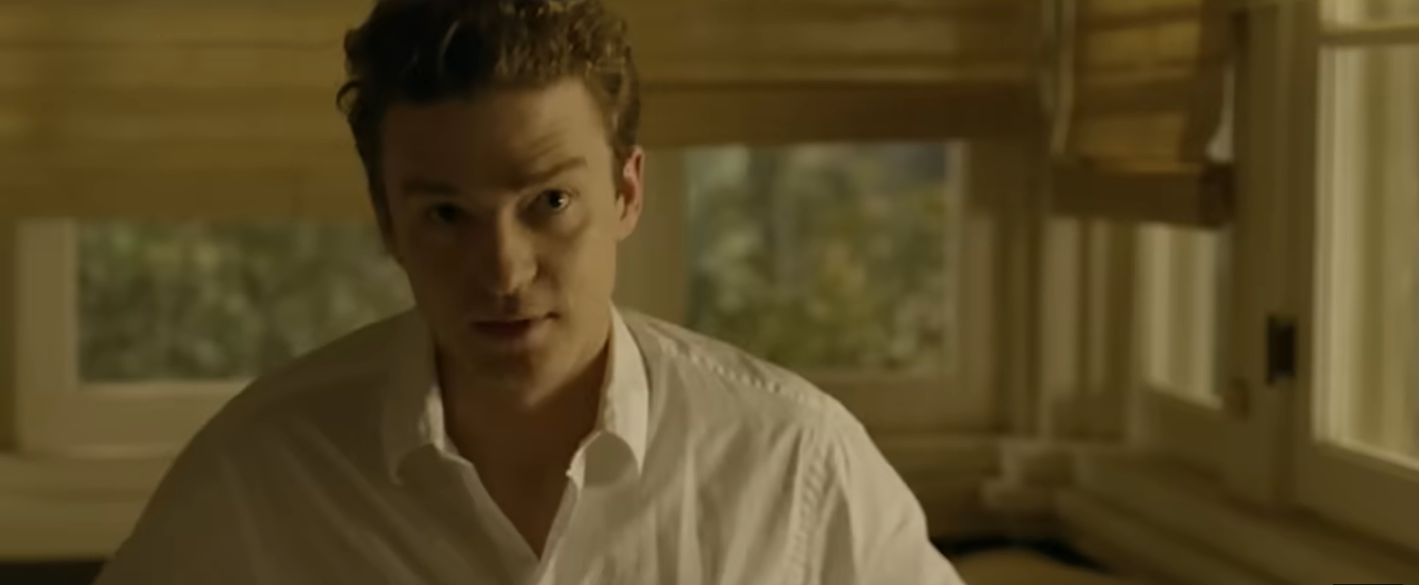
We meet Sean Parker, co-founder of Napstar, who finds out about Facebook from a Standford student he is sleeping with. He recognizes its value and decides to find Mark.
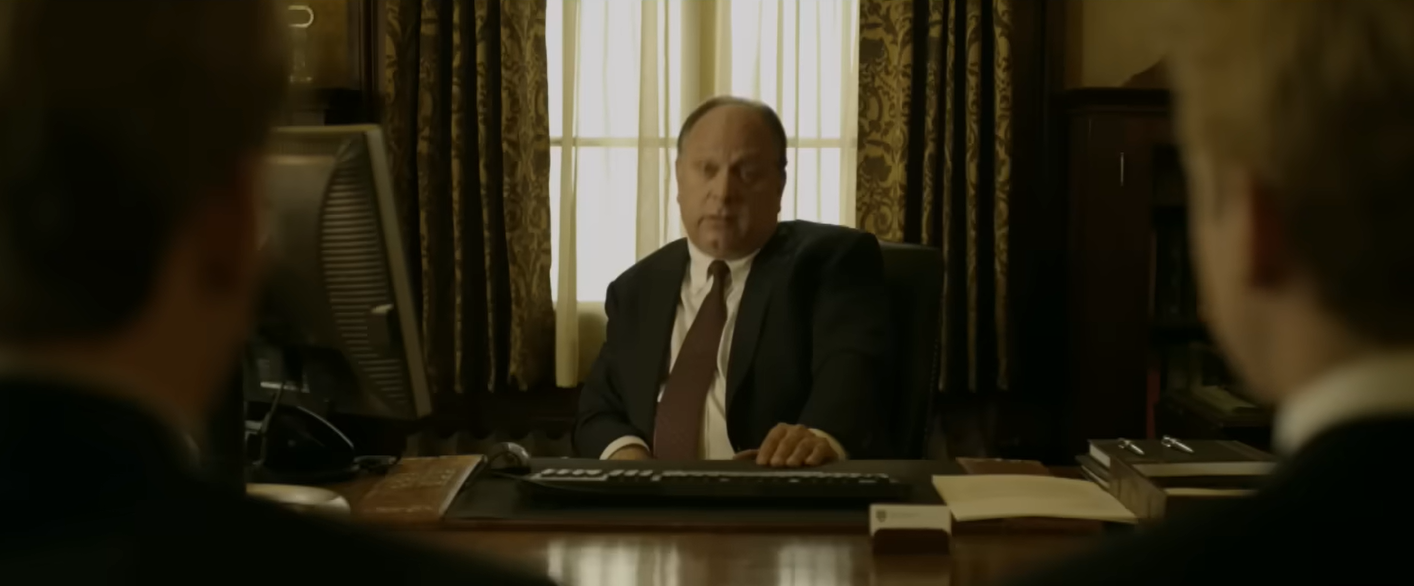
Meanwhile, Cameron and Tyler pay a visit to the Harvard president Larry Summers, hoping that Harvard can take disciplinary against Mark’s “theft” of their idea. Summers dismisses them, telling them to move on to other projects.
During spring break, Mark and Eduardo take a trip to New York, where Eduardo sets up meetings with potential advertisers. Mark, however, is not enthusiastic. This is, until their last meeting of the trip, when they meet up with Sean.
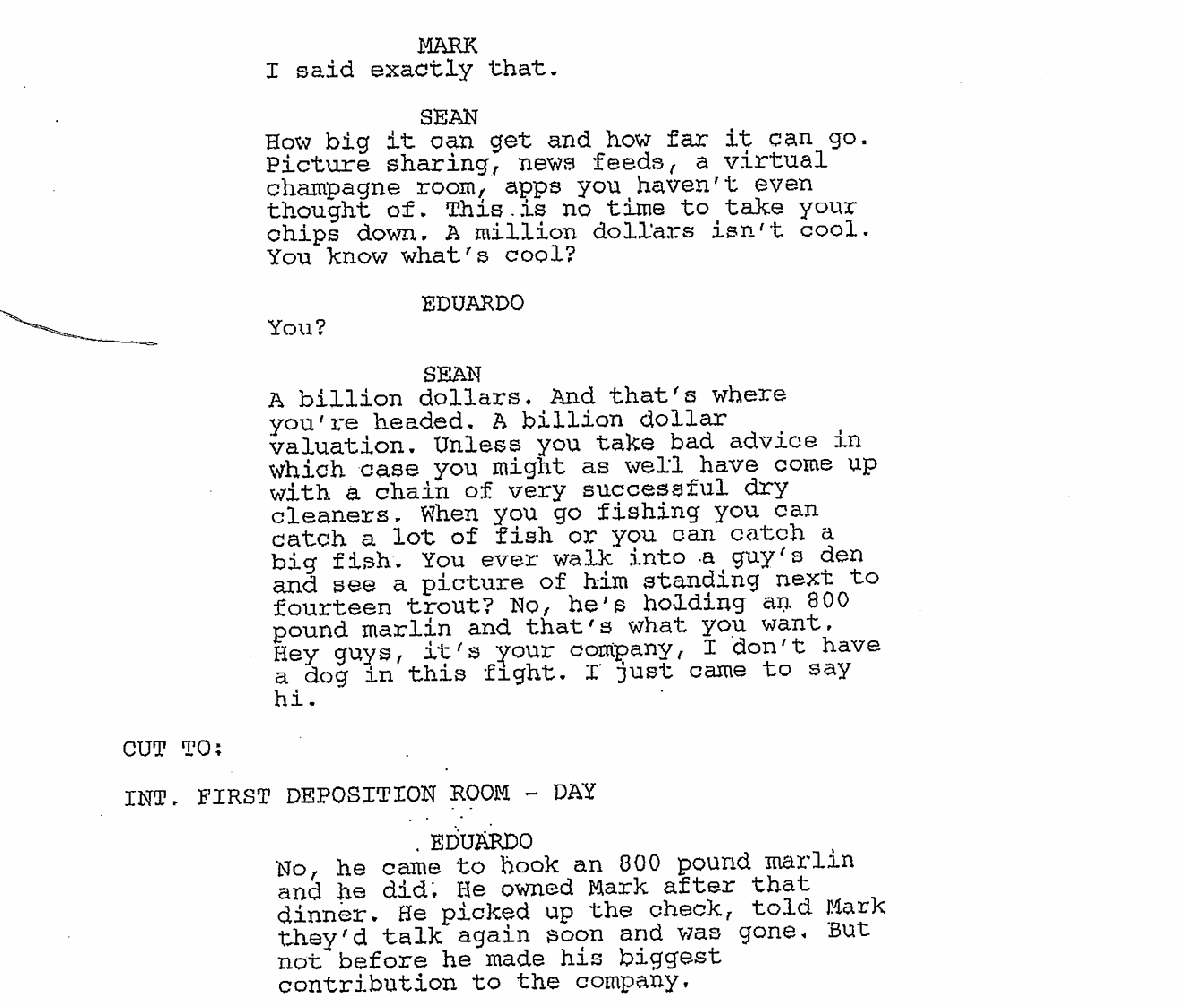
Mark is impressed by Sean, while Eduardo is not – he believes that The Facebook doesn’t need Sean to be successful. At the end of the dinner, Sean suggests for Mark to drop the “The,” making the company just “Facebook.”
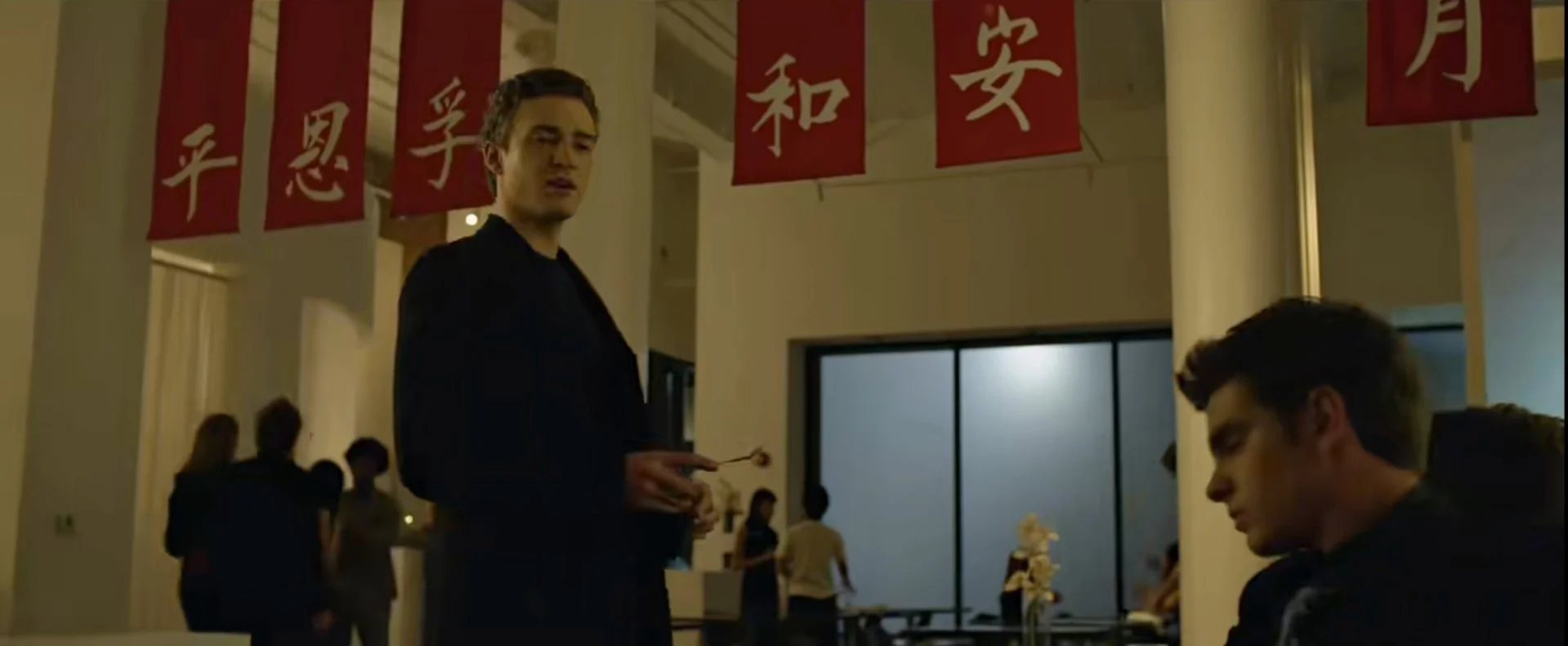
Sean’s presence in the story is interesting in many ways. He is the third biggest character, yet only appears at the halfway point, which sometimes makes him feel more like a catalyst than a real character. He is also the only main character who does not appear in the hearing scenes, which means that, unlike everybody else, he doesn’t get to tell the stories. The Sean that we meet is a combination of Mark’s and Eduardo’s narrations, both with strong opinions and emotions towards him. The film, therefore, begs the question of how much of the Sean we witness is real.
Bad To Worse
As a part of his Phoenix Club initiation, Eduardo is asked to carry a chicken around, and ends up being accused of animal cruelty. Meanwhile, Mark decides to move to California during summer without consulting Eduardo first. They get into a row.
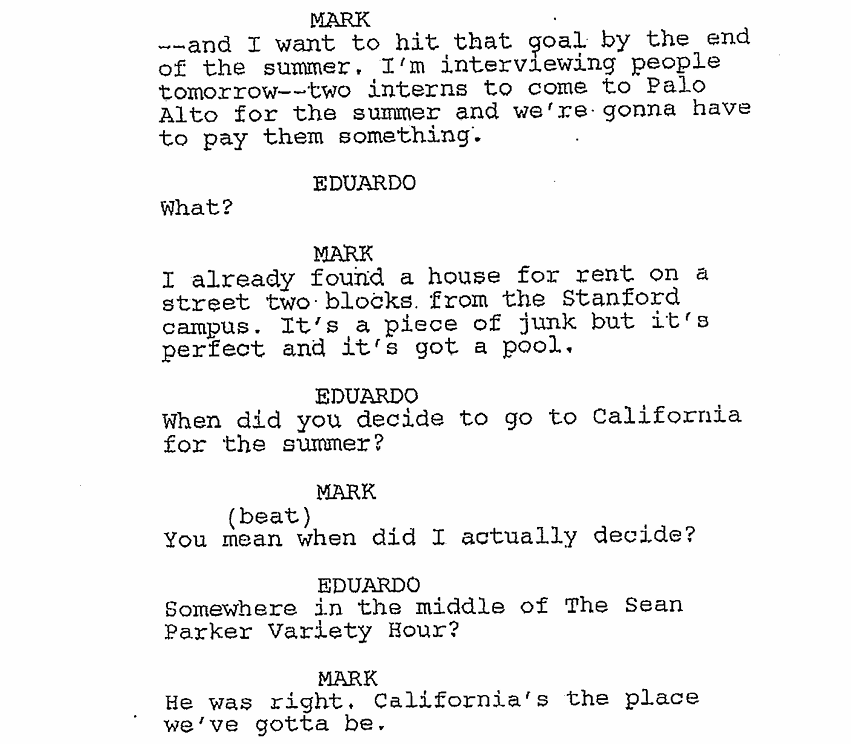
They make up quickly, however, at Facebook’s interview for the summer interns, where the candidates have to hack while taking shots.
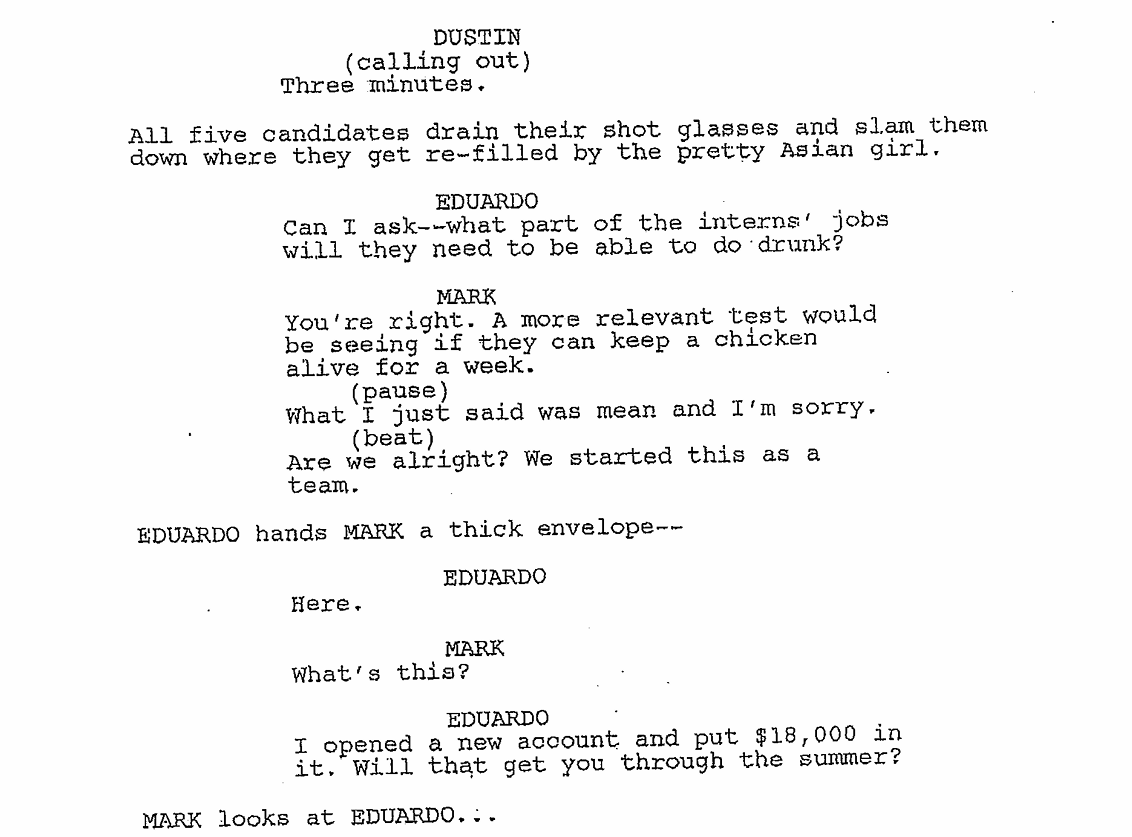
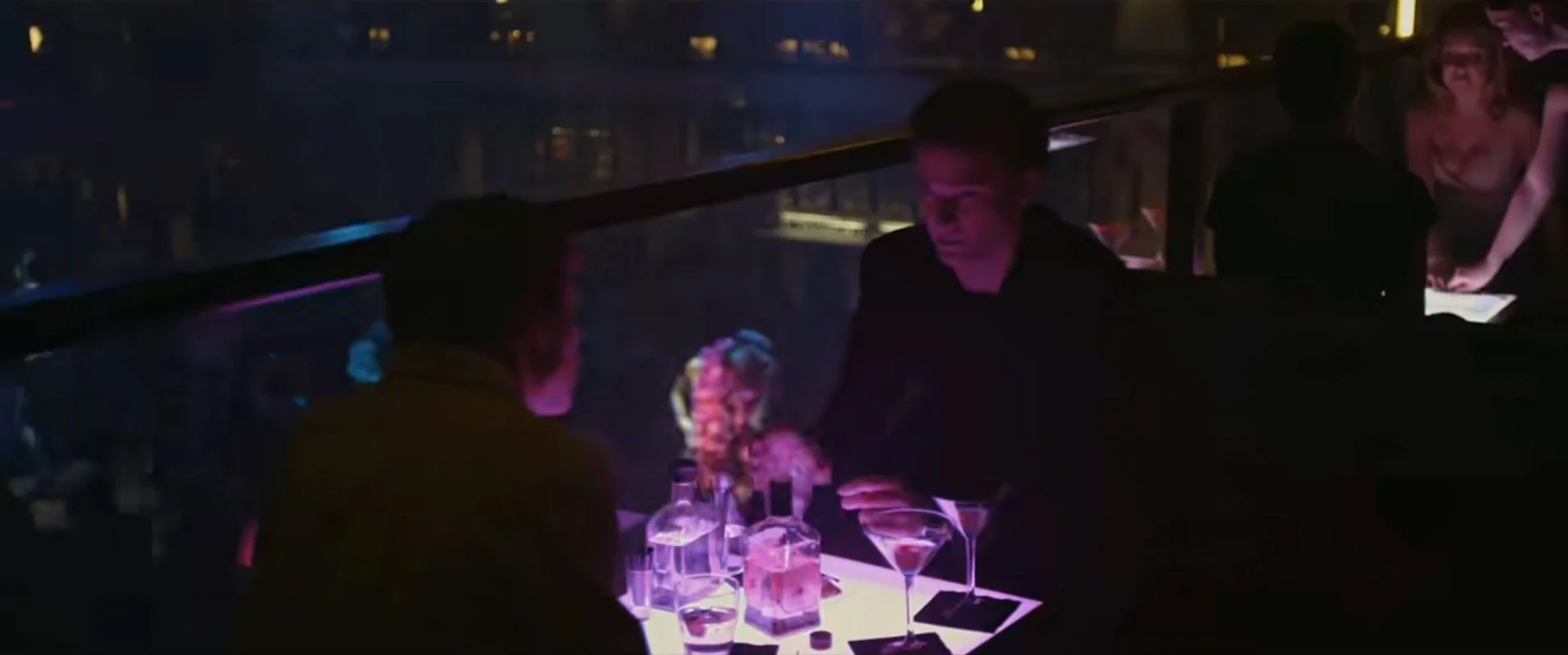
Eduardo works on business in New York, while Sean meets up with Mark at Facebook’s summer house in Palo Alto. Sean takes Mark out, questions Eduardo’s dedication to the company, and offers to help putting Facebook on two continents.
Break Into Three
The Winklevoss brothers lose their rowing match by a narrow margin in England, where they also learn that Facebook has expanded outside the US. The twins and Divya decide to take legal action and sue Mark.
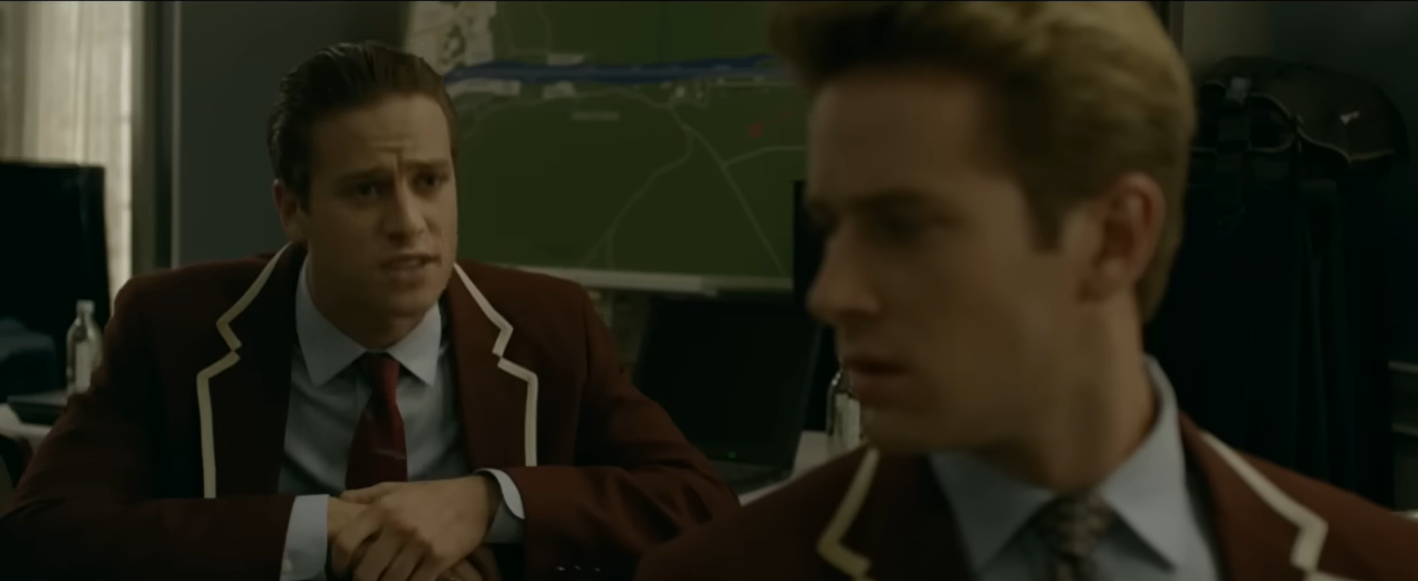
Eduardo arrives in pouring rain to the Palo Alto house to discover Sean there. He learns that Sean has been setting up business meetings for Facebook.
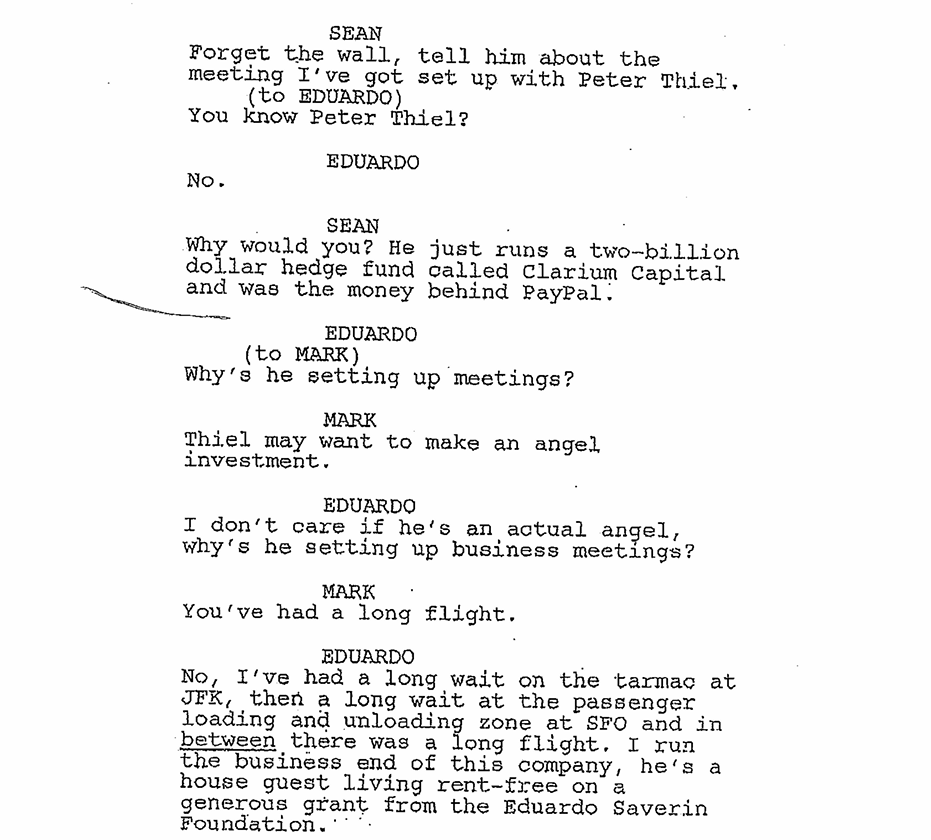
Mark and Eduardo get into a huge fight. Eduardo blames Mark for replacing him with Sean in making business decisions, and Mark blames Eduardo for his absence.
After the fight, Eduardo freezes Facebook’s bank account.
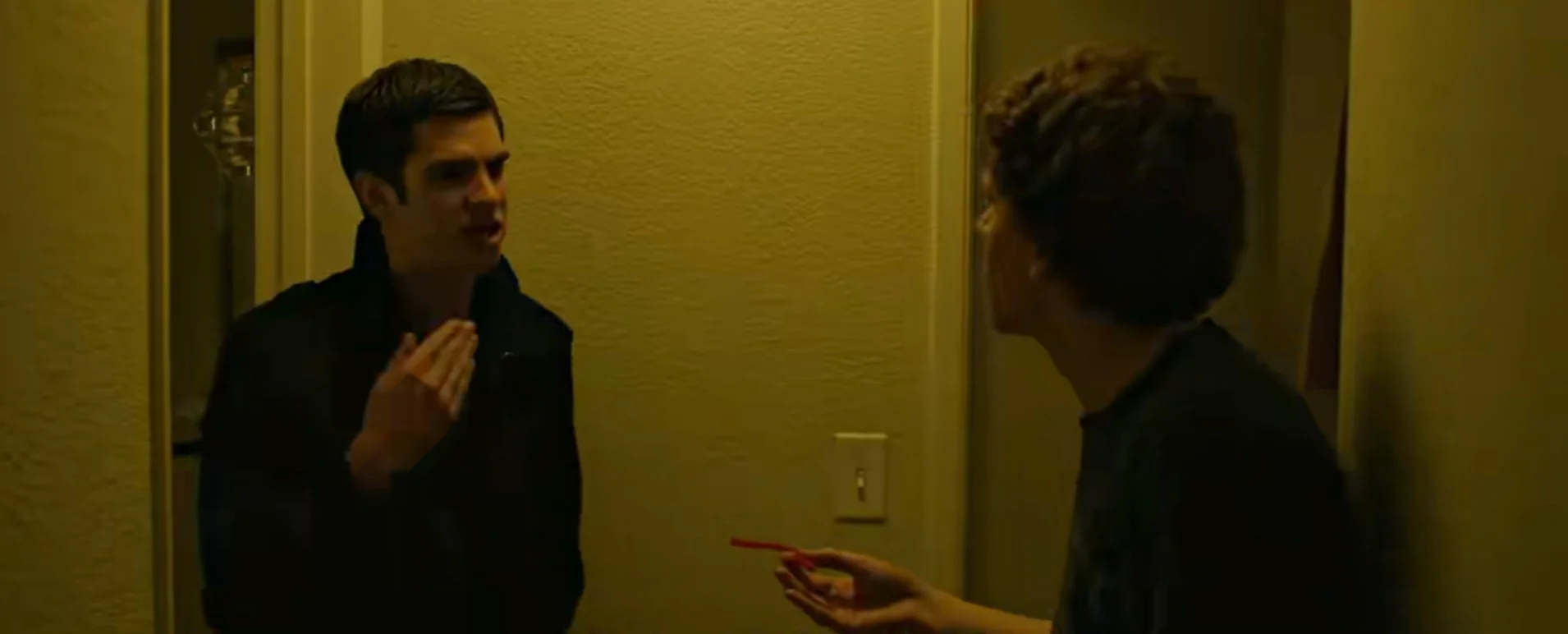
Mark and Sean have a successful meeting with Peter Thiel, who decides to invest $500,000 and asks for some corporate restructuring for Facebook. In New York, Jenny goes crazy over Eduardo not calling her back, and tries to set fire to Eduardo’s apartment. Eduardo puts out the fire while receiving Mark’s call about the frozen back account.
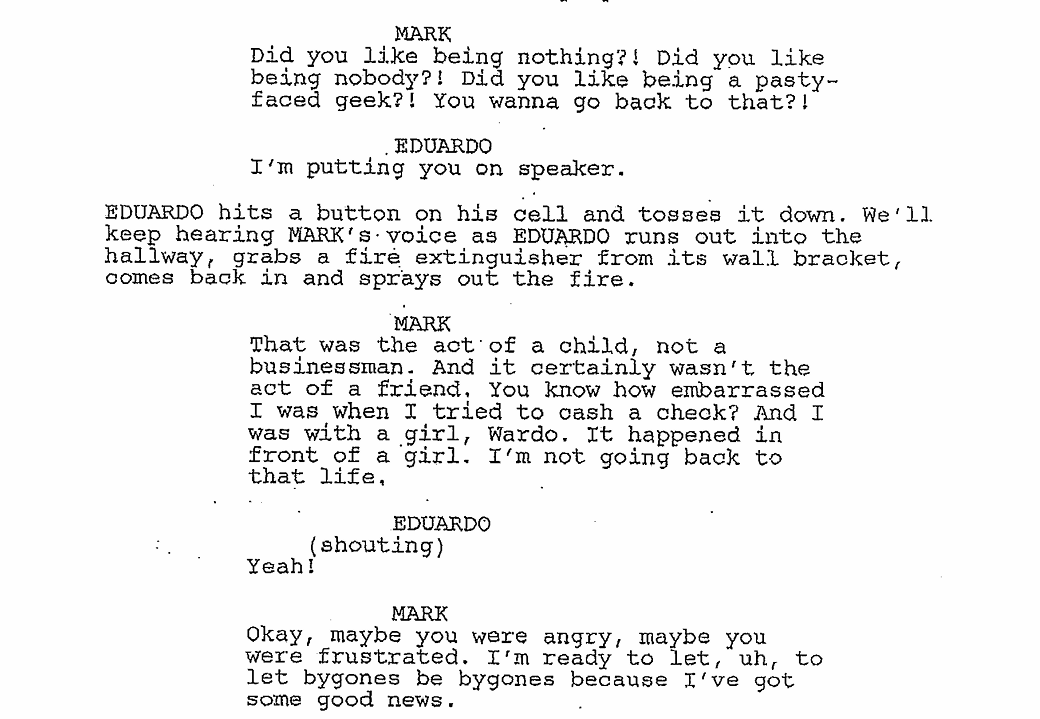
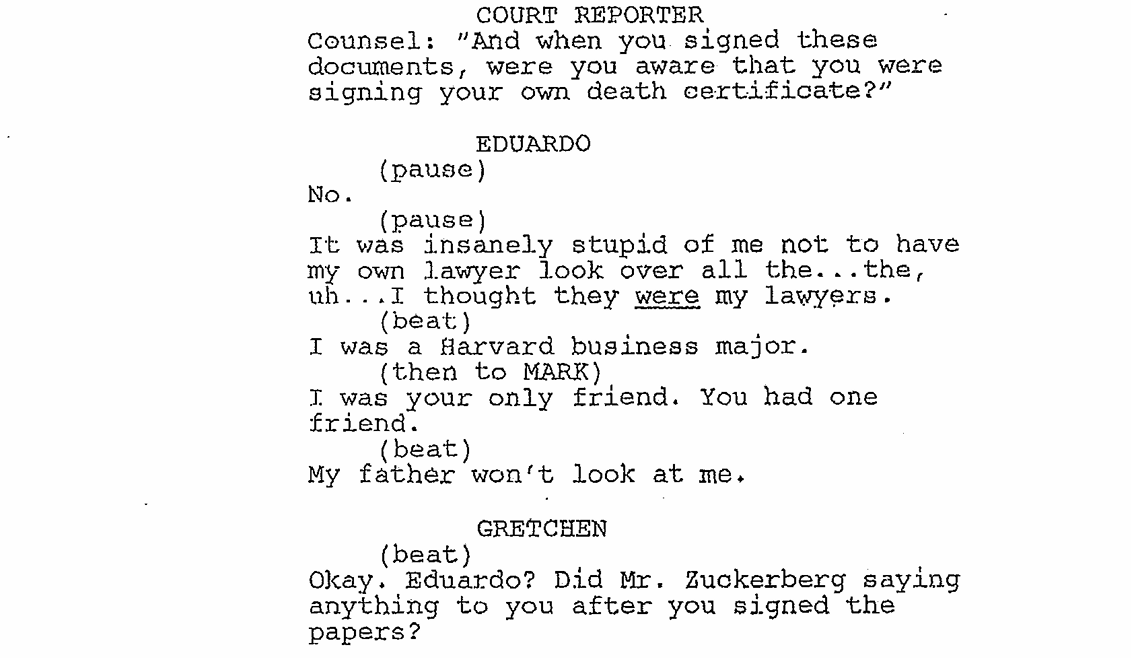
Mark tells Eduardo the news of Thiel’s investment and that they’re getting set up in a new office. Despite their fight, Eduardo is happy to hear the news, and jumps onto the next flight to San Francisco. He signs the papers for Facebook’s corporate restructuring without carefully reading them.
Finale
A few months later, Facebook is about to reach a million members. Eduardo arrives at Facebook headquarter to celebrate, only to discover that Mark has issued 24 million new shares of stock, all of which coming from Eduardo’s ownership of the company –his 34.4% share now diluted to 0.03%, which the documents he once signed ensured.
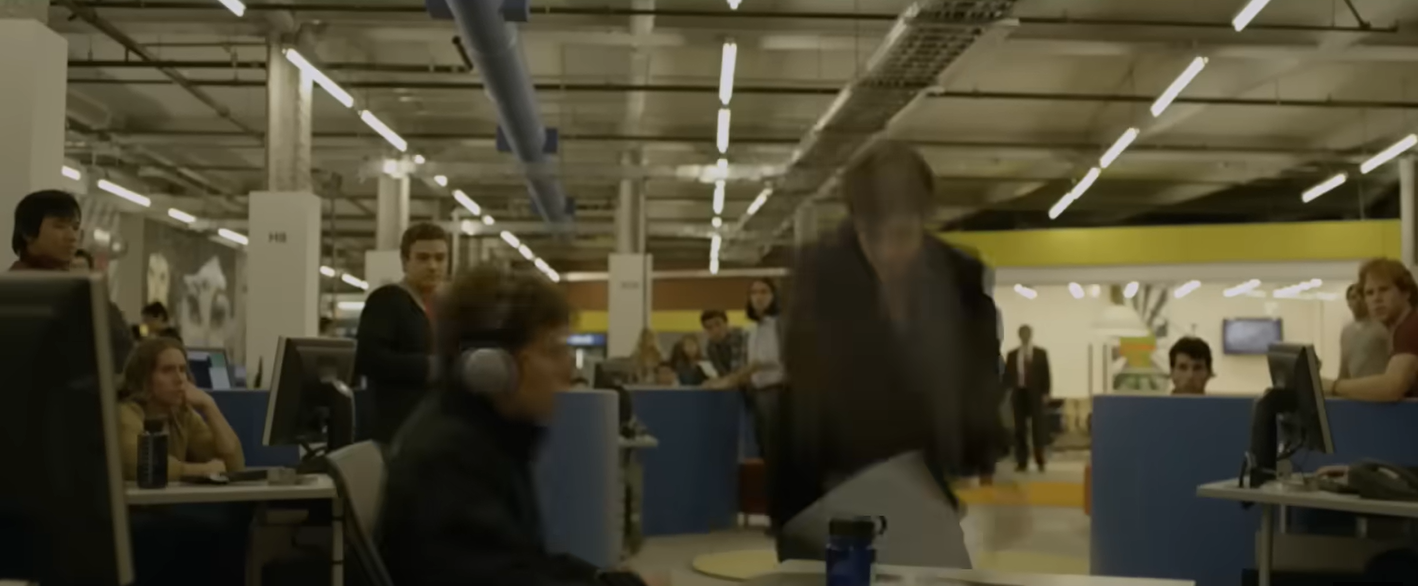
Eduardo smashes Mark’s laptop and vows that he will sue Mark for everything, while Sean mocks him and has him removed by security.
Facebook hits a million members. Sean and the rest of the company leave for celebration, while Mark stays behind. Police arrive at Sean’s party and arrest him for cocaine possession with a minor. Mark, alone in the office, gets the news.
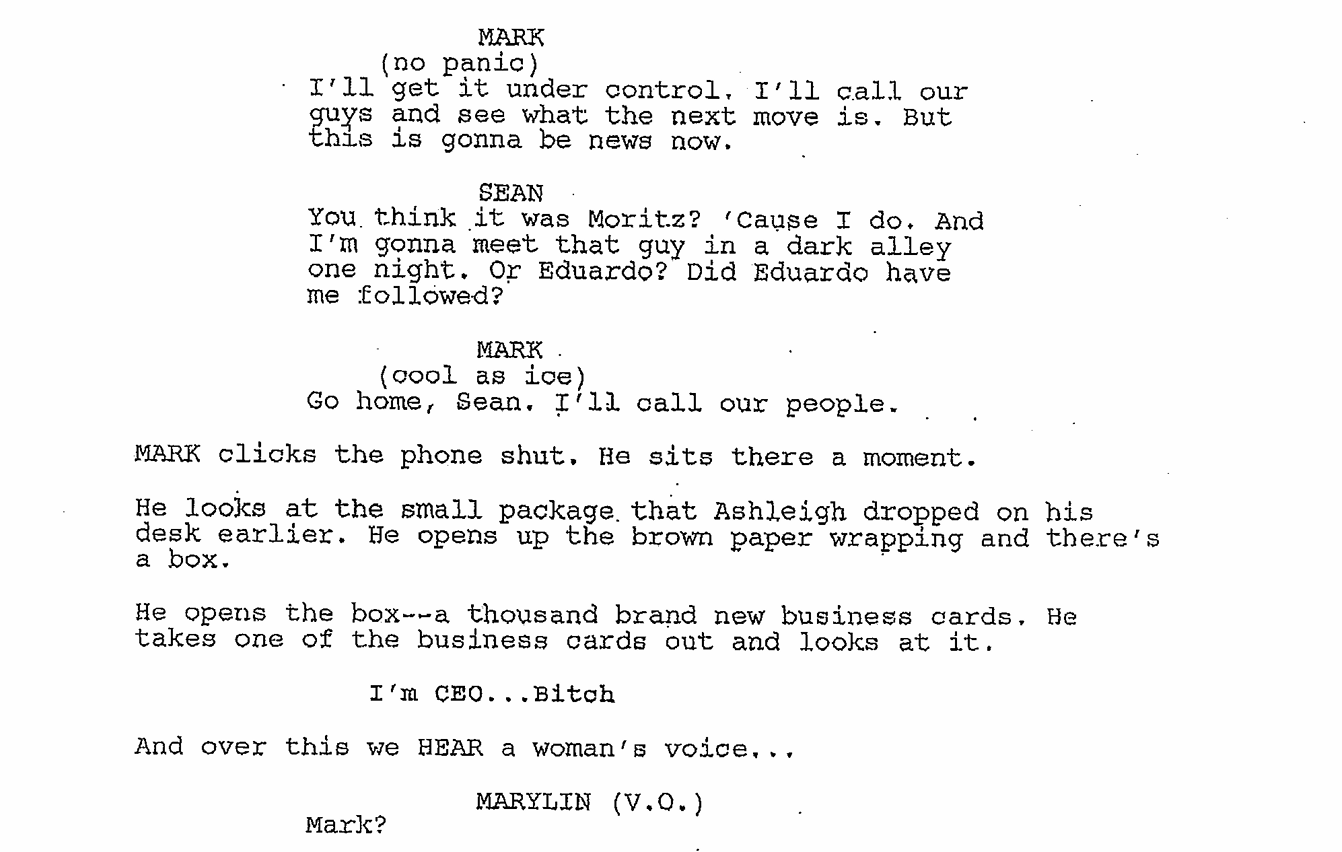
In the deposition room, everyone is gone. A young lawyer Marilyn alone stays and talks to Mark.
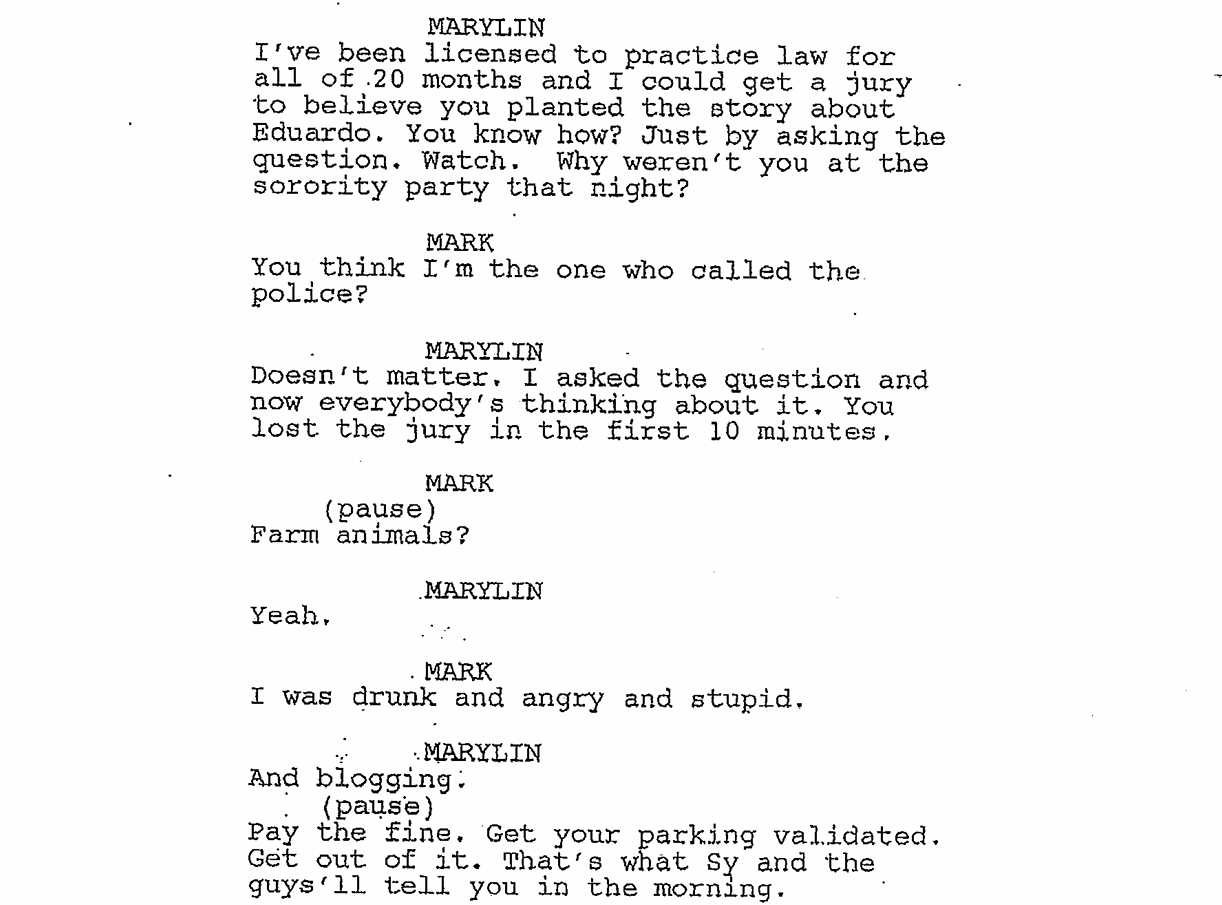
Marilyn’ s words are the film’s last stroke in the debate of how storytelling influences the way we view each other. When she says “You lost the jury in the first 10 minutes,” she isn’t just referring to the court, but also the audience, every one of whom has been judging Mark from the beginning of the film.
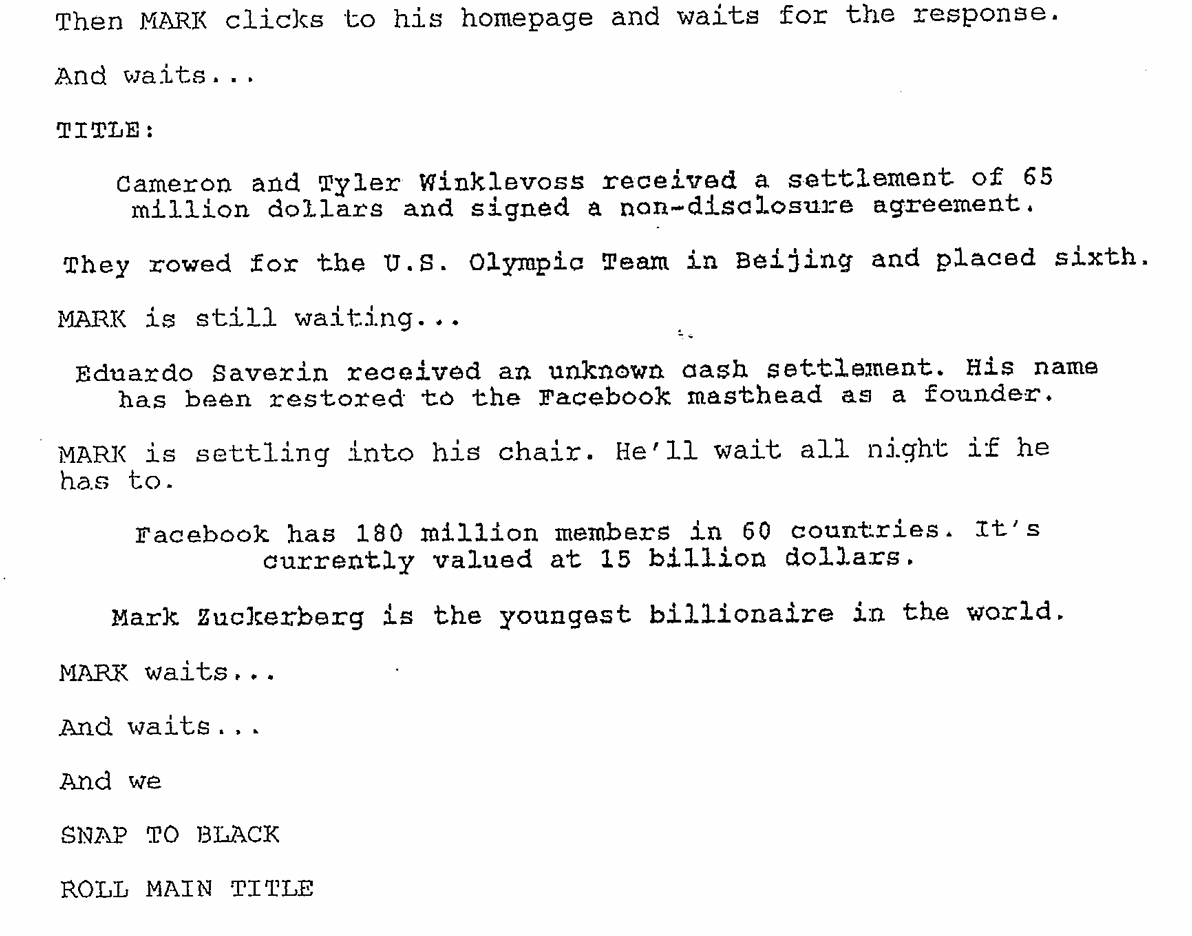
Through the constant intercutting between the hearings and the action, The Social Network is a perfect example of unreliable narrator and subjective storytelling. It explores the idea of social representation on several levels: from Mark’s obsession with how he is viewed, to the uncertainty surrounding the narrative voice, and finally, to a discussion of social media itself, where everybody is presenting an image of themselves that is not entirely the fact.
The Social Network’s message grows beyond the two hours of Mark’s story. It is present, and relevant, in every social network around the world.