Kinolime Fix It: Turning Supergirl (1984) From Rotten To Certified Fresh [Podcast]
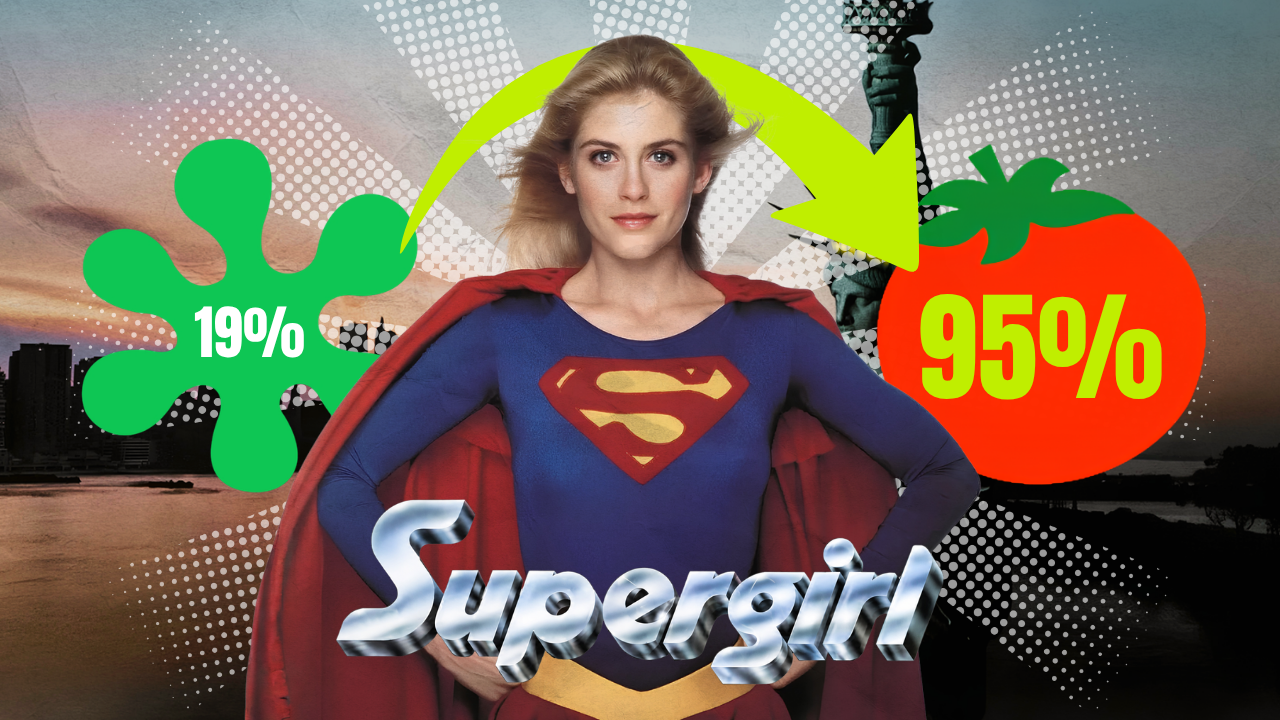
Supergirl. It's one of cinema's most spectacular failures, a 1984 film that lost $21 million, scored a measly 4.4 on IMDB, and became the punchline to a decades-long joke about failed superhero movies. But what if we could fix it?
In this episode of the Kinolime podcast, Meara, a professional screenwriter, script doctor, and creative executive at Kinolime, approaches the film with one challenge: don't rebuild it from scratch, but strengthen the existing framework. Using the fundamental rules of screenwriting: character motivation, thematic core, and antagonist design, he reveals exactly what went wrong with the original and how it could have been a compelling story.
In this episode, you'll learn:
Why Supergirl became a superhero disaster that still haunts the character today
The #1 screenwriting mistake that sabotaged the 1984 film (and why most writers make it)
How to fix a protagonist with vague, inconsistent motivations
Why world-building matters: reimagining Argo City to support character goals
The exact strategy for turning a random love interest into a meaningful plot element
How to make your antagonist a mirror/foil instead of just an obstacle
The difference between passive and proactive characters and why it matters
A complete reimagined synopsis that could have saved the film
If you're a screenwriter struggling with character motivation, an aspiring filmmaker trying to understand why scripts fail, or simply a fan of the superhero genre curious about what went wrong, this technical breakdown of Supergirl's narrative failures will teach you invaluable lessons about story structure and character development.
Full Transcript: Kinolime Fix ItEpisode 2: Turning Supergirl (1984) From Rotten To Certified Fresh
Participants
Meara Owen-Griffiths - Creative Executive, Kinolime
Meara: Hello and welcome to the Kinolime Podcast. I'm Meara, and today we're fixing Supergirl. With Supergirl having another chance at the big screen now in 2026, I wanted to look back at the original version and dare to ask the question: "How did they get it so wrong?"
Back in 1984, Supergirl was unleashed upon the world and went down as one of the biggest superhero disaster classes of all time. And that's really saying something.
Setting the Context: Why This Matters
Meara: As a screenwriter myself, a script doctor, and a creative executive here at Kinolime, I read thousands upon thousands of screenplays. And as we always say, the screenplay is the heart of the movie. If you have a bulletproof screenplay, chances are you'll have a good movie. If your script sucks, you're asking for a miracle.
So for the purposes of this analysis, we're going to focus entirely on story, narrative, and character. Let's treat Supergirl like it's going into production next week. We've not got much time. The script lands on my desk for a final polish with a week to go. Oh boy.
My goal won't be to tear it apart completely and rebuild it from the ground up, as appealing as that may sound. My aim is to look at the framework that already exists and ask: "How could this be strengthened while remaining fundamentally parallel to the original story?"
And vitally today, we're going to be looking at how character always drives story. Because if even your protagonist doesn't know what they're trying to achieve, why the hell should anybody at home care? So today, we're fixing Supergirl.
The Legacy Problem: Why Supergirl Never Gets Respect
Meara: Getting general audiences to take Supergirl seriously has always been an uphill battle. The character is, by design, an offshoot of a far more famous hero, an extension of Superman Kal-El's story rather than a standalone creation.
The most significant thing writers ever did with the comic book character of Kara-El is kill her off in 1985, just a year after the 1984 Supergirl movie bombed. That reality still hangs over the upcoming 2026 adaptation.
In the 1980s, audiences were only deemed deserving of Supergirl after Superman had already headlined an entire trilogy of films. The assumption seemed to be that audiences first needed years of investment in the Man of Steel before they'd follow his cousin into her own adventure.
Today, audiences work very differently, yet she still remains an afterthought. The new Supergirl is arriving after just a single film, Superman 2025, suggesting a level of confidence that simply didn't exist four decades ago. But it's still piggybacking off the first century's success. Advanced material does not seem confident in marketing itself as a solo venture.
The Caped Crusader himself and Krypto, the annoying Superdog, are set to appear to ensure a turnaround on investment. This is the third attempt at a live-action feature film Supergirl, and we've also had three live-action television versions, five really if you include unsuccessful pilots.
Maybe if more of these adaptations had resonated with audiences, DC would be a little bit more confident in this new entry.
The 1984 Supergirl: A Summary of Failure
Meara: Today let's take a look at the original attempt and investigate why it failed so badly, grossing 14 million dollars against a 35 million dollar budget, boasting a 4.4 on IMDB, and a measly 20% on Rotten Tomatoes.
In case you haven't seen it for a while or don't want to subject yourself to the film at all, here's a brief summary: When a powerful energy source known as the Omega Hedron is accidentally lost from the idyllic safe haven of Argo City, Kara Zor-El travels to Earth to recover it. Adopting the identity of Linda Lee, she enrolls at a girls school while searching for the missing artifact.
The Omega Hedron has fallen into the hands of Selena, an ambitious witch who uses its power to pursue wealth, influence, and romance. As Selena's magic grows increasingly dangerous, Kara embraces her destiny as Supergirl and battles dark sorcery, monstrous creations, and supernatural forces. Ultimately, she defeats Selena, restores the Omega Hedron to Argo City, and returns home a celebrated hero.
Immediately, Supergirl feels less like a superhero movie and more like a fantasy epic. And that's not a bad idea, in fact, it's probably the best thing the script has going for it. The problem is that the concept is far stronger than the execution.
The Core Problem: A Weak MacGuffin
Meara: At its core, the story revolves around a mystical artifact being lost across time and space, prompting a quest to recover it before disaster strikes. That's classic fantasy territory. Countless fantasy stories have built entire worlds around that premise and managed to make them compelling.
Whereas the Omega Hedron's purpose is nebulous, it's variable, and it's uninteresting.
Supergirl is attempting something remarkably similar, yet it never commits to the genre's strengths. The fantasy quest, the magical MacGuffin, and the otherworldly setting are all lost to familiar environments that just feel like plot engines.
In fantasy, we see ordinary heroes venture into exciting but dangerous new environments. In Supergirl, we see a near godlike hero venture into a stuffy boarding school and a local fairground. That's the fundamental issue right there.
The Real Problem: Kara's Broken Motivation
Meara: The biggest problem with Supergirl is its characterization and specifically, Kara. Her motivations seem to undulate from scene to scene, leaving audiences with little sense of what she actually wants.
At first, she's pursuing a lost Omega Hedron. Alright, fine. Then she's trying to blend into human society, but it's never entirely clear why. She has no reason to hide or blend in. She doesn't need to learn human ways. There's absolutely nothing to stop her kicking Earth's doors down and taking what she needs.
This happens, or more accurately, does not - because the plot insists upon it, and the producers want some half-baked romance in there. By this point, the film has accumulated plenty of activities for Kara to do during her stay on Earth, but very little in the way of a coherent internal journey.
She has goals, but no overarching objective that ties them together. That's fatal for a screenplay.
The Fix: Reimagining Argo City
Meara: Let's zoom out for a moment. The very existence of Argo City, this refuge built by survivors of planet Krypton after its collapse, it feels like it defies the logic of Superman. He's the last of his people, gifted with these extraordinary powers he must learn to understand all by himself. And that falls flat if his kin are living in this magical utopia within reachable distance.
If we begin by reimagining Argo City as effectively a leaky bomb shelter with dwindling power and resources, this necessitates some courageous individual to brave dangerous space travel to find a solution. Immediately, the story has a hero-shaped hole right in the middle of it.
A rather elegant solution to this issue would be to give Kara a clear emotional need before she ever departs for Earth.
Imagine a version of Argo City where Kal-El's exploits have become the stuff of legend. Superman is held up as this ideal Kryptonian: brave, selfless, heroic. This addresses Kara as an extension of her cousin rather than avoiding that issue.
Kara idolizes him and dreams of following in his footsteps, but the society around her refuses to take her seriously. She's young, she's ambitious, eager to contribute, yet constantly patronized by those in authority. No matter how capable she proves herself to be, she's always kept on a short leash.
This backwards, stubborn Argo City makes more sense than the utopia we're provided. If it's populated by the survivors of Krypton's collapse, these are the same people who thought their planet was too advanced to perish. The colony should retain the same arrogance and regressive thinking.
Crucially, Kara needs to believe that these limitations are unique to Kryptonian society. She assumes that once she leaves home, she'll finally be judged on her merits rather than her gender or her age. On Earth, she believes she can be appreciated. That gives her a much stronger reason to journey to Earth rather than simply trying to retrieve a lost object.
Reframing Kara's Journey: From External to Internal Quest
Meara: Superman, we're told, is off-world on a peacekeeping mission according to a convenient news broadcast. But it would make more sense and create a more interesting character, if Kara never intended to seek him out. She's assured in her own ability to rectify the situation.
The Omega Hedron becomes the plot objective, but proving herself, making a name for herself beyond being just Superman's cousin, becomes the emotional objective. This also offers us a heavy dose of meta-commentary.
And now when Kara arrives on Earth, she soon discovers something unexpected. The same prejudices from back home exist here too. That single change immediately gives her more agency. The story is no longer happening to Kara; it's happening because of Kara. She's making choices.
Now when she arrives on Earth, she encounters a far more interesting obstacle than just a supervillain. She discovers that the social attitudes she thought were unique to home are alive and well. The same dismissiveness, the same condescension, the same tendency for people to underestimate her.
And unlike the villains in a typical superhero film, these aren't problems she can solve with heat vision or flight. She cannot punch society's ails into submission. This creates a meaningful distinction between Kara and Superman.
Superman's stories often revolve around the question of how a godlike figure should use his immense power. Kara's story becomes about confronting problems that power alone cannot solve. No amount of strength can force people to respect you.
The Omega Hedron therefore remains the external objective, the ticking clock that keeps the plot moving along. But internally, Kara is pursuing something much larger. She begins the story believing that heroism means emulating Superman, saving the day, recovering the artifact, and proving her worth to others through action.
This now gives Kara the basis for a genuine character arc. She begins the film trying to emulate her cousin and ends it when she learns to stop measuring herself against Superman and define heroism on her own terms.
Suddenly, every strand of the story is pulling in the same direction, which is what we want. The quest, the coming-of-age narrative, and even the romance, if we really have to, can all become expressions of the same central theme: Kara's struggle to define herself in a world determined to underestimate her.
That's the kind of internal journey the existing film is missing. It doesn't require rebuilding the story from scratch. Just give its protagonist a destination beyond the very next scene.
Fixing the Setting: From Boarding School to Adventure
Meara: Let's continue to do what we can to distinguish this story from standard Superman fare. Instead of trying to fit in at the Daily Planet, Kara is trying to fit in at this really, really boring high school, a much less dynamic location with much more regimented rules that contributes very little beyond the odd brief fish-out-of-water moment.
Consider if she comes to Earth seeking this artifact. Perhaps she could position herself in an archaeology university, or some kind of course, or internship, which will help her locate the Omega Hedron. Where she ends up cannot be random. It needs to directly correlate to her apparent rush to return the sphere to her home city. It needs to be a step on that journey.
This would give her more specificity and drive versus enlisting her in a regular school. Again, this feels proactive. School is a necessity. University or applying for a job is a choice. It ages her up. It makes her feel less like a hapless teenager and more like a motivated character. It even gives her a cooler outfit or disguise.
Imagine if instead of plaid skirts, she's got an Indiana Jones thing going on between the red and blue. Instead of classrooms and dorm rooms, she's on dig sites, leveraging her supervision to help find artifacts, trying to impress head archaeologists so she can be included in the next dig, attempting to work her way up the corporate ladder.
We can keep the structure of a dismissive male authority figure like Nigel and instead posit him as the person who possesses key information on the Omega Hedron's location. Kara must appeal to him, but she has to work ten times as hard as her male colleagues to impress him.
Fixing the Villain: Making Selena a True Foil
Meara: Next up, we fix the antagonist. The easy fix would be to scrap Selena entirely, replacing someone expressly created for the film with one of Supergirl or Superman's existing rogues gallery. Failing that, it's imperative that the antagonist has values and objectives that counter Supergirl's directly.
Instead of Selena using the Omega Hedron to make a man fall in love with her and turn herself into some kind of princess, look, the less we say about that the better, she could feasibly use it in a way that mirrors the collapse of planet Krypton. A response to oppression.
If Selena is someone who suffers under the same thumb as Kara, she can respond to it in a different way. Rather than trying to change the system from within, she's reached her wit's end and is determined to tear it down. She turns to magic and the arcane to dismantle, not to fix.
We therefore posit Kara and Selena as twin products of the same inherent issues. Neither can succeed in their goals while the other prevails. This shouldn't be complicated. This should be basic, fundamental rules of storytelling.
Kara crashes to Earth. Selena is a would-be witch watching the stars for science. She sees the rough trajectory of the falling star and is seeking the crash site, leaving this object from the heavens to be something that could grant her the power she desires.
Now both of them are seeking the same artifact, putting them at direct odds. They are on a collision course rather than Selena conveniently bringing the Omega Hedron to Kara in the current version.
These changes help fix another issue: the episodic nature of the script. At times it feels like this is a series of episodes mashed together into one bloated story. Now we have a classic progression.
Kara comes to Earth to retrieve the artifact. Great. Because she doesn't know where to begin, she has to seek it out, thus necessitating archaeology. Great. The existence of power structures necessitates her to conform and challenge them. Great. These same power structures oppress and radicalize Selena. Now Selena and Kara can clash. Perfect.
We still conclude with them doing battle and Kara's obvious victory, but it's much more multifaceted now. It's not just a fetch quest with a random love triangle thrown in the middle.
Fixing the Romance: Making It Meaningful
Meara: Speaking of which, let's address the elephant in the room: the love triangle. Again, this movie wouldn't have been greenlit in the early 1980s without this being tacked on, so I'm going to try and adapt it rather than nuke it entirely.
Firstly, the love potion and coursing of Ethan needs to go. We've learned our lessons. It doesn't make sense in the first place. Why is it a potion rather than a spell? Why can it only last 24 hours? Why, why, why?
Ethan is this shirtless groundskeeper, feels pretty objectified ironically. I would rather cast him as a fellow archaeology student, a peer to Kara, someone who can acknowledge the discrimination she and Selena by extension face every day.
Someone who can see Kara in action, become fond of her weird alien idiosyncrasies, someone who can become appreciative of her strengths, build natural chemistry rather than some cockamamie magical love potion.
To protect his utility, his connective tissue between Kara and Selena, maybe we could position him as someone previously romantically involved with Selena. But she lost him as she became radicalized, pushed him away. He now serves as a prize. Selena is convinced she has to win him back once she reshapes reality to fit her worldview.
Kara, a pure soul who wants to redefine systems of power peacefully, is a more attractive option to Ethan and a reminder that Selena's methodologies continue to alienate her.
The Reimagined Synopsis: A Better Story
Meara: So what do you think? Here's the new and hopefully improved synopsis.
Populated by the scant few survivors of planet Krypton, Argo City risks encountering the same grisly fate as its predecessor. Determined to prove her worth and outgrow her cousin's long shadow, Kara Zor-El takes it upon herself to travel to Earth where she hopes to acquire the Omega Hedron, a mystical source of unlimited energy capable of stabilizing the colony.
Adopting a human identity, Kara enrolls in an archaeological course to locate the artifact but is soon surprised to learn that the pervasive prejudices and narcissism that plague Argo City also exist on this planet.
Selena, an ambitious downtrodden witch, rivals Kara in seeking the Omega Hedron, intent on using its limitless power to violently reshape reality in her own image. As Kara races to secure the orb, she must overcome underestimation and disadvantage while battling Selena's dark sorcery and monstrous creations.
Kara must adapt to an alien culture, redefine how she understands heroism, and save Argo City before it wastes away.
Why These Changes Matter: Character Drives Story
Meara: Now this more assured, proactive version of Kara has an overarching objective throughout the entire story. Each new sequence details a step towards that goal. She clashes against forces of evil that represent how a less optimistic, a less hopeful individual may react to the same stimulus that she faces herself.
So what are we thinking? Could these changes to Kara's characterization have helped sharpen her maiden voyage? Or was the base screenplay just too weak to begin with?
I really hope that today you've learned a little bit more about how to make your character more proactive, the importance of a strong thematic core for your character, and how to position your antagonist as a foil for your hero rather than just an obstacle.
Closing and Call to Action
Meara: Alright, I've been Meara. Thank you guys for watching, and happy writing, Kinolimers!
John: If you got something out of today's podcast, please share it with your filmmaking and screenwriting community, and hit subscribe. It genuinely helps us keep making these. We need them, and we'll see you in the next one.