The Best Way to Fund An Indie Film Right Now [Podcast]
Is independent film finally bouncing back? In this episode, veteran producer Mike Gabrawy breaks down everything he saw at the 2025 Cannes Film Market and why, for the first time in years, the indie film industry feels alive again. From the billion-dollar success stories of micro-budget films like Obsession and Iron Lung to the collapse of traditional pre-sales, Mike and John dig into what's actually working for filmmakers right now.
They cover how independent film financing has fundamentally changed, which countries and tax incentives are most attractive for producers, what genres buyers are actively seeking, and why every filmmaker now needs a self-distribution strategy to survive. Mike also shares why chasing trends is a trap, how content creators are reshaping the path to Hollywood, and the Duplass brothers' powerful lesson that still holds true today: the cavalry is not coming.
Whether you're a first-time filmmaker wondering how to fund your debut feature, a screenwriter trying to understand the current marketplace, or an experienced producer rethinking your finance plan, this conversation is packed with actionable insight straight from the front lines of the global film market.
Full Transcript: Kinolime Podcast Episode 52: The Best Way to Fund An Indie Film Right Now
Participants:
John Schramm - Head of Development, Kinolime
Mike Gabrawy - Producer (Hotel Mumbai, Resident Evil)
John: Mike was just there for the entire Cannes trip. He's got such insight on what's going on today for young filmmakers, for writers, for the market. You're going to get inside the brain, the genius of Mike Gabrawy today. Mikey, how you doing?
Mike: I'm doing good. I'm doing good, John. How are you?
John: So great to see you. Sorry to not get to catch you on this Cannes trip, but I've heard wonderful things. You were glowing the entire time about the market. So I think I just want to dive in. Real quick, what felt different to you this Cannes versus the other dozen or so that you've been to?
The State of the Industry Post-Pandemic
Mike: I feel like we've been in a bit of the dark ages for the last couple of years. The independent film industry has not really recovered since the pandemic. It feels like we came out of the pandemic, rocked into a double strike, and then we had this very odd start of last year with the fires that really disrupted Hollywood. It was a singular event, but it feels like it disrupted Hollywood for months because you're not really able to get into business when people are dealing with much bigger real-life disasters. So it just felt like the industry has been in this nebulous, weird spot for years now since the pandemic, which is already a really difficult place to be.
This Cannes, for the first time, any of the markets recently that I've been to, felt the most buoyant, positive, and hopeful of anything I've seen recently. We're seeing an appetite for films and for independent films that I haven't seen in the last couple of years. And it's really refreshing.
John: I wonder what you attribute that to, because I was at Cannes in 2019, right before COVID. And the vibe there was fine, Once Upon a Time in Hollywood premiered, Parasite, et cetera, the bigger films. But the indie feel for sure was not there. It felt like we were treading water, even though no one knew that there was a coronavirus on its way. I love how you zeroed in on the indie side of things. What do you attribute that to, in your estimation?
The Power of Original Storytelling
Mike: In this contraction that's happened in the industry over the past several years, it's forced a reckoning. Is independent film in trouble? Yes, and it has been for about a hundred years, right? There's always going to be a challenge. Regardless of that challenge, you're going to have breakout films like The Brutalist and this year Obsession. That is such a great case study for original storytelling. And that's what I feel like Hollywood's lost its way over the past several years, the whole fatigue over superhero movies and sequels. This industry will atrophy without original stories.
What's been so cool is that you see a movie like Obsession that was made for supposedly under a million dollars, I'm friendly with the producers, and then it goes on to sell for some astronomical amount, like fourteen, fifteen million dollars. And I think it's going to hit a hundred million at the box office. It's a phenomenon. I know that's an outlier, but what that shows is that original storytelling has value in the marketplace.
Part of the reason we're struggling so much in this industry is that there's not enough good movies. This contraction is going to force producers to make better films. I've made plenty of straightforward action films that are less than inspiring, but that's what the market was demanding. I just think we're in this really cool place where original storytelling is back in a way. And the other anecdotal story is Iron Lung, which was another phenomenon and something we can talk about later - I think there's a case study to be made there.
John: Yeah, both YouTubers. But going back to what you said about the declaration of indies being dead for a hundred years - there's a great book by my favorite producer, David O. Selznick. He produced Gone with the Wind and Hitchcock's first US film, Rebecca. He's got a great book called On Memo. David would always dictate to his secretary the memo for the day, and you can read his book, it's just all the memos. But he was declaring indie films... people were saying indie films were dead in the thirties. We're almost a hundred years later and here we are having the same conversation. It doesn't mean they're dead. I just think you're right, you have to make better movies.
The audience has too much distraction, too many options. And also, the price to go to the cinema now is ridiculous along with the popcorn, the parking, and the babysitter. So you've got to be even better as a filmmaker to get them to commit and to go. Because at the end of the day, people do want original, awesome stories, right? Obsession, it's an outlier, but it's also a very good film. That speaks to a lot of what people are craving right now.
Financing Independent Films in Today's Market
John: On the financing side in Cannes, just to give people a little insight, what were you hearing on the money side, the financing side for filmmakers post-Cannes?
Mike: The way that I've made movies and a lot of independent producers have made movies, is driven by the international market and pre-sales. That has contracted severely with the rise of the streamers and all these other outlets for films to get made. So you have to be a lot more crafty in how you make movies now. You need to be more versatile. I feel like the middle has dropped out. I've made a lot of movies in that eight-to-twelve-million-dollar world, and that is the toughest section from a market standpoint because pre-sales are down by fifty, seventy-five percent. It's crazy.
John: Oh, wow.
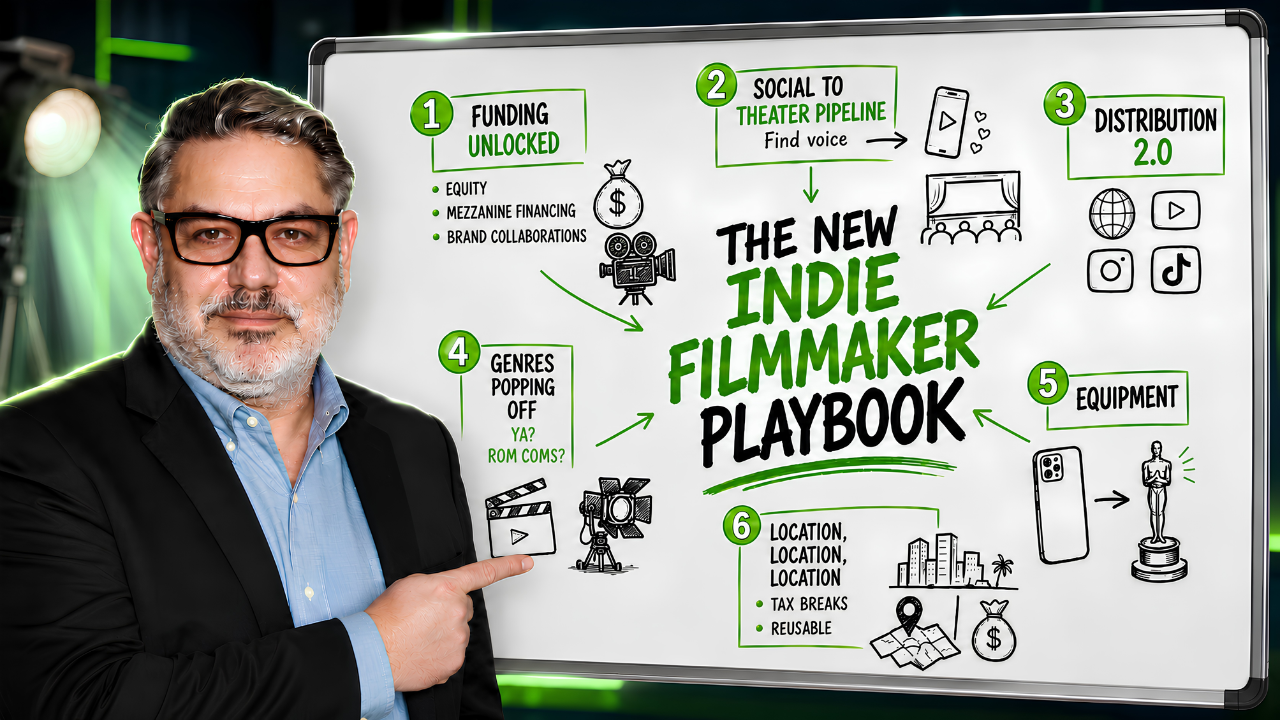
Mike: So now you have to look at how you bring in other non-traditional film financing, equity, mezzanine financing, brand collaborations where brands are supporting films. Every company now has a production division: designers, car companies. That whole brand-and-entertainment space is where a lot of the ad dollars are going. You just have to be more clever about how you put your financing together.
These movies are either going to go smaller and more interesting, like Iron Lung or Obsession, and kind of bootstrap their way into existence, or they have to be undeniably theatrical in that fifteen-million-plus world where the movie looks and smells and feels like a theatrical film and will get somebody behind it. The days of pre-sales plus a really attractive subsidy plus a little bit of gap and your movie gets made, that doesn't exist anymore. You need to find alternative financing components, whether it be, you know, rich dentists, or more aggressive gap funds and mezzanine funds that'll come in and finance your movie.
Building an Audience Before Making the Film
Mike: What these guys have successfully done, when you look at Iron Lung or some of these content creators moving into traditional entertainment, is they find their audience first, and then they take their projects to that audience. In that same way, that's what all these platforms and short films can do. That's where you build your voice and your personal brand or your personal vision. And then you can take that audience to traditional entertainment. That's invaluable right now. If you control the audience, you control the market.
John: I love that. My gut's telling me that what these filmmakers are doing so well is finding their audience. Let's just say objectively your film is good, there's an audience for your film. You just have to go find it, because there are people out there who want to watch your movie. I truly believe that people are dying for a good film. Now, if your film's bad, that's a tougher hill to climb. But if your film is good, there is an audience out there. Take solace and pride in that. There is a way for you to get your film off the ground, you've just got to go find it. It's a little extra elbow grease. I know it's kind of annoying. Who wants to go out and distribute your film after you went to war writing it, producing it, directing it? But there is an audience out there, case in point the examples Mike brought up.
What Genres Are Buyers Looking For?
John: From what you heard from the market standpoint, what are people looking for genre-wise? Obviously horror always plays, you mentioned Obsession and Iron Lung, which fit into that category but what have you been hearing?
Mike: They're always going to be looking for those movies. Horror is a genre that doesn't necessitate having to get one of the five names that everybody in the industry is chasing from a casting standpoint. So horror is just always going to be around, and you're going to have these breakthrough films that pop and are interesting.
I feel like there's an appetite now for romantic comedies and YA stuff that I have not seen before, like Cat of the Space. There's a real appetite for that. And then there's always the perennial action thriller, sci-fi. That's going to go forever because it just travels so easily. A good action film will travel, and it's easy to translate from a cultural or audience standpoint.
Top Countries and Subsidies for Filmmakers
John: What countries have you been hearing are becoming major players in terms of subsidies or incentives? What's being pushed now? A couple of years ago it was Romania. What's the new up-and-coming country, or a country that's been here to stay but is becoming a really attractive hub for filmmakers?
Mike: Part of solving the finance problem is identifying the right subsidy program to realize your movie. It starts from the creative standpoint, where is this going to fit creatively? And then you find out where the best place is to make the movie.
A perfect example is the movie I just finished, The Last Resort, which is a really fun action film set against the backdrop of spring break that we shot in the Canary Islands. I think the Canary Islands is one of the most attractive, busiest subsidy programs, great depth of crew, great locations. If you have a film that qualifies as EU or you can get a lot of European elements into it, it becomes an irresistible program. They also have co-productions with several countries.
The UK obviously has a very aggressive incentive right now and great talent. And then some of the usual suspects that will always be attractive if you can engineer the package the right way: Australia, New Zealand, Canada. Those three Commonwealth countries are probably the most heavily subsidized, with varying degrees of national requirements for cast, directors, and above-the-line talent.
When I look at the movie I shot in New Zealand, you combine a forty percent tax credit, a producer's offset, and a dollar that at the time was in the mid-fifties or sixty cents to the US dollar - all of a sudden your ten-million-dollar film is actually six million, and you're getting half of that out of the subsidies. Then you need three million out of the market on a really commercial film. That becomes much more tenable. Even if you can get to two of that and you've got to find a million in equity, it becomes infinitely more attractive depending on the genre and the package.
John: Do you think filmmakers should be gearing their settings toward these countries because money is so tight right now? Maybe retrofitting their story into a location to take advantage of these incentives?
Mike: From a producorial standpoint, it's always a consideration. That's how movies get made. You're also going to see, there's talk of a federal incentive in the US, and there are tax shelters here that are in place but difficult at times to access. I've been lucky enough to get them a couple of times. It used to be Section 181; now I think it's 168K or something like that. These are, in my opinion, the only way these movies get made in the US at a certain price.
You can still make a very small movie in the States and get it done for a price. But the other thing is to look at places like New York and New Jersey, who I think are doing it right, and other jurisdictions in the States, and then see how you can marry that to the federal tax incentive. If we can get a federal incentive, there'll be a gold rush back to the US in production, I believe.
John: I think that's the key. All the other big-player countries have some sort of incentive, we do as well, but to get some sort of federal subsidy program, it would just mean no one would go overseas. We talk about this all the time as we're piecing together our projects, where to shoot. But if it was easier and more advantageous here, why leave? It's easier for the crews and the cast. I completely agree. I think that would be fantastic.
The Biggest Mistake Filmmakers Are Making
John: What do you think the single biggest thing filmmakers are getting wrong about today's market?
Mike: I can't speak to all filmmakers, but I think you've got to seize on this. There's no barrier for entry right now. You can make an amazing movie. Look at Sean Baker's career one of his first films is Tangerine, shot on an iPhone. It was one of three films submitted to Sundance shot on an iPhone. It gets in, sells for what, a million bucks? And then goes on to great success. His second film gets nominated for an Oscar, and we all know what happened with Anora.
So you've got to look at how you marry really original storytelling to an industry that now, from a technical standpoint, has no barrier for entry. You can make really amazing films with prosumer equipment and anything you can get your hands on. The mistake would be to follow a trend, because as soon as everybody's talking about horror or whatever genre, by the time it's in the zeitgeist, it's already too late. It's already saturated. You have to be true to yourself and to what storytelling is personal to you.
If I was coming out of film school, I'd be like you have an embarrassment of opportunity right now to hone your craft and find your voice as a storyteller and as a filmmaker. You have all these outlets, whether it be Instagram or YouTube, to find your voice and make short content that builds your skill. It's a craft. You learn how to write by writing, and you direct by directing.
Budget Realities: $10K vs. $100K Films
John: I hear this all the time from the big filmmakers. Sam Raimi was saying many years ago, "You have no excuse. Go film." Which I totally agree. But let's be very frank about cost. If you adjust for inflation, some of these early films were fifty to a hundred thousand dollars in today's money. Do you recommend someone spending a hundred thousand? It's not a lot when we're talking about what we do on a daily basis. But do you think there's a difference, if they're going to go for broke, like Kevin Smith did with credit card debt between a hundred-thousand-dollar film and a ten-thousand-dollar film in today's market? From a buyer's standpoint, could they do something equally potent for their career at ten thousand?
Mike: I come from a world where I started my career in big studio movies, and I just think, anecdotally, you can make Titanic for two hundred million or you can make it for two million. You've got to know which version of that story you're telling.
I grew up coming out of film school in the nineties, which was the golden era of independent films, all the things you're talking about, whether it was Clerks or El Mariachi...
John: Brothers McMullen, Party Girl, all of it, yeah.
Mike: All of it. Slacker. Sex, Lies and Videotape. These movies felt like they were willed into existence. I think there's absolutely the opportunity for that. But on the other side of having this access to technology, you've got to find your voice and become proficient at what you're doing before you dive into a feature.
There's no reason that young filmmakers shouldn't be making two short films a year or more. I have filmmaker friends involved in these one-minute film festivals, and those films are super fun. You've just got to get your team together and make short films and find your craft.
Why Filmmakers Must Also Become Distributors
Mike: Once you're on the other side and you're making your fifty- or hundred-thousand-dollar feature, you also have to, in the current environment, because distribution is so broken, especially in the United States, become a distributor as well. There are so many success stories about filmmakers who self-distribute their films and have filmmaker-driven release strategies. They take a roadshow with their movie, they actually make money, and they do well.
If you're making a movie for a hundred thousand dollars, your chance of breaking out is so tiny that you have to figure out how you're going to take your movie out. Less than one percent of films, if you look at Sundance's entrance as a barometer of how many independent films are being made well, point-one percent of those get distribution at Sundance. That's the biggest, most important US festival, and it's still tiny. You have to look at different ways to distribute your movie. There's so much support now for self-distribution. And again, if it's a passionate, important film to you, you'll find a way.
John: I love that. I want to harp on that a little more to really drive home the point of distribution for filmmakers. If it's your money and you don't mind taking a bath, so to speak, that's one thing. But if you're getting investor money or money from friends, you want to pay them back because you want to snowball your career. You want to get the twenty-thousand-dollar feature that you self-distribute and make your money back, plus enough to turn that twenty thousand into a hundred-thousand-dollar feature for your next one. Keep building.
I hear filmmakers from the nineties all the time say, "I wanted to make sure I paid back my investors," because they knew they were going to go to them at some point for their next feature. The distribution part of what you're isolating here is super important. It's no longer just making your great film, you have to be the businessperson as well. Do you agree with that sentiment?
The Three Lives of an Independent Filmmaker
Mike: One hundred percent. At that level of entrance, you're going to live three lives. The first life is getting your movie made, getting the script together, putting the creative package together, finding the financing, and making the movie. Number two is actually making the movie, which feels like this eternal process of shooting, editing, and finishing. And then afterwards, if you are not one of the fortunate ones that gets into one of the top five festivals and that movie pops and gets distribution, guess what? You're going to figure out how to be a distributor. And being a distributor is a completely different skill set than being a filmmaker.
You have to familiarize yourself with how film distribution works and how you release things to communities. I just got an amazing documentary that won all these awards, and it is insanely tough material. I'm talking to the producer, who's been nominated for two Oscars, and he's struggling to find distribution for this amazing movie. We're talking about doing an affinity marketing plan with a filmmaker-driven theatrical roadshow in the US.
In the same way a Marvel movie is eventized and is a huge thing, I think we have to look through the independent lens and do the same thing for independent films. If your film is music-themed, figure out how you can tie a music component to the release. If there's an impact angle and it's about a social issue, find out how you can use that tool to get more awareness for your film.
"The Cavalry Is Not Coming"
John: Would it be fair to say that what separates filmmakers who have careers from those who are stuck is the distribution angle? Or is there something more to that?
Mike: There's a great keynote from South by Southwest by one of the Duplass brothers, and it's well worth looking up on YouTube. The thesis was: the cavalry is not coming. Nobody's coming to rescue you in independent film. You are it. Independent film is not independent film, it is dependent film. You're dependent on everyone.
John: I love that. It's not independent, it is dependent. I love that. Make a t-shirt.
Mike: You should make a t-shirt! That's in a textbook at Loyola Marymount that I was quoted in. It's something I say all the time.
Watch that speech, because I think it's really good. Looking at the Duplass brothers is such a good trajectory to follow. These guys made a movie that I don't think anybody has seen. They did some tiny movie that didn't work. Then they went and made The Puffy Chair for fifteen thousand dollars, and they basically kicked off this whole mumblecore movement of making films where the crew can never outnumber the cast, really character-driven work.
I remember it went to Netflix, and I think the year they made The Puffy Chair, they were the second-most-streamed movie on Netflix. They did this campaign in Austin where they promoted the movie almost like an indie band, almost like a music thing. They built their own audience. All of a sudden they became this brand for films, Hannah Takes the Stairs and all these cool little indie movies. Frances Ha. Really intimate, character-driven films.
You just have to take control. They say this great thing: "We don't take meetings. We just want to make movies." They would not waste their time waiting for the industry to help them, they just helped themselves. That's a huge lesson right now. The cavalry is not coming. No one's going to come and save you. You have to save yourself. The best way you can do that is to be great, find your voice, make amazing short films before you make your first feature. And then, if your feature is worthy, you're going to get behind it and find an audience for it.
John: I heard a similar saying from a producer once: "Nobody wants to make your movie." You've got to go out and make it yourself. There's something about pulling yourself up by the bootstraps and going to make it.
I also think when we mention these lower-budget movies that hit it out of the park, people want to see that. A film for twenty thousand dollars that catches fire? They want to see it. It's almost, I don't say it's voyeuristic, but they want to see how something gets made for seven-fifty or for ten or fifteen thousand dollars. I remember ten-plus years ago, there was an Anton Yelchin and Jennifer Lawrence romance movie made for a hundred and twenty thousand dollars. It sold at Sundance for big bucks. People like seeing someone take a low budget and make it work because they can think, "I can do that too. It's within my reach." If we start talking about ten, fifteen million dollar movies, it's like, "I'm never going to get that money." But, "Hey, I can maybe do a movie for fifteen thousand, like the Duplass brothers. Maybe now, with market inflation, forty thousand." That feels achievable.
Closing Thoughts
John: Like you just said, you've got to go out and sharpen your skills as a filmmaker. Shoot shorts. If you want to write, write. You've got to do it all, because eventually your time will come. You will get your opportunity to make a feature if you build your skill set.
Mike Gabrawy, thank you so much, my friend. You're wonderful as always in embracing us and imparting all your knowledge. We'll have you on again soon. Really appreciate it.
Mike: My pleasure. Thank you so much for having me.
John: If you got something out of today's podcast, please share it with your filmmaking and screenwriting community and hit subscribe. It genuinely helps us keep making these. We'll see you next time.