Hollywood Misconceptions Holding Filmmakers Back [Podcast]
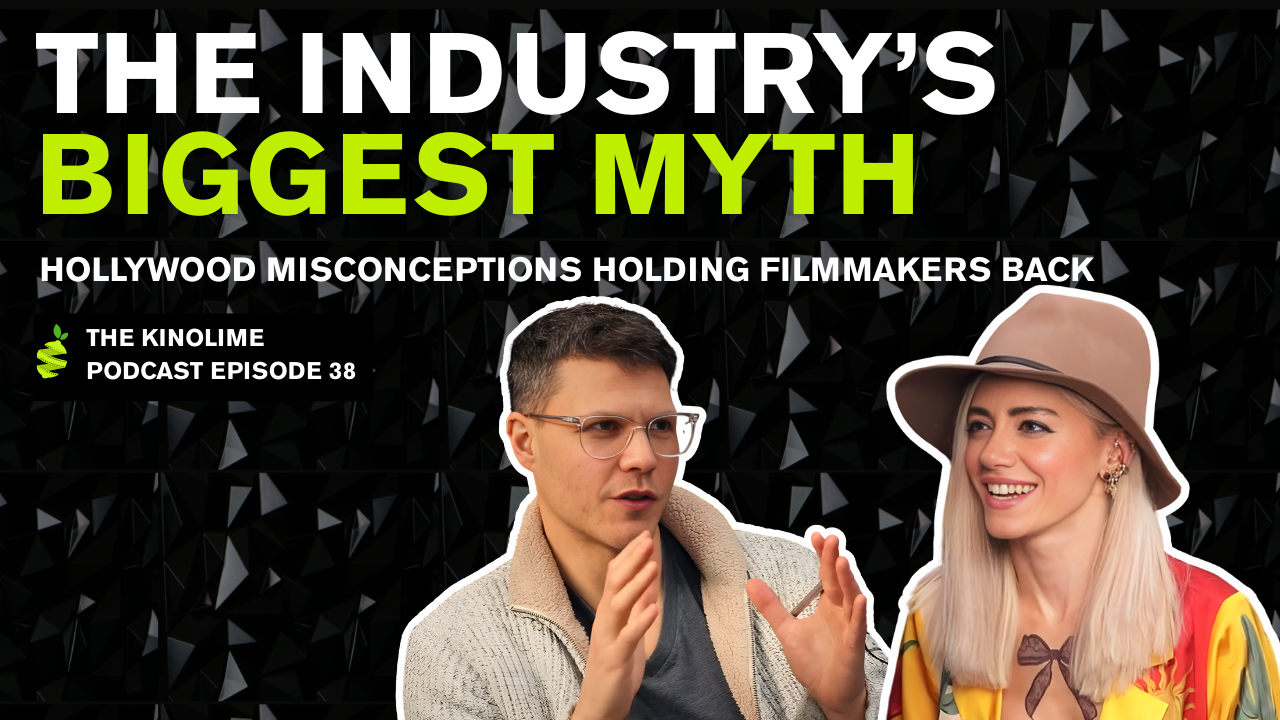
John and Chaya pull back the curtain on the myths that keep filmmakers spinning their wheels. In a candid, funny, no-BS conversation, they break down the biggest Hollywood misconceptions - from “indie vs. studio” and “a great script will get you discovered,” to what a producer attachment really means, how to spot the middle-ground bullshitters, and why the best films let the art lead the message.
They also dig into glamour vs. grit, modern attention spans, and the truth about “top vs. bottom” in an industry where every win is a new beginning. If you’re trying to break in (or stay in), this episode is your reality check and your motivation to keep grinding.
Full Transcript: Kinolime Podcast Episode 38: Hollywood Misconceptions Holding Filmmakers Back
Participants
John Schramm - Head of Development, Kinolime
Chaya Amor - CMO and Producer, Kinolime
John: Hey everybody, welcome to The Kinolime Podcast. We have the amazingly talented, super brilliant, and oh my gosh, so fashionable, Chaya Amor in the studio. Girl, how you doing?
Chaya: Good. The list was short. Thank you.
John: If I said everything, it would take the entire episode and we’d have to edit it out. People want to hear about producing, making it, and how this all works.
Chaya: Let’s give the crowd what they want.
John: When you came to me with the idea for today’s episode, I loved it immediately.
Chaya: You did. You were like… boom.
John: Today we’re talking about Hollywood misconceptions. There are so many misconceptions about filmmaking - what it takes to be a writer, how to get in, producing, all of it. We’re going to have a candid conversation and share perspectives from different paths.
Chaya: You don’t have a choice.
John: I don’t have a choice. Let’s get into it.
“Hollywood vs. Indies” (Two Separate Worlds)
John: There’s this idea that Hollywood hates indie and indie hates Hollywood. What do you think?
Chaya: I love this misconception, because the biggest misunderstanding is thinking they’re two separate entities. They’re part of the same ecosystem, just different roles. Indie can feel more open and more creative, but it’s also smaller and tighter. And Hollywood has its hands deep in indie because that’s where they scout: what’s interesting, what can be magnified.
Hollywood doesn’t kill creativity, and indie doesn’t create creativity. Indie is where people start. Hollywood is where something can expand, including the creativity.
John: It’s yin and yang. They need each other. The indie world feeds Hollywood, and Hollywood gives indie filmmakers a bigger platform.
Chaya: Exactly. Hollywood needs content, but they don’t always want to spend money unless they know it’s good. Indie is a shopping market. And indie creators are trying to get into the Hollywood frame so the work can scale.
John: They’re always looking for the great indie director.
Chaya: Yes. And actors move between the two for a reason, they want both.
John: Indies will never go away. People want to make films and don’t always have studio money. And Hollywood will always exist because it has the resources but it also needs indie talent to rise up.
“If My Script Is Great, Hollywood Will Find Me”
John: Misconception number two: If my script is great, Hollywood will find me.
I’m an idealist, I want to believe great work rises. But it’s a hard business to break into. I’ve seen friends who are incredible writers not work as much as the ones who hustle harder.
Chaya: Totally. We don’t have a “self-driving” career path in film, you have to drive it yourself. In any industry, having a good idea isn’t enough. You have to package it. You have to position yourself.
And your script might be good, but you are the value to the script as much as the script itself.
John: That’s why Kinolime exists, not to plug us, but because we’re trying to find great scripts through a process that actually leads to production.
Chaya: But even then, you still have to enter, submit, put yourself out there. You always have to put yourself in position.
John: A producer once told me something that changed my perspective: “John, nobody wants to make your movie.”
And it clicked. They already have their slate, their priorities. You have to push your project forward. You can’t just write it and wait.
Chaya: Exactly. Writing the script is only the first part.
John: And honestly it’s not even halfway.
“Credentials Are Enough” (Committed vs. Credentialed)
Chaya: This one matters a lot to me as a producer: committed vs. credentialed.
People can be impressive on paper, film school, degrees, knowledge, connections. You can have great conversations and think, “Wow, this person knows everything.” But what matters most is: Can you stay in it with me until the end? Through the ups and downs?
John: The misconception is that credentials are enough. They’re not. It’s grit. It’s hustle. It’s showing up again and again.
When I started, I wasn’t the most talented writer. I got consistent work because I was a grinder. I wrote draft after draft, put in the hours, and kept improving.
Chaya: As a producer, I can say the same: the best partnerships often aren’t with the people who know the most trivia or theory. It’s the people who don’t stop. They commit, and they finish.
“If a Producer Is Attached, the Movie Is Basically Greenlit”
John: Misconception number four: If you have a producer attached, you’re good.
I fell for this early in my career. A top-tier indie producer optioned my script. He called me and said, “John, I’m going to make your movie.” I was new in LA -thought it was gold. The movie never got made.
So yeah, having a producer attached is great, but it doesn’t mean a movie will get greenlit.
Chaya: Having a producer attached often means your script is strong enough to get attention. That’s a boost. But communication matters: expectations, timelines, and clarity. And you should keep hustling. More interest can help momentum.
John: Exactly. Making a movie is a miracle. People who make movies consistently say it all the time, every time one gets made, it’s shocking. So: congrats if you have a producer, but it’s not a guarantee.
Chaya: It’s still the beginning of the line. So much can change, stay vigilant.
“Everyone in Hollywood Is a Bullshitter”
Chaya: People always ask: “How do you deal with Hollywood bullshitters?”
The misconception is that everyone in Hollywood is a bullshitter. First of all, every industry has bullshitters.
But this industry runs on relationships. Reputation is everything. Lose your reputation and you fall.
The bullshitters tend to sit in the middle. The people at the top, most of the time they’re kind, smart, hardworking, and relationship-driven. Same with people at the bottom who are building. The middle is where some people overpromise and underdeliver.
Do they ruin it for others? Sure. But it’s not the whole industry.
John: Every business has BS-ers. Hollywood isn’t full of them. There are tons of talented people who care about making great work.
And sure sometimes you “fake it till you make it” or act like you’ve been there. But the point is: don’t let the misconception poison you.
Chaya: Don’t get deterred. Bullshitters are talented at mimicking. But the successful people? Most of them aren’t bullshitters.
John: The misconception we’re putting to bed: Hollywood isn’t full of bullshitters, at least not the ones doing the real work.
Art vs. Message (And the Problem With Spoon-Feeding)
Chaya: This is a big one: art vs. message.
People always ask, “Why now?” “What’s the message?” And yes, message matters. But the art has to drive the message. When the art is great, you don’t feel preached at.
Think of Casablanca or The Godfather, the message is there, but you’re experiencing the story first.
John: A lot of art today feels literal and on-the-nose. Subtlety gets lost. I don’t want to be hit over the head with the message.
Chaya: Exactly. Give me a good story and the message will be there. And also, don’t be lazy with meaning. Sometimes messaging is flat, oversimplified, and consequence-free.
John: Theme should emerge through character. If you push the message as the engine, you telegraph it. People get allergic to that.
Chaya: Don’t be too forward and don’t be too lazy.
John: Take me on an adventure. Tell me a story. Don’t teach me a lesson.
Chaya: Give the audience space to interpret but not so much space that they’re lost. There’s a balance between spoon-feeding and giving nothing at all.
Glamour vs. Grit
John: Walk us through glamour vs. grit.
Chaya: The misconception is that it’s all glamour. For me, the red carpet is actually a grit moment, that’s when I’m working the hardest. Who I meet, how I pitch, how I navigate investors and pressure.
The most glamorous part is being on set in a hoodie and sweats, fully in the creative zone.
John: Totally. For 99% of people at these events, they’re working. You have to be “on.”
Chaya: The glamour never takes away from the grit. Even when you’re celebrating a win, you’re still working.
Reacting vs. Adapting (Attention Spans + Modern Viewing)
John: This one is timely. There was talk about streamers wanting plots repeated because people are on their phones.
Chaya: Here’s the thing: social media is fast-paced, but that doesn’t mean people are dumb. It can mean they’re overloaded. If something is interesting, people will stop and watch.
Oversimplifying and repeating is reacting to what you think is the problem. Instead, adapt by making the film meaningful enough to earn attention.
John: I’ve seen that. Teens can lock into an older movie if it’s good. I put on My Cousin Vinny for three teenage girls recently and they were glued.
Chaya: Exactly. It’s not that they can’t handle a slower pace. They just won’t tolerate it if it’s not good.
John: So don’t react, write your best story.
Chaya: Yes. Become more engaging, not less. Give them more reason to lean in. Don’t repeat. Don’t spoon-feed.
John: Don’t use spoons.
Chaya: Don’t use spoons. Use your hands.
Top vs. Bottom (The “Ladder” of the Industry)
Chaya: People think, “I’m on the bottom, you’re on the top.” But in this industry, every time you succeed at one thing, you’re on the bottom of something else.
I never feel like I’m at the top. Sometimes it helps to breathe and look back but the ecosystem makes you feel like you’re always stepping into a new ring.
John: I’m going to get heavy: maybe there is no top and bottom. Maybe you’re just hovering where you are. I wish I’d been more present early in my career instead of chasing the next rung immediately.
Chaya: I hear you. But I like the ladder concept because it reminds me I can reach down and help someone up and someone above can help pull me forward. It’s a moving system.
John: What if it’s more like a carousel, everyone moving together, equal, no head of the table?
Chaya: We’re going to disagree. I think it’s useful to visualize something above you so you can climb toward it. But when you get there, you realize you’re back at the bottom again and that’s normal.
John: You’ll never truly reach “the top.” Human nature wants more. The key is honoring where you are.
Chaya: And remembering: there are always new beginnings. Also, if you stop moving in this industry, you can lose your spot fast.
Q&A With Chaya
John: What have you learned as a producer over the past several months to a year that you’re taking into 2026?
Chaya: There are so many lessons. I feel like everything is a lesson.
Leadership on Set
John: You’ve been on a lot of sets. What’s something you bring to set and production?
Chaya: It’s important to me that I know every single person on set. I learn their names and what they do. I want everyone to feel seen, cared for, and appreciated because people do their best work when they feel good and supported. I want it to feel like a family, not like, “Oh, the boss is here, scram.”
What Blew Your Mind Recently
John: What’s something you’ve watched lately that blew your mind?
Chaya: I rewatched The Godfather, all three.
John: One or two?
Chaya: I’m a one.
John: I’m a one, too.
Chaya: It’s my cleanser. It reminds me why I’m in the business, acting, craft, storytelling. A movie that old can still grip you completely.
Fashion (Because Of Course)
John: Speaking of drip, your fashion always blows me away. Where do you shop?
Chaya: I go to people’s homes, steal their clothes, put them on. (Kidding.) I thrift, I shop online. It’s not like, “Today I go shopping.” It’s more like: I see it, I want it, I get it.
John: I get jealous.
Chaya: You can take it. Sometimes I’ll see something in a book or a reference and I’ll go hunting for something with that energy.
John: If you find a men’s medium, pants 32/30, with feathers, I’m your guy.
Chaya: This is so fun. John, you’re amazing. He’s a great screenwriter.
Kinolime Competition
John: Thanks for joining us at Kinolime. If you’re a screenwriter or filmmaker, listen up: we’re opening our third annual Feature Film 3.0 Screenwriting Competition, running January 23rd to March 15th. That means you can get your movie made.
If you’re new to Kinolime, here’s what we do: we host a yearly screenwriting competition open to writers worldwide (English language, properly formatted). Film lovers read your script and vote. The top script gets made into a movie with Kinolime.
Our first competition winner, The Waif, and last year’s winner, Mob Mentality, are going into production in 2026, two movies in one year. If you want your screenplay turned into a film, go to Kinolime.com, set up an account, find the info, ask questions, and get your submission ready. We can’t wait to read your work.