
Lessons From the Indie Film Path with Bret Raybould [Podcast]
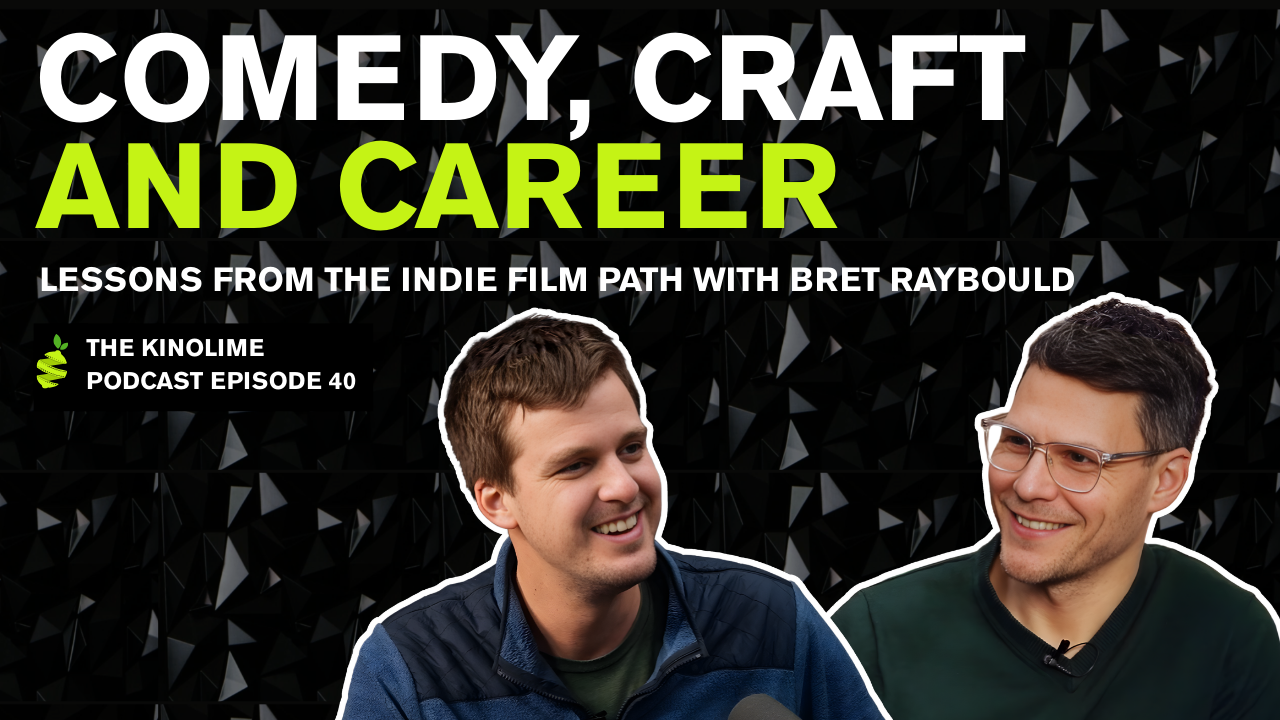
Bret Raybould drops into the Kinolime studio for a completely unscheduled, laugh-heavy episode that turns into a masterclass on actually finishing your script. Fresh off selling an animated series (Stupeheroes) to Tubi, Bret breaks down how stand-up teaches you to “write out loud,” why comedy works best in collaboration, and how he and his partners generate six to eight pages in a long room session without getting precious. Along the way, John digs into the dreaded second-act sag, Coppola’s 15-page approach, and the simplest rule that separates amateurs from professionals: writers finish.
Full Transcript: Kinolime Podcast Episode 40: Lessons From the Indie Film Path with Bret Raybould
Participants
John Schramm - Head of Development, Kinolime
Bret Raybould - Stand-up comedian, Writer
John: Welcome to the Kinolime Podcast. We have an impromptu, unscheduled episode today because the incomparable Bret Raybould here with us in the studio.
Bret: Broke in. He forced us to podcast with him.
John: That’s right.
John: Bret is an amazing stand-up comedian and also a very talented and paid screenwriter. So today we’re going to pick his brain about comedy, writing, and breaking into the industry. Bret, thanks for coming in.
Let’s start with something exciting. You recently sold a show to Tubi. Tell us about that. You’re a working comedian here in New York City, but you’ve also transitioned into screenwriting.
Selling a Show to Tubi
Bret: Sure. A couple of friends and I were lucky enough to sell a show to Tubi, which is honestly one of the most exciting streaming platforms right now. They have a huge audience base, and you don’t even need a login to watch their content.
I do have to give 99% of the credit to my writing partner Christian Duran, who’s an incredible comedian, writer, and director. He was the one who really shepherded the project toward the sale.
John: What’s the show called?
Bret: It’s called Stuperheroes.
John: Love it.
Bret: It’s a cartoon series. The premise is that three kids save a crash-landed alien. As a reward, he gives them each a superpower. The problem is they’re ten years old when they make the wish, so they choose ridiculous powers.
Now they’re forty years old and stuck with these useless abilities.
John: That’s fantastic.
Bret: And the powers are actually the least important part of the show. It’s really about being a disenfranchised forty-year-old and trying to navigate life.
Comedy, Age, and Creative Perspective
John: So you’re writing about forty-year-olds already?
Bret: Hey, I’m only 34.
John: Are you? I thought you were over 35.
Bret: How dare you. As someone nearing fifty-
John: I’m 42.
John: I know, I know.
Writing Process: Stand-Up vs Screenwriting
John: Let’s talk about your writing process. You’re a stand-up comedian but also a narrative writer. What does a typical writing day look like?
Bret: Stand-up and script writing are completely different processes.
For stand-up, I don’t really “write” in the traditional sense. I come up with an idea and talk about it with people. I’ll call a friend and run the joke by them. Stand-up is a spoken art form, so the writing happens through conversation and performance.
The audience becomes your proofreader. If they laugh, you keep it. If they don’t, you cut it.
John: So how do you transition from that to writing feature scripts?
Writing Comedy With Partners
Bret: I mostly write comedy scripts, and I almost always write with a friend. I actually love that process because writing with someone else makes me feel funny.
I’ve written things on my own, but comedy is just easier with another person.
Something Jordan Peele once said, the best writing advice is simply “follow the fun.”
If your writing partner says something funny, that’s your direction. You don’t need to overanalyze it. Just follow what’s fun.
First Drafts and “Shoveling Sand”
John: Jordan Peele also described the first draft as “shoveling sand into the sandbox.”
Don’t worry about what it looks like yet. Just get the sand in the sandbox. Later, you can build the sandcastle.
Bret: That’s exactly right.
Confidence Comes From Finishing
Bret: For me, the hardest thing for years was simply finishing a script.
I always wanted to write a movie, but for almost ten years I’d get to around page 40 and stop.
The first 25 pages are easy. That’s the exciting part of the idea. But after that, the work really begins.
The “Second Act Problem”
John: That’s incredibly common. The first act is setup, character, world, the inciting incident.
But the second act is where writers get stuck. That’s why so many screenwriting structures exist, they help guide you through that middle section.
One technique I like comes from Francis Ford Coppola. He used to write in 15-page increments. He would only know where the next fifteen pages were going, and then he’d let the characters guide him from there.
If your characters have strong goals and obstacles, the story will move forward.
The Psychological Value of Finishing
Bret: Exactly. Finishing a script, even if it’s terrible, is incredibly valuable psychologically.
Once you finish one, you realize: Oh, I can actually do this.
And that realization makes the next one easier.
“Writers Finish”
Bret: When friends ask me for writing advice, I usually say this:
Writers don’t write. Writers finish. That’s the whole job.
John: That’s a T-shirt right there.
Celebrating the Draft
John: Every time I finish a draft, I celebrate. I go out to dinner, maybe a nice restaurant, maybe Taco Bell.
Finishing a draft is an accomplishment.
Once you have the clay on the page, the fun begins, shaping it.
Learning Through Doing
Bret: You really can only learn by doing. I’ve read tons of screenwriting books, but eventually you just have to figure out your own process.
Personally, I hate outlining. It feels like homework. I just start writing.
That said, having a talented co-writer definitely helps.
Finding the Right Writing Partner
John: That’s another great point. If writing alone feels daunting, find a partner.
Ideally someone who complements your skills. One of my collaborators once said to me:
“You have the skills I don’t have, and I have the skills you don’t.”
That’s a great partnership.
Writing Together in the Room
John: How do you actually write together?
Bret: My favorite way is literally writing in the same room. My friend Daniel and I will sit together and write the script side-by-side.
Sometimes we’ll work for about ten hours.
John: Ten hours?
Bret: It sounds intense, but it includes walking, getting food, talking, it’s not ten straight hours typing.
But in that time we’ll usually produce six to eight pages, which is pretty solid.
Writing Ugly First
Bret: One trick that really helps me is writing ugly dialogue first.
Just write the idea in the simplest possible way:
“I’m mad at you. You betrayed me.”
Then you fix it later.
John: That’s fantastic advice. Don’t be precious with the first draft. Just get it on the page.
Your characters, motivations, and scenes will change anyway during revisions.
Avoid Getting Stuck on Details
Bret: Sometimes I’ll even leave placeholder names.
If a character is a king, I’ll literally write “King Guy.”
Then later I’ll come back and give him a proper name.
The important thing is to keep writing.
Final Writing Advice
John: Before you go, what’s the best writing advice you’ve ever received?
Bret: Well, the big one is still:
Writers finish.
Another is follow the fun.
And the third is something every writer needs to hear:
You can do it.
Closing Thoughts
John: Brett, thank you for coming in. You’re an incredible writer, comedian, and friend.
Bret: Thanks for having me.
John: And thank you to everyone listening. Let us know in the comments:
What’s the best writing advice you’ve ever heard?
Kinolime Competition Announcement
Our previous competition winners, The Waif and Mob Mentality, are both going into production in 2026.
That means if you win this year’s competition, your film could be next.
Submit your screenplay at kinolime.com, create an account, and send us your work.
We can’t wait to read it.