
How to Turn a Good Script Into a Must-Read w/ writer-director Adze Ugah [Podcast]
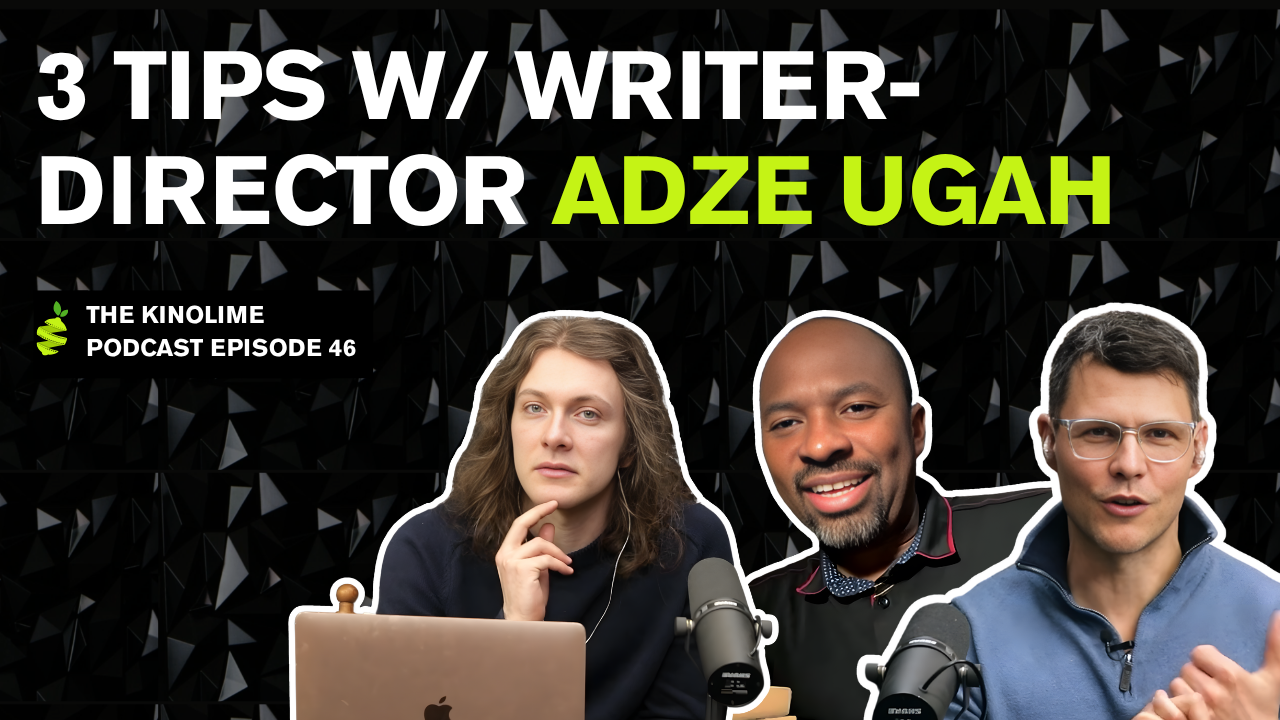
Adze Ugah’s path to filmmaking didn’t begin with privilege, connections, or a clear roadmap. It began with obsession, with stories, with cinema, and with the need to tell something true. In this episode, John and Danny sit down with the South African director behind Shaka and the upcoming Something Like Molasses (Kinolime Production) to talk about the long road from Nigeria to film school, the lessons that changed his understanding of storytelling, and why the most powerful work always starts with the filmmaker’s own point of view.
It’s a thoughtful conversation about craft, persistence, vulnerability, and the courage it takes to put yourself on the page. From early movie influences to hard-won industry experience, Adze shares what shaped him as an artist, and why authenticity is still the thing that makes stories connect.
Full Transcript: Kinolime Podcast Episode 46: How to Turn a Good Script Into a Must-Read w/ writer-director Adze Ugah
Participants
John Schramm - Head of Development, Kinolime
Danny Murray - Creative Executive, Kinolime
Adze Ugah - Director (Shaka iLembe, Something Like Molasses - Kinolime Competition Runner-up)
John: Hey everybody, welcome to the Kinolime Podcast. It’s John Schramm and Danny Murray, and we have an amazing guest today. I’ve been wanting to make this happen for weeks, and now we finally have Adze Ugah from South Africa here with us, director of the upcoming feature Something Like Molasses, which was our runner-up in the first competition. Adze, what’s up?
Adze: What’s up, guys? So good to be here.
John: Jeez, I’ve been looking forward to this more than you have, as far as I’m concerned.
Danny: I think on the excitement level, we’re both at a ten. There’s so much to talk about. We want to get into Shaka, the biggest South African show ever, and of course Something Like Molasses. But before we do that, we want to know more about you. Take us through who you are, where you grew up, and how you first fell in love with cinema.
Early Life and Falling in Love with Film
Adze: Jeez. Okay. As far back as I can remember, I’ve always wanted to be a filmmaker. That’s a line from Goodfellas, if you caught it.
John: Of course. “Ever since I was a kid, I always wanted to be a mobster,” right?
Adze: Exactly. I was born and raised in Nigeria, and life was tough, but I was lucky. My mom was a social worker, and my dad was an engineer who worked for the national broadcaster in Nigeria, the Nigerian Television Authority - NTA.
Even before we had a television at home, I was obsessed with anything involving moving images. The moment I saw something on a screen, I was glued to it, mesmerized, hypnotized. If someone sent me to get water or a knife or a fork, and I passed a television with something playing, I’d forget the errand completely. That’s how obsessed I was.
As the years went by, I found myself increasingly drawn not just to movies, but to narrative itself. I started figuring out the codes and tropes, the things that make movies work. I’m a very empathetic person, and whenever I feel something strongly, I want to share it. So if I watched a movie that touched me, I’d immediately go tell my friends about it.
I got so good at retelling movies that in grade school, when the teacher wanted to keep the class occupied, she would call me to the front and have me tell a story.
John: No way. Really?
Adze: Really. I was the storyteller.
John: I remember reading in Sid Field or Robert McKee that one of the best ways to learn storytelling is to tell stories out loud or pitch them to friends, because you naturally cut out the fat and focus on the meat. It sounds like you already had that instinct as a kid.
You touched on something really interesting too, being an empath. I’m an empath as well. What was your first big movie moment as a kid? Was there a film that truly blew you away and made you think, This is what I have to do?
The Films That Shaped Adze
Adze: There were several, and let me just say, for a kid my age, they were probably very inappropriate. But that’s how it was growing up.
The first film that truly left me in awe of storytelling was Full Metal Jacket.
John: How old were you when you saw Full Metal Jacket?
Adze: Maybe 12 or 13.
John: Okay, I thought you were going to say four or five.
Adze: No, no. The thing about Nigeria back then was that there wasn’t really a structured film culture in the way there is elsewhere. We consumed movies through VHS tapes, Betamax tapes, and whatever happened to be on television. There was a cinema culture, but Hollywood films weren’t easily accessible in theaters where I grew up.
So the way we discovered movies was basically by chance. There were no magazines, no marketing campaigns, no one telling us what was coming out. If you wanted to find a great film, you had to watch everything. And luckily, I had a voracious appetite for movies. I could spend an entire day feeding tapes into the VCR and just watching film after film.
My mom was also a wonderful storyteller, so I think I got that storytelling bug from her. And because my dad worked for the national broadcaster, he was able to bring VHS tapes home. So between the two of them, my appetite for cinema was constantly being fed.
I remember Full Metal Jacket making a huge impression. I remember Goodfellas making a massive impression. And the first VCR film my family got access to was The Man with the Golden Gun.
John: 007. Wow.
Adze: Yeah. Not a great film, but there’s still some good stuff in there.
But in terms of the films that made me think, You have to make movies for a living, it was Full Metal Jacket and Goodfellas.
Leaving Engineering for Film School
Adze: At that time, there really weren’t film schools in Nigeria, or even on much of the continent, in the structured sense. If you wanted to study film, you usually had to leave the country. And no one in my orbit was a filmmaker. No uncle, no cousin, no relative, nobody who even knew a filmmaker.
In my family, film wasn’t considered a career path. You could be a doctor, engineer, lawyer, anything respectable. But film? Not even part of the conversation.
So I found myself in university studying engineering. But after a while, I realized I was spending more time and money on film books than on engineering books. It became obvious that if I didn’t make the switch, I was going to live a miserable life.
Fortunately, around 1998 or 1999, the Nigerian government opened a film school, and I went.
John: What did your parents think? Because leaving engineering to pursue the arts is basically every parent’s nightmare.
Adze: You can imagine how heartbreaking it was for them. My dad was more forgiving than my mom, but remember, he was an engineer at the broadcaster, not one of the creatives. He believed there was a more stable career path in engineering because he knew what the creatives were earning.
So I had to be strategic. I knew if I told them too early, they would try to stop me. They’d emotionally blackmail me and give me every reason in the world not to go. So I didn’t tell them until I was absolutely sure it was happening.
I had already registered, paid the first tranche of school fees, and secured accommodation. The film school was about a five-hour drive from where my family lived. On the actual day I was supposed to leave, I told them, “In about an hour, I’m getting on a bus and going to film school.”
I didn’t give them time to react. I dropped the bomb, and then I was out of the house with my bags.
John: Wow. That’s impressive.
Adze: It was the only way I could do it. I’m sure there was a lot of resentment after I left. When I think about it now, it must have been very harsh for them.
Film School in South Africa
Danny: So you get to South Africa. You’re in film school. Tell me about that experience.
Adze: Film school in South Africa was fantastic. My studies in Nigeria had been more theoretical, but I wanted to study actual film - 16mm, 35mm, celluloid. South Africa offered that.
So suddenly I was in classes, handling 16mm cameras, writing treatments, making films. And the school didn’t just automatically let anyone become a writer-director. They assessed you first. If they didn’t think you’d make a good director, they would steer you toward editing, cinematography, or something else.
There was a real chance I wouldn’t get into the directing track. But fortunately, they looked at me and said, “Yep, you’re going to direct.”
Out of all the foreign students that came in that year, from Canada, India, Kenya, Brazil, I was the only one who was allowed to study directing.
Danny: When you started film school, did you go in wanting to be a writer-director, or just a director?
Adze: Initially, I wanted to be a director. But that’s where I really learned how important writing was, especially in our context. Over time, I came to understand the value of being able to write and direct, because that’s filmmaking. You’re not just directing traffic, you’re telling stories.
At AFDA, the school insisted on that. If you couldn’t write, you couldn’t really direct. And if you could direct but couldn’t write, that was a problem too.
It was hands-on, rigorous training. We made our 16mm films, our 35mm films, and went through the entire process. You learned patience and discipline because film was expensive and resources were limited. This wasn’t the digital era where you could do 70 takes and fix it later. You had one or two takes, maybe a few rolls of film, and everything had to be planned precisely.
That intensity taught us a lot. Filmmakers now don’t know what they missed.
The Biggest Lesson from Film School
Danny: So what was the best lesson you took from film school, the one thing that really changed your perspective and stayed with you?
Adze: The biggest lesson was this: when it comes to storytelling, you have to put yourself into the story.
We talked earlier about empathy. You can watch someone else’s experience and be moved by it. But when it comes time to tell your own story, a lot of people make the mistake of staying too objective. They refuse to take a point of view. They don’t impose themselves on the material.
So the story ends up feeling like it belongs nowhere, because the storyteller hasn’t truly entered it.
The thing that changed everything for me was realizing that storytelling begins with the filmmaker, the storyteller first. It starts with their point of view, their experiences, how they relate to the subject matter, and what they bring of themselves into the work.
John: I love that. I really do. And for everybody listening at home, Tarantino talks about this too. Every movie he makes, someone calls him and says, “Hey, was I that character?” because he pulls from real life.
That’s what makes a screenplay come alive. What Adze is saying is: put yourself in it. Use your life, your mother, your father, your cousins - not literally, but emotionally. That’s what makes the work leap off the page.
Adze: Exactly. That’s what shifted things for me.
In the beginning, I made films and assumed they were great because I wrote them and I shot them. But then people would watch them and not connect. And I’d think, Don’t you see what I see? And they’d say, No, we’re just not feeling anything.
It wasn’t until I learned that lesson that things changed. I realized that honesty, transparency, vulnerability, and authenticity are what connect you to other people. But it requires courage. Otherwise, what are we doing?
John: Exactly. Otherwise you’re just making newsreels.
Recurring Themes in Adze’s Work
Danny: Do you think that idea shows up in your work as recurring themes? Is there a through-line in the way you approach story?
Adze: I’m always fascinated by belonging, belonging and acceptance. I don’t know why it matters so much to me, but it does. Maybe that’s why I resonated so much with Full Metal Jacket and Goodfellas. At their core, those stories are about belonging, being part of a community, wanting to fit in, wanting to be accepted.
As human beings, that need never really leaves us. It starts in family, school, neighborhood, and continues through adulthood and relationships. What do you want from a relationship? You want to belong. You want to be accepted, flaws and all.
So for me, that’s always an entry point into story.
John: That’s fascinating. Every great filmmaker seems to have something that keeps bubbling up. Tyler Perry has it. Michael Mann has it. There’s always some recurring emotional question they’re wrestling with.
And for everyone at home, maybe that’s worth thinking about too: what theme keeps surfacing in your work, whether you realize it or not?
Starting Out in the Industry
Danny: So you finish film school. What happens next?
Adze: By the time I graduated, I still hadn’t fully paid my school fees. I was allowed to graduate, but I wasn’t given my diploma. But the good thing was, I had a showreel. I had the films I’d made in school - my 16mm film, my 35mm film - and they were strong enough to stand on their own.
So I put them onto VHS tapes and sent them to production companies in Johannesburg saying, “Hi, my name is Adze Ugah, I’m looking for work, here’s my reel.”
I got a few polite rejections. Then one company, Penguin Films, got back to me. They mostly made TV series for South African television, and they said they had an opening for a third assistant director.
At the time, I thought, Third assistant director? Great, I’ll get to do some directing. I had no idea it had absolutely nothing to do with directing.
But I took the job anyway.
And once I got there, I refused to coast. I was hungry. I was always in everyone’s face, the director’s, the AD’s, everybody’s. If someone needed coffee, I’d get it. If someone needed a tampon, I’d get it. I didn’t care. I just wanted the machine to keep running.
And every script I got, I read it as if I were directing it myself.
By the time we finished the show, the producer was impressed enough to move me up to second assistant director for season two. Then by the time that wrapped, they were ready to offer me a directing job.
John: That’s such a great example of creating your own luck. You took a third AD job - which could have seemed tiny, and through hard work, hunger, and persistence, you turned it into a directing opportunity. That’s what people need to understand: you create your own luck.
The First Real “Welcome to the Business” Moment
Danny: On that first professional job, did you have a moment where you thought, Okay, this is the real industry now?
Adze: Funny enough, yes. The moment the unit locations manager handed me a radio.
John: Ah, yes. The walkie-talkie. That’s huge.
Adze: Exactly. I suddenly felt like I was part of this network, this hive, this army making a television series. It was humbling. I think I almost shed a tear.
It didn’t matter that I was just a third AD. I was part of the machine. And even though the role had nothing to do with directing, I was the first one on set. I was receiving actors, getting them through makeup and wardrobe, standing next to television stars who depended on me to keep things moving.
That was my real entry into the professional space.
Moving from Television to Features
Danny: So when did you transition from TV into feature films?
Adze: South Africa is mostly a television economy. We do have cinemas, but most of what plays there is Hollywood. So if you want to make a living, you usually have to work in both TV and film.
I’d been doing TV for a long time when I attended a workshop taught by Robert McKee. And that workshop reignited the writer-director in me.
I decided to take what I’d learned and put it into practice. So I started writing a script based on McKee’s structure. I wasn’t writing it to produce it. I wasn’t pitching it. I was just writing to learn, to test the ideas. I kept rewriting it for years.
Eventually, I walked away from it.
Then one day, while I was back in Nigeria for personal reasons, I got a call from a writer I’d worked with before. They asked, “Do you have a feature script you’d want us to produce?”
I said, “Well, I’ve got something I wrote just as an exercise.”
I sent it to them, and they loved it. When I got back to South Africa, they told me they had some money and wanted to make the film.
That became my first South African feature, Go Hell. It turned into a cult classic. It didn’t win awards, but audiences loved it. And that was the beginning of my feature film career.
Working in South African TV and Film
John: And you’re still doing both now, right? TV and features?
Adze: You have to. If you only make feature films in South Africa, it’s very hard to make a living. They’re fewer and farther between, budgets take longer to come together, and once the film is released, it’s competing directly with Hollywood.
So yes, you have to do both.
Making Shaka
John: Let’s talk about Shaka. For anyone listening, this is basically the South African Game of Thrones. Is it fair to say it’s the biggest South African television show ever made?
Adze: In terms of production size and budget, yes, probably.
There was an original Shaka Zulu miniseries made in 1987, and it was very successful internationally. Decades later, MultiChoice - the biggest cable broadcaster on the continent, wanted to revisit it. This time, the story would be told from the point of view of the Zulus themselves, rather than the European settlers.
The company I’d been working with, Bomb Productions, with Angus and Desiree, pitched that version, and MultiChoice said yes. The budget, by African standards, was massive. At the time, no show on the continent had cost that much to make.
John: And you’ve now done three seasons?
Adze: Yes. We did the first season in 2022, and we’ve just finished the third season. We’re in post now, and that will be the final season.
John: How long is a shoot like that?
Adze: Each season is about a five- or six-month shoot.
John: That’s insane.
Adze: It is. But compared to something like Game of Thrones, it’s still very fast. We often shoot battle scenes in one to five days, and I do a lot of action. I really enjoy directing action, blocking violence, building those large-scale sequences. So on all the seasons, I became the action unit director. Even when I had my own episodes, if there was a battle scene in someone else’s episode, I’d often direct that sequence too.
John: That’s fantastic. You’re like David Leitch, pure action.
Discovering Something Like Molasses
John: So now let’s get into Something Like Molasses. Kinolime enters your orbit through connections in South Africa, and we bring you this screenplay. What was your first reaction when you read it?
Adze: At the time, I’d just made my second South African feature that I had both written and directed, Sierra’s Gold, which won Best South African Feature at the Durban International Film Festival in 2024.
That put me in the orbit of the Durban film community, and when Something Like Molasses came to them, they said, “We know your director.”
When I got the script, I had been hungry for a story that would truly challenge me, a story that would force me to confront my own fears, hopes, and demons. Something that would shake me and make me ask hard questions about our humanity.
That’s exactly what Molasses did.
When I read it, I thought: whoever wrote this is one of the bravest people I’ve come across.
African society can be very conservative. There’s a lot of pressure around image, how you are perceived, how you appear to others. Nobody wants to be judged or singled out. Most people just want to stay safely within the pack.
But Molasses didn’t feel like it came from someone trying to fit in. It felt cathartic. It felt like someone who needed to say something true, something painful, something necessary.
It didn’t feel sensationalized. It felt deeply honest. And the truth is, what’s in that script is not rare. It reflects experiences a lot of people in South Africa recognize, even if they don’t talk about them. I had just never seen it expressed with that kind of truth and force on the page.
John: And Nina is incredible. What’s even crazier is that it was her first screenplay. She absolutely knocked it out of the park. And believe it or not, you were one of the directors she specifically mentioned wanting for it.
Why the Story Hit So Deeply
Adze: I don’t know whether it was serendipity, convergence, or alignment, but there was something in Molasses that felt like it needed to be expressed.
I always think of storytelling almost as an altar. People can go to therapy. They can go to church. But cinema is another kind of altar, a place people go willingly, where they can be confronted with things that take them apart and maybe help them begin putting themselves back together.
That’s what Molasses felt like to me. It takes certain things apart. It examines wounds, humanity, and brokenness in a way that can be painful, but necessary. It’s the kind of story that stays close to the soul.
The Character That Pulled Him In
John: When people read Molasses, they often latch onto a different character. Was there one character who immediately pulled you in?
Adze: Without a doubt, it was Zizo.
There’s a backstory to that. Every film I’ve written and directed that I truly love has had a female protagonist. I didn’t set out to do that consciously, but it’s there. And I started asking myself why.
Then I realized it probably goes back to my mother.
My father was very much a patriarch,“I’m the man of the house”, and that often meant he was abusive, especially toward my mother. As the firstborn, I think I always subconsciously wanted to protect her.
So when I see a female character in a story fighting impossible odds, trying to survive and win, I think some part of me sees my mother in that. That’s probably one of the demons I’m always working through when I write or direct.
And in that sense, Molasses fit deeply into that framework for me.
John: That’s what great art does. You read something, and even if the writer didn’t intend it in exactly that way, it opens up something personal in you.
Closing Thoughts on Something Like Molasses
John: For everyone at home, Something Like Molasses is on our website in the archives. Read it. It’s genuinely a masterclass in screenwriting. Even as an early draft, it’s raw, emotional, and incredibly powerful.
And hopefully, God willing, the filmed version is coming soon. With Adze at the helm, and with Angus and Desiree and the whole Bomb team involved, we really believe it’s going to become something special.
Adze: We’re looking forward to it. Of course there’s always anxiety, are we going to nail it, are we going to get it wrong? But I think the film gods brought us together for a reason.
And I think that reason is to bring this material into the world, because it says something important about our humanity. Especially in the times we live in, when you sometimes wonder whether people even remember what it means to be decent anymore.
Outro
John: You’re such a thoughtful filmmaker, Adze, and a thoughtful human being. Every conversation with you is different, and I always learn something. On behalf of the Kinolime team, thank you for coming on board, for your time, and for your creative input. We really believe this is going to become something special.
Adze: Thank you, John. I always say it takes one to know one. And to both of you, I say ditto. You guys are both great.
Danny: Adze, thank you so much for your time. We’ll definitely have you back on because there’s still so much more to talk about, especially as the Molasses journey continues.
Adze: Guys, this has been fun. I really appreciate the opportunity. Thank you so much. Can’t wait to do this again.
John: Can’t wait. Can’t wait to start shooting Molasses. We’ll see you all later.