
If I Had Legs I’d Kick You - How To Make Writing Appeal To Talent
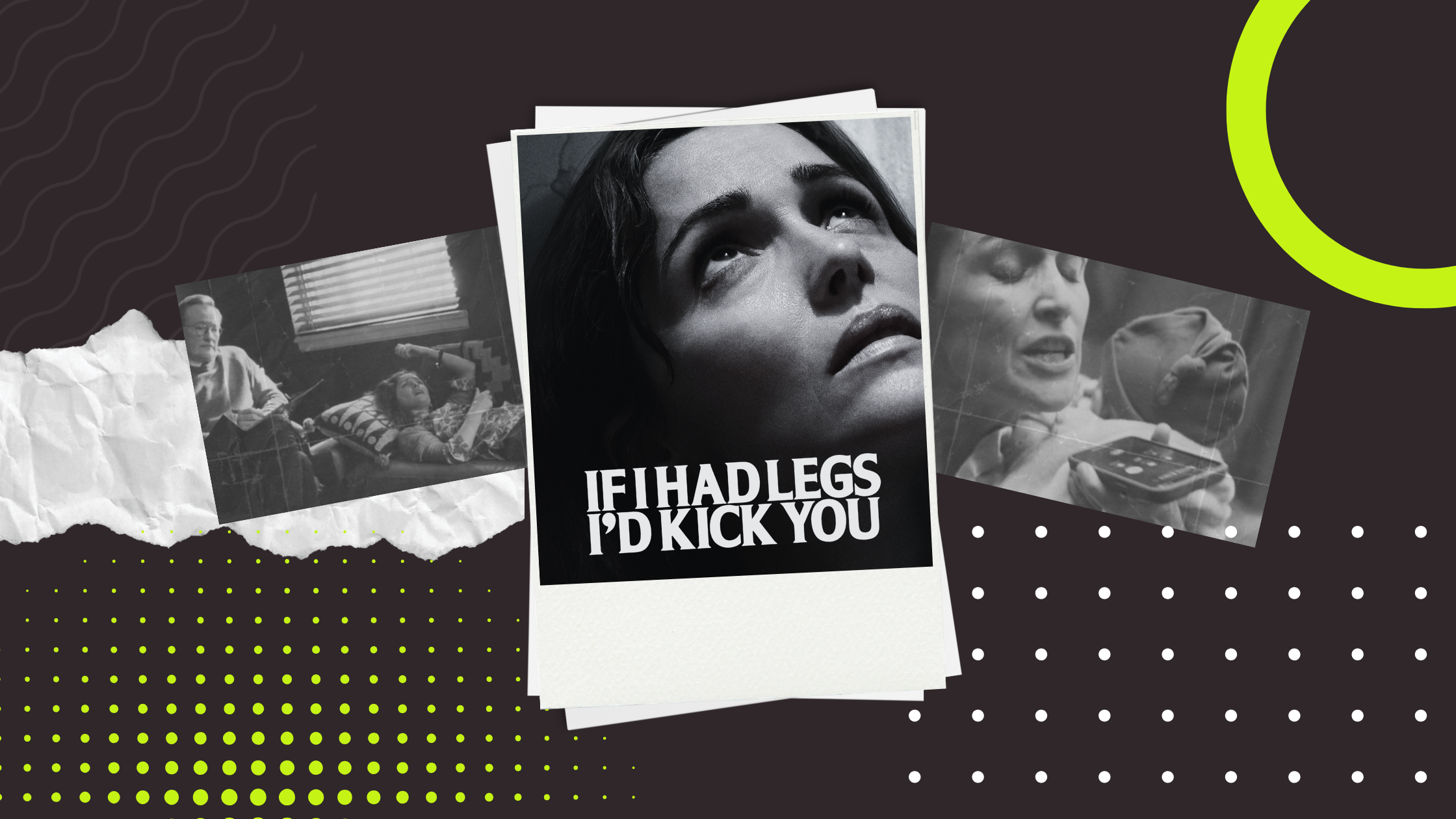
Things could be awkward in the Bronstein household this awards season, with Ronald nominated for co-writing Marty Supreme, while Mary, writer-director of If I Had Legs I’d Kick You, was snubbed by Academy voters – not just for directing, but for Best Original Screenplay too. In this reader’s view, her screenplay deserves at least a nod for one of the year’s most unsettling and original scripts.
Today, I want to examine her overlooked screenplay, a vividly rendered study of maternal burnout, and explore how you, as a writer, can make your scripts attractive to actors. In our recent conversations with directors and agents, attaching talent to projects in our active development, one point recurs: actors want roles unlike anything they’ve played before. Writing complex characters who carry the plot and shape the tone, while elevating ordinary moments, can significantly increase your chances of attracting A-list talent.
Let’s examine why Rose Byrne, the versatile actress perhaps best known for blockbuster comedy fare, was drawn to Mary Bronstein’s psychological comedy-drama script – which is about as funny as a kick in the teeth – and why her performance landed her a Golden Globe win for Best Performance by a Female Actor in a Musical / Comedy Motion Picture, and a first Academy Award nomination.
OPENING IMAGE
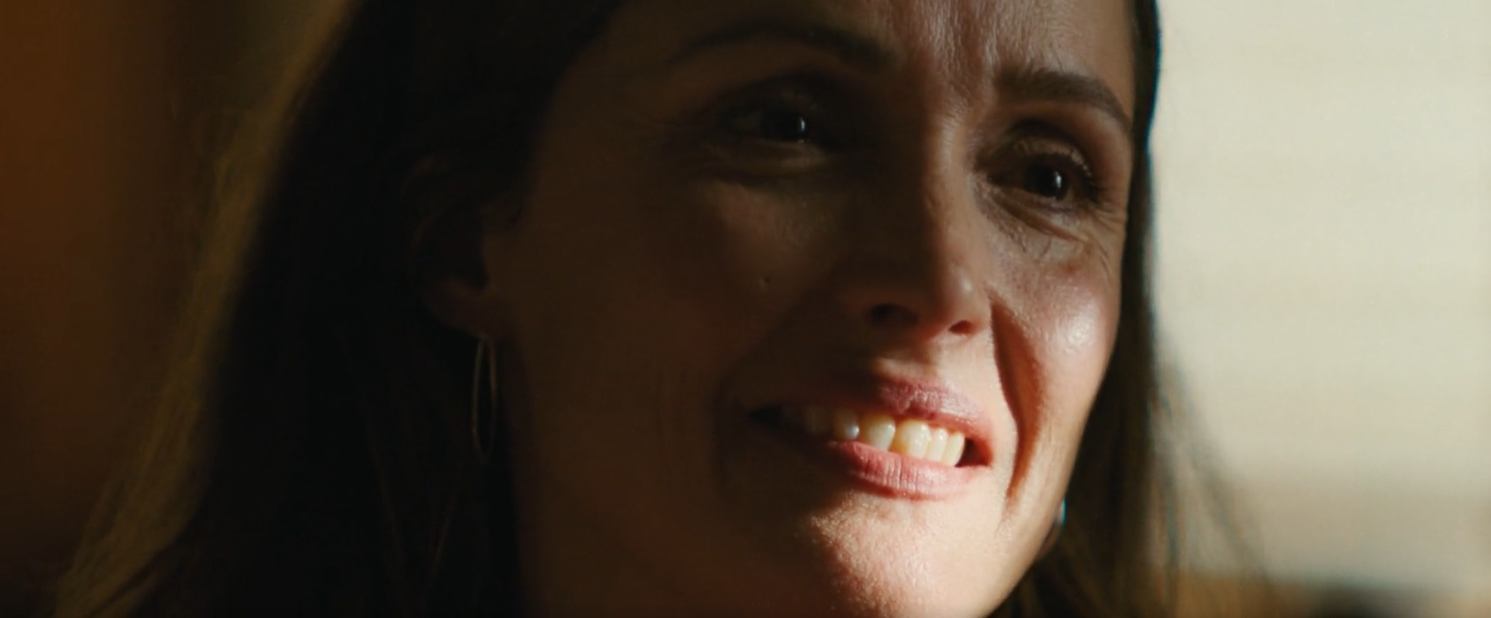

In a doctor’s office, protagonist LINDA and her 7-year-old daughter (“Child”) meet Dr. Spring (played by Bronstein). Child never appears on camera; she is always just offscreen or obscured. This keeps the focus on Linda’s isolation – the struggle she’s fighting to keep hidden. As Bronstein noted in a Q&A, audiences naturally empathize with children – removing that biological shortcut casts full attention on Linda.
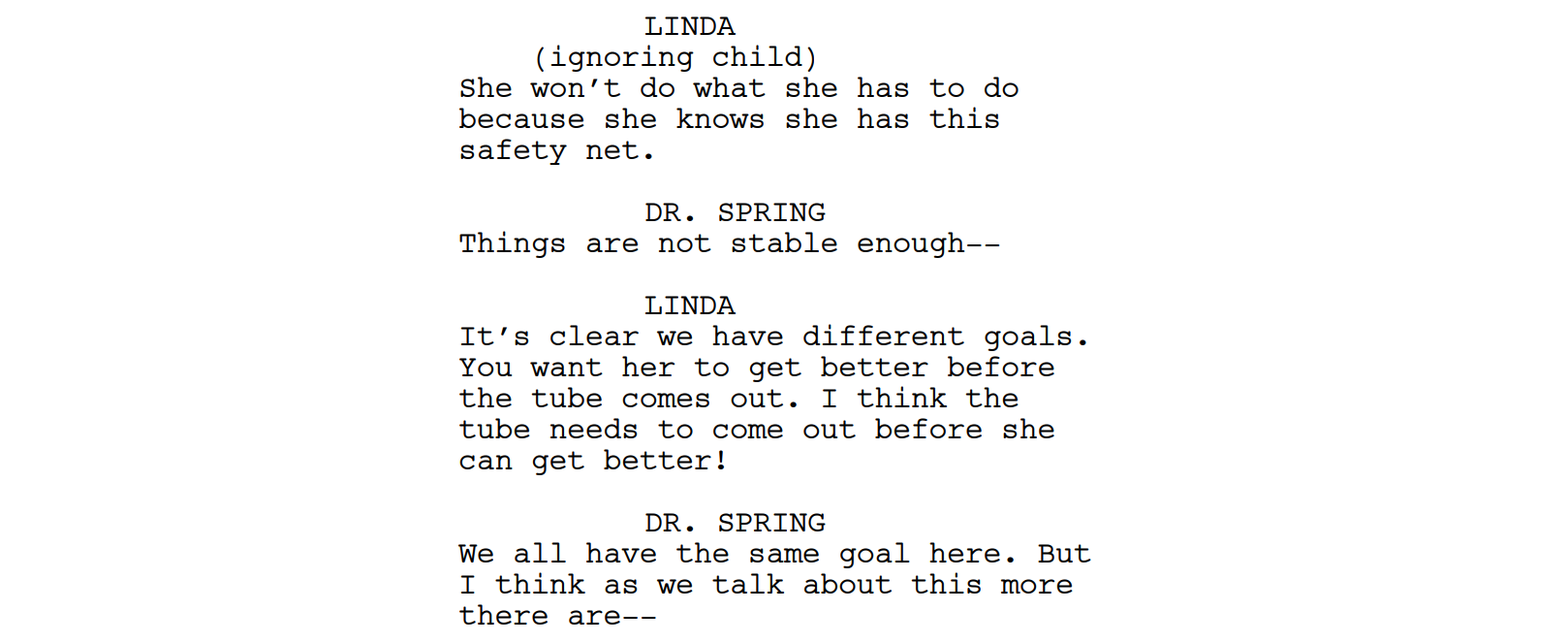
Child tells Dr. Spring that Linda experiences sudden, unprompted mood drops. Unlike Child’s father, CHARLES, Linda is malleable. Child has a pediatric feeding disorder and relies on a tube, which Linda wants removed. Dr. Spring dismisses Linda’s concerns, siding with Child. Prematurely aware of her own mortality, Child fears she will die if the tube is taken out.
We immediately establish the shared objective – Child must gain weight by eating solids during the day, and via the gastric feeding tube at night.
SET UP

Linda and Child return to their California apartment. Linda’s daily routine revolves around persuading Child to eat solid foods. She oscillates between caring for her daughter and encouraging nutrition, while also growing frustrated, snapping, and shouting.
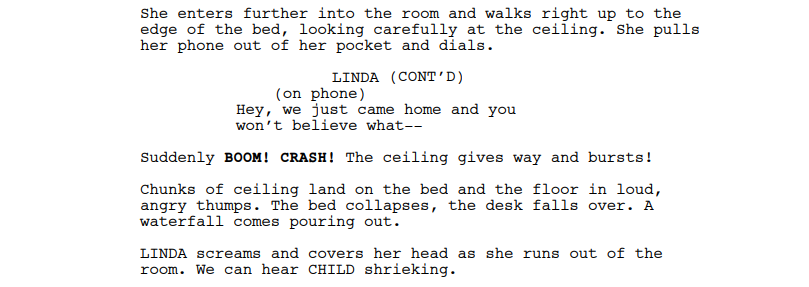
A brief moment of respite ends when Child reports the bathroom is flooding. Water collapses the ceiling, causing extensive damage and traumatizing Child. Charles is a ship captain, meaning Linda is effectively a single mother for months at a time. She cannot reach him, and he cannot help. The hole in the plaster seems infinite and hypnotizing to Linda.
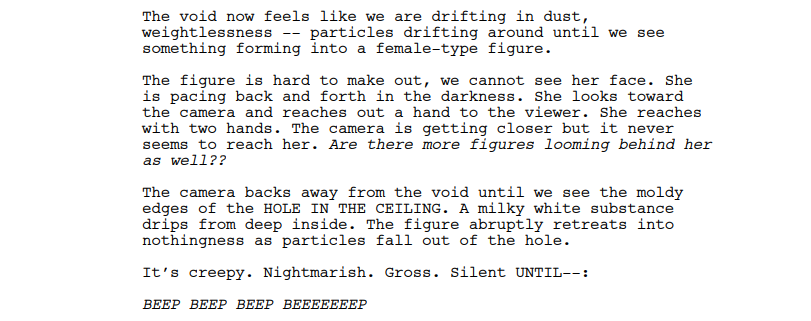
Within the void, a mysterious female figure beckons to Linda.
INCITING INCIDENT
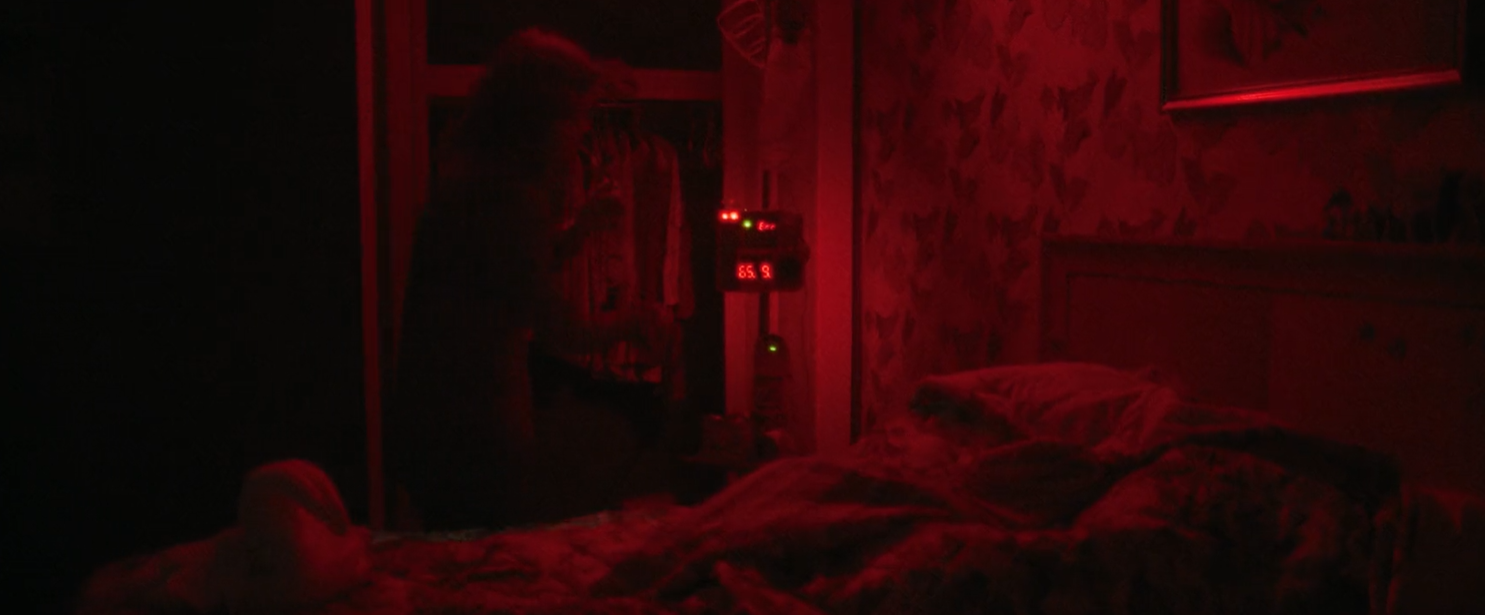
Cut to an extended-stay hotel, where Linda and Child stay while the leak is repaired. The script immediately parallels the apartment’s hole with the tube through which Child is fed.
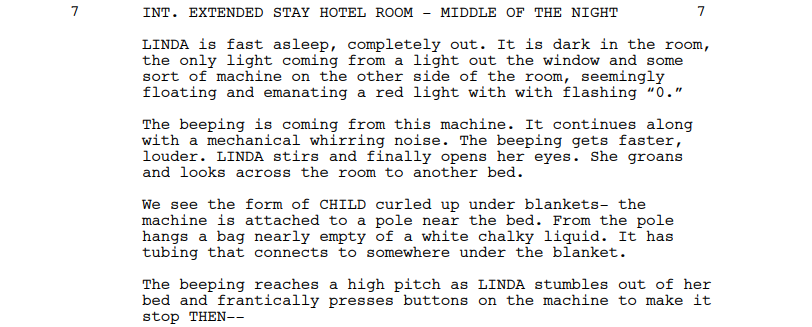
This shift in location is the subtle alteration that kicks the plot into gear. New places means new faces, and all the correlating interruptions to Linda’s schedule.
DEBATE

In the debate section, Linda grapples with existing beyond her role as caregiver. She leaves Child unattended to smoke a joint outside, monitoring her via baby monitor during tube feeding. She feels guilty but relies on these brief respites to stay sane.
Linda meets JAMES, the hotel superintendent, who discusses a holotropic, dead-brain theory. Back in her room, Linda gorges herself with food – scratching an itch without pleasure.
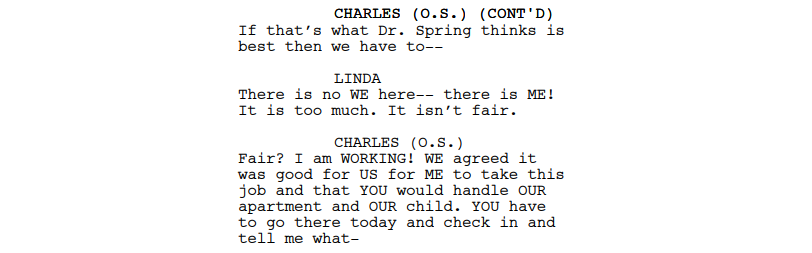
At breakfast, Linda argues with Charles over the phone. Charles tries to reassure Linda that it’s temporary, but she is already exhausted from caring for Child while working full time. Child is fixated on hamsters.
Linda has an ongoing feud with the Parking Attendant at the hospital, where she struggles to park up every day for Child’s program. He threatens to have her towed and banned from the lot.
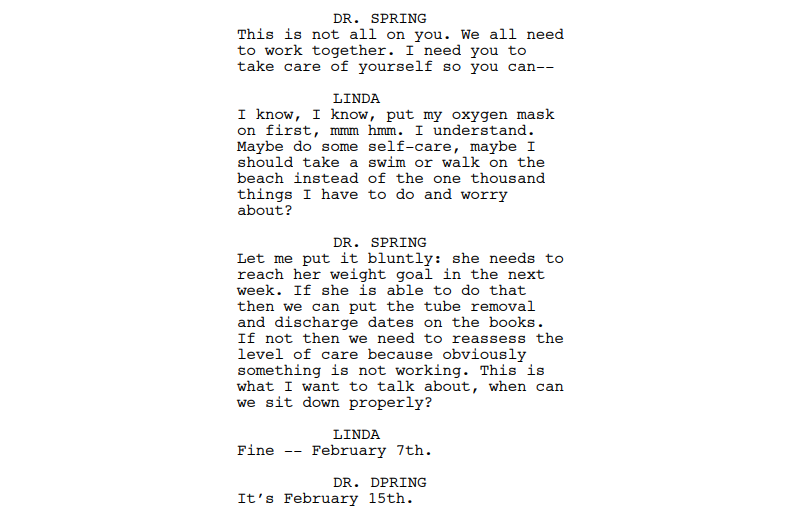
Dr. Spring makes Linda feel like a bad mother, reprimanding her for missed sessions and dismissing her excuses about being unhoused. Her mantra of “don’t feel guilty” and “it’s nobody’s fault” only heightens Linda’s sense of responsibility for Child’s health. She emphasizes the stakes, highlighting Linda’s disorganization.
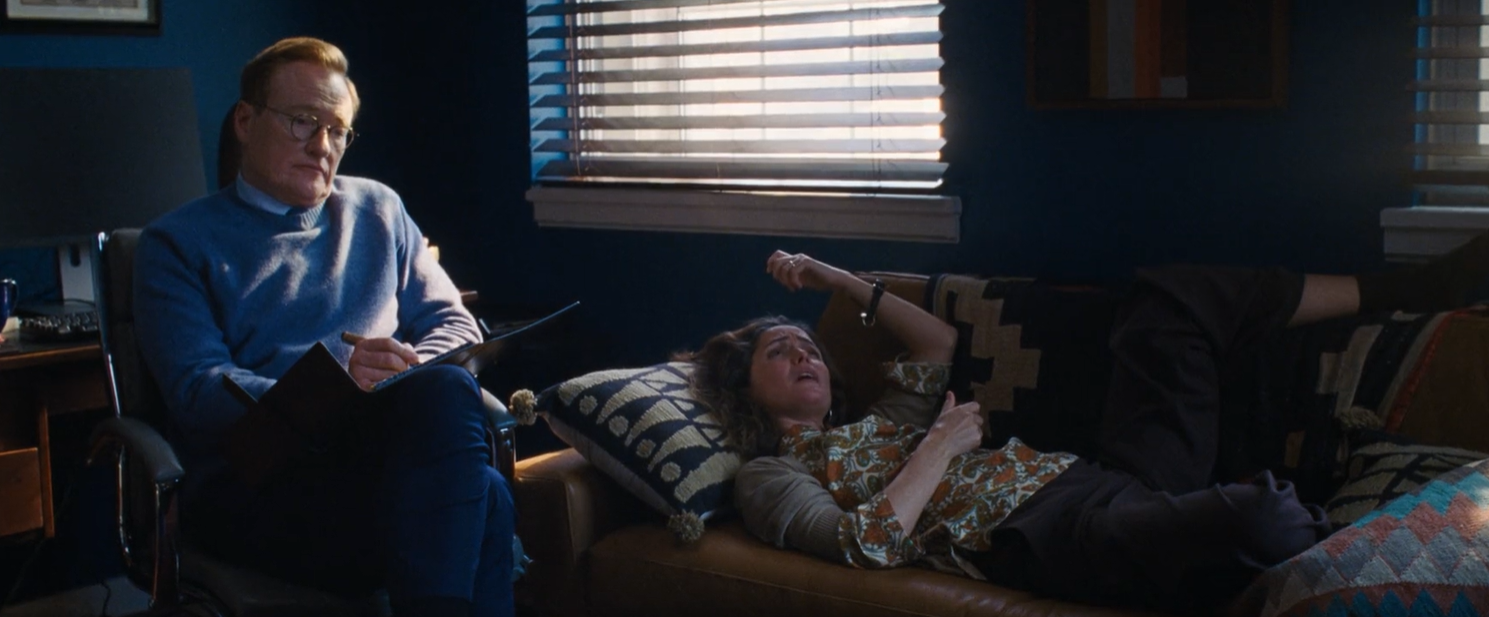
Linda sees her THERAPIST, recounting her woes and framing everyone – Charles, her landlord, Dr. Spring – as antagonists. The therapist maintains professional distance, while Linda strives to bridge it. She emails him about her dreams, frustrated when he fails to offer analysis. One dream, depicting a breakdown of his boundaries, fails to elicit any reaction.
BREAK INTO TWO
After her session, Linda learns work on the apartment has stopped – the Super’s mother has passed away – prolonging her purgatory. He says he’ll return next week and confuses her by claiming the hole has “spread.”
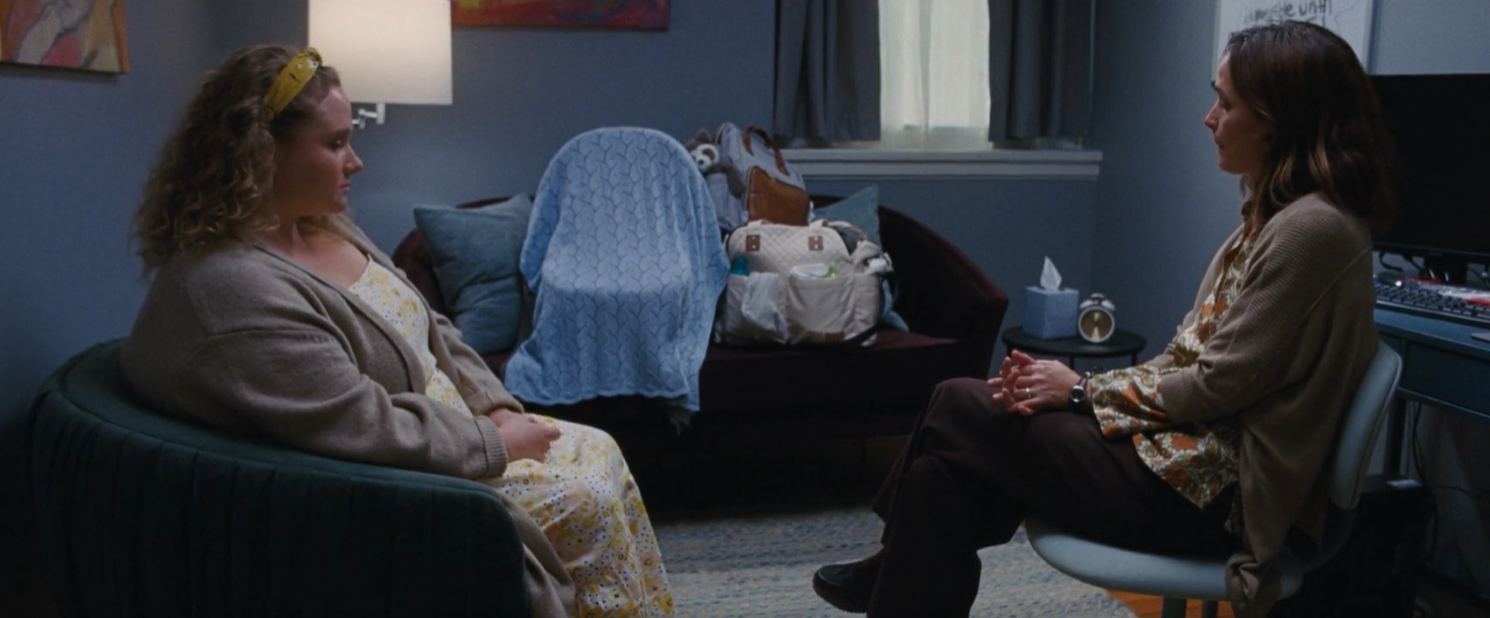
The bigger shock is that Linda is a professional psychoanalyst, working in the same building as Therapist. She sees CAROLINE, a new mother with postpartum anxiety. Linda’s own instability heightens reader tension and recontextualizes her impatience with Dr. Spring in a clinical setting.
FUN AND GAMES
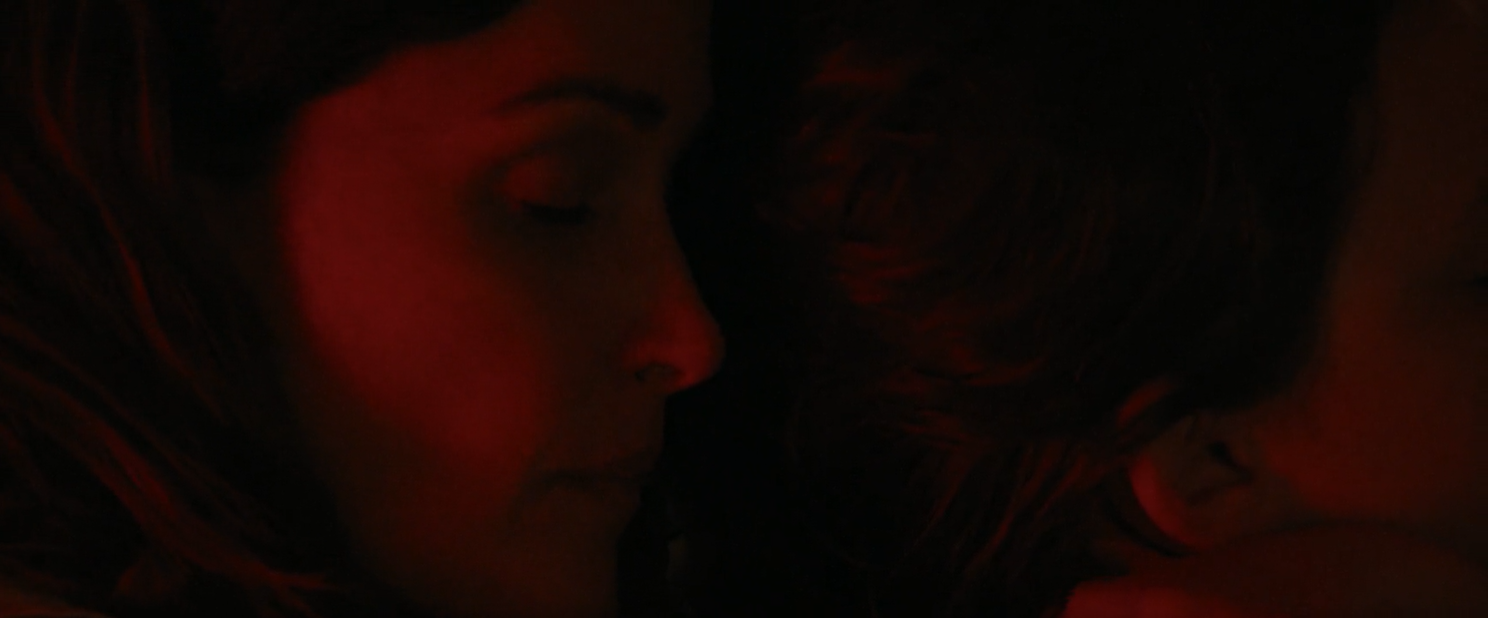
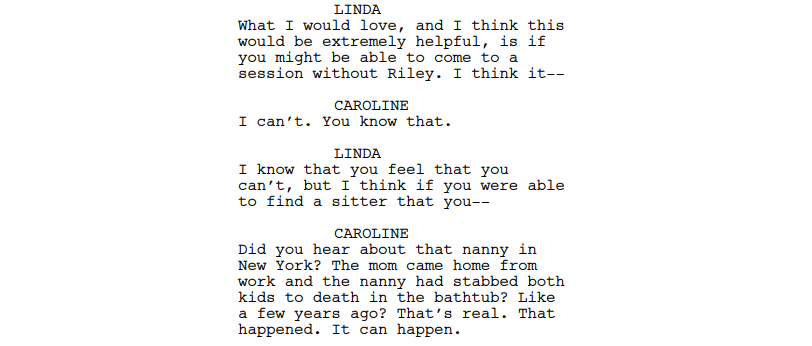
Linda can’t help comparing her experiences to Caroline’s. Caroline irrationally fears her three-month-old, Riley, hates her after she rolled onto the baby while asleep. Linda knows this is unfounded and feels irritated, as she has “real problems.” She tries to be empathetic but realizes her advice is something she should follow herself. Caroline must bring Riley to sessions, citing a New York case where a nanny killed a child.
In the staff kitchen, Linda researches holotropic breathing, exploring alternative treatments for her anxieties – hinting she no longer trusts the methods she practices. She shares the space with Therapist, which feels awkward, and MICHELLE, who derides her new interest.
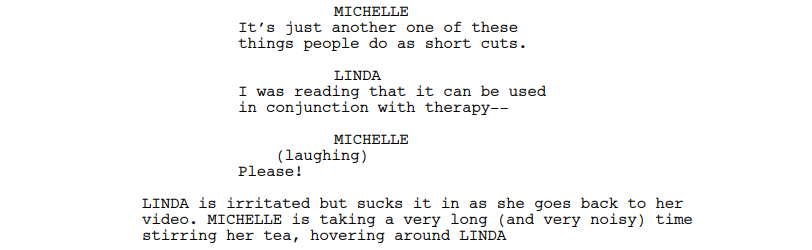
Despite this, Michelle offers her a shoulder to cry on – not as a fellow therapist, but as a friend. Linda’s other clients are vapid and wash over her.
Child and Charles criticize Linda over the phone, which she must endure. Charles claims to love her but is otherwise unsupportive, implying she has it easy. He complains he can’t “sit around all day” by the pool or beach. When Child asks for a hamster, he leaves the door open, overruling Linda’s refusal.

She tries to soothe Child, singing her to sleep. At night, she binge-eats, drinks wine, and watches reality TV—perhaps to feel like a better mother by comparison. James helps her buy wine from Diana, but she avoids conversation. Her attempts to get more weed from her dealer go ignored.
She walks until she’s out of baby monitor range, continuing the half-hour journey to her apartment. When Charles calls, uneasy that Child is alone; she lies that James is babysitting. With no power in the apartment, she sends Charles a photo of the ceiling hole to show no work has been done. Her real reason for returning is to retrieve marijuana. She relaxes and watches B-movies.
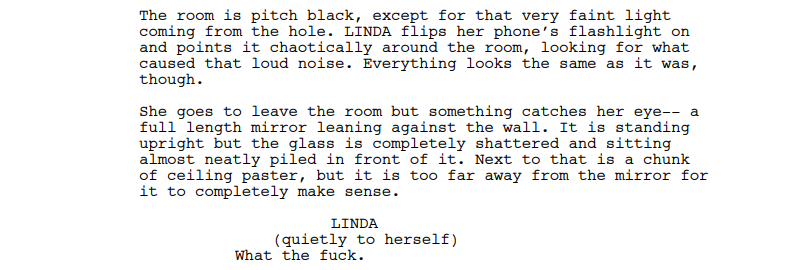
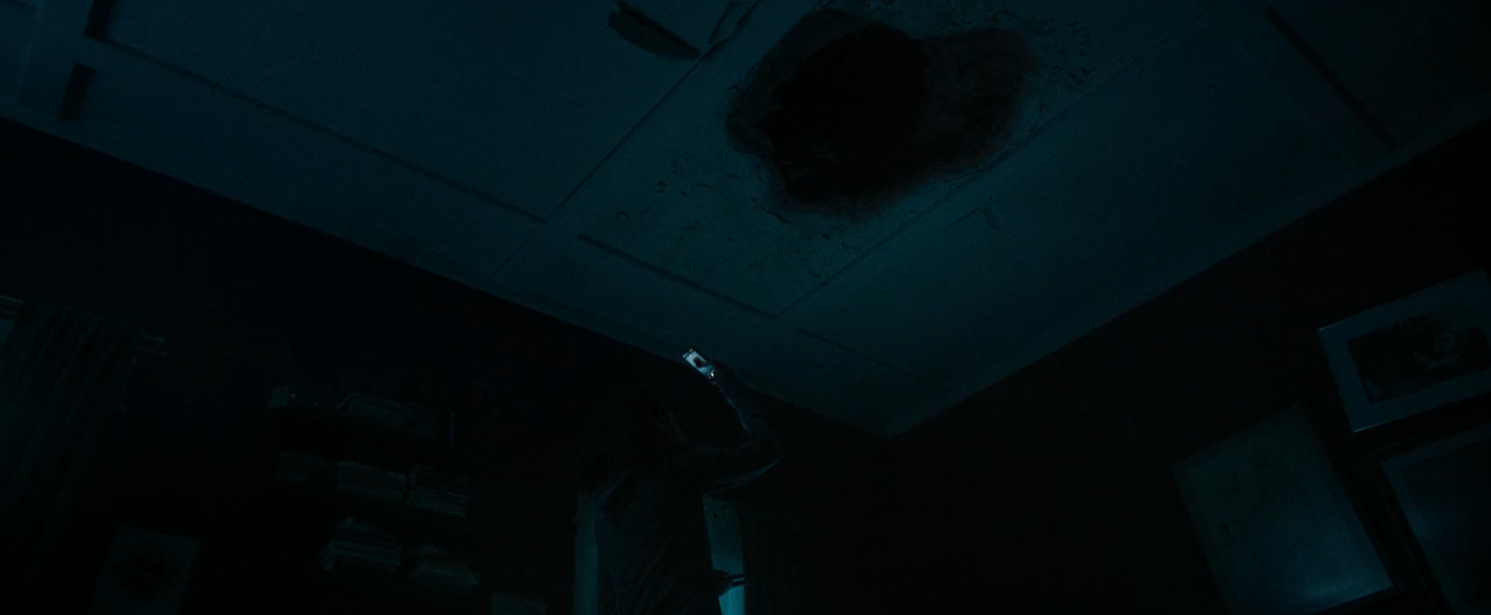
Startled by a crashing noise, she finds a mirror near the hole shattered. Investigating, she sees orbs of light in her reflection, which she interprets as her mother’s presence. The hole casts a bright spotlight on her, then darkens. Frightened, she runs back to the hotel.
The next day at the hospital, Linda tries to get Child to go in alone to avoid conflict with the parking attendant and Dr. Spring. When Child refuses, Linda persuades another mother to walk her in, promising they can “look at” hamsters as a bribe.
At work, a client tells the emotionally closed-off Linda that she appears in his romantic dreams, mirroring her admission to Therapist. She considers the line between being a good mother making a bad choice and being a bad mother. She reiterates that Child must gain 50 pounds by next week, which she knows is impossible.
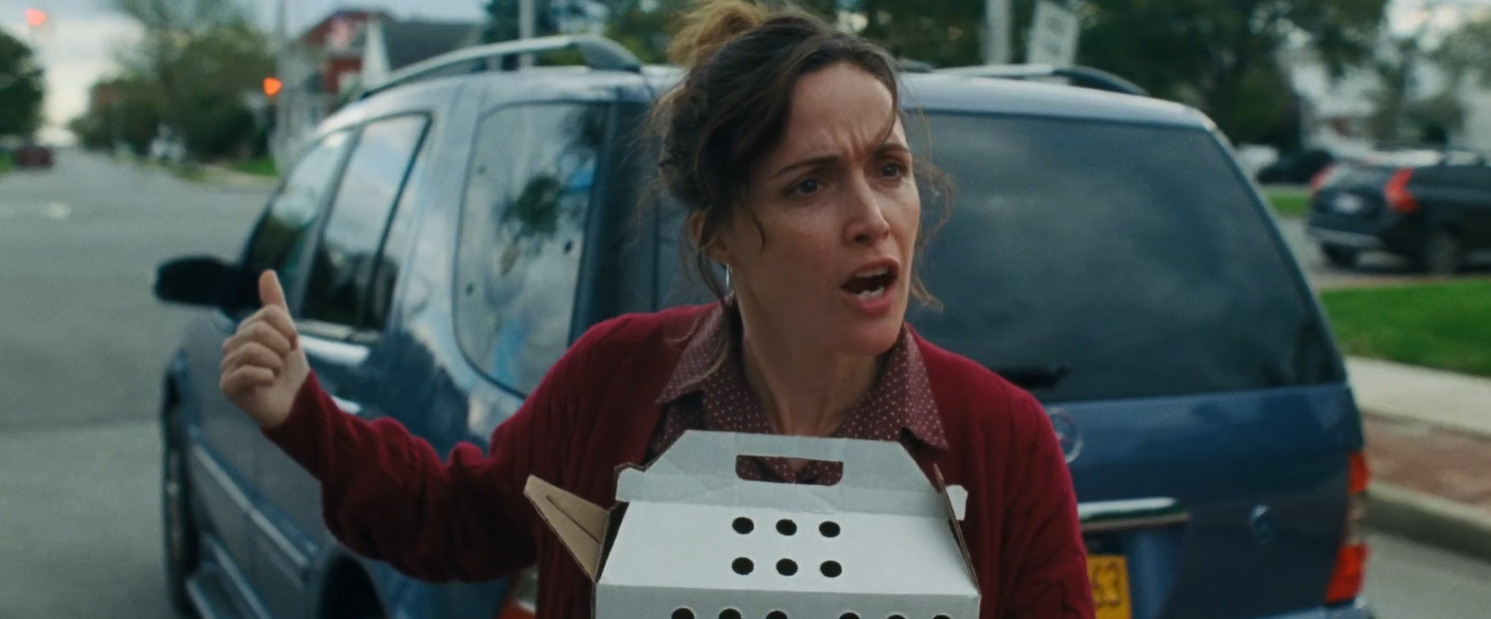
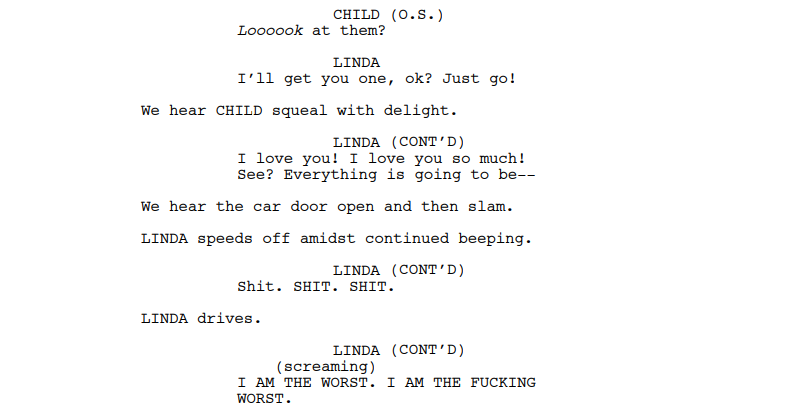
Driving home, Child’s new hamster escapes, causing Linda to panic and nearly crash. After re-boxing the hamster, they’re rear-ended. During the confrontation, the hamster escapes again and is run over.
Linda buys a second hamster to appease the devastated Child. Hiding her discountenance, she begs Charles to come home while insisting all is fine. Linda receives an emergency call from Caroline, who fears her child had a seizure and wants a session tomorrow. Linda locks herself out of the hotel room, and James again attempts conversation.
MIDPOINT
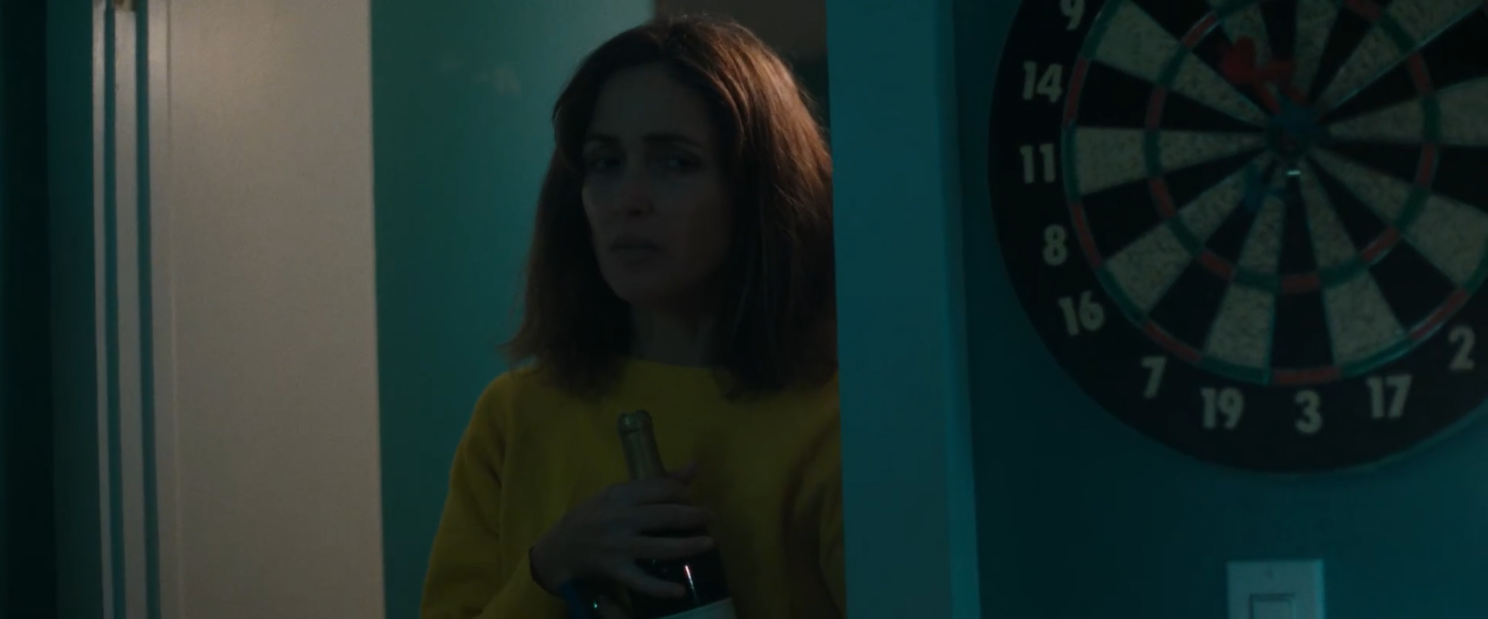
James' repeated attempts at engaging Linda begins to wear her down. His persistence in trying to bond with her is exhausting. She despairs, unable to get back into her room the night she was instructed to get a good rest. He offers to assist her in purchasing drugs on the dark web.
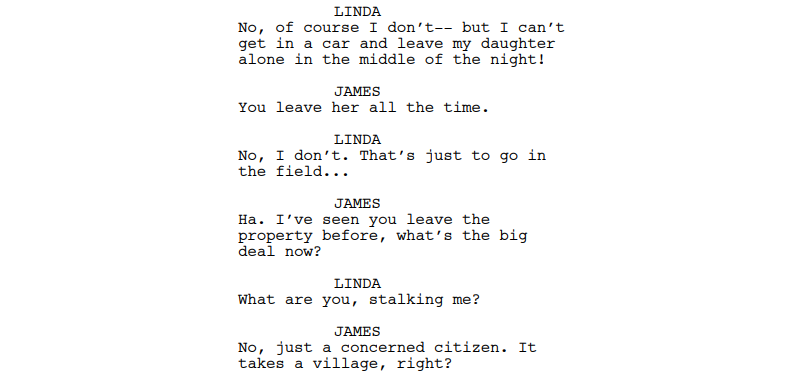
She instructs him to buy cocaine. He knows a lot about her coming and going, which makes her uncomfortable, then angry when he brings her qualities as a mother into question. In an unprecedented development, Child awakes in the night and calls for Linda through the baby monitor.
BAD TO WORSE
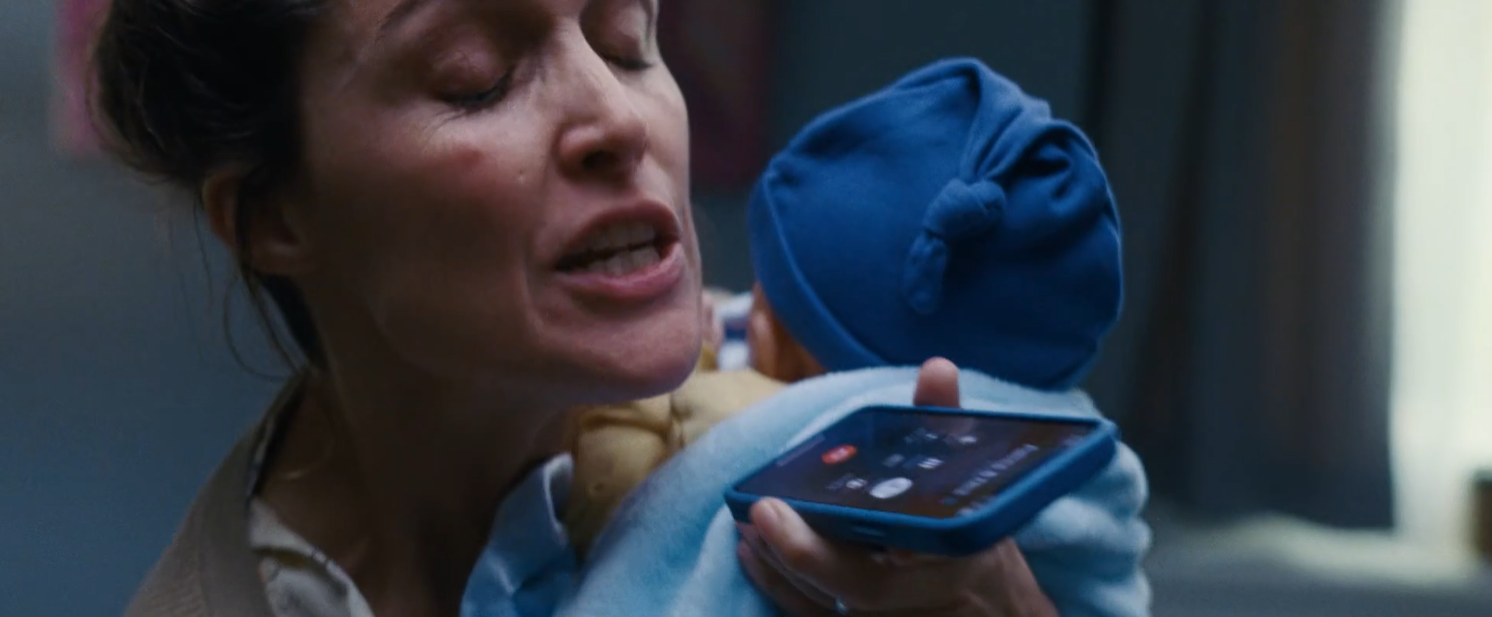
Linda fades in and out of lucidity, completely sleep deprived while still trying to be a good therapist for Caroline, whose antics are grating on her. She blames herself for her mistakes and claims her husband blames her too. Linda suggests she seeks medical aid for her anxieties. Excusing herself for the bathroom, Caroline disappears, leaving Linda stranded with Riley, the baby.
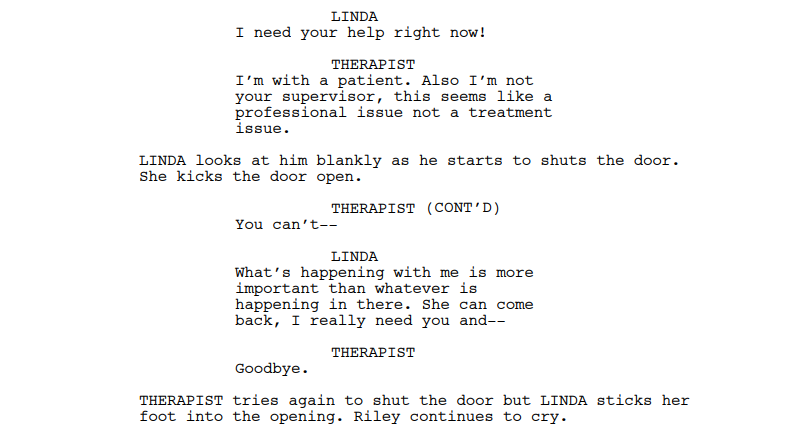
Riley wakes and begins to cry. Stuck, Linda goes searching for Caroline and discovers that she’s left the building. Panicked, she tries to interrupt Therapist’s session for help, but he tells her she must deal with this issue herself. Michelle, similarly, advises Linda to call Caroline’s emergency contact and leaves Linda to resolve her predicament.
She calls Nick, the husband, who is unaware that Caroline is suffering with these issues, or even that she’s in therapy. He’s dismissive and claims this isn’t his problem – it’s Linda’s. She snaps back when he tells her he can’t come right away as he’s working, informing him that if he does not materialize within half an hour, she calls the police.

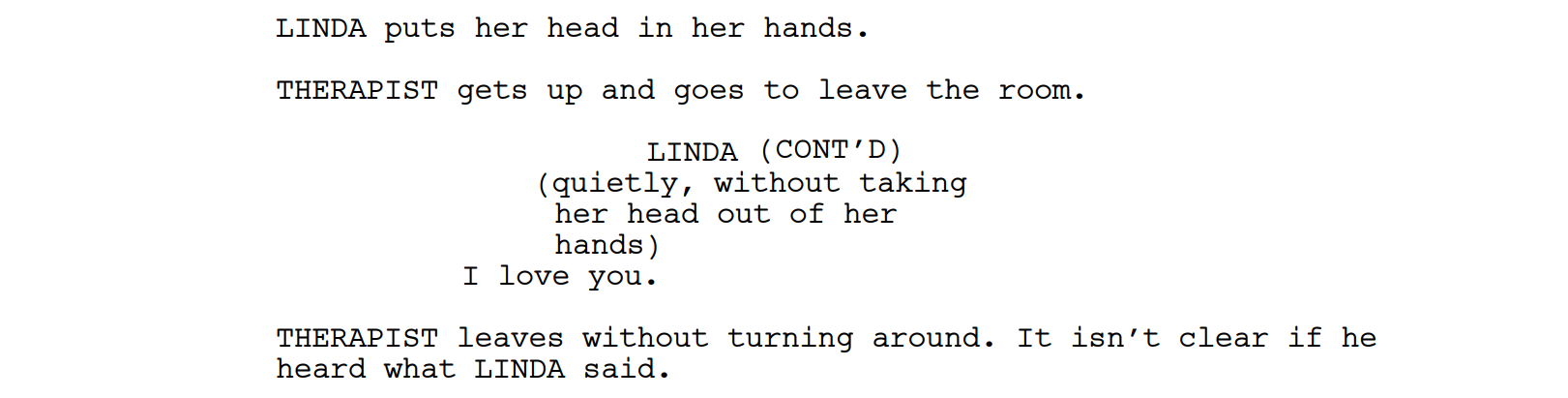
Stephen shows up for his session and is confused and/or angered by the crying baby’s presence. Therapist steps in and helps deescalate, impressing Linda with his assertiveness. Upon learning she succumbed to Child’s hamster demand, he tells a weird story about cruel animal testing he did on rats as a medical student – the purpose of which is to convince her that rodents are resilient. Linda confesses she loves him.
Linda answers a cop’s question, frustrating him with her non-diagnostic, psychotherapy language. He wonders if she’s homicidal or suicidal, but tries to calm Linda down by saying this abandonment of a child is more common than she thinks. Linda is wrestling with her own overwhelming feelings regarding her own child.

While buying gift cards to pay for James’ elicit online transactions, Linda blows up her landlord’s voicemail. At the hospital, Dr. Spring continues to pester Linda about booking a family therapy appointment. While she’s trying to position themselves as on the same side, Linda still feels like this is a personal attack. Dr. Spring informs her that Child’s weight trajectory means she won’t make the goal, and her continued care in the hospital is in jeopardy. Linda is shocked to find there is no tube-removal operation, it’s simply yanked out.
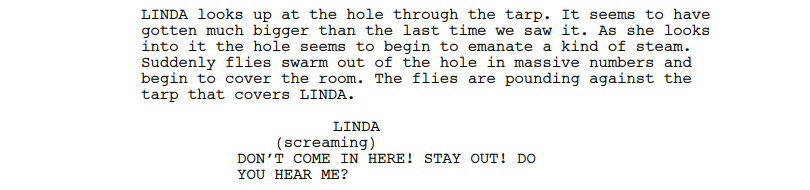
Back at the apartment, Linda plays hide and seek with Child. The hole appears bigger and a swarm of flies seems to attach from within. Linda takes Michelle up on her offer to chat, expressing her concerns about Caroline. But Michelle discovers that Linda isn’t taking supervision therapy, which is a licence requirement. Suddenly, she’s back to being a professional, not a friend.
BREAK INTO THREE

Linda follows a holotropic breathwork tutorial, succumbing to her curiosity and desire to be numb to her misery. She finds herself floating in the void space from within the ceiling hole.
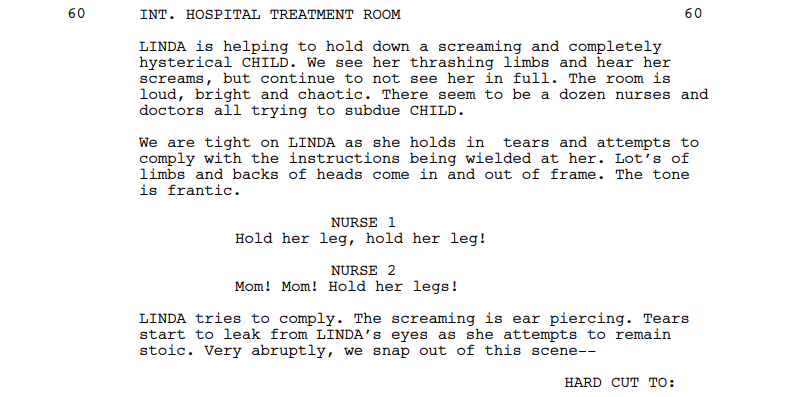
Her calm is shattered by a sudden vision of nurses and doctors holding down a frantic Child, who screams in pain.
FINALE
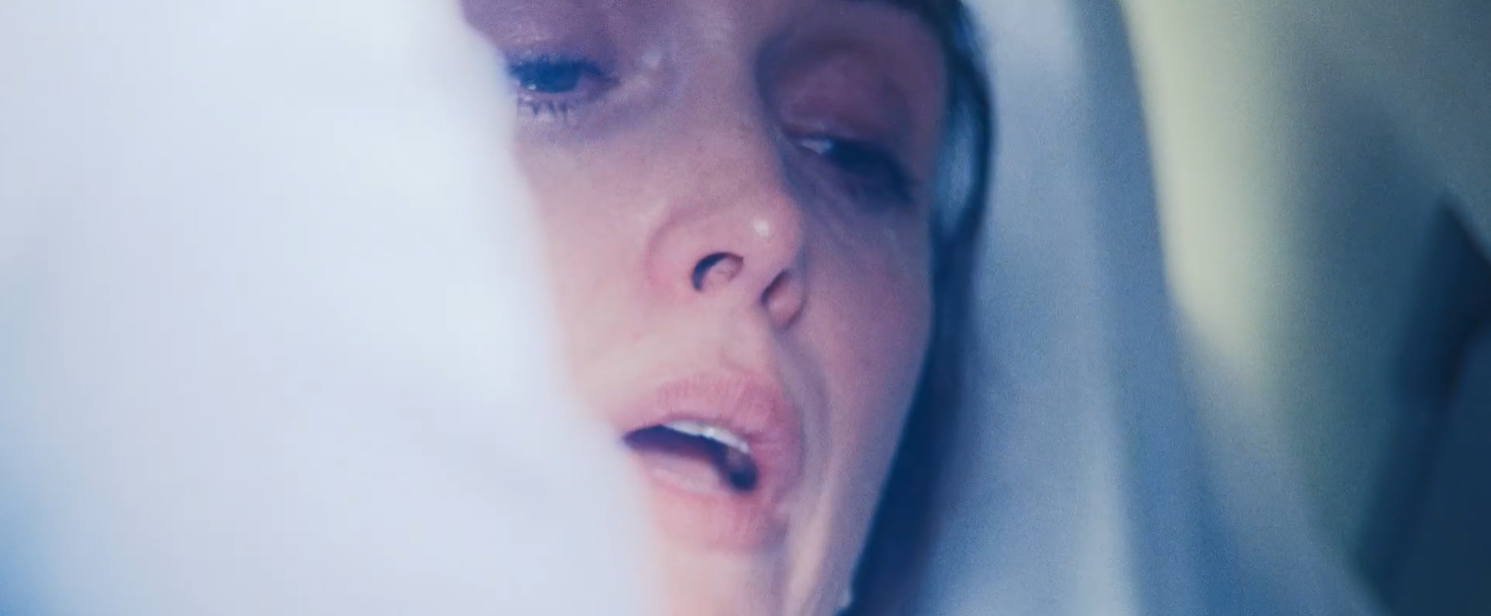
Post breathwork, Linda comes across manic and disassociated. She approaches James and invites him to see the hole in her apartment. He’s unimpressed and downplays its significance, suggesting they don’t even need to be in the hotel. Smoke from his joint is sucked up and spat back by the hole.
James leads them in visiting the upstairs apartment, which Linda says is under renovation. He’s convinced there’s something supernatural at play. She tells him that her breathwork guided her here. Looking into the hole from above, they can see an intact room beneath, where a dream version of Linda commits acts of self-harm.
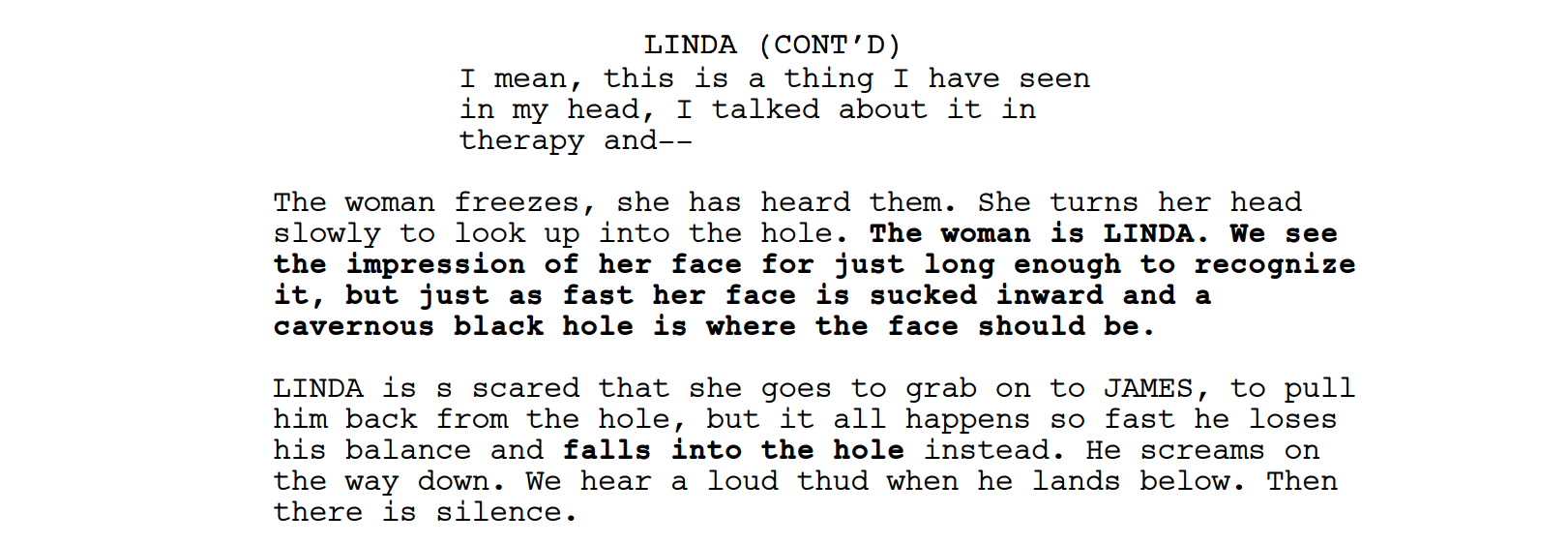
James breaks his leg falling into the apartment below. We cut away to a session with Dr. Spring, almost like nothing ever happened. Eva, another child’s mother, accuses Linda of scratching her car. Dr. Spring launches a group meeting, which Linda interrupts by causing a scene – triggered by the repeated insistence that none of this is ‘her fault’. She tells the other mothers that none of this is helpful.
In her car and on the phone to Charles, she breaks down, explaining the hole is getting larger, Caroline is missing, and she has no chance of her life ever going back to normal. The Parking Attendant harasses her again, and she accuses him of fabricating the scratch on Eva’s car as some kind of punishment.

Linda reveals to Therapist that she aborted her first pregnancy, shedding some light onto her feelings of inadequacy as a mother. He informs her he can no longer be her therapist, which is crushing to her.
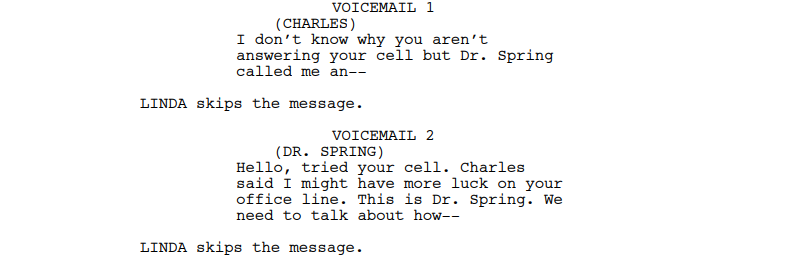
Her phone is blown up with voicemail messages from Dr. Spring, Charles, Nick, and lastly Caroline – who is scared of becoming the nanny who killed the child.
Linda is concerned that Child likes Dr. Spring more than her, and suggests they perhaps don’t need the hospital programme anymore. Child is excited that she might be better, but then begins to cry. She knows that she’s still sick.
James is mad at Linda for abandoning him after he broke his leg. They’ve shared a surreal, supernatural experience together that she won’t acknowledge. Caroline shows up at the hotel, having followed Linda. She’s having a psychotic episode and slaps Linda, then flees. Linda chases, breaking the baby monitor in the process, but loses Caroline in the dark. She spirals and calls Therapist for an emergency session.
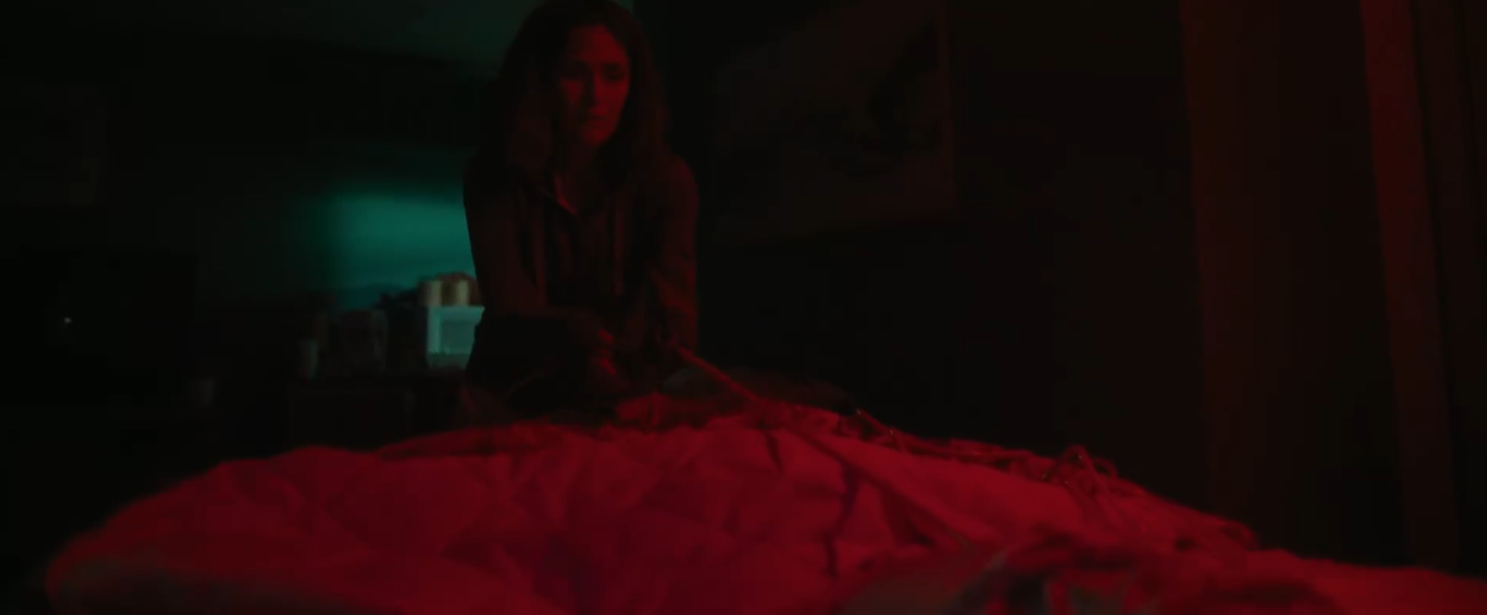
Overwhelmed by the incessant beeping of Child’s feeding machine, Linda removes the tube. The hole is disturbing and reminiscent of the apartment ceiling. It begins to contract, and Linda has a realization… She runs to the apartment, passing bizarre hulking men removing bags of something from the building.
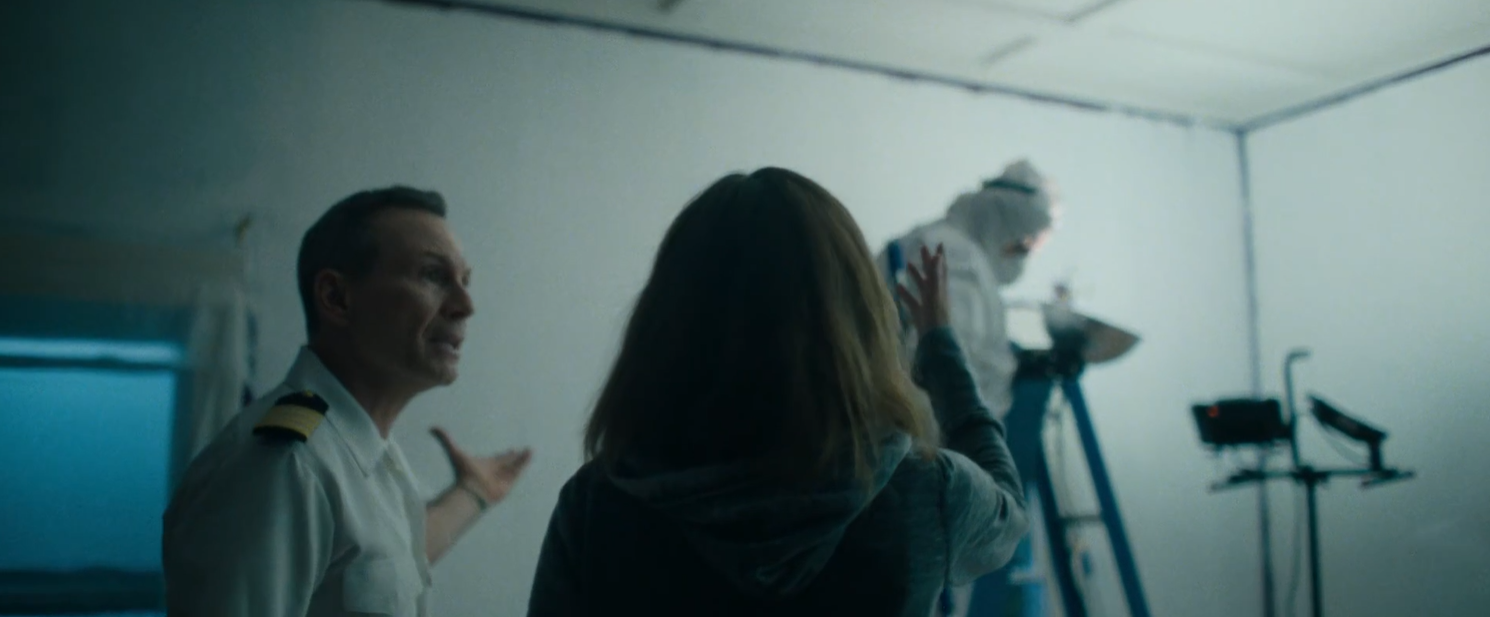
She finds Charles in the apartment – he’s left work because the not knowing has impacted his concentration. The hole in the ceiling is gone. Charles makes out like it wasn’t a big deal to get it fixed. Linda, knowing she has to confess she left Child alone and removed her tube, fears that he’ll leave her.

In one of the best scenes of the screenplay, Linda silently implores James to play along, pretending to be a babysitter. Just when it seems like she might get away with it, James lays everything out very directly – calling Linda a ‘fuck up.’

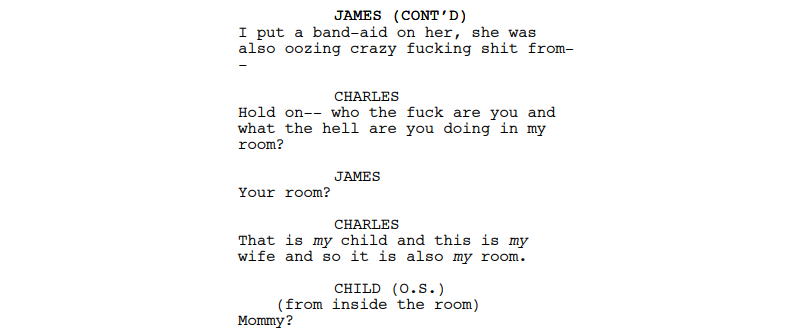
Distraught and baffled, Charles attacks James. Linda flees. She follows the same route that Caroline took, and tries to drown herself in the ocean. It supernaturally dispenses her back on the beach and her hyperventilation morphs into holotropic breathwork. She’s left with her failures here – she cannot even kill herself successfully. She has failed at just about everything she has attempted in this screenplay. This is an act of submission. She succumbs to her breathing, accepts herself.
CLOSING IMAGE

She loses herself in the void, then abruptly wakes up.
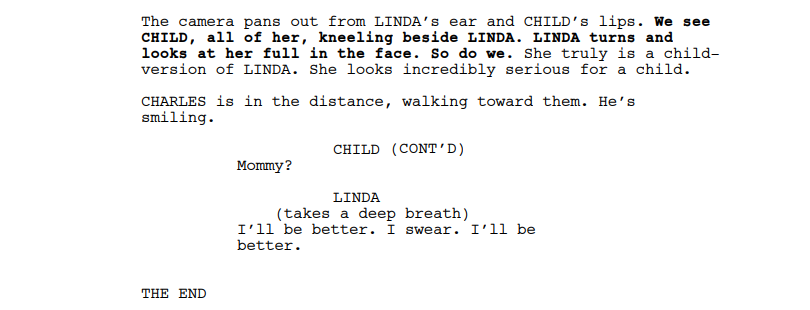
We see Child’s full profile for the first time. Bronstein says it’s the first time Linda sees Child as a person, not an obligation. She promises to do better.
CONCLUSION
So why was If I Had Legs so appealing, and what attracted Byrne to appear in what’s only Bronstein’s second writing / directing gig, and her first since 2008? For me, it’s the focus on Linda. Every scene is hung on her character and the correlating performance. Nothing happens that doesn’t frame her front and center. There is no better opportunity to show off your acting chops than a film that doesn’t divert the camera once. On top of that, the subject matter of a struggling, faux-single mother is one that is historically overlooked by major motion pictures. This doesn’t come across as a gamble, rather feeling overdue, and the ability to spearhead this story is undeniably attractive to an actor.
On top of that, it’s not a straight, strict drama – it has layers of thriller, comedy, it flirts with psychological horror. It gives its star ample opportunity to flex their muscles. It’s a full body workout at a home gym, nobody else is there to compare yourself too. While Therapist and James are recurring supporting roles, they’re subdued parts compared to Linda’s bombastic decision making and heightened emotional state.
It’s my opinion that everything in the screenplay is literal rather than supernatural, just through the lens of an overworked, overwhelmed, and overstimulated mother who’s trying to hold two lives together. This is exemplified in the film especially – the comical length of the feeding tube, the fact that Charles is much nicer in person than over the phone, Therapist’s complete disinterest in her issues. Everything feels elevated, as if the narrator aggrandizes the story. In the early scenes, Dr. Spring tells Linda ‘perception is reality’ – not, perhaps, in relation to Child, but to Linda.
There’s a lot to be said about writing as an avenue for performance, and this is the exact kind of screenplay that actors – amateur and veteran alike – will flock towards.
We award If I Had Legs a 4/5.