Our Oscar Predictions: Front-runners, Snubs & Sleepers [Podcast]
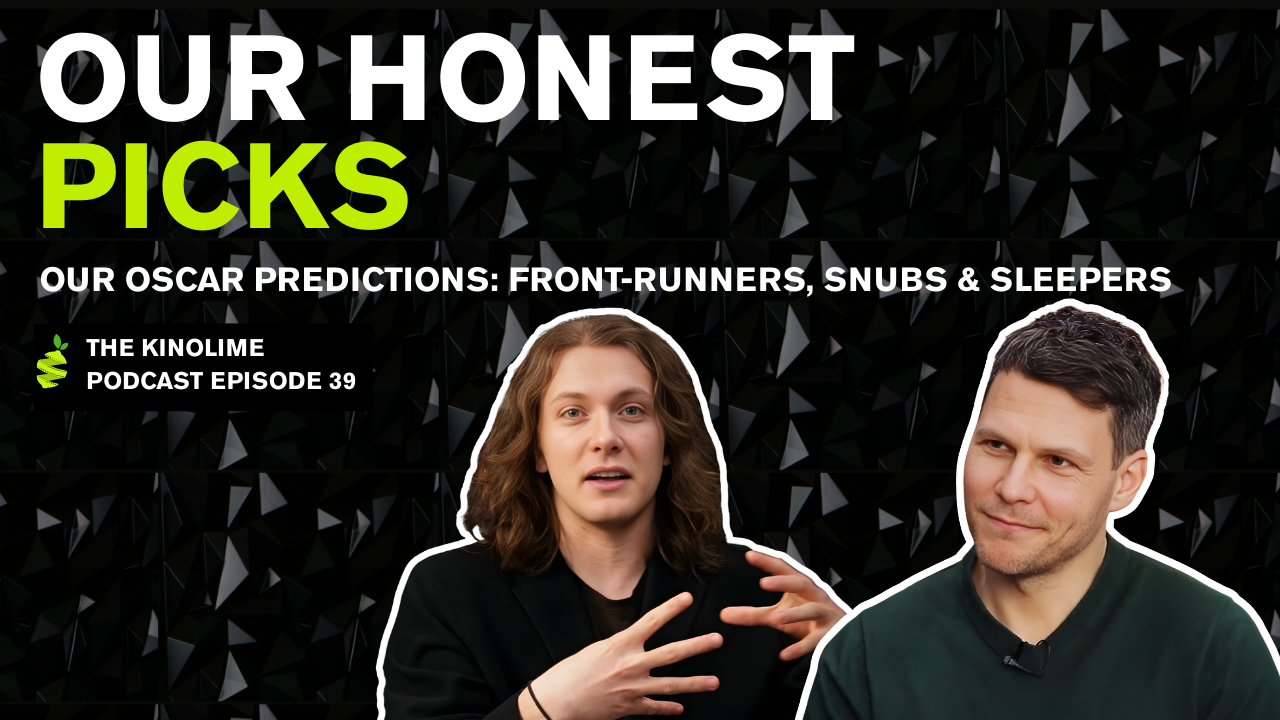
The Oscars are almost here and we’re not just making predictions, we’re pulling back the curtain.
In this episode of the Kinolime Podcast, John and Danny dive deep into the history of the Academy Awards, from Louis B. Mayer’s power play in the 1920s to the modern-day campaign machine fueled by “For Your Consideration” screenings and strategic spending. How much of Oscar season is about art and how much is about influence?
Then, we break down the major categories with our official picks: Who Will Win, Who Should Win, and Who Was Completely Snubbed. From blockbuster American epics to intimate indie performances that slipped through the cracks, nothing is off limits. Expect strong opinions, a few hot takes, and some passionate disagreements.
If you love awards season debates, behind-the-scenes industry insight, and unapologetic film nerd energy, this one’s for you.
Full Transcript: Kinolime Podcast Episode 39: Our Oscar Predictions: Front-runners, Snubs & Sleepers
Participants
John Schramm - Head of Development, Kinolime
Danny Murray - Creative Executive, Kinolime
Why the Oscars Exist (Power + Labor)
Danny: The Oscars were originally about consolidating studio power and trying to stop Hollywood from creating unions. That part didn’t work out. The consolidation of power pretty much did. And here we are 100 years later with a really snazzy award show that all of us love.
Welcome
John: Welcome, everyone, to the Kinolime Podcast. John Schramm, gonna say your name for you. Danny Murray, we’re here on a balmy 32 degrees in New York City. The sun is out. It feels like spring.
Danny: It’s horrible. I’m so excited I’m getting out of this city.
John: Yeah, this guy’s getting on a plane to LA.
Danny: Directly after this, because I cannot stand being in this.
John: He needs 110-degree heat, and we’re about 70 degrees below that. But Danny, so good to see you. A lot’s going on in film, specifically the Oscars. The Golden Globes are “meh” to me. Ricky Gervais was the best thing about them in the last 15 years.
Danny: Yeah, it just feels like a warm-up to the award show anyone actually cares about. It doesn’t capture the zeitgeist the same way anymore.
John: Ricky Gervais resuscitated the Globes. They were flatlining, he came in and got them going. But today we’re talking Oscars: the history, what goes behind a campaign, and our list of who will win, who should win, and the biggest snubs.
The History of the Oscars - Louis B. Mayer, AMPAS, and Control
Danny: The Oscars are a very Hollywood story. At the end of the 1920s there was Louis B. Mayer, co-founder of MGM, one of the key architects of the studio system. Think Barton Fink: an assembly line where fixers tell everyone what to do.
John: I love that and I love the middle initials. I should be John A. Schramm. You should be Danny D. Murray. David O. Selznick, legendary. It just hits.
Danny: It’s not because people wore top hats, right?
John: And bathed and shaved and got ready for work. Those days are gone. I’m bringing back the middle initial.
Danny: Anyway, Mayer wasn’t a fan of worker revolutions or people organizing for better conditions. He wanted the capitalist jungle. He was born in Russia and left right before the Soviet Revolution, and he decided that mindset could never creep into his studio system.
Danny: He planned to build a palace on the beach in Santa Monica. The quotes were insane, so he said, “My studio guys can build palace sets in a week, have them do it in six weeks.” But the crew had just formed a union and told him, “We can do it, but it’ll cost you a fortune.” That triggered all his anti-union panic.
Danny: So in 1927 he creates AMPAS, the Academy of Motion Picture Arts and Sciences, basically to bring everyone under one umbrella and control the ecosystem.
Danny: His famous line was: “I found the best way to handle filmmakers was to hang medals all over them. If I got them cups and awards, they’d kill themselves to produce what I want.” The whole thing was essentially built to circumvent unionization.
Danny: It didn’t stop unions. But it created prestige and power. The first Oscars were tiny: five bucks to get in, around 270 bigwigs. The “Oscar” nickname came from a librarian who said the statue looked like her uncle Oscar.
John: Steeped in tradition and myth.
Danny: Then scandals and publicity pressures hit, and Hollywood realized it needed the Oscars as a prestige machine. Long story short: the Oscars started as consolidation and anti-union strategy. Unions still happened but the consolidation stuck.
John: A ceremony that celebrates the rich and famous in their rich-and-famous ways.
Danny: It’s my favorite. I like clapping, eating popcorn, and pointing at those people.
Oscar Campaigning - “For Your Consideration” and Voter Reality
John: The snubs really get me. Like Leo winning for The Revenant, that bothered me. We’re going to do: who will win, who should win, and who should’ve been nominated. But first, how do these films become contenders? It’s not just art. It’s campaigning. Give us the background.
Danny: This is actually my first year getting invited to a lot of “For Your Consideration” screenings and events. And it’s great fun. It’s also the first year in history they’re trying to enforce a rule that Oscar voters, there are about 10,000, have to actually watch the movies.
John: Oh, you have to watch it?
Danny: First time they’re trying to make them.
John: Do we know these voters even exist? Are they like… deceased?
Danny: If you go to a snazzy restaurant in New York or LA and you see someone smacking their waiter’s hand and talking about celebrity, it’s probably one of them. It’s basically 10,000 of the most “prestigious” producers, writers, directors, and actors.
Danny: And the campaign is the key: there are too many movies and not enough time. Studios spend money pushing what they think can grab voters’ attention.
John: So it’s like a political campaign, buy visibility, manufacture recall, and hope the voter remembers your name when it’s time to vote.
Danny: Exactly. And you can’t directly campaign to voters so you push it through the public. It’s decided by a small club most of us will never be in.
John: We’re not in the club, but we can definitely poke fun at the club.
The Picks - Who Will Win / Who Should Win / Snubs
Best Picture
John: Let’s start with Best Picture. Who will win?
Danny: Come on. It’s the only thing I’ve been talking about for five months. One Battle After Another (OBAA). It’s going to win.
John: Yeah… I hate to say it, but John’s pick is OBAA.
Danny: OBAA’s gonna win.
John: Who should win?
Danny: Also One Battle After Another. How often do you get a $200 million movie, some say $130 million, that actually lives up? It’s an American epic. I’ll watch it forever.
John: My “should win” pick is Sinners. It feels like the most complete film. Technically, performances, score, everything. Also, how is F1 in the conversation?
Danny: Apple probably paid a lot of money.
John: Exactly. That’s campaigning. F1 was fine, but Best Picture? That’s nuts.
Danny: Another great American epic, Sinners. We got spoiled this year.
John: Who should’ve been nominated? Biggest snubs?
Danny: Kelly Reichardt’s The Mastermind. It lingered. I kept thinking about it until I realized it was one of the best movies of the year. It’s an anti-heist movie about the lies of the American dream, slow burn, everything goes wrong. Josh O’Connor is incredible.
John: I was going to pick something else, but I’m with you, The Mastermind is a snub.
Best Director
John: Who will win? PTA for One Battle After Another. It is what it is.
Danny: Of course. If the whole movie was just the hill scene and the car crash scene, it would still be winning.
John: Who should win for me: “The Coogs”, Ryan Coogler for Sinners. The care, the details, the craft, remarkable.
Danny: My “should win” is still PTA. But I’ll say this: Coogler’s montage through history alone deserves an Oscar.
John: Biggest snub: Guillermo del Toro for Frankenstein. I can’t believe he’s not nominated.
Danny: I don’t know… Frankenstein, I just don’t care.
John: Your boy Elordi is in it, though.
Danny: Mine for “should’ve been nominated” is Bi Gan for Resurrection. A three-hour Chinese film that’s a massive swing, twists conventions, and feels like you’re watching the beginning of cinema again. Also: shout-out to Kelly Reichardt, she should be in the conversation every time she makes a movie.
John: Unfortunately, no campaign behind those kinds of films.
Best Actor
John: Who will win? Timothée Chalamet. It’s his year. The mustache. He was great. He’s great. Nothing but love.
Danny: Also the best campaigner I’ve ever seen. I wonder if it could go to Leo because of the Marty Supreme scandals, though. I still think it’ll go to Chalamet.
John: Who should win? Michael B. Jordan in Sinners. He’s playing two versions of himself and they’re distinct in subtle, believable ways.
Danny: Totally. The twins are distinct without being showy.
John: My “should’ve been nominated” picks: Paul Mescal in Hamnet and Joel Edgerton in Train Dreams. Subdued, classical acting, less flashy than the big performances this year.
Danny: I agree on Edgerton. But Mescal feels like he’s playing the same guy in every movie.
John: It’s the haircut!
Danny: He’s always grieving. Quietly staring out a window with his bottom lip trembling.
John: That’s also George Clooney, he plays himself in every movie.
Danny: My “should’ve been nominated” is Joaquin Phoenix in Eddington. You start not liking him, then you should hate him, but you end up loving him and feeling empathy the whole time. He transforms into so many different versions of that character.
Best Actress
John: Who will win?
Danny: Jessie Buckley for Hamnet. But Hamnet feels like the kind of movie made to make me angry when it wins over something more deserving. Big Shakespeare crying energy.
John: Flashbacks to Shakespeare in Love.
Danny: She was great, but it’s not exciting to me.
Danny: Who should win? Emma Stone for Bugonia. I feel like I say it every year, but she rocks my world by the end.
John: My “should win” is Rose Byrne for If I Had Legs I’d Kick You. The vulnerability, never seen her like that.
John: Who should’ve been nominated?
Danny: Kathleen Chalfant in Familiar Touch. She plays an older woman moved into assisted living as dementia takes hold. It’s the best performance of the year, sad that no one saw it.
John: My snub is Chase Infiniti for One Battle After Another. Category confusion killed her, lead or supporting, either way she got snubbed.
Best Supporting Actor
John: Best Supporting Actor. We’re probably going to disagree here. Who will win?
John: I’m saying Sean Penn.
Danny: I think it’s going to be Benicio del Toro.
John: Interesting. Okay. Same movie, One Battle After Another. Who should win?
Danny: Sean Penn. I think it’s one of the greatest supporting performances of all time. I don’t even think he’s going to win anymore because it would be his fourth Oscar, which is crazy. But Lockjaw is one of the best supporting performances I’ve ever seen. I’ve watched the movie six times, and every time I find something new in what he’s doing.
John: I’m going with Delroy Lindo in Sinners. It’s funny, I didn’t love Sinners when I first saw it. But the film has really sat with me. As I made my list, it all came back. Lindo was fantastic. I think he should win, even if he won’t.
John: Who should have been nominated?
Danny: I have two. Both fit the same mold: young actors we know who had breakout performances no one saw coming.
First, David Jonsson in The Long Walk. You watch him and immediately think, “Okay, this guy’s an A-list star.”
Second, Jacob Tremblay in Sovereign. He plays a teenager being radicalized by his dad. You realize: this kid was amazing at seven, and he’s going to be amazing at 77. He has it.
John: Wasn’t he also the kid in Wonder?
Danny: I think so. He was fantastic.
John: I’m going to go back to Paul Mescal. I really think it’s a travesty he wasn’t nominated somewhere. He was fantastic.
Best Supporting Actress
John: Who will win?
Danny: I think will and should is Teyana Taylor.
John: I’m in agreement there. Not much debate.
John: Who should win?
John: I’m obviously on the Sinners train, but Wunmi Mosaku’s performance, wow. Not a ton of screen time, but it was a tour de force. Layered, restrained, emotionally rich. I felt her entire backstory. That’s hard to pull off. For that alone, she has my vote.
John: Who should have been nominated?
Danny: Felicity Jones in Train Dreams. She’s the emotional anchor of maybe the most emotional film of the year. It’s devastating she didn’t get nominated.
John: My pick is Odessa A’Zion in Marty Supreme. A young performance that felt incredibly composed. She’s going toe-to-toe with Timothée Chalamet in a huge role, and every time she holds her own. It felt like watching a 50-year-old Meryl Streep inside a 20-something body. Crushing it.
Danny: And her mom is Pamela Adlon. So, yeah.
John: I’m sorry you didn’t get nominated.
Best Original Screenplay
John: Now we slow down. This is our category. Best Original Screenplay. Who will win?
Danny: I think it’ll be Sinners.
John: You think so? I agree, actually. I was shocked when Sinners got 16 nominations. It felt like John had joined AMPAS.
John: They would’ve had 20.
Honestly, as time passed, the writing in Sinners stood out more and more.
John: Who should win?
John: I’m sticking with Coogler. Double-double.
Danny: I’m going with Robert Kaplow and Richard Linklater for Blue Moon. It’s two hours of what feels like incoherent rambling that somehow becomes one of the most poignant stories of the year. It’s an incredible feat of writing.
John: You know what? I’m changing my pick. I’m going Blue Moon. Linklater’s writing gets overlooked. He can hold your attention with nothing. That’s insane craft.
Danny: In a just world, he’d have two Best Picture nominations this year.
John: Who should have been nominated?
Danny: Blue Sun Palace by Constance Tsang. Probably the most striking midpoint of the year. It’s essentially two movies about the isolation of the immigrant experience in New York. It has such command of structure and tone. In a just world, that gets a nod.
John: Sorry, Baby by Eva Victor. She got snubbed across multiple categories. Acting, directing, writing, this was such a sharp, intimate screenplay. Not bombastic. Not flashy. Just honest and controlled. That deserves recognition.
Best Adapted Screenplay
John: Final category: Best Adapted Screenplay. Who will win?
Danny: You already know mine.
John: I’m going with someone else. Let’s move on. Who should win?
John: I’m saying Hamnet. I loved the film, and I think the adaptation was beautifully handled.
Danny: You think Hamnet is a better screenplay than One Battle After Another?
John: I do.
Danny: That’s insane. I think One Battle After Another obviously should win. It’s one of the great American scripts.
John: Who should have been nominated?
Danny: James Sweeney for Twinless. Probably the best film out of Sundance last year. A love story and a friendship story involving two sets of identical twins. It’s mature, funny, adult drama, the kind we claim to want but rarely support. It deserved more shine.
John: My snub is No Other Choice. And I can’t believe Park Chan-wook has never won an Oscar. Oldboy, The Handmaiden, this film, he’s brilliant.
I actually got to meet him at an HBO premiere. He was incredibly cordial. Just pure brilliance.
Danny: The Academy is becoming more international. Hopefully next time, Park.
John: If we forgot something, or you completely disagree, especially with Danny, hit us up. Let’s debate. We’re on Kinolime, Instagram, X, the website, smoke signals, wherever you can find us.
Danny: Smoke signals work.
John: And let us know if you’re tuning into the Oscars. We’re doing a pool.
Kinolime Feature 3.0 Competition
John: If you’re a screenwriter or filmmaker, listen up. Kinolime is opening our third annual Feature Film 3.0 Screenwriting Competition from January 23rd to March 15th.
That means you, a screenwriter or filmmaker, can get your movie made.
Submissions open January 23rd and close March 15th. Anyone from around the world can submit, as long as it’s in English and properly formatted.
Readers and film lovers vote on the work. If you get the most votes, your screenplay gets made into a feature film at Kinolime.
Our first winner, The Waif, and last year’s winner, Mob Mentality, are both going into production in 2026.
That means if you win this year, your movie could be next.
Go to kinolime.com, set up an account, get your script polished, and submit. We can’t wait to read your work.