Careers in Film: Real Industry Advice - Kinolime NXT [Podcast]
How does an indie production company find its next film? Not through agents or studio backroom deals but through open submissions. At Kinolime, the next movie we make could come from anyone bold enough to hit “submit.”
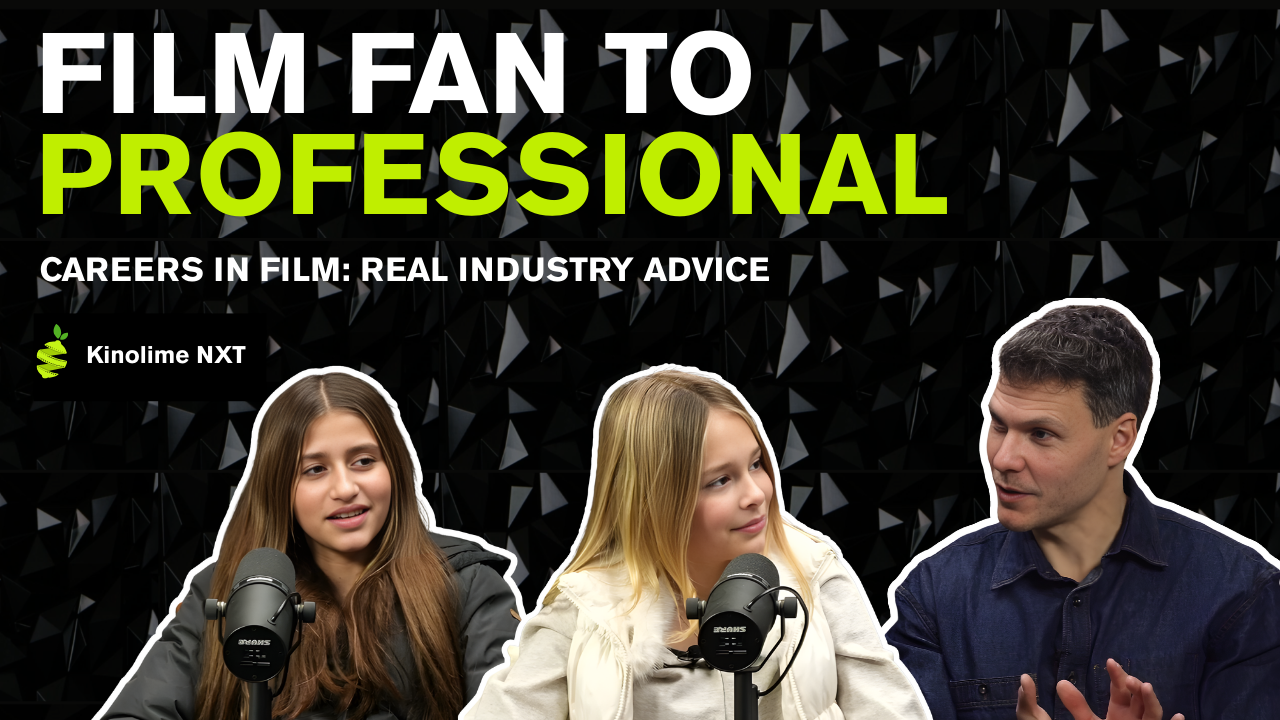
Recently, two students visited our Brooklyn studio to learn how independent film production actually works. They toured the space, asked sharp questions about storytelling and career paths, and sat down with John to interview him about his job, his journey, and how Kinolime turns open submissions into produced films.
John Schramm, Kinolime’s Director of Development, evaluates every screenplay that comes through our pipeline. A self-taught writer who built his career by studying the craft from the ground up, John went from aspiring screenwriter to professional storyteller and now serves as the creative gatekeeper, helping decide which stories move from script to screen.
His role spans far beyond reading scripts. From developing projects with writers and directors to hosting the Kinolime podcast and shaping the company’s creative voice, John sits at the center of the story engine. But the core of Kinolime’s model is simple:
“We hold a screenwriting competition. That’s how we get the movies we want to make.”
And now, we’re looking for the next young generation of filmmakers.
Full Transcript: Careers in Film: Real Industry Advice | Kinolime NXT
Participants
John Schramm - Head of Development, Kinolime
Mirabelle Browning - Student (Hopefully future screenwriter)
Lydia Brinster - Student (Hopefully future screenwriter)
John: So, how does Kinolime make our movies? We get that question a lot. Recently, a couple of middle schoolers came by the studio to see Kinolime in action. They followed me around, we walked through the space, and I showed them our process: how Kinolime selects and develops movies with help from the audience. Then we sat down in the podcast studio and had a great time talking through everything Kinolime. Here’s that conversation.
Meet the Interviewers
Lydia: Hi, I’m Lydia.
Mirabelle: And I’m Mirabelle.
Lydia: Today we’re interviewing John Schramm.
John: Hey, what’s up?
Lydia: What is your job, exactly?
What a Director of Development Does
John: I’m the Director of Development here at Kinolime, and Kinolime Films is a production company, we make movies.
My job is to help pick the movies we’re going to make, from the early stages of the screenplay all the way through physically making the movie. So I’m also a producer.
Mirabelle: Okay. What training and education did you do to get your job?
How John Became a Professional Screenwriter Without Film School
John: I actually never went to school for this—I’m self-taught.
When I decided I wanted to be a filmmaker, I didn’t even know what that meant. Was I going to direct? Produce? I just knew I loved movies and wanted to make them.
So I started by reading every book on screenwriting I could find, and watching interviews with great screenwriters. I looked at the greatest films of all time and asked, “What do they all have in common?” A great screenplay. That made me want to be a writer.
Eventually, I became a professional screenwriter and now I help pick which movies we make.
Lydia: Oh, that’s cool.
Mirabelle: Nice.
Responsibilities and Day-to-Day Work
Lydia: What are your job responsibilities?
John: I have a lot of responsibilities. One big part is helping pick the movies we make. I work with writers and directors on the screenplay side—anything creative and story-related is my department.
We’re also in a podcast studio right now. We do a weekly podcast, and I host it and manage that content. And I handle a lot of the public-facing work for the company, I’m kind of the brand ambassador for Kinolime. I speak at schools and talk to young people about filmmaking and writing.
Mirabelle: What’s the best or worst part of your job?
John: The best part is I get to be creative all day. I’m not crunching numbers or doing hard math, I get to play in the world of story.
The worst part is I’m a bit of a perfectionist, so I have a hard time turning it off. When I go home, I’m always thinking about movies. Even when I watch a movie, I’m analyzing it, like, “Oh, this is what’s happening here.” It’s hard to fully let it go sometimes.
Why John Chose This Career
Lydia: Why did you choose this?
John: I just love movies. To me, it’s the best thing in the world. Film involves sight and sound, it’s one of the most immersive experiences you can have. I’ve loved movies since I was a kid.
Mirabelle: What skills do you use at your job?
Why Story Analysis Is His Strongest Skill
John: Story skills. I’ve been a professional writer for 13 years, so every screenplay or movie we look at, I view it through the lens of story.
My biggest strength is knowing what makes a good screenplay and how to improve one. I can usually spot what isn’t working, so we can make fixes and changes.
Lydia: Who do you work most closely with?
John: Directors, other producers, actors, and our executive team here at Kinolime. We also have an IT person who handles the website and our competition model. So I work with a wide range of people day-to-day, it’s not just one type of person.
Mirabelle: What do you do on a typical day at work?
John: It depends. If I’m in the office, like today, I’ll have a lot of face-to-face meetings with staff, and we’ll do the podcast.
If I’m working from home, it’s a lot of reading and story analysis. Film is global, so I also have Zoom meetings with people in places like LA, Ireland, and China. But mostly, what I do is analyze story.
Lydia: Do you do your podcast every day?
John: Once a week, on Wednesdays. Then we release the video the following week. Sometimes we’ll shoot a few episodes in one day if there’s a lot going on in the movie world.
The Five Most Important Tasks in John’s Job
Mirabelle: What are your five most important job tasks?
John: The five most important tasks are:
Managing the team that reports to me,
Reading screenplays,
Giving notes on those screenplays,
Helping develop our screenwriting competition, because that’s how we find the movies we want to make,
And honestly, the best part: watching movies.
Lydia: Yeah.
Mirabelle: Got to watch them.
John: I love movies.
Lydia: Movies are great.
Mirabelle: Me too.
Favorite Movies
Lydia: What’s your favorite movie?
John: I’ll give you five movies I love:
Jurassic Park
Heat
Amadeus
Point Break
The Best Years of Our Lives
Those are five I could watch anytime.
John: Now I’m the interviewer. Lydia, what’s your favorite movie?
Lydia: I like a lot of movies, but there’s one that not many people have probably heard of. It’s called Walking with Dinosaurs, and it’s so good. You know it?
John: Yes.
Mirabelle: I’ve never met so many people who know what it is.
John: That’s why you’re besties.
John: What about you?
Mirabelle: I have a lot, but How to Lose a Guy in 10 Days has always been my favorite. I love it so much.
John: Great film.
How to Get Training for Film Careers
Lydia: Any other questions?
Mirabelle: How could I get the training and education to do your career?
John: In high school and college, there are filmmaking classes. Filmmaking can be screenwriting, directing, producing, there are so many jobs that go into it.
Right here, for example, we have Matt running the cameras and switchboard. We have someone who builds sets. There’s also art and set design, there are a lot of paths into filmmaking.
For me specifically, I would recommend film school, where you study writing and directing. You learn story, and you also learn how to operate a camera, what shots to use, and so on. Film school is probably the best way to get the training you need.
Work Environment and What Makes It Fun
Lydia: What working conditions make this career pleasant?
John: I mean… look at this building. It’s not like a stale, sterile office. Everything is fun. We’ve got movie lights and cameras everywhere. The environment is creative.
Our office is in Industry City in Brooklyn. You can even see the Statue of Liberty from here. There are coffee shops and restaurants in the building, so that’s fun too.
In the filmmaking world, people talk a lot about movies and creativity—which is really cool. It’s just a fun environment.
John: Anything else? Any other questions?
Lydia: I’m good.
Mirabelle: Yeah, I think I’m good too.
Lydia: Thank you so much for watching.
Kinolime NXT High School Screenwriting Competition
John: So you just heard me say it: we hold a screenwriting competition, and that’s how Kinolime makes our movies.
And here’s what we’re offering right now for high school students: a chance to make your short film a reality. That’s right, we’re going to give you money if you win, so you can take your short film to the big screen.
Go to kinolime.com/nxt for all the information, and get your submission in. I want to read it. The whole team wants to read it. We want to see you take your dream to the next level.
Go to kinolime.com/nxt for all the information, and I’ll see you there.