
How a TOP 3 Screenplay Was Written | Luke Reilly on Prisoners of Air [Podcast]
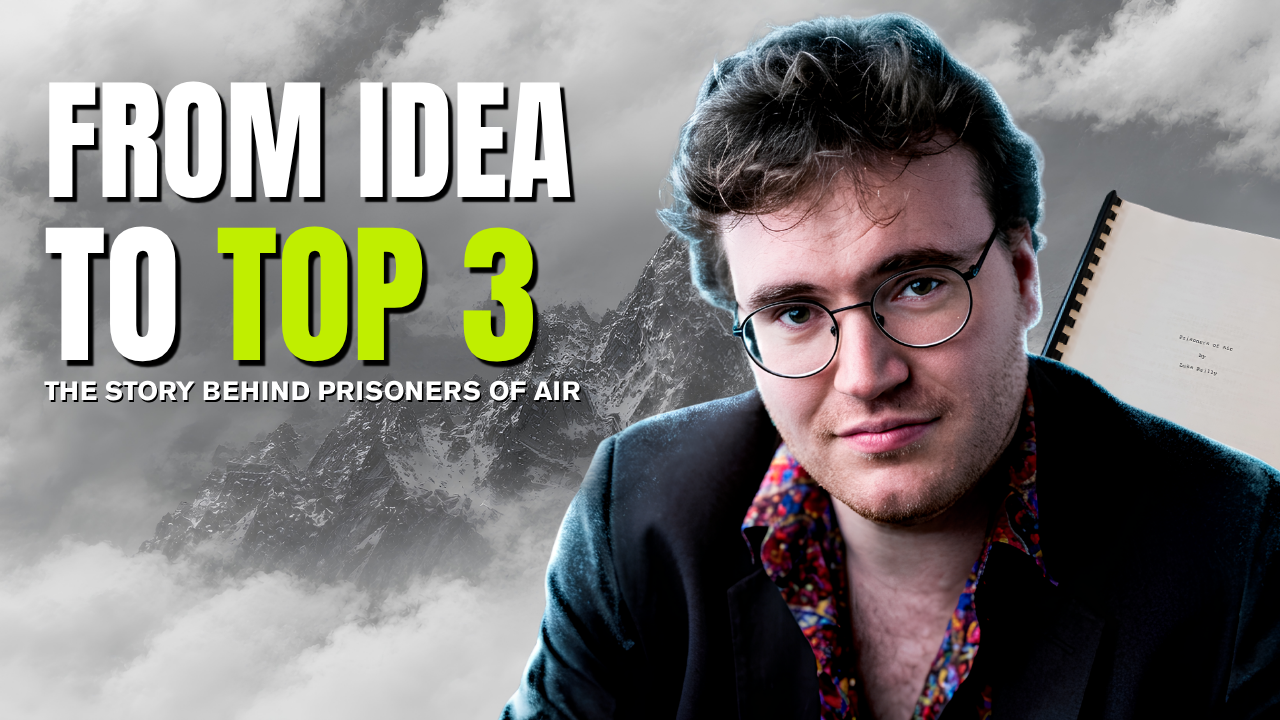
In this episode, Luke (Top 3 finalist - Kinolime's 2026 Script to Screen Feature Competition) tells us how an AMC series sent him spiraling into research, why he deliberately broke the real John Ray's character to serve his story, and how he actually wrote the thing: without an outline, working two hours a night after his day job. He's honest about feedback, ruthless about what stays and what goes, and deeply philosophical about why screenwriting shouldn't follow a formula just because it exists.
If you've ever wrestled with how much historical accuracy your story can hold, or wondered if you really need that ten-page outline to start, or questioned the screenwriting rulebook, this one's for you.
Full Transcript: Kinolime Podcast Episode 57: How a TOP 3 Screenplay Was Written | Luke Reilly on Prisoners of Air
Participants
John Schramm - Head of Development, Kinolime
Luke Reilly - Screenwriter, Top 3 finalist - Kinolime's 2026 Script to Screen Feature Competition (Prisoners of Air)
John: Welcome everyone to the Kinolime Podcast. I'm John Schramm, and with me today is Luke Riley, our finalist from the Script-to-Screen Kino Lime Competition. Luke is coming in from the UK. What's up, dude? How are you?
Luke: Doing good, yeah. Great to be on. Thanks for having me.
John: Thanks for chatting. We're going to get into all the nitty gritty of your writing process, how you came up with the idea of Prisoners of Air—which is one of my favorite screenplays—and all things career story. What we're aiming for is to educate our audience. You're a seasoned writer. You can tell by the words on the page that this isn't your first rodeo. So if you can impart some wisdom to our eager Kinolimers, we'd greatly appreciate it.
The Genesis of Prisoners of Air
John: How did you come up with the idea of Prisoners of Air?
Luke: I wish I could say there was a big inspirational moment—like it came to me in a dream or something. I watched AMC's TV series The Terror, which was about the Franklin Expedition. I watched it when I was on the sofa resting after coming back from shooting a short film during COVID. I just fell in love with it. I started researching the Franklin Expedition and found that there was a whole story about what happened after the expedition got lost—about the search for it.
A character called John Ray emerged. He was the man who actually found the fate of the Franklin Expedition, but he was ignored by the British establishment because he believed Inuit testimony. That testimony revealed that the Franklin men were reduced to cannibalism. For trusting in that testimony, for daring to believe people who were considered inferior at the time, and for suggesting that Englishmen could stoop to so-called savagery, he was basically shunned from the establishment and forgotten by history.
I thought there was a really interesting story there—trying to resurrect what I think was a very heroic man and also understanding a relatable way of engaging with the past. This was a man whose ideas were quite far ahead of his time, and very relatable to a modern audience. So yeah, I thought there was a thread there, and I kept pulling it.
John: So you had the thread of the expedition and the question of what happened to it, then obviously the conclusion. And John Ray—when did you bring in the other character? What's his name?
Luke: Good Sir. That's right.
John: When did you bring in Good Sir? Did you initially try to have the film rest on John Ray's shoulders, or tell us how you got to that conclusion with those two?
Luke: I think when the film first dawned on me—when it felt like I had something—was when I found the two of them together. That's when I realized it was a combination, a two-hander, almost a romance, a kind of story about the romance of friendship. It's a film about contrasts and a bit of a buddy movie.
I discovered this alternative story of Good Sir, who was a real-life figure. He went on an expedition to actually look for his brother, who was on the Franklin expedition. I think that level of human relatability—the fact that he was motivated by grief—created an interesting contrast. John Ray was motivated by a humanitarian wish to find his fellow men, but also by professional accomplishment and a desire to conquer the wilderness. That was a really interesting contrast.
Also, I realized you could bring contrast in terms of how they're perceived. John Ray, to our sensibility, appears very modern, very far ahead of his time. So I thought an interesting contrast would be to make Good Sir very much of his time and very unrelatable to us now. That would set up this debate between the past and the present, between those two characters. Yeah, the film came to life when I realized it would be about their relationship.
John: So when did you realize the screenplay was actually working?
Luke: When I discovered that relationship between the two, I knew I had something. I felt I was onto something. It felt like it had an archetypal structure—a bit of a buddy movie, the Odd Couple dynamic. That structure of two people from very different backgrounds who eventually come to see each other's point of view and eventually develop a love of friendship. Not a romantic love, but yeah, I also like how you can use these characters to make it a bit of a thought experiment. You can play out ideas and debates through the contrast.
I think a lot of stuff I write are two-handers, basically dialogues. I've written a few novels—still trying to publish them—but I've also had a screenplay produced before, and they've all been fixated around two main characters. I think it's a really interesting way of telling stories because the one-on-one relationship is one of the most precious relationships of our lives. Whether it's your best friend, your wife, your husband, your mother, your father, your sibling—I think the duality is what fascinates me.
John: Let's start with Adam and Eve, right? You need two people.
Research and History vs. Story
John: I've gotten into the trap of going down rabbit holes of research. Aaron Sorkin once said that you can get trapped in doing too much research. How did you navigate that for a historical piece like this? Did you go down a rabbit hole, and how did you get yourself out of it?
Luke: I think I limited myself. I was aware that once I started researching certain books, I could just keep reading forever. There's a point when you do too much research—you're doing academia more than creativity. I had a novel project I wrote about two years before that I didn't end up publishing, and I read way too much for it. When I sat down to write, I realized half of it was useless because I couldn't use any of it. It was all interesting stuff, but ultimately not useful.
So I set myself a target of about ten books.
John: That's a lot, but I think setting yourself a limit when you're doing research is really important. Research can be a form of procrastination too—a subconscious one. It's easy to tell yourself you need to learn more about the history and era, but at the end of the day, you have to get your ass in a chair and write.
Luke: But procrastination can be productive too. It's often in those moments when your mind wanders that something really interesting comes out. When I'm sitting at my desk writing and I pop off to the toilet, the idea will always jump into my head. That's when I write the scene—click.
John: I take lots of walks too. I listen. And I always get ideas in the shower.
How did you balance the history and accuracy against serving the story? When did historical facts lose to the story?
Luke: The first dialogue I wrote was a long speech by John Ray that was pretty much word for word from the Richard Richardson Franklin Expedition records from around the 1810s. But also, the true terror and darkness of that historical story informed the tone of my fictional story. Basically, at the end of my film, Abel falls foul to the same condition, the same lack of humanity that the man in that historical story experienced.
I'm doing a master's degree currently, so I have one head in an academic camp and one in the creative camp. I wanted to keep them separate. I had a mentality of kind of—well, screwing history a bit. The John Ray of my film is very much not what the real John Ray was like. He was a devout Christian, quite proud of his nation and country. And—spoiler alert—what happens to him at the end of my film doesn't happen to him in reality. He went back to the UK and lived happily ever after. He was a doctor in the Orkney Islands. He was a teetotaler—he would never drink.
John: So what made you tear all those things apart? Was it to bounce off Good Sir? Why did you make that switch to a more savage—or at least, in myth—version of John Ray?
Luke: I think it was definitely to create more contrast and more sparks with Good Sir. I was writing the Ray that the British establishment saw—the demonic stereotype in their heads of this man who had gone native. I was also writing a Ray in an alternative universe where he had become much more bitter and angry. He had maybe turned to drinking, and he was almost playing up to the stereotype that the British establishment saw. He was almost mocking them, like, "Well, you think I'm a drunk idiot? I'm going to be a drunk idiot. I'm going to shock you."
That's how I justified it. I think historical fiction is always like an alternative reality anyway. So I was basically indulging that alternative.
John: I'm glad you did. You're a producer-screenwriter, so you know what it's like to have your movie made or at least to see your words produced. What is your writing process like? What does Luke Riley do when he's going to write?
Writing Process and Discipline
Luke: That's a difficult question because it's been different with each project. I wrote Prisoners pretty much for the first time with a full-time 9-to-5 job. Before that, I was freelance—doing sound work, various odd jobs, and writing around those. But with Prisoners, I had a set structure. After work every day, I would go to a café or a pub in the UK and write for about two hours. Usually a diet coke—sometimes something to get the juices flowing. I'd do this for about seventy percent of the year. When I felt like I was getting closer to finishing, I'd start working weekends, usually from 10 a.m. to 4 or 6 p.m.
John: So for writers out there who have jobs and want to know how they can do this—you clearly wrote two hours after work. Were you an outliner? Did you have an outline ready?
Luke: I'd open the laptop and see where I got to yesterday. I usually write about a scene or half a scene a day.
John: No outline, though. You didn't have one?
Luke: Not a detailed one. I knew where the story was going—I had it in my head. I'd written down rough notes on Word documents, what I call "splurges." I knew where it was going. I only start writing when I know what the ending is. But I kind of work out how to get there as I go. I don't like to write down every scene beforehand and follow a prescription. I kind of fill out the scene, creating dialogue in a malleable way. I think structure should also come about the same way—through inspiration, not just as bullet points. There's no reason why beautiful structure couldn't fall into your head the same way a line of dialogue does. When you're at your desk and nothing's working, you go to the toilet and dialogue falls into your head. Why can't that happen with structure too?
John: So you didn't have an outline, but you make it up as you go along?
Luke: That's right. I know where I'm going, but I'm chopping and changing quite a lot. When I finish a day's work, I'll write a very rough sketch of what's going to happen in the next section. Then pretty much half of my work the next day is looking at it and thinking, "No, that doesn't really work. I want to do something else." So I'll work out something else and the cycle repeats.
John: Once you had the first draft, what was your process? Did you have friends read it and give notes?
Luke: Yeah, I sent it to friends in the industry and paid a few people to read it as well. Having a stable job and income meant I could be more structured about that. I sent it to maybe seven or eight people, then collated their responses and looked for common themes. But I think it's important to find places where you push back—where you go, "I don't like what they said there."
I remember someone said that John Ray—spoiler alert—is a very important character to die off screen. I immediately knew that had to stay off screen because that's the whole point. That's what grief and losing your friends feel like. You don't see them. There's this larger-than-life person suddenly gone. It's the frustration of wanting them back but knowing they can't come back.
I think that's general advice for writers responding to feedback: don't feel the need to do everything people suggest. But also don't be too belligerent. You have to find a balance. Sometimes when you have a reaction to a note, that's not you being arrogant—that's you actually thinking, "No, I need to stick to my guns."
John: Was there an area where you wish you'd pushed harder? An area you were afraid to explore that, looking back, you should have gone deeper into?
Luke: I don't think I have regrets in terms of intensity. I didn't hold back. There's some pretty brutal stuff in there. What I would have loved to explore more is the Inuit perspective. When I first did my research, the big inspiration for me was the Inuit perspective. These strange encounters they had with the lost Franklin men were like straight-out ghost stories—horror films. They're spine-chilling tales of an Inuit family settling down for the night, and a child sits up and says, "There's a strange man outside." They step outside, and for many of them, it's the first time seeing a white man. And it's a white man whose nose is black because of frostbite. He's completely lost his mind. He's sleeping in a seal carcass.
A lot of that definitely went into Abel—the man who lost his mind. I wouldn't say it's a regret, but it's possibly not my story to tell. And it would be a different film. But there's a whole rich story there—the Franklin expedition told from the Inuit perspective.
Favorite Scenes and Inspirations
John: If you could film one scene tomorrow that would convince the world to watch Prisoners of Air, what would that be?
Luke: I'd pick the scene where they're reading out the roster of ship names to Abel. They're reading the names of the men of the Franklin expedition to this strange figure they found who can't speak and seems to have completely gone mad. They don't even know if he's a Franklin man. For all the bossy quality of the script and all the rich language in there—which I am proud of—I just love the simplicity of that scene.
John: Give me your second choice.
Luke: John Ray's monologue. I love his intro too—when they go to the bar or pub, whatever you call it back then. When you meet John Ray for the first time, it's just so cinematic.
John: Is it inspired a bit by Das Boot?
Luke: Yeah. There's that first scene where they're just getting completely drunk. I remember that. Yeah, that movie. I've never felt more claustrophobic in my life than watching that film. That's a masterpiece. It's fantastic.
The Kinolime Experience
John: Let's talk about Kinolime. How has entering the competition been for you? What would your takeaway be from being a participant?
Luke: It's been a huge experience for me. Being in the top three was a huge boost to my confidence. It's been real validation of the screenplay. I think the model is really innovative. From my perspective as a writer, the level of stress testing it goes through is remarkable. I've been through two rounds of audience voting and a judging panel, and that's a real sign of strength for the script. It's been a huge confidence boost.
But I do think it's an interesting model. It's kind of creating a ready-made audience for the films when they do get produced, which feels strange because no one's really done that before. But I think it's really cool. I've really enjoyed the process. I would have loved to have won overall, but as you said, I have experienced the process of seeing my words become a film and seeing my film on a big screen. I'm just really happy for Kat, the winner. She gets to have that chance.
John: But that doesn't mean Prisoners of Air can't be made. For everyone listening, we're not official yet, but we've extended an option contract to Luke. Hopefully we'll get things done very soon and have another film in our slate.
Luke: I appreciate that so much. It will happen. It's going to happen.
John: I love your screenplay. I have big plans for it. So we'll get into that later. But I want to do a lightning round here. Quick answers—don't think, just go with instinct. You seem like a thinker and well-read.
Lightning Round
John: Top three movies. Go.
Luke: Amadeus. And I think that's because I mentioned it, and they usually ask it. The Fisher King by Terry Gilliam. Oh, great. Jeff Bridges and Robin Williams give brilliant performances. Fantastic film.
John: Screenwriting advice you disagree with?
Luke: There's a trend in screenwriting that sees it as overly formulaic—like you're writing a mathematical formula. You get your inciting incident on page 15, blah blah blah. But if you look at great screenplays, they often do get close to that formula. But you can't impose it. You have to arrive at it. You have to discover it through the process. Basically, screenwriting is like any other art form, any other form of creative writing. Treat it like writing a poem or a novel. Don't see it as somehow separate from that.
John: Best screenwriting advice you've ever heard?
Luke: Screenwriting is acting.
John: Can you explain?
Luke: When you're writing dialogue, you're kind of like an actor improvising. Let yourself be freer with that. I often find that even if I'm writing in a library, I'm kind of whispering the lines beneath my book. I probably look a bit crazy, but don't be afraid to act when you're writing. Stand up and act it out as well.
John: Aaron Sorkin talks about that too. He walks around acting out the lines for the cadence.
Luke: Yeah, that's important. I like that.
John: Movie you wish you'd written—and you can't name the three films you already mentioned.
Luke: Maybe Network. Just a really gorgeous script. I think The Prestige too. That's interesting—most people either love or hate it. I'm glad you're in the camp that likes it.
John: I'm a big Prestige fan. When people rewatch it now, they don't seem to love it for some reason, but I think it's fantastic. I think it's his best film before Interstellar. I'd say it was his best.
Luke: I don't know. It goes back to what I was saying about structure. I saw an interview with Chris Nolan where his structure is just incredible—the way he constructs scenes like little jack-in-the-boxes or tricks that surprise you and upset your expectations, often two or three layers at a time. But he basically said he approaches structure the same way a famous poet approaches his lines. He does it through feeling. He does it through inspiration. He's not sitting there being formulaic.
John: Do you think Odyssey is going to be great or meh?
Luke: The trailers look—I have to say it looked quite bad.
John: I kind of agree. He's surprised me before, but the aesthetic compared to Gladiator—it's just so flat. I'm very worried.
Luke: You can't discount Nolan though. He's great. He's also an alum of my university, so I've got to represent.
John: Last question: what's a habit that made you a better writer?
Luke: Always carrying a pen and a notepad. Whenever I read, I make notes. I can't read without a pen. I mark up my books.
John: Do you freehand your drafts, or do you type?
Luke: I type. I type in Word, because that's how I used to write my novels. I type in Word and then transcribe it over to Scrivener for formatting as a script. The process of transcribing really helps streamline it.
John: Sorkin does that too. He'll write a screenplay and then retype it almost by memory—his mind subconsciously removes the fat.
Luke: Yeah, it's a similar thing. It's also more practical. I can just think and go faster. But when I'm stuck, I'll write by hand. I'll take a notepad, go on a walk, sit in a park, and write a scene with pen and ink. I find that can be a real breakthrough. I don't overuse it, but it's a good way to slow my mind down. When I write by hand, the slowness forces me to stay more in the scene, and that's when better choices emerge.
John: So interesting. Luke, you're amazing, dude. Thanks so much for joining the Kinolime Podcast. If you got something out of today's episode, please share it with your filmmaking and screenwriting community and hit subscribe. It genuinely helps us keep making these shows. We'll see you in the next one.