
How to Write Visually

Many screenwriting classes, books, and videos will often emphasize the ever-important point that film and television are visual mediums, but then do little to direct writers on how to actually take advantage of this in any practical way. Simply saying “show, don’t tell” without explaining what to do next tends to lead aspiring writers astray, leading to scripts that look more like novels than screenplays (which entirely misses the point). So, in this blog, we’re going to dive into what screenwriters actually mean when they say to write visually, give some useful tips that can improve any writer’s skillset in this department, and refer back to some of the best examples of visual writing throughout cinema.
“Show, Don’t Tell” – What it Actually Means
While “Show, Don’t Tell” is one of the most important screenwriting tips one could learn, it is also one of the most misunderstood. Many might believe this to mean writing with less description, but that’s not the case. In reality, what it means is to focus your descriptions on observable, implicit behavior rather than internal thoughts or explanations. Once again, film is a visual medium, so the audience won’t be able to read your characters’ minds in the same way that a novel might allow; behavior and action are everything. The goal is for the reader to be able to understand your characters’ internal conflicts through their actions, therefore making the need for any further explanations completely unnecessary.
Here’s a quick example: Let’s say you have a character (in this case, John) who is nervously awaiting his turn to be interviewed for an important job. How would you make his emotions clear?
What Not to Do:
John is nervous about the interview.
What to Do:
John wipes sweaty palms on his pants. Checks his watch. Checks it again.
The important thing to remember is that a screenplay is the guidebook for a movie. Whoever’s playing John is going to have to do something to depict this nervousness onscreen, so as the screenwriter, it’s your job to decide what actions would be best to achieve that goal.
Behavioral Description – Let Characters Reveal Themselves
Piggybacking off the previous section, let’s dive a little bit deeper into the idea of “behavioral description”. You probably know by now that good writers are supposed to let their characters reveal themselves rather than explain their motives, but what are the best ways to do that? Humans are intricate creatures, after all, and their emotions are usually more subtle than expected. Some of the most popular ways writers utilize behavior are through the use of:
Gestures
Body language
Physical reactions
Interactions with objects
Small choices that reveal something grander
Here’s an example. Instead of:
Sarah is angry
You need to have Sarah express her anger in some specific way, such as:
Sarah folds the letter slowly…and then tears it straight down the middle.
Obviosuly this is a made-up character, and you don’t have any context into why she’s tearing up this letter, but even with very little information, you can get a pretty clear glimpse into how this character is feeling in this moment. Additionally, writing this way builds subtext and gives the audience something to work for. During this made-up scene, an audience member would have to see Sarah commit the action, think about it for a second, and then come to their own conclusion about what it implies. This makes the movie-going experience more interactive and rewarding for the audience, all while allowing your scene to be more interesting and active in the process.
What NOT to Describe in a Screenplay
Another huge mistake that new writers tend to make is including unnecessary details in their scripts that ultimately should be left up to other departments, such as directors, cinematographers, actors, and production designers. As a writer, you should avoid including the following:
Camera Directions
As a writer, I understand that you may have the entire film in your head as you write, but ultimately, where the camera goes is going to be left up to the DP and the director, so avoid any camera directions unless it’s absolutely necessary for the scene to unfold in a particular way
This means no closeups, camera pans, tilts, etc. Just write what’s going on in the scene; these shots will be figured out later.
Actor Instructions
While more obvious things like tone and volume can certainly be included in your scripts to add clarity, you definitely should be avoiding hyper-specific performance notes that are almost certainly going to change depending on the actors and director.
Do not write something such as “He says angrily, but with an underlying sadness”. These nuances are not ultimatley not your decision, so including them in your scripts will just be a waste of pagespace and time.
Novelistic Description
As always, the goal is to say as much on the page in as few words as possible, so do your best to avoid long paragraphs about character history, internal thoughts, or symbolic meaning. If we can’t see or hear it, then it doesn’t have to be there.
Example of an “overwritten” description: “The room reflects the sadness and loneliness he’s felt since his childhood”.
Example of a more visual rewrite: “The room was spotless. Empty. Not a photo in sight.
Professional Scripts Use Lean, Visual Writing
The best writers in the entertainment industry have all mastered the skill of creating stunningly vivid imagery in as few words as possible, often relying on short action lines, precise verbs, and concrete imagery. This is why literacy is so important when being a writer. Read as many books and scripts as you possibly can, and eventually your vocabulary (and writing style) will begin to improve naturally. The more words you know, the better you’ll be able to communicate an idea quickly. And as a result, your scripts will become leaner, clearer, and more enjoyable to read.
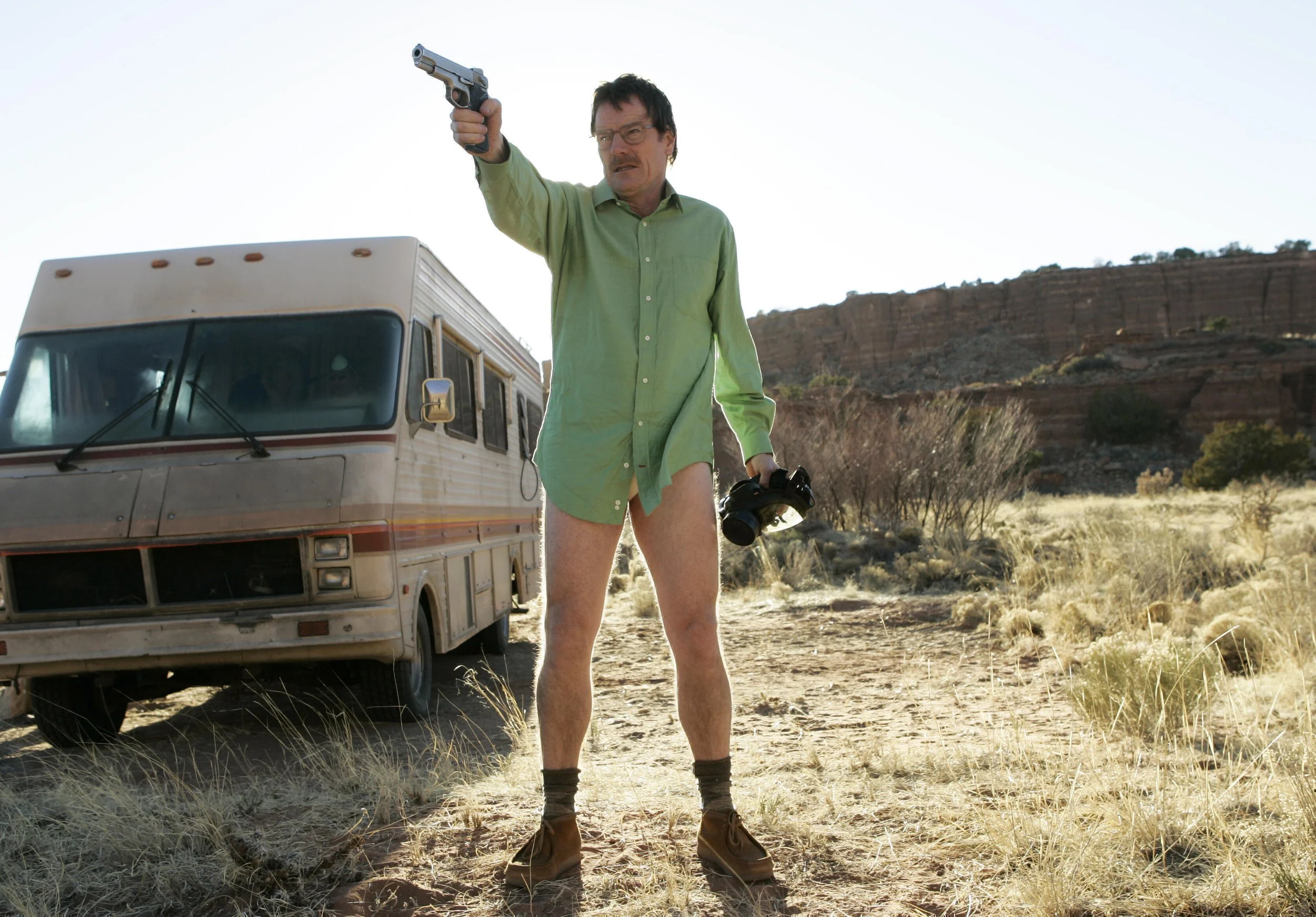
Here’s an example from the pilot of one of my all-time favorite shows, Breaking Bad:
“Walter White stands in his underwear in the desert. A gun in one hand. A gas mask in the other”.
Barely taking up one line of space, the audience is able to see the entire picture and begin to make their own assumptions about the tone, character, and eventual plot of this series.
Writing Cinematically on the Page
Okay, I usually hate the use of the word cinematically (mainly because people tend to throw it around when they can’t think of another word), but here it actually works. Every script’s end goal is to be a movie, which means you HAVE to write in a way that makes the reader visualize it in real time as if they were watching it. You don’t want them to spend two minutes reading something that will only translate to ten seconds of screentime, because that will confuse their sense of time and mess up the pacing of your film. You want to keep things moving quickly, build a clear visual picture, and provide a clear guide on what your movie is going to feel like when it’s all said and done. Here are some great tips on the best way to achieve this “cinematic” writing style:
Use Active Verbs
Active verbs, as compared to “to be” verbs, help cut down the word count of your action lines and get right to the point. In addition, they offer the opportunity to substitute bland vocabulary with something more interesting for your reader to imagine.
Example of what not to do:
“John begins to slowly walk across the room.”
Example of what to do:
“John crosses the room.”
Keep Paragraphs Short
Most professional scripts only use action blocks that are between 1-3 lines. This may not sound like a lot, but if you give any of your favorite scripts a read, you’ll quickly notice they don’t need much more than that.
Focus on What Changes
Only describe the changes that move the scene forward, not static details. Trying too hard to build the setting of the scene is an easy trap to fall into; one where you become oblivious to what’s useful or useless to include. If you prioritize only the changes, you’ll find that everything else was just background noise.
Think Like a Camera
Notice I said think and not act, because acting like a camera will lead to including camera directions, which we already highlighted earlier was a no-go. Thinking like a camera means to imagine that you’re watching the actions within your script through a camera lens.
What do you see? What details MUST you include to get your point across? What are the characters doing that, if you forgot to mention it, would completely ruin the flow of your story? These are things you have to include, and everything else can be ignored.
Quick Checklist for Visual Screenwriting
Okay, we’ve gone through all the most important lessons to learn for great visual screenwriting, but I know that it can still be a lot to remember to implement in your writing. So, to make things easy, we thought we’d make a quick and easy checklist for you to refer back to. The next time you think you’re done with a scene, simply ask yourself these questions:
Can the audience see this on screen?
Am I describing behavior instead of thoughts?
Are my action lines short and active?
Did I remove all unnecessary explanations?
Does every description help tell the story visually?
If the answer is yes to all of these questions, then great, you’re on your way to being a great visual screenwriter.
Conclusion
Visual writing is ultimately one of the core skills that every screenwriter should have. Obviously, you still have to have a unique voice, a creative story, and a million other impressive qualities that take years to acquire, but if you don’t master this one, it can be detrimental to all the other work you’ve put in. So when you’re writing your next script, try to communicate through behavior, keep your descriptions lean, trust the actors and directors, and give your audience the chance to interpret meaning through action, not blatant explanation. And if you ever get lost along the way, just remind yourself that you’re writing a movie, and if something’s not going to make it in the movie, then it should have never been there in the first place.