What It Really Takes to Become a Working Screenwriter [Podcast]
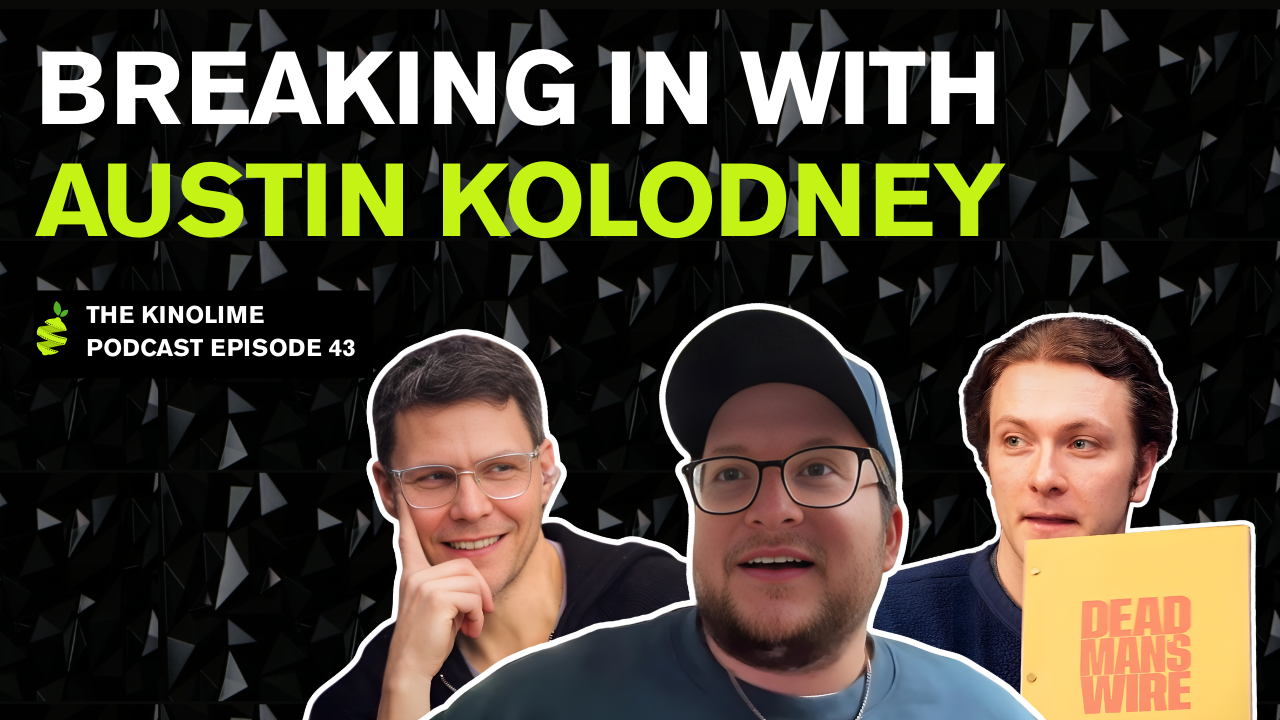
Austin Kolodney’s path to Dead Man’s Wire is the kind of screenwriting story that feels almost too wild to be true. In this episode of the Kinolime Podcast, he sits down with John and Danny to unpack the long, unpredictable road from writing a spec script he had to see on screen to watching it become a feature directed by Gus Van Sant and starring an extraordinary cast. Along the way, Austin shares the realities behind option agreements, unpaid rewrites, surviving on day jobs, and holding onto creative autonomy when the industry starts circling.
It’s a funny, candid, and deeply inspiring conversation about persistence, luck, taste, and the sheer endurance it takes to stay in the game. From Werner Herzog meetings and ten-mile walks across LA to working at the zoo while waiting for the next call, this episode is a reminder that there is no straight path into filmmaking, only the one you keep fighting to stay on.
Full Transcript: Kinolime Podcast Episode 43: What It Really Takes to Become a Working Screenwriter
Participants
John Schramm - Head of Development, Kinolime
Danny Murray - Creative Executive, Kinolime
Austin Kolodney - Writer “Dead Man’s Wire”
John: Hey everybody, welcome to the Kinolime Podcast. Danny, this is all you today. Why don’t you set us up and tell us who we’re interviewing? Because I am so pumped for this one.
Danny: Yeah, man. We’re interviewing Austin Kolodney, screenwriter of Dead Man’s Wire.
John: Let’s give a round of applause for Dead Man’s Wire.
Danny: It’s a pretty incredible story how you got this movie made. The production itself is incredible, and your whole journey as a filmmaker and screenwriter is really captivating. We’re going to go over all of it. How are you doing today, Austin?
Austin: I’m doing well. It’s a nice rainy day in LA. I’ve got some very basic errands to get through today, but I’m always excited to chat with fellow film lovers. So yeah, I’m honored to be on the platform. Thanks for having me.
John: Awesome. Dude, by the way, congratulations on your first movie getting produced with Gus Van Sant. You cracked the code. Share your secrets.
Austin: My credit score was definitely sacrificed in the process.
John: Yeah, that was one thing.
Austin’s Early Career and Working in Film
Austin: I’ve worked in film for over a decade now, in varying capacities. I’ve done director’s assistant work, PA work, art department work. I’ve held boom mics. I’ve second AC’d here and there on indie features. Just being around creative people, being on set, and learning, I’ve never stepped on a set and not learned something.
But I was always writing and directing my own stuff whenever I could, mostly on the side and largely in the sketch comedy space. I came up putting a lot of stuff on Funny or Die. I had around 40 sketches on the homepage and signed with a manager who got me a Comedy Central digital series. I did a couple things with them, directed with Almost Friday TV, did some music videos, always in the short-form digital space while trying to get my indie features made.
Discovering Film and the Influence of Magnolia
Danny: Let’s take it from the beginning. You grew up in Santa Clarita. Did you always love film? Was there a moment, a movie, a scene, where you thought, “This is what I have to do”? Tell us about young Austin.
Austin: I think the movie that first made me understand what a director does, or at least made me feel like, “Whoa, we’re in the hands of someone’s vision here” - was Magnolia. PTA.
John: Oh yes.
Austin: That really did it for me. I even have one of the mugs right now, the little frog.
From the moment that prologue plays, that eight-minute opening about happenstance and chance, even before you meet the main ensemble, you’re eating out of his hand. I love that movie. It’s not for everyone, but it’s for me, baby. That definitely kicked off my interest in his body of work, what influenced him, and then going down the Altman rabbit hole.
Danny: How old were you when you saw Magnolia?
Austin: I was really young. Like 10 years old.
John: I love that your mom took you to see Magnolia.
Austin: No, no, it wasn’t even in theaters. It must have been around 2001. She had it on VHS, and what I was drawn to was that Magnolia is three hours and change, so it came as a two-tape VHS set. You had to switch the tape. That really left a mark on me.
And just how PTA moves the camera, what he does with the performances - I mean, Tom Cruise’s character in that film, Frank T.J. Mackey, is my favorite Tom Cruise performance. The scene with his dying father is incredible.
And if I’m being honest, I was raised by a single mom. I’ve never met my biological father, so that storyline definitely cut pretty deep. That movie was really impactful.
There were others too, Little Miss Sunshine, Children of Men. My grandpa was a big Kubrick fan, so I watched Dr. Strangelove. My mom showed me Dog Day Afternoon when I was pretty young. Those were the movies that really sparked my interest in film.
Community College, USC, and Learning to Direct
Danny: Walk us through what it was like when you decided this was the path.
Austin: By senior year of high school, I knew I was going to community college, College of the Canyons. Shoutout Mike Leech. That was really where I learned how to write and direct. You were adapting material for these little ten-minute pieces, watching your teammates, giving notes on performance. That’s directing. How do you help someone achieve a more authentic, engaging performance? You watch it, study it, practice it, rehearse it.
That definitely gave me the bug for writing and directing. I also had some really impactful cinema professors there, Max Keller and Gary Peterson. Gary wrote my letter of recommendation to USC. He let me start a film club. I owe a lot to that school and those professors.
John: So you’re in community college doing the film thing. Two years in, did you decide then, “I’m going to film school”?
Austin: Yeah. I applied to UCLA and USC. I heard from UCLA first and got in. I had a dorm lined up, a potential roommate, I’d signed my letter of intent, then I heard from USC. Their financial aid office brought me in, matched what I’d be paying at UCLA, and gave me the whole razzle-dazzle tour of the facilities. It just made sense to go there.
John: How many years were you at USC?
Austin: I transferred in 2012. It was on my dime, so I thought, “If I’m paying for this school, I want to wring as much film juice out of it as possible.” I PA’d on as many student thesis films as I could and tried to write and direct as many of my own projects as possible.
By 2015, I was wrapping up general ed classes that hadn’t transferred over and interning at Annapurna Pictures during my last semester.
Interning at Annapurna and Working for David O. Russell
Austin: Megan Ellison ran Annapurna, and it was a very cool time to be there. They were coming off films like Zero Dark Thirtyand American Hustle. It was such an auteur-driven environment. I got to watch executives work with directors up close, and I learned a lot.
Then through that internship, I got a chance to interview to become David O. Russell’s assistant while I was still in my last semester at USC in spring 2015. I was going through rounds of interviews to work for him on the movie that ended up being Joy. They were so secretive I didn’t even know what the movie was at the time.
Writing on the Side and the Years Before Dead Man’s Wire
Danny: So you’re doing these jobs to pay the bills and get experience. At this point, you still had the vision that you wanted to write and direct. Were you writing on the side? Did you have your eye on something longer-term?
Austin: During production on Joy, there was no time. I was working seven days a week, doing 16- or 17-hour days sometimes. There was no real writing on the side while we were in production.
But later, a friend of mine, Sam Presman, recommended me to direct one of these narrative sci-fi web series projects called Haven Origins. That became my first paid directing job. It was enough to pay rent for a month or so, and it was the first time I got paid to direct.
Danny: So then what got you going toward Dead Man’s Wire? Give us the fast forward.
Austin: Basically, from 2015 to 2020, I was directing sketches, working as an assistant, squirreling away money, producing low-budget features, and reinvesting that money into my own directing work.
John: I love that.
Austin: That’s my advice to people. Go work. Do whatever job you have to do. I’d even driven Lyft at one point. But try to reinvest a little into your own directing or writing. Tarantino wrote Natural Born Killers and True Romance before making Reservoir Dogs. I thought maybe I could write something that would sell to a studio or a bigger director, and maybe I could be on set doing production revisions.
Finding the Story of Dead Man’s Wire
Austin: I saw footage of Tony Kiritsis and Richard Hall on YouTube and literally said out loud, “How has this not been made into a movie yet?” The way Tony was operating and talking, the look on Richard’s face, them slipping on the ice, stealing a cop car, the press conference — the tension, the awkward shuffling, the human interactions between him and the cops who knew each other. I was floored. I knew it had to be a movie.
So I started developing it as a film and got in contact with Allan Berry and Mark Enoch, who are kind of the foremost historians on the subject. They opened their books to me about the case because they’re from Indianapolis and had interviewed a lot of people involved.
To me, it felt like the kind of movie I wanted to go see. Something tense, dramatic, darkly comedic, and saying something about America, the American dream, and class. And honestly, if I hadn’t gone into film, I think I would have gone into history. I love history and the storytelling of it.
John: That’s such an important tip: you wrote something you wanted to see. I say that to writers all the time. Tarantino said it too, write what you want to see.
Austin: One hundred percent. I think the most important audience member to consider is yourself. To get a movie onto the big screen and actually made is a hell of a journey. David O. Russell used to say, “Austin, you’re going to die nine times over and be reborn.” That’s what this process felt like. It would seem dead, then alive again, then dead again. If you’re doing it without genuine passion for what you want the final thing to be, I don’t know if it’s worth it. You kind of have to be all in.
The Option Process and the Reality of Screenwriting Deals
Danny: Take us to the moment before the great news comes in that changes every screenwriter’s life. You’ve written the spec, you’re struggling, maybe attaching people, walk us to that life-changing moment.
Austin: To be candid, I tried to get the script to Gus first. My manager shared it with a company that had done his last movie. I have the emails from 2022. I wanted Gus and Jack Black. That was the pairing I had in my head.
That didn’t happen then. Eventually, I signed an option with Cassian Elwes and Tom Culliver. Tom really went to bat for the script and saw the vision. That was one of the only places that put option paperwork down.
A lot of times people say, “Oh, they sold their script,” but most first-time writers aren’t outright selling a script for WGA minimum or more. Usually an indie production company options it. That’s basically a lease. They put a few thousand dollars down, which is great because it covers rent for a month or two, but the option is usually 12 to 18 months.
At that point, I was lucky to have a manager and an entertainment lawyer reading over the paperwork. That’s a big piece of advice I’d give young writers: if you’re signing a scary contract, get someone in your corner who understands law, especially entertainment law.
Meeting Werner Herzog
Danny: What did that process look like once bigger names started coming in? What did the Werner Herzog pass look like compared to the Gus Van Sant pass?
Austin: The submission draft that went out had a lot of research in it. I had hyperlinks to archival footage. I had the blueprint of Tony’s apartment on page two after the title card. It was around 115 pages.
Then I got word: Werner wanted to meet about the script.
I was so broke and probably in a slightly manic headspace. I’d had producers bait-and-switch me before - “You’re going to meet this huge person,” and then it falls through. So I thought, “I’m not giving anyone the chance to cancel this.”
They wanted me at 1:00 p.m. at his producing partner’s mansion in Bel Air. It was a nice day out. I had already memorized the path.
Werner is big on walking. If you’ve ever read Of Walking in Ice, he says the world reveals itself to those who travel by foot. He once said a man on any important mission should walk to it, not drive. So I thought, all right, I’m going to follow his advice.
So I walked from Silver Lake. It was like a ten-mile walk.
Danny: Did you walk back too?
Austin: Yeah. And I told my manager and producer, “I’m not bringing my phone.” They said, “You need your phone in case he cancels.” I said, “That’s the whole point. I’m not giving you the opportunity to cancel an hour before.”
When I got there, his producing partner was genuinely disturbed that I had walked. He said, “You walked here? What do you mean you walked here?” But Werner understood immediately.
John: Were you sweaty?
Austin: No, I had cooled off. I got there early. It wasn’t too hot, I was wearing a tank top. Honestly, it was one of the best days of my life.
Protecting the Script and Holding Onto Autonomy
Austin: I brought two copies of the script: one watermarked for him and one for me. There were pens on the table. I think maybe they expected me to bring my laptop and hand over the file, but they hadn’t bought the script yet. My leverage was that they didn’t have it.
John: That’s very smart, by the way.
Austin: To be honest, it caused a lot of tension. I don’t know if I’d recommend everyone do it, but it made sense for me and for where I was at.
I also never wanted to just hand over the file because I was doing rewrites without getting paid. In my mind, I was thinking, “If I’m starting rewrites with Werner, then I should be getting paid.” But they didn’t pay me for seven months.
One of the first things Werner said to me was: “Austin, I’m going to wean you off the truth and bring you closer to the facts.”
That was important for me to hear, because film is a director’s medium, and Werner’s vision of the movie was not as grounded in the historical research I had done. He wanted the essence of the crime, not literal fidelity to the record.
The moment he said that, I knew we were heading toward a page-one rewrite, new locations, new names, different dynamics. We changed a lot.
But I’ll always cherish that time. I was broke, but I got to go to Werner Herzog’s house and work through the script line by line. He’d call me on weekends for two-hour conversations about it.
Werner’s House and the Rewrite Process
John: Real quick, what was the coolest thing in his house?
Austin: His cat. He had a cat named Mutz.
He also had one of those personal saunas, which I thought was cool. But honestly, the house wasn’t gaudy. It was tasteful. It felt like a library, beautiful books, beautiful art. He showed me Poetics by Aristotle and told me, “You must read this.” It was a really admirable home.
When the Herzog Version Fell Apart
Austin: At one point, Nick Cage was going to act in it. It was getting pretty far along. Werner went on a scout, and then something happened. I still don’t know exactly what. We were approaching a start date, getting closer to shooting, and then Werner sent me a cryptic email saying he was no longer part of the project.
He said he had worked in good faith, but had lost faith in the production.
I was losing my mind. I was calling him, trying to get answers. He’d speak in riddles. He said things like, “There is a difference between a castle in the sky and a truck that will not move.” Or, “It is as if the producers are at a Las Vegas casino and bluffing hand after hand. You must hold cards at some point.”
I didn’t know what that meant. Teamsters? Financing? Something else? I was just going crazy.
Working at the Zoo While Waiting
Austin: At the same time, I was so broke that I needed work, but I still wanted to keep my schedule open in case rewrites came back. So I went to a job fair in Northridge and got a job at the LA Zoo.
It was early morning work before the zoo opened, Friday through Monday, which meant I could still maybe take meetings later in the day. So I did manual labor at the zoo. Werner left the project around spring, and I basically worked at the zoo the rest of the year.
Then, right when the option was expiring, they extended it and finally paid me what I was owed for the rewrites.
Danny: Was the zoo job influenced at all by Herzog? He always talks about filmmakers having jobs outside film.
Austin: It was, honestly. He says go be a bouncer at a Berlin nightclub, go be a janitor, go work on a ranch. I took that to heart. But it was also practical, the zoo was close enough to bike to, and city jobs take care of people. My grandpa worked for the city too.
And I did get good writing done while I was there. Seeing the sunrise, cleaning enclosures, looking at animals, it was oddly peaceful and inspiring. I’d listen to audiobooks like William Friedkin’s autobiography while working.
The Surprise Return of Gus Van Sant
Austin: At one point, someone leaked that Werner and Nick Cage were attached, so I started getting all these texts from friends congratulating me. Meanwhile, I was literally cleaning enclosures at the zoo and thinking, “Guys, I don’t know what’s happening. I don’t even know if this is true.”
Then in the fall, a friend of mine who worked as an assistant at a company sent me a screenshot of a submission that said: “For this actor’s consideration: director Gus Van Sant, script Dead Man’s Wire by Austin Kolodney.”
And I thought, “What? This is too good to be true. This is what I dreamed about back in 2022.”
Then my manager and I called Tom, and he confirmed that yes, it looked like it was happening, though everyone was still cautious because we’d all seen how easily things could fall apart.
What ended up happening was that once Gus came on board, the version of the script they went back to was basically my first draft again. They cut around ten pages and added a little scene, but mostly it went back to the original version.
Rewriting for Gus and Casting Al Pacino
Austin: I was still working at the zoo when I heard Gus was on board. Then I got my first phone call with him. Eventually there was talk of going out to Al Pacino for the M.L. Hall character, and I couldn’t believe that was even possible.
But I was also trying to protect myself. I’d maxed out all my credit cards and was still at the zoo. I was willing to do more rewrites, especially if it helped land Al Pacino, but I needed some assurance I could survive if the movie didn’t go into production.
So I tried to eke out a little money for the rewrites. I read Al’s memoir Sonny Boy and another interview book just to infuse as much of his voice as possible into the role if we were going to expand it.
Meanwhile, my friend Sydney Marquez, a set decorator, got hired in Louisville, where the production was shooting because of the tax credits. The movie is set in Indianapolis, but Louisville could still sell that 1970s look. So I was backchanneling research materials to her that Allan Berry and Mark Enoch had shared with me.
Things were still a little frosty between me and the producers, but of course, when Gus Van Sant calls, I’m answering that phone.
Going Into Production
Austin: Then it all moved very quickly. After years of glacial starts and stops, suddenly it was: we need to finish casting, build stages, lock locations.
Once I knew my plane ticket and hotel were booked, I gave my three-week notice to the zoo. I told them, “I think my movie is going in Louisville.” They were thrilled for me.
And the moment I landed in Louisville, Tom said, “We have to cut the basketball sequence. We can’t find a stadium, and we can’t afford to fill one.”
That was the immediate reminder: if you want to be the one shaping the script, you also have to be the one killing your darlings. I wanted that agency. I wanted autonomy in how the cuts were made and how the script adapted to production reality.
So from the moment I landed, we were scouting, cutting scenes, combining things.
John: So you’re there. The movie is real now.
Austin: I still didn’t breathe easier until Gus called action on day one. Until then, there was always a part of me thinking it could still fall apart. But once he called action, I knew we were running.
Gus Van Sant’s Approach to the Script
Danny: What was it like developing the Gus Van Sant version compared to the Werner version?
Austin: Gus basically went back to the first draft. At one point he asked if he could read the Werner draft, but I don’t even know if he had time to get through it. His notes were minimal and intuitive.
For example, his note on the M.L. Hall scene was basically: “Maybe they talk.” Then he said, “Have you seen Network?” I said yes. He said, “You know that Ned Beatty boardroom scene? Maybe he could lay into him like that.”
That was basically his note.
That’s how he likes to work. He’s not prescriptive. He asks collaborators for their instincts. If he likes what you bring, he says yes.
Why Austin Originally Wanted Gus
Danny: Back in 2020, why did you want Gus in the first place?
Austin: There were two directions in my head. Tony Kiritsis was either Jack Black or Adam Sandler. If it was Jack Black, I wanted Gus. I loved Jack Black in Don’t Worry, He Won’t Get Far on Foot, and I remember leaving that movie thinking Jack Black could win an Oscar in a leading role if Gus directed it.
I thought Gus could tap into the dark humor of the story, like in To Die For or Drugstore Cowboy, but also the tension and the heart. A lot of Gus’s movies have real heart.
If it was Sandler, I was imagining the Safdies. But once the budget realities set in, it was clear this wasn’t going to be some $25 million studio movie. It was closer to a tight $10 million production on a roughly 20-day schedule. And honestly, I think only someone like Gus could pull that off.
Writing a Big Thriller in a Small Number of Locations
Danny: For a thriller that mostly takes place in a handful of locations, the movie feels really big. How did you do that on the page?
Austin: It was about rhythm. When do you pop out? When do you cut away? When do you build peaks, valleys, crescendos?
I also wanted to make sure we didn’t ignore the larger world for too long. We should know how the cops are talking about it. We should check back in with Linda. We should see how the crowds are reacting.
That was one of the most interesting things in the archival footage: some people took Tony’s side and said there should be an investigation into the company, while others said Richard was a good man and Tony was crazy. It became a kind of Rorschach test.
That helped make it feel bigger than just two guys in a room.
The Timeliness of the Story
Danny: This was filmed right around the time that the UnitedHealthcare shooting happened, right?
Austin: Yeah. We were already in motion when that happened. Gus was attached, Bill was attached, Dacre was attached, they were already building things and then the UnitedHealthcare assassination happened.
It comes from a similar seed of discontent with a system. In our case it’s real estate. In that case it’s healthcare.
But our story doesn’t end the same way. And honestly, if Dead Man’s Wire ended in pure bloodshed and massacre, I don’t know if that would have been the movie I wanted to make. The ending we have, with the court case and Tony still running his mouth, is funny to me. It lands like a punchline.
So while I understand why people see the parallels, I do draw a distinction.
Tonal Influences: Dog Day Afternoon, Fargo, and Uncut Gems
Danny: Were there specific North Star films you were thinking about while writing?
Austin: If I had to pick three: Dog Day Afternoon, Fargo, and a little bit of Uncut Gems.
Dog Day in terms of structure especially. I didn’t want the biopic version of the story where you watch Tony develop the land and then sit through a long courtroom procedural afterward. The meat and potatoes are when that dead man’s wire is strapped to Richard. That’s the heart of the movie.
I wanted to open with Tony arriving and trust that the audience is smart enough to fill in the blanks from context clues and archival footage. Similar to Dog Day Afternoon: the movie just starts, and suddenly they’re walking into the bank.
Life After the Film’s Release
John: The movie is made, released, and out in the world. How has your life changed?
Austin: First, I have to express gratitude. This was the dream, getting the script into the hands of a big director like Gus, then having this incredible cast. Coleman Domingo, Bill Skarsgård, Dacre Montgomery, Mahala, Cary Elwes, Al Pacino. It’s a murderers’ row. Cary especially really put the movie on his back in a lot of ways and did so much to promote it.
But something funny happened after a Santa Barbara screening. Josh Brolin and his wife were in the audience. Afterward he came up to me, shook my hand, and said, “I dig your story, man. It feels old school.” Then he said, “Promise me you won’t drink the Hollywood Kool-Aid.”
That really stuck with me.
Since then I’ve been invited into some very cool rooms. I got to meet PTA briefly. I’m having meetings with fun companies. But to be completely candid, I haven’t landed the next job yet. Financially, I’m kind of back to square one. I may need another day job. I have no ego about it. I’ll PA on a commercial. I might pick up shifts at the zoo again.
I never thought this would be a golden ticket where suddenly I’m off to the races forever. It’s a huge victory, but the path of a filmmaker is not linear.
Supporting the Film and the Screenplay Book
Austin: I’m very excited the movie is out there and that people are talking about it. It’s going to come out internationally too. I just want people to see it because I think it’s a fun time at the movies.
John: Go see Dead Man’s Wire. Support this film.
And we’ve got a cool little gift here. We haven’t even talked about this screenplay book. It’s one of the most incredible screenplay packages I’ve ever seen.
Austin: It’s a very cool piece of merchandise. Ro put it together, and Ken Farmer designed it. Mo at Ro really spearheaded it. It’s a collaboration, not just my screenwriting. Our stills photographer Stefania’s photos are woven throughout it, and she was such an integral part of the crew. One of our set dressers, Vin, also shot some 35mm photos for it. It’s a really cool piece.
John: Go get it. Go buy it. Support it.
Danny: The intro you wrote for it is amazing too.
Austin: I got to quote Cameron Crowe, quoting Max from Say Anything. It was a fun moment in life for me.
Final Advice on Writing and Taking Notes
Austin: I have stacks and stacks of Werner notes. When I worked for David O. Russell, he said, “Never trust a man who doesn’t write everything down.” So I’m a big advocate for handwritten notes and documenting everything.
John: That’s what we’re about. It’s a screenwriting podcast. Always be writing.
I always carry a notebook around too. You need to be able to take notes. It’s great advice.
Closing
John: Austin, you are a true gem of a human being. We love your work. Thank you so much for sharing your story today. We’d love to have you back on and go even deeper into writing and process.
Austin: I’d love that. Hopefully I land one of these next feature gigs and maybe within a year I’ll be in New York and we can do it in person.
John: We would love that. We really appreciate you.
Danny: Yeah, man. Incredible story on the page, and your actual story as a writer and filmmaker is awesome. I had a blast this week getting to read the screenplay again, watch the movie again, and learn more about how it all came together. It’s beautiful to see.
Austin: That’s awesome to hear. Thank you guys for having me on.
John: Thank you very much, man. We really appreciate it.
Austin: Thank you. I appreciate it.