
What do INT and EXT mean in a Screenplay?
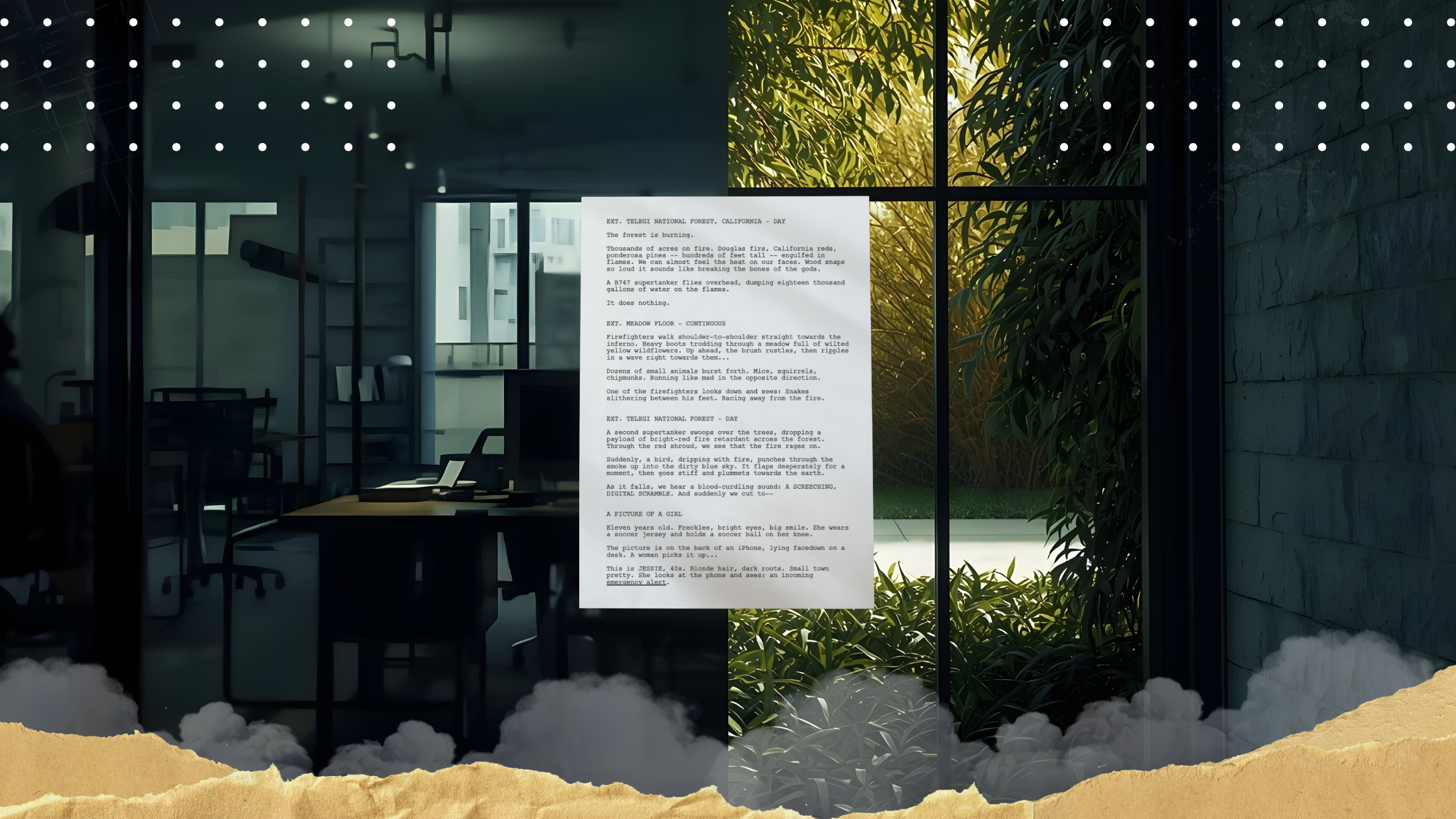
Screenplays have a very specific industry-standard format and if you do not use it, your project will start off as a red flag. Let’s go over the basics and then dive in to one piece that is seemingly straight forward but can be confusing — the use of INT. and EXT. in the slugline.
What is a slugline?
Glad you asked.
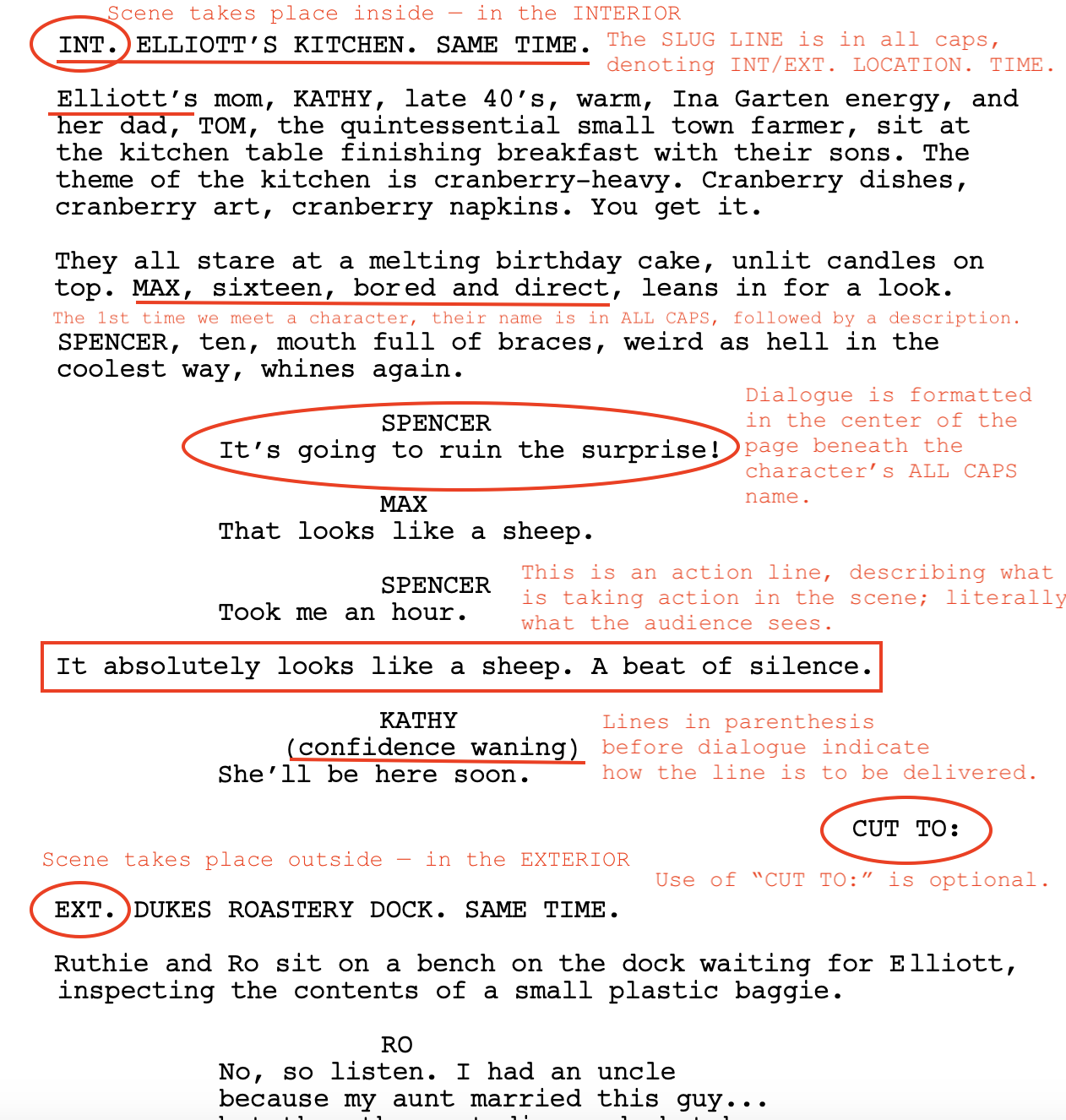
Let’s take a look at this page from My Old Ass.
It begins with a SLUGLINE:
INT. ELLIOTT’S KITCHEN. SAME TIME.
The slugline begins a scene and cleanly states when and where the scene takes place. In this case, it is an INTERIOR shot (INT.) in ELLIOTT’S KITCHEN at the SAME TIME as the previous scene. The time could also be DAY or NIGHT or MOMENTS LATER. It’s brief and most screenwriting software will have the standard options automatically available.
After the slugline comes an ACTION LINE, which describes what is literally seen onscreen. The action line is also where characters are given a brief introduction. Note that Elliott’s name is in lowercase while her mom and dad are in ALL CAPS. This is because Elliott has already been introduced in the screenplay, so every time thereafter she will have standard Proper Pronoun capitalization. Her mom and dad are being introduced here for the first time, so their names are in ALL CAPS, followed by a quick description:
Elliott’s mom, KATHY, late 40’s, warm, Ina Garten Energy, and her dad, TOM, the quintessential small town farmer, sit at the kitchen table finishing breakfast with their sons.
There are a few things to note here. It can be easy to describe characters in cliche ways but you must avoid this.
KEN, wearing a T-shirt and jeans…
JESSICA, pretty but doesn’t know it…
AMY, 30s, hot…
These descriptions don’t tell us anything substantial about the characters. Unless it’s critical for Ken to be wearing a T-shirt and jeans for the story…let wardrobe decide what to put him in and tell us instead about his essence. Is he laid back? Is he underdressed and aloof?
Is the only thing important about Amy that she’s an attractive person for another character? Or is Amy superficial and into her looks or detail oriented and well-put together? Look at the descriptions in My Old Ass:
MAX is sixteen, bored, and direct. SPENCER is ten, mouth full of braces, and weird as hell in the coolest way.
The action lines are where your talent as a writer can really shine, so keep them concise and informative. The general rule is to try to keep them to about three lines (but look, My Old Ass breaks that rule here) and that you be wary of filling up a page with all action lines. Readers’ eyes and attention will start to wander if there’s too much text and not enough negative white space.
Do also note in the first action line how writer/director Megan Park also described the theme of the kitchen as cranberry-heavy:
Cranberry dishes, cranberry art, cranberry napkins. You get it.
You can have some fun here and there to let your voice shine, but be conscientious about how often and when.
Next up, the DIALOGUE.
For DIALOGUE, it is centered on the page with deeper margins. Screenwriting software will automatically indent this for you. The speaking character’s name is in ALL CAPS followed by their dialogue. There might be some contingent information, such as SPENCER (O.S.) meaning “OFF-SCREEN” as in, we literally hear Spencer but do not see him. Maybe he calls from another room. This is different from SPENCER (V.O.) meaning VOICEOVER, as if Spencer were narrating the project.
Finally, between the character’s NAME and their DIALOGUE there might be a PARENTHETICAL to help give the emotion or delivery of the line. On this page we see KATHY speak with her (confidence waning). That’s a little clue from the writer to the reader. Be careful with how often you use your parentheticals; some people in the industry get distracted by them if there are too many and consider them to be superfluous or choices for the director or actor to make. But they work well to help indicate tone and meaning in the screenplay itself.
Finally, this scene ends with a CUT TO: the next scene; this is not necessary to include. It’s implied that a scene will cut to the next one. Sometimes this is a hard cut or a match cut. Sometimes the scenes blend together, where you may use the CONTINUOUS time in the SLUGLINE.
The more you read screenplays, the more variety you’ll see, but the format remains very consistent to include these elements.
SO. INT. and EXT.
Seems easy enough, right? If a scene takes place indoors, you use INT. for interior. If it takes place outdoors, you use EXT. for exterior.
But sometimes, there are tricky scenarios. What if someone is talking on a phone as they walk to their car and get in? Well, you might use both:
INT./EXT. ELLIOTT’S CAR - DAY
Or if you want to be more specific you could try something like:
EXT. PARKING LOT - DAY
Elliott walks to her car, cradling her phone against her ear as she unlocks the door.
INT. ELLIOTT’S CAR - CONTINUOUS
She slides in the driver’s seat and starts the ignition.
There are a few variances in formatting (some people underline their SLUGLINES; others include them in BOLD; but no matter what, they are always in UPPERCASE).
The most important thing you can do is be consistent within your own screenplay.