From the Chicken’s POV : Ian Samuels on Bringing Chicken to Life [Podcast]
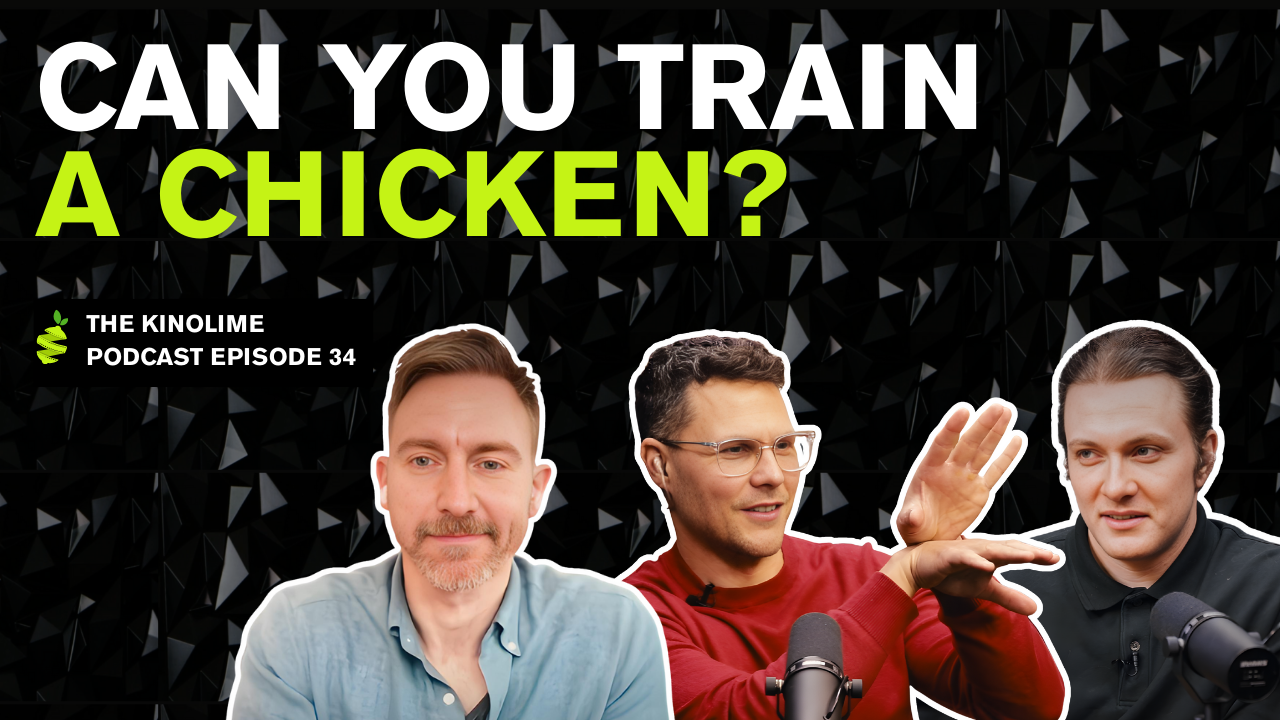
After placing in the Top 3 of the Kinolime Short Film Competition with his Short Chicken, filmmaker Ian Samuels sits down with the Kinolime team to talk through what happens after the script is celebrated, when creative vision meets real-world logistics.
From working with a professional chicken trainer and blending live animals with puppetry, to designing a bold, first-person visual language inspired by Aronofsky and The Dark Knight, the conversation explores how far a filmmaker can push perspective while staying grounded in story.
John, Danny, and Ian also unpack the less glamorous side of independent filmmaking: financing hurdles, creative compromises, and the question every filmmaker eventually faces, what do you do when the money doesn’t quite line up with the dream?
Equal parts funny, thoughtful, and deeply practical, this episode is a candid look at process, persistence, and the stubborn belief that sometimes the only way forward is to make the film anyway, even if it means wrangling a chicken.
Full Transcript: Kinolime Podcast Episode 34: From the Chicken’s POV : Ian Samuels on Bringing Chicken to Life
Participants
John Schramm - Head of Development, Kinolime
Danny Murray - Creative Executive, Kinolime
Ian Samuels - Writer Chicken, Kinolime Short Competition Finalist
Bringing Chicken to Life
Ian: I’m in touch with an animal trainer, a chicken trainer, who’s really excited about the project. There’s also going to be some puppetry involved, so we’re figuring all of that out right now. I’m meeting with her next week. She just wrapped a pigeon show, so she’s been working with birds. Chickens are supposed to be pretty smart, so we’ll see how it goes.
Kinolime Check-In & Project Support
John: What’s up, man? How’s it going?
Ian: Great, really great to see you guys again.
John: Since we last spoke, the competition wrapped. Kinolime loved your screenplay so much that we wanted to provide additional funding to help you make Chicken as a short film. It’s been an in-house favorite since day one, Danny was especially big on it.
John: I loved Chicken. It just grabbed me.
Danny: I got oddly angry watching Good Boy. It was fine, but I kept thinking: if there was ever a story that needed an animal protagonist on screen, it should be a chicken.
Production Approach: Real Chickens, Puppetry & POV
Ian: Right now, the big question is pulling together the extra funds. But creatively, we’re moving forward. I have a team ready to make it. We’re planning a mix of real chicken performance and puppetry.
The way I’ve written it, the chicken functions almost like a puppet anyway. We’ll storyboard the shots we need, then focus on capturing the right eyeline. She doesn’t need to “perform” much, no crying chickens or anything like that.
We could do POV shots with the beak at the bottom of the frame, or shoot over the shoulder with puppetry for wider shots. Some scenes might be more first-person. A lot will depend on what the trainer says is possible, and honestly, what we discover on set.
John: I keep thinking: I need to know how this ends. If you can’t train a chicken, do you audible to another animal?
Wrangling Chickens & Early Filmmaking Roots
Ian: We can wrangle a chicken. Maybe not fully train one, but we can get it in the right spot, looking in the right direction.
One of my first movies was in fifth grade, I did Beauty and the Beast with my two cats. I’m not an animal trainer, but I’d set food down, film them walking different directions, and cut it together. You can tell a story that way.
Timeline & Financing Reality
John: When do you think you’d shoot, assuming the funding comes together?
Ian: There’s a version where we shoot in March if I can close the financing. That’s the big question.
John: This is something filmmakers deal with constantly. If the money doesn’t come through, what’s the plan?
Ian: There are two paths. One is continuing to pursue financing. The other is scaling back, rethinking how we shoot, getting more creative to lower costs. I have ideas for that, but the ideal version is still top of mind.
Camera Style & Visual Language
Danny: Ever since I read the script, I’ve been imagining how you’ll shoot it. Is the chicken-cam still part of it? Like a GoPro rig?
Ian: Possibly. I’ll talk with my DP, but the camera will be low to the ground. Maybe handheld, maybe on a small rig moving through space with her.
I’ve thought about those Aronofsky-style “snorricam” shots, where the camera is rigged to the actor and the world moves around them. I don’t know if it’s possible, but what if you could do that with a chicken?
POV, Inspiration & Immersion
John: Have you seen those bird POV videos? Hawks flying, it’s incredible.
Ian: Exactly. I want to be fully in her perspective. There’s a car scene where she’s looking up through a moonroof, seeing abstract city lights. We’ll get macro shots, reflections in her eye.
It reminds me of that shot in The Dark Knight where the Joker leans out of the car and the world blurs past him. That same feeling, but with a chicken.
The world will be abstract: extras mostly legs, one kid whose face you actually see, but mostly we’re with her.
Chickens & Ethics
John: Has this changed how you feel about chickens? Are you still eating chicken?
Ian: That’s my conundrum. I love animals, and I love eating them. I don’t know how to reconcile that. But yes, I still eat chicken. My dream is actually to have a chicken someday, maybe this will push me to finally do it.
Closing Thoughts & Thanks
John: Whether it’s owning a chicken or rolling your first frame, we’re so excited to be part of this journey. Thank you for trusting Kinolime with your story, we’re your biggest fans.
Ian: Thank you. This competition really gave me the kick I needed to get this rolling.
John: And just a reminder, we’ve got a feature competition opening next year. If you’ve got a feature script, send it our way. We love your work.
Ian: Thank you so much. Happy holidays.