
What SpongeBob Can Teach You About Writing Characters [Podcast]
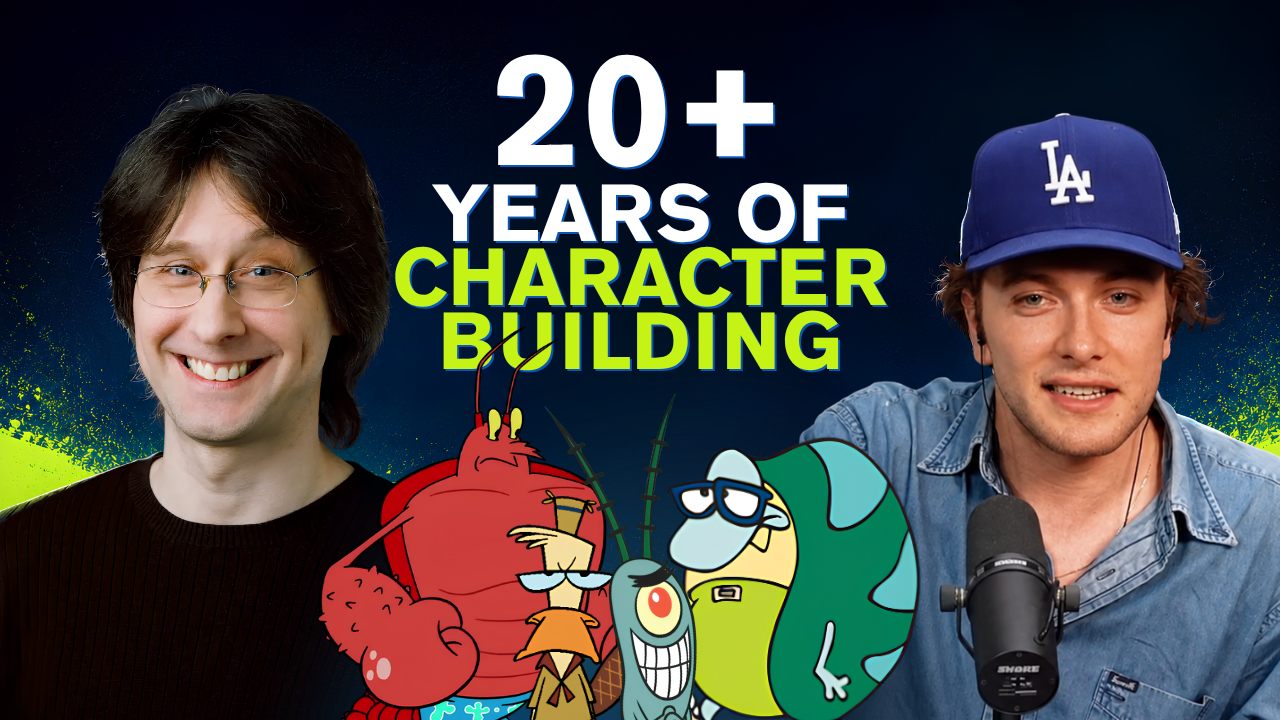
Welcome back to the Kinolime Script-to-Screen podcast. Today's guest occupies a spot in screenwriting that almost nobody else does: he writes for characters he also voices, on a show that's been running for over 26 years.
Doug Lawrence - Mr. Lawrence to most of the world - has been in the SpongeBob writers' room since the very beginning, working alongside creator Steve Hillenburg and Derek Drymon. He's the voice and co-writer of Plankton, a writer on The Patrick Star Show and Kamp Koral, and most recently wrote the Plankton movie.
In this conversation, Doug talks about what it takes to keep a cast of characters feeling alive after hundreds of episodes and three generations of viewers": how the show's visual, cartoonist-first instincts shape every script, how the writers' room finds new structures without losing what makes an episode "theirs," and what changes when you're writing dialogue for a character you're about to step into the booth and perform yourself.
Let's get into it.
Full Transcript: Kinolime Podcast Episode 54: What SpongeBob Can Teach You About Writing Characters
Participants
Danny Murray - Creative Executive, Kinolime
Mr. Lawrence - Writer, Voiceover actor (SpongeBob)
Danny: Hey everybody. Today we are here at the Kinolime Script-to-Screen podcast with none other than Mr. Lawrence. We are so excited to have you today — just, you know, to make sure in case anybody goes "that's not him," it's him. We're going to be talking about SpongeBob screenwriting, and I guess the amazing career that kind of brought you here. This is a screenwriting podcast, and where specifically you lie in this is really almost unlike any other writer — you're writing, you wear a lot of hats on SpongeBob and all the other subsidiary shows, and you're writing for characters that you voice. What do you think specifically makes these characters — from a writing perspective, from a performance perspective — what has made these characters classic for so long, across what now seems like three different generations of young adults and kids watching this?
Writing as a Cartoonist, Not Just a Screenwriter
Doug: It has to come — I mean, first of all, it's that everybody continues to find it interesting, which is crazy all by itself. You know, just the fact that — why this show over other pieces, other things? But we also always, in pretty much all the things I've done, I don't consider it a family show or a kid show. I just consider it a comedy show. So to me, we're throwing things really hard in the writers' room, and myself — when I'm doing stuff that won't necessarily end up in the episodes, because it sometimes goes too adult, or it just goes too far, tonally, for what we do — we work like comedy writers do.
I started in improv comedy and stand-up years ago, so I came from a performance place, but I also was a cartoonist, so I came from that place too. There are things specific to me, and things specific to the show itself, and one of those things is that it's coming from a cartoonist's perspective almost entirely. I think a lot of shows, for better or worse, come from a complete screenwriter's perspective, which doesn't necessarily always lend itself to being visual.
So when I'm writing something, even if I'm not actually drawing it, I could — it sort of goes back and forth: is this something someone could pull off in a drawing? Am I giving a storyboard artist something they're going to strangle me for, or is this something I'd want to do if I were boarding it? In past cases, I was. That's part of the process for me — coming straight out of a visual place first, and dialogue is always something I work out after I've already seen the pictures in my head of how it's going to work visually.
That's always what we're saying in the room: "That's a really funny concept, but how is that visual for us? How does that lend itself to gags? How does it lend itself to the kind of humor we do on our show?" — which isn't done as much as it used to be. We do a lot of slapstick, a lot of double-talk, things more associated with the old theatrical cartoons, even more than shows today, because a lot of them are like animated sitcoms. I think we're a sitcom too, but a different species of one, because we're always coming at it from the visual. It goes through a process where more artists get involved and add more visuals before it's finished for everyone to see — a great process where things get added, perfected, tweaked, and edited down to what we think will be the best-paced story, but also the funniest. That's kind of what wins in our room all the time: what's the funniest thing.
Inside the Writers' Room
Danny: On that note — is there a specific structure to the room? I imagine I can't even fathom how many writers and writers' assistants have gone through the SpongeBob writers' room over the last 20-plus years. What specifically works in the room? What structure, what temperament from new writers breeds success there?
Doug: First of all, there hasn't been as many as you'd think. Most everybody has a background on the show — no one just gets a job as a writer and suddenly is a writer on the show. Everybody has to come up through the ranks in a way, almost everybody except me, because I had already been there with Steve Hillenburg and Derek Drymon at the beginning — we were from Rocko's Modern Life. We had similar sensibilities, and I was the only writer on the show at the time, kind of bridging the gap between the storyboard guys and the writing department, because I had done both.
It's a small group — a little brain trust across all the series, because the group also created The Patrick Star Show and Kamp Koral. We weigh in on the movies too — I wrote the Plankton movie. So there's a lot going on, and we come into contact with other writers coming into the fold for the movies. But the actual show itself, the nucleus of everything, is really just a small group.
When people come in, they're sort of, in a hazing kind of way, forced to go along with how we already do it. There's a lot of "well, we don't do that — that's not our show, that's not how we'd handle that." Sometimes we just feel it — we're writing something we all think is right, and then it occurs to us, "oh, that's not really our show, that's somebody else's show." Then we find a way to make it ours.
Because it's a visual show, and because the characters — I mean, now it's so much easier to write the show in some ways. In other ways it's harder, because you've got to come up with new things after 26-plus years. We're all used to it now. The characters are the characters — very solidly constructed at this point, where we know we can stretch them a little, go over here, but then come back. We know the dynamics of the characters almost completely — it's like having a friend where you'd say, "oh my god, wait till my friend sees this, they're going to go ballistic over this new ice cream." That's what it is with these characters. As if they were our good friends, we know exactly how they'd react — and if we're thinking that way, the audience knows them too, because they've been watching them as long as we have. So you can't betray that too far. You've got to stay true to character, even if a character changes — you want them to snap back a bit after.
Keeping Characters Fresh
Danny: How do you keep these characters fresh across hundreds of episodes and multiple generations? You know what to expect from them, but every episode you want to bring something new.
Doug: Yeah, that's the trick. Sometimes we feel like, "oh wow, I've got nothing today, I've got nothing in my head." I've literally had moments in a meeting where I'm next and I've got nothing, and I go, "so, what do you got?" and then, "yeah, let me go to the bathroom." And somehow, miraculously, in that time — because of adrenaline — something appears. I come back and go, "how about this one, I was tinkering with this idea since I went to the bathroom."
That only comes from doing this for years and years and knowing these characters well enough that I can actually conjure something. And then sometimes you just blank. Sometimes it's not happening that day. But especially when you have characters that work, and dynamics that work, you really are unlimited — there are more ideas out there.
We have stepped on ourselves a few times, doing an episode so close to one from five seasons ago that we'd just forgotten about — "oh, that's really close, I wonder if anybody's going to notice." I always hear writers on shows that run eight or ten seasons say they're stretched for ideas by the end. I can't even imagine after 20-plus. And then The Patrick Star Show made it even crazier, because that show needs more jokes than SpongeBob almost — more surrealism, quicker pacing, shorter stories for the gags to blossom. On that show, the board guys are really the writers, and the screenwriters help along. On SpongeBob, we've been writing scripts for a while now.
Has the Writing Philosophy Changed?
Danny: Across the seasons, has your philosophy on how you write and develop these characters changed?
Doug: I don't know — if there are changes, it's probably something that's changed in me that becomes part of it. That "write what you know" thing is real. We don't get too specific on SpongeBob because we're in another place, and we generally do upbeat stories — it's a comedy show, so we don't get caught up in that other stuff.
As time has gone on, I think I'm pretty similar to how I used to write, just better at it now. I can pinpoint things and pace things — my brain does it without me thinking it through sometimes. I can map out a show pretty fast now. What I'm still trying to do is not just come up with new ideas, but piece together a story that lends itself to a different structure — so the structure of the episode isn't the same one you just saw, so it doesn't move along the same way every time. It's fun to come up with a new one: "ooh, I haven't done it this way before."
Certain episodes hang on one particular thing or theme, and what I like is when the pacing of the whole episode, the way we tell that story, is unique — almost a standalone. You can't do that with all of them — we have a lot of tropes and structures we've used over and over because they work, and they're easy to put new stories into. But I always strive to create new structures, if anything just to keep myself from getting bored.
Rethinking Story Structure
Danny: Can you talk more about what you mean by changing structures within a show that has so many seasons and such specific tropes?
Doug: Some episodes are about SpongeBob having a problem of some kind — a conflict at work, a problem with Mr. Krabs he needs to rectify, a problem with Squidward, or a show about Squidward having a problem with Patrick and SpongeBob. We've set these up over time. But some shows don't follow the normal A-to-B kind of structure, because the story itself lends itself to something else.
We did an episode on Kamp Koral — it just stuck in my head — like the Rashomon Kurosawa film, showing different points of view of a story. We don't know what happened; we just know something occurred, and here are the stories explaining it. An outhouse exploded at Kamp Koral, and Krabs was trying to get to the bottom of it, find out who did it. Everybody told their story of what they saw, so the whole thing became a little mystery — not a murder, but a mystery — where you find out who did it at the end. That whole episode was about the structure of the story more than anything, though the characters carried it out.
Then there's "My Leg," an episode about the guy who yells "my leg." That was a weird one — I was really happy with how that structure came out, because the whole episode was built around how many times we could get Fred to say "my leg" out loud. I had to create a story that let that joke play out. That's a strange approach: doing it for the joke, then making the characters fit into it. Other episodes come right out of character — I've written a lot of shows where SpongeBob loses something and has to go find it; that's another structure. We could probably put them all on a board and count how many we've used repeatedly.
When we've used a structure once, there are two ways to go: one is other writers reusing that structure with a different story. The other — the ones I really love — are the ones we can't do again. They're a jewel unto themselves, you can't duplicate them, and I love that too.
Borrowing From Film and Literature
Danny: On that Rashomon-structured episode — is there a specific film, whether through structure or inspiration, that you'd love to bake into a future episode that you haven't done yet?
Doug: Yeah, we're always thinking about movies — we'll often remove things because "that's too much like that story, we can't do that." We just did a "Snow White and the Seven Jellies" episode, directly drawing from the old Disney feature. You can't get too into it, because it's Disney, but you can get close enough that it reminds people of what they already know from the fairy tale.
Fairy tales have been a well we keep going back to, along with literary things like Moby Dick — the kinds of sources old cartoons used to pull from. We did "Plankton and the Beanstalk," with Krabs as the giant and Plankton as the little one, and I made SpongeBob the goose that lays the golden Krabby Patties. Stuff like that is fun because we're being spoofy, but everyone knows the characters, so you can play with them like they're playing a part.
I'm sure The Shining pops up somewhere, and other classic, older Hollywood movies. There are little things you probably wouldn't even notice, because once it's in Bikini Bottom and restructured the way we do it, in some cases you wouldn't know we're imitating something. It's not like The Simpsons, which directly imitates things because they want you to know that's what it is. We're more like — as long as we know, we're fine, it doesn't matter. It's really about what gets the writers' room going. If most of us aren't on board with something, we pass and move on. Some stories sit around for a long time until one day the group finally gets the way in — some small thing clicks, and we say, "okay, let's do that one."
Finding the Show's Voice in the Early Seasons
Danny: During the early seasons, were there specific problem areas in the writers' room before you fully understood these characters and the structures this world could support? What were the biggest sticking points you had to unlock?
Doug: Right at the beginning — well, it started with a bible, like a lot of shows do. The bible has things you use, and things that, once you start writing, putting stuff together, boarding it, you realize, "oh, that's not what I thought it was going to be." Visually it doesn't work the way you thought, or story-wise it's a little out there, or it doesn't fit. Once you get a room full of people working on it together, new minds contribute things you never would have come up with yourself.
At the beginning, our biggest concern was making the dynamics in the bible actually work and hold up for real. I remember doing a lot of acting out the characters in the room, because they were brand new — actually standing there, physically trying to embody the characters, saying "he would talk like this" or "he would do this." That's still part of our process — we all still do the voices when we're pitching gags and dialogue.
That's been my specialty, I guess — creating characters and the dynamics between them, because some characters just don't do anything together. It took us years to decide that Sandy and Plankton should know each other, because they're both scientists — we'd kept them separate for a long time. That's what turned Bikini Bottom into more of a community, where almost every character has interacted with almost every other one over time. We've had the luxury of time that most shows don't get — though it's also uncertain, because we never know if the show is coming back season to season.
One early episode stands out — me, Steve, and Derek banging it out in the writers' room, and I remember getting excited because it started to feel like something. At first we were sitting there going, "who's going to watch this show? Are kids going to care about this little sponge guy?" But that episode, "Naughty Nautical Neighbors," was the one where Squidward, tired of SpongeBob and Patrick's friendship, sabotages it without them knowing — making each believe the other has a problem with them, then dealing with them separately while loving the chaos in the middle. That was the first time we saw Squidward doing something beyond being annoyed at his job at the Krusty Krab — just at home, sabotaging his neighbors' lives out of sheer irritation.
That one episode created a dynamic we suddenly understood: "we've got these three now, we know who these three guys are." "Sandy at the Tree Dome" similarly solidified who Sandy was and her situation in the world. It really came down to character dynamics — because if those didn't work, the comedy wasn't going to work, and people weren't going to connect with the characters. It's not just about the characters individually; it's about how they interact. That's the hardest thing to do — making the conflicts make sense, and creating a satisfaction in these characters existing next to each other, so you not only relate to them but love that this guy lives next to that guy.
Favorite Settings for Comedy
Danny: Is there a specific setting within the show that reliably breeds your favorite comedy — two particular characters in a specific setting? What's your favorite to write, and what's the hardest?
Doug: Problems usually come up because we're trying to do too much in an episode — we've got 11 minutes, and if it's not a special or a movie, we end up piling too much on and realize we need to simplify, which is another place new dynamics and structures can come from.
There are certain characters we don't use as much, just because we haven't found new paths for their dynamics — if a character's too one-note, you might not see them again. Other characters we've been able to do more with over time, and I fall in love with certain things because we've been doing this so long. I love when the characters are together and not doing their normal thing — there's a party, and Squidward's there, and Plankton's there, and everybody's on equal footing. He's not trying to steal the formula; Squidward's still a curmudgeon, but tolerating the situation, thinking "well, it's better than being home by myself." That kind of dynamic — everyone just being human together — we don't do a lot of, because we need to keep to story. Specials and longer episodes are usually where we get the whole group together; we can't do that on every episode.
Writing for a Character You Voice
Danny: When you're writing a character you also voice, do you feel like you understand them more inherently than characters you're writing but not performing?
Doug: I don't know if it's that different, because you kind of have to understand all the characters on whatever show you're on — you have a pretty good understanding of it either way. But when you play the part, it's definitely more personal. It's instinctive rather than deliberate.
Plankton is a lot more complex than when we started — he was just a megalomaniacal little jerk. Once he was married, with the whole mad-scientist, wanting-to-take-over-the-world thing, he became more interesting — and because of time, we were forced to make him more interesting, or risk it all going stale. Some shows just do the same thing over and over until they run out of gas, and the tough part is making it still feel spontaneous, sparky, and funny.
In one way it's really comforting — but in another, it's scary, wondering how you're going to keep doing it. Then there's the flip side: you don't have to create from scratch, because the show is a playground where we keep coming up with new characters and seeing if we get a reaction. Most of the time we don't see audience reactions for a year and a half or so — so a lot of it comes down to what the writers' room likes, what we respond to. If we really like a character, we keep bringing them back.
Early on, so many story ideas came from "what happened to you as a kid." The Rock Bottom episode came from a story I told the room about getting on the wrong bus as a kid — a big, traumatic, crazy thing that happened to me — and we instantly knew we had to do it. When something actually happened to you, it becomes even more personal, both from a writing standpoint and a performing one — and that's true of Plankton too. I get to work out my own frustrations playing him. I can use that character to express things in the writing that I then have to back up in the performance — which is funny, because sometimes I'm in the recording booth looking at what I wrote a month earlier going, "who wrote this crap?"
Writing Plankton for the Movie vs. the Show
Danny: You just wrote and voice-acted Plankton in the Plankton movie. How does writing him for the show compare to writing him for a full feature?
Doug: For the movie, the big thing was that Karen takes over Plankton's position — spoilers — which forces a change in him, makes him "unscrew his valve a little" and go a direction he usually doesn't. Because it's a movie, you need a bigger story, a bigger plot, more going on. We needed Plankton to genuinely care about Karen in a way that doesn't necessarily come through in the show, where they're more of a bickering, funny couple. We needed a real moment where he shows he actually cares about — is in love with — this computer, and loses it when she's gone.
The movie also showed his background, his hillbilly family, which we'd touched on in the show but this reinforced. It's a bigger scope and scale. And working with other collaborators and board artists on a movie means a lot of "that's really funny, but that's not his character" — holding onto who he is while letting him change. He gains empathy by the end of the movie, but he's still got the same personality, the same narcissism, the same desires — that doesn't change. What changes is that things are better between him and Karen. He's still a jerk who's going to try to take over the world, but the relationship improved. You move a character just enough to make that happen, then bring them back. We've shown more of Plankton and Karen having fun together since, not just arguing — actual date nights.
If a show runs long enough, people want to see that kind of expansion — as long as you don't change the characters too much, people will go on the ride with you, as long as it stays true to character and stays funny. One of the hardest things in screenwriting generally is making sure characters don't all sound like the same person — that each one speaks in their own voice, so if you read the dialogue without knowing who's speaking, you can still tell.
Facing the Blank Page
Danny: You're currently writing a new episode. What's your process — your North Star — when you're staring at a blank page, even with an outline in hand?
Doug: Everybody writes differently, gets into stories differently. I'll look at the outline — usually we all go over it together, I write the outline off our notes, then we look at it once more as a group, and anybody can weigh in: "I don't think you need that beat," or "I had a better idea for the ending." We go through and think about it.
Then, instead of starting to write the very next day, I take a day to look at the notes and everything else — and if there's something that would help me get in the mood, a certain movie, a nature documentary, some kind of art, I'll do that kind of research and development. Right now I'm writing a pirate episode, so I watched Pirates of the Caribbean, Treasure Island, and a bunch of pirate cartoons — not necessarily to lift specific gags, but just to get into that feeling.
When I finally sit down at the blank page, I like quiet — no loud noises, just space to think. I get into it by really pretending I'm there, mentally stepping inside the Krusty Krab or wherever the story is set — not physically blocking it out and taking selfies, but mentally walking around the place: what would be in the kitchen, how does the scene start, what's the funny thing that happens? In those quiet moments, I've made myself start laughing — genuinely stopping to think, "oh my god, that's so funny," wanting to tell everybody the joke, not knowing where it came from. We never said that in the writers' room; we never would have thought of it. That still gives me a lot of joy and a lot of energy.
Connecting With Fans
Danny: After sitting with these characters for so long — thousands of hours — what's it like to still be writing from that place?
Doug: It only happens this way because you've been doing a show for a long, long time. I've written on other things, done my own projects, but this is the one everyone still collectively wants more of — at least for now, though you never know.
What I love, especially meeting fans at Comic-Cons and traveling, is that people know the characters as well as I do. I'm the one writing and voicing it, but there's this collective feeling — someone will come up and say "my favorite episode was this," and talk about the character like they know them personally. It makes me feel like everyone I meet is somehow related to me. When people get as excited as I do when I come up with a great bit, it's a kind of kinship with the fans — grateful, and still a little confused by it.
What Writing Has Taught Him About Himself
Danny: What do you think you've learned the most about yourself through your career writing?
Doug: That's a good question. It teaches you to observe more closely than you might have at first — spending more time thinking about an exchange you had at the store, with your family, something that happened when you were a kid, or something that happened two minutes ago in the front yard. It teaches you to notice those moments and, more importantly, write them down so you don't forget.
Art is a challenge no matter how you approach it — it's always something new. If it becomes stale, if you're just cranking it out with no real feeling for it, I don't think you get great work out of that. For me, it has to get emotional — I need to feel like I'm actually part of what's happening. Sometimes I'll remember something that happened in an episode and think back on it as if it happened to me personally, then realize, no, that was Plankton in that one episode — it gets a little blurry.
I think what you learn is to be an observer, to not get stale in how you think about things, to keep an open mind and let new ideas in. I don't think we get tired of it, because we just want to do a good job — you're always second-guessing yourself, wondering if you're good enough, if the idea is good enough, if you're doing justice to the project. But that's what it is: keeping the new ideas flowing, staying informed and engaged.
Danny: Doug, thank you so much. It's been absolutely wonderful to talk story with you.
Doug: So great. Thanks so much for watching, everyone — let's make a movie together. Take care, bye.
If you got something out of today's podcast, please share it with your filmmaking and screenwriting community and hit subscribe — it genuinely helps us keep making these. We'll see you in the next one.