
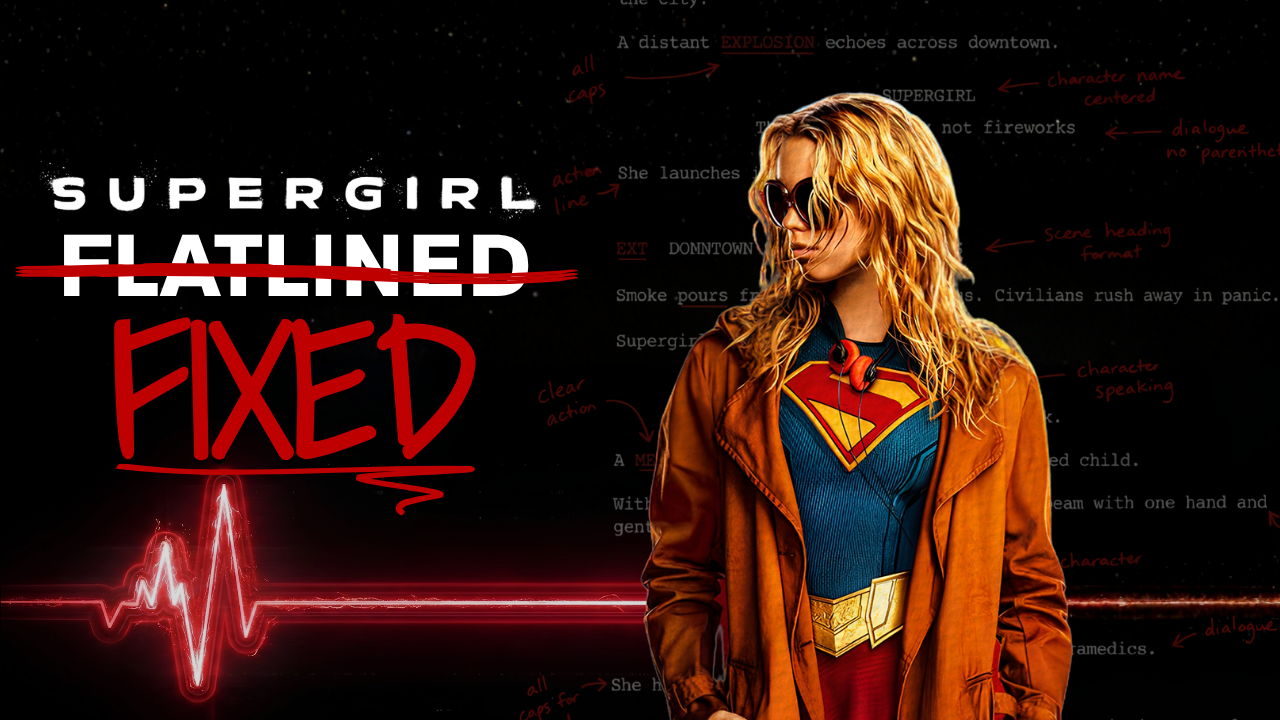
Welcome back to Kinolime's Fix It series. This time, Meara turns his attention to one of 2026's biggest disappointments: DC's Supergirl, a film that reportedly lost around $100 million at the box office and vanished from theaters within a week.
Rather than picking apart the surface-level complaints: the soundtrack, the color grading, Meara goes straight to the structural issue underneath: Kara and Ruthye never actually change each other. Using True Grit and Logan as case studies, he breaks down why the mentor/mentee dynamic works when it works, traces how Supergirl diverges from its own comic source material, and rebuilds the film's second act from the ground up to show what a version with real reciprocal transformation could look like.
It's a masterclass in one of the most common traps in screenwriting: characters who share a goal but never actually touch each other.
Full Transcript: Kinolime Fix It Episode 6: Why Supergirl (2026) Feels So Empty
Participants
Meara Owen-Griffiths - Creative Executive, Kinolime
Meara: "We won't greenlight a film until we have a finished script we're happy with, and we won't cast until the script is finished." James Gunn famously said that in 2025. In light of DC's 2026 Supergirl adaptation already losing about $100 million at the box office — and that's discounting marketing costs — today we wanted to look at why this adaptation is probably already dumped on VOD by the time you're watching this.
Today I'm looking at why this isn't resonating with audiences, and why I think James Gunn should have taken a much closer look at the screenplay before greenlighting it. Some people liked it, some people hated it, but the general consensus — backed up by the fact that where I live it was pulled from cinemas after only a week — is a resounding "meh."
A lot of the criticism you've probably heard so far is largely superficial: the needle drop was weird, the coloring was kind of ugly, it feels like just another Guardians of the Galaxy. But here at Kino Lime, as always, we want to focus on the heart of the story, which is character. Today, let's investigate why Supergirl failed to reach the lofty heights of last summer's Superman, and why films like Logan and True Grit succeeded where Ana Nogueira and James Gunn didn't.
I'm Meara, screenwriter and creative executive here at Kino Lime, and welcome to Fix It.
The Core Problem: A Relationship That Doesn't Transform Anyone
Meara: The greatest issue with Supergirl is that Kara and Ruthye do not learn anything from one another. This relationship is the heart of the story — it's what kicks the plot into gear, and it's through this pairing that the film attempts to deliver its thematic message. So why isn't Kara and Ruthye's dynamic exciting the moviegoing public?
This is the single most important question all of you writers at home should be asking of your own work. If one facet — like the connection between your two leads — feels boring, the entire premise can fall apart. Fail to make this aspect bulletproof at your own peril. In a buddy-up story like this, reciprocal transformation is key, and without it, your whole premise is going to feel hollow.
I recently came across a great video by screenwriting YouTuber and film professor Lessons from the Screenplay, titled "Boring Characters Are Not a Character Problem." The argument is that boring characters are never really the core issue — it's the story that's making them boring. Characters become dull when they're unimportant, and in the case of Supergirl, both leads have a desire, but they're not informing one another as they move toward that objective.
That video articulates something I run into a lot in the work I do for early-career screenwriters. When they get a note that a character is uninspiring, they can't resist diving deeper into backstory — the trauma, the idiosyncrasies, the interstitial complexities. More often than not, and in the case of Supergirl, this accomplishes nothing. It's like putting lipstick on a pig.
Consider Kara and Ruthye's story. Once we reach the break into Act 2, their trajectories are set. They don't rub off on one another, communicate, argue the depths of their principles, or improve each other as people. They're passengers with a shared end goal, and that results in a lot of negative space in the story. The engine fails to make them interesting, and no amount of manufactured trauma or fun little quirks is going to cover that up.
The consequence is a rinse-and-repeat Act 2: they're allegedly closing in on Krem of the Yellow Hills, but this plays out as a cyclical beat — Kara loses her powers, gets them back, beats up some bad guys — repeated roughly five times. Kara and Ruthye feel like they're on parallel journeys, sharing an Uber to the same destination, but remain strangers to one another.
Why the Mentor/Mentee Formula Usually Works
Meara: Many films follow a pattern nearly identical to Supergirl's — a seasoned, reluctant mentor figure and a principled, inexperienced student. For comparison, we'll be looking at True Grit and Logan today, but the same pattern shows up in The Last of Us, Shane, Midnight Run, Léon: The Professional, Terminator 2: Judgment Day, and Pixar's Up, among many others.
Why is this so prevalent? Because certain archetypes are complementary. The weathered, cynical mentor is moved by the emotionally open, inexperienced mentee. The mentor regains hope and vulnerability; the mentee gains experience, confidence, and maturity. It's a tried-and-tested formula.
The 2026 film is loosely based on Tom King's Supergirl: Woman of Tomorrow comic — a story with a lot to say about revenge, and about how burning passion leaves you cold once it's spent. In that source material, Kara and Ruthye initially clash but eventually improve one another. Stepping back further, the comic run is itself predicated on True Grit, Charles Portis's 1968 American classic. We're going to look at that story, asking why the novel resonates so deeply, and how your characters must inform one another if you want your story to feel special.
Case Study: True Grit
Meara: In the novel and its adaptations, we follow Mattie, a teenage girl seeking help exacting revenge on Tom Chaney, a scoundrel who killed her father while employed as a farmhand. Her life has been poisoned by her relentless pursuit of revenge instead of justice. She seeks out U.S. Marshal Rooster Cogburn, a grizzled alcoholic she's convinced will funnel his talent for violence into suitably punishing Chaney. Rooster begrudgingly agrees because he needs the money, but is reluctant when Mattie insists on tagging along.
To begin with, Mattie has strong principles but no experience and little compassion. Rooster has great experience but no ambition and even less compassion. LaBoeuf is all ambition, inherited principles, and way too much ego. As the trio track Chaney, these varying qualities begin to equalize.
Mattie learns that people aren't categorized as good or bad in real life. Her mentors are flawed, vain, often selfish — not at all the heroic figures she'd dreamed up — but she learns that anyone can be courageous, and that protecting people can be a braver decision than punishing them. Rooster, meanwhile, is worn down by life; he views the world as an ugly place where people don't change. Mattie's naive, uncompromising perspective restores his sense of purpose. Her stubbornness, which he struggles with at first, eventually forces him to become the man he's rumored to be — or maybe once was — and that stubbornness becomes the very thing he admires in her. LaBoeuf, finally, is driven by professional recognition, chasing accolades and reputation — things Mattie thinks about very little. She constantly deflates his ego, forcing him to reconsider his purpose beyond external validation.
Each of the three seriously informs the other two. Supergirl is a simpler narrative on paper, since Kara fulfills the Rooster role without the complication of a true LaBoeuf-type archetype interfering — which is likely why an attempt to shoehorn that role in falls flat. Ana Nogueira could have constructed the story as a dual narrative and, better yet, positioned Ruthye as the POV character, as is the case in both Woman of Tomorrow and True Grit. She's the character with the thesis; Supergirl is the one with the antithesis — so the eventual synthesis of the two should primarily belong to Ruthye.
Case Study: Logan
Meara: In 2017's Logan, Wolverine begins the film as an isolated, cynical individual who has cut nearly all ties with his old life. He's long abandoned any form of heroism, seeks to avoid new responsibilities, and just wants to be left alone. Laura, X-23, is feral, distrustful, and defined by her design as a weapon. She seeks freedom, but on a deeper level she needs guidance, connection, and family.
Logan initially treats Laura like a burden, and she sees him as another captor. But as they journey together, Logan rediscovers his purpose through her — by the climax, he's no longer running from attachment; he's willing to die protecting someone else. Conversely, through Logan, Laura learns that strength isn't only about killing and surviving — it's also about caring for others. Logan learns to care again, while Laura learns what caring means. It's really that simple.
You may notice that in many of these examples the mentor is an older man — maybe not retirement age, but closer to veteran than novice. That's because they need enough experience, reputation, and time to have lapsed from the principles their mentee still maintains.
Where Supergirl's Kara Goes Wrong
Meara: In Supergirl, Kara is turning 23. She's been through more than perhaps anyone on Earth — losing her planet and civilization — but all of this is relatively fresh, and effectively all she's ever known. We don't get the chance to see Kara as an optimistic individual; she's been a drunken mess since her introduction.
This could still work — the same way it does with Rooster — if we felt like time had eroded her principles, or if she were maintaining a reputation as a heroic figure on the planets she frequents. Ruthye could go seeking Supergirl — the hint is in the name — and find her washed up, drunk, and uncaring. That opens the door for Supergirl's arc to bring her back to a baseline we never actually got to see, instead of the punk-rock characterization the film settles for.
The film version of Kara takes the worst aspects of comic Kara and drops the redeeming qualities. She's largely apathetic. When Ruthye loses her sword to an intimidating stranger, it feels like Kara intervenes because she wants to look cool, not because she cares.
In Tom King's comic, Kara is initially reluctant to help Ruthye — it's her birthday, and she's trying to take a day off — but she remains principled throughout. When Ruthye proposes they go after Krem, Kara tells her plainly that killing people is wrong. When Krem steals her ship and shoots Krypto, the two are bound together, and Kara immediately assumes the mentor role — she knows the cosmos, while Ruthye has never left her little patch of home. There's a charming scene where Kara teaches Ruthye how to wash her hands: caring, almost maternal, deeply patient. This cinematic version of Supergirl could never.
In Nogueira's script, when Ruthye initially asks for Kara's help, it's rejected — "not my circus, not my monkeys." Only after Krem, the vague and easily forgettable villain, shoots her space dog does Kara chase him down, bringing Ruthye along. The reasoning is ambiguous, because Kara isn't depicted as someone nurturing enough to care in the first place. Ruthye ends up a passenger rather than a driving force — Kara is annoyed and even inconvenienced by her presence.
What the Film Gets Wrong About Revenge
Meara: Returning briefly to True Grit and Logan — and then I promise I'm done — we can look at what they have to say about revenge: it's never a clean resolution for rage.
When Kara and Ruthye encounter Krem in a climactic showdown, Kara pleads with Ruthye not to kill him, because revenge isn't the answer — a stance that's easy to voice after you've killed countless goons on the way there. Why this is Kara's position remains unclear; it feels like something her cousin Kal-El might say, but what experience does Kara actually have with the futility of revenge? Once Ruthye acquiesces — because Kara has authority over her, not because Kara has taught her anything — Kara kills Krem herself, exacting the very revenge she'd just argued against. She fails to put her own principles into practice, which makes the whole adventure feel like happenstance. Nothing is meaningfully imparted from one to the other.
In the comic, by contrast, Kara spends a long stretch teaching Ruthye that killing is wrong and revenge isn't sweet. When Krem banishes Kara to a distant planet, Ruthye has to practice caring for her mentor, learning patience and empathy in the process. As a result, when Ruthye finally gets the chance to kill Krem — her objective for the entire run — she decides against it. Later, when Kara's horse is killed, she's ready to kill Krem in retribution, but Ruthye, having internalized the lesson Kara spent so long teaching her, talks her out of it. They've effectively swapped places on their original principles. Being morally scrupulous is one thing, but it's not until your ethics are tested by extremes that you're really forced to prove them.
By the conclusion of the film, Kara is still parroting what she's been preaching the entire time — there's no shift in her logic from her first encounter with Ruthye. Ruthye is still hellbent on revenge, and not pulling the trigger herself doesn't mean she doesn't still achieve it. It shouldn't take an entire 90-minute runtime for your protagonist's stated objective to come into conflict for the first time — that's a failure in the writing that should have been caught long before pre-production.
Films often struggle to balance a protagonist who's a damaged mess with one who never really crosses any ethical lines. James Gunn knows this precipice well — part of what made Star-Lord likeable was his attempt to operate ethically in a cutthroat galaxy while also being a space pirate who takes whatever he wants. Here, there's a wonderful missed opportunity to depict Kara as a godlike figure who preaches peace but is prone to the same rage as the rest of us — and to have the person she imparted that wisdom to hand it back to her in a powerful moment we never get. Instead, the writing implies it's fine for Supergirl to take revenge on someone else's behalf. Worse, Krem is already captured and effectively defeated at this point — this plays out more like an execution than retribution through combat.
Kara being stuck in her grief and unable to move on is an interesting character trait. But it feels contrived to equate her grief with Ruthye's quest for revenge — the idea that she's trying to prevent her mentee from falling into the same trap she succumbed to just doesn't track as written.
A Revised Version
Meara: We don't want this to become another True Grit remake, and it's important to deviate from the material you're paying homage to. That said, a Kara who begins the film feeling like she can't make a difference, burying her trauma at the bottom of a bottle, could slowly give way to a more optimistic character, one who learns from Ruthye that the mere existence of good people out there helps others sleep at night in a cutthroat galaxy. And Ruthye, introduced as hellbent on revenge, must learn that justice and revenge are two separate, incompatible ideals.
Here's a revised synopsis: Krem kills Ruthye's father. Ruthye seeks revenge and enlists Kara, who accepts because she too has suffered and once sought an outlet for her own boundless fury. We cut Krypto getting shot from this part of the story entirely. Kara goes along with Ruthye because she wants to put a guiding hand on her, fearing where this untethered kid could end up if nobody steps in, she doesn't have a big-sister figure, or any Kryptonian peer, so she sees herself in Ruthye.
Throughout their journey, Kara repeatedly insists that revenge isn't the answer - sparing (and imprisoning) the brigands they come across instead of killing them. These lessons seem to fall on deaf ears, but when they finally capture Krem and Ruthye has the chance to execute him, she can't. Kara's message has worked its way into her. Due to that hesitation, Krypto is shot and injured, and in a burst of raw fury, Kara is now the one prepared to kill Krem. Ruthye has to relay Kara's own principles back to her - revenge will leave you cold - and if Kara truly believes that, she has to lead by example.
Now we have complementary arcs. Kara came out here to drink and avoid her responsibilities, but finding this naive girl she sees herself in gives her something to fight for — she's reminded of what she stands for and why she's needed. For Ruthye, it's a classic hero's journey: she leaves her old world behind, ventures into the unknown chasing an improbable goal, and along the way learns that her objective was false. Her new experiences give her clarity, and she can return home changed. She holds up a mirror to Kara, and to herself.
Does this absolve Kara of the guilt and grief of losing her planet and people? Absolutely not. But it teaches her that her cousin's stuffy boy-scout ethos, which she's been actively avoiding, actually holds some weight. Now she can return to Earth ready to listen and contribute, with a newfound sense of purpose.
The Takeaway
Meara: For you writers at home, the one lesson I'm asking you to take away from this video is that all of your characters are component parts floating around within your story, but it's vital that they leave fingerprints and impressions on one another. This ultimately determines how a viewer interprets your story's thematic message, and more importantly, how they feel when they walk out of the theater. Make that experience worth their time.
If your characters inform, learn from, and influence one another, you've taken the audience on that journey with them. But if you make the audience feel like a third wheel, it's going to be awkward for everybody.
I've been Meara. Thanks for watching, and until next time.
If you got something out of today's podcast, please share it with your filmmaking and screenwriting community and hit subscribe - it genuinely helps us keep making these. We'll see you in the next one.