How to Write a Logline, Treatment & Pitch Deck That Actually Sells [Podcast]
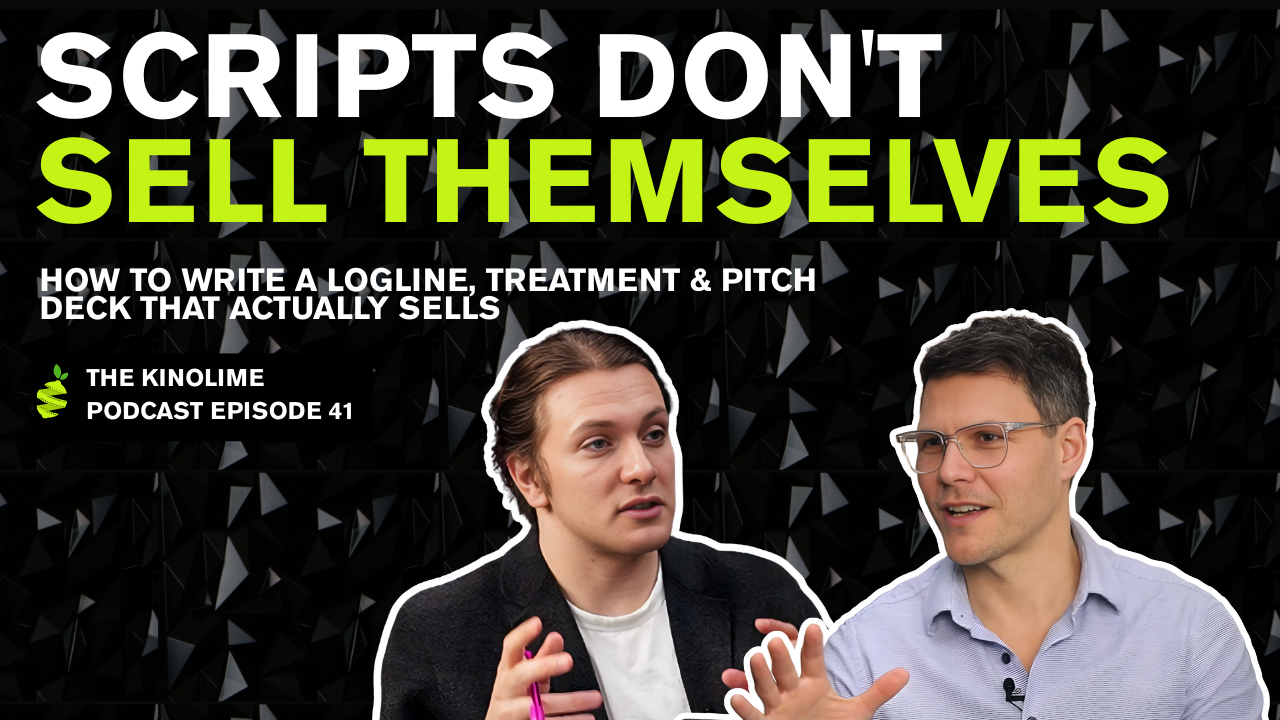
This week on the Kinolime Podcast, John and Danny tackle one of the least glamorous but most essential parts of the screenwriting business: submission materials. From loglines and one-pagers to treatments and pitch bibles, they break down why these documents matter, how they can sharpen your understanding of your own story, and what makes them actually stand out. Along the way, they unpack examples from films like Kill Bill, E.T., Mr. and Mrs. Smith, and Stranger Things, while sharing practical advice for writers who want to present their work with clarity, confidence, and voice. If you’ve ever struggled to condense your screenplay into a compelling pitch package, this episode is for you.
Full Transcript: Kinolime Podcast Episode 41: How to Write a Logline, Treatment & Pitch Deck That Actually Sells
Participants
John Schramm - Head of Development, Kinolime
Danny Murray - Creative Executive, Kinolime
John: If you’re going to be proactive enough to be part of the less than 1% of people who sell their screenplay and get their movie made, then be proactive in every part of the pitch. Every chance you get to show why your story is great and get more eyes on it - do it.
Hey, how are you? Welcome to the Kinolime Podcast. I’m John Schramm.
Danny: And I’m Danny Murray.
John: Throw it up, Ron - the names, the titles, whatever. Put it on this fake background. We have an identical background, and it’s actually not this one.
Danny: Yeah, it’s the exact same one, but not the actual background.
John: Danny’s giving away all our secrets here at Kinolime.
Why Submission Materials Matter
John: Welcome. We have a very exciting and informative podcast today, because we’re talking about all the stuff I hate doing, but unfortunately, it’s part of the business: your submission packages for competitions, producers, directors, whoever.
Now look, I’m going to preface this by saying I’m all about the screenplay. Do you need a one-pager? Do you need a really amazing bible? Probably. But shouldn’t it all really be about the page and the words?
Danny: But we live in a different era, John. You need the gloss. You need the sizzle with the steak.
John: We’re going to go through a few things here. And look, in our competition, we’ve seen treatments that are super well written compared to ones that are not. It does grab your attention. These materials can be really effective.
For me, the best thing about the process is that it helps you harness your story. When I’m trying to figure out a one-pager, I’m asking, “How the hell am I going to get my whole story into this?” But it forces you to think about your antagonist, protagonist, turns, twists, everything.
Danny: One hundred percent. What I find a lot is that you’ll see great screenplays that maybe do not have great treatments or great decks attached to them. But I think if you have the capability to write a really strong screenplay, you also have the capability to make a great deck, a great one-pager, or a great treatment.
And again, if you’re going to be proactive enough to be part of the less than 1% of people who sell their screenplay and get their movie made, then be proactive in every part of the pitch. Every chance you get to show why your story is great and get more eyes on it, do it.
John: I’m going to disagree on one thing. I don’t think that if you can write a great screenplay, that automatically means you can write a great treatment. Honestly, it’s really hard. It’s like the difference between an advertising copywriter and a screenwriter. They’re just different head spaces.
Danny: The treatment maybe, sure. But a one-pager is especially salesy. You’ve got to come out swinging and get people’s attention.
John: Exactly. It’s different from writing a longer narrative. But that doesn’t mean you shouldn’t try, because they work different muscles. It’s a good exercise.
So let’s break this down. First up: the logline.
The Logline
John: A logline is essentially a one- or two-sentence condensed version of your story.
It absolutely matters when we get 1,000 submissions in our competitions. We always talk about it. Meara especially, Meara is like a shark with loglines. He gets so excited when he sees a great one.
When you have a logline, there are elements to it. It’s kind of like an equation: A plus B equals C. D, why don’t you tell us what that equation is?
Danny: Sure. In two sentences, what you’re really trying to do is articulate as succinctly as possible where we’re meeting the story, who your main character is, who your antagonist is, and what the stakes or conflict are.
At its core, it’s really your protagonist, goal, and conflict. Those are the three main elements.
Make sure you mention your protagonist. Make sure you mention the goal. Make sure you include the antagonist or central opposing force. It sounds basic, but most of the really great loglines do follow that formula in some way.
And we’ve got two good examples today: Kill Bill and E.T.
Example: Kill Bill
Danny: “After awakening from a four-year coma, a former assassin wreaks vengeance on the team of assassins who betrayed her.”
Think about that. “After awakening from a four-year coma” - there’s your setup. “A former assassin” - there’s your protagonist. “Wreaks vengeance on the team of assassins who betrayed her” - there’s your goal, conflict, and antagonist. It wraps everything up in a single sentence.
John: Exactly. There’s not one word in there you could really take out. It hits every box.
Example: E.T.
John: “A troubled child summons the courage to help a friendly alien escape from Earth and return to his home planet.”
Again, “a troubled child” gives us the protagonist. “Summons the courage to help a friendly alien escape” gives us the goal. The conflict is built into the idea of escape and return. The antagonist is less explicit, but in that film it’s more of an outside force than a single villain.
Danny: And that’s really what this exercise is about: getting your story down to a sentence or two. It helps you think clearly about protagonist, goal, and conflict.
John: And it’s basically your elevator pitch. You walk into an elevator, the door opens, and suddenly you’re face to face with somebody important. You’ve got five seconds. What do you say?
The One-Pager
John: Next up from the logline is the one-pager. This has gotten much more common over the last ten years or so.
Now, it’s not a one-page version of your entire story in full detail. There are different approaches to a one-pager, but today we’re giving a shoutout to a great website: No Film School. If you haven’t visited them, you should. They’re an incredible resource.
The structure they use is really solid. At the top, you have your screenplay title, your name, phone number, and email, your contact info. Then below that, you have your logline and genre.
After that, there’s a section called Why It Matters. This is where it gets a bit more salesy. Why are you telling this story? Why now? Why does it matter? What’s your vision? Keep it brief, almost logline length.
Then you move into your Synopsis, which is your story broken into three acts:
Act One: Who are we? Where are we? What’s the problem? Where are we headed?
Act Two: What gets more complicated? What goes wrong? How bad can it get?
Act Three: How does it fall apart? How does it come back together? How does it end?
And then finally, there’s Why It Will Succeed, which is your closing pitch for why this idea will work in the market.
Danny: What this is really calling for, if you want an easier way to think about it, is the main plot points of your story.
In Act One, they want your setup, inciting incident, and turn into Act Two. Then they want your midpoint, your turn into Act Three, your climax, and maybe how it ends.
If you can boil down the structure of your story, it becomes a lot easier to articulate it in these longer documents.
And one obvious note we see all the time: it’s called a one-pager because it should be one page. I’ve seen one-pagers that are two pages, three pages, that’s not a one-pager.
John: And don’t do eight-point font, please. Keep it readable.
The Treatment
John: Next in the hierarchy is the treatment, and this is one of my favorites.
The great screenwriter John Collee - look him up, amazing credits, Master and Commander, Monkey Man, Happy Feet- believes that you can tell whether a story is working in a five- to ten-page treatment.
At Kinolime, we include a treatment section in our competition submissions because we really believe in the power of the treatment. In early rounds, if you don’t have time to read 26 screenplays, you can read 26 treatments and get a very good sense of which stories are working.
That’s why I love them. You can digest a lot of story quickly. You’re condensing 120 pages into five to ten pages. It’s more detailed than a one-pager, and you get to add more meat to the story.
Danny: And it’s also a creative way to ask: what is special about your characters? What establishes your tone? What makes your story unique in a concise way?
Also, while it’s not a hard rule, treatments are generally all about the words, no media, no pictures.
Example: Mr. and Mrs. Smith Treatment
John: We looked at a treatment by Simon Kinberg for Mr. and Mrs. Smith. What I love is that it starts with a very clean overview - almost like a mini one-pager for what you’re about to read. It gives a quick character setup, almost like backstory, and then boom, on page two it launches into the story.
And the writing has energy. It starts with a bang. You can have fun with your treatment. It doesn’t have to read like a dry play-by-play. Put your voice into it.
Example: My Own Private Idaho Treatment
John: Then we looked at My Own Private Idaho by Gus Van Sant. Totally different style. He has fun with the formatting. It’s spaced differently, giving the page more breathing room so your eyes don’t strain. It’s a more dramatic story, so naturally it leans more into character and feeling than big set pieces.
It runs longer, around 20 pages, which is more than the five to ten pages we usually like. But when you’re Gus Van Sant, you can get away with it.
Danny: What both examples do really well is establish the premise, the characters, what they’re trying to accomplish, and the tone of the piece.
With Mr. and Mrs. Smith, it’s all about the premise, inciting incident, call to action, and the set pieces that make it fun.
With My Own Private Idaho, it’s more character-driven. And that’s fine too. A treatment doesn’t have to be all plot summary. It can include dialogue. It can let us hear your voice.
John: Exactly. When I read a treatment, I don’t just want to be blown away by the story. I want to hear your voice. I want to get a feel for the dialogue. I want to see what kind of writer you are.
That’s why I love treatments so much.
Danny: And I’ll just double down on that. In any short-form pitch document, one of the biggest things you’re looking for is voice. A lot of treatments feel phoned in, like the writer is just putting down what they think they’re supposed to put down.
Don’t do that. Lean into what makes it unique. Make it feel like your story. If the writing in the treatment doesn’t feel tonally aligned with what you want to see on screen, it won’t land.
Kinolime’s Free Treatment Course
John: At Kinolime, we actually have a free course on our website called Writing the Treatment, which we made with the amazing Alexei over at Young Screenwriters.
If you go to Kinolime.com, click the little hamburger menu, go down to Courses, then the crash course section, you’ll find Writing the Treatment. It’s free.
There are seven lessons, and each video is between three and twenty minutes. You can do it in a day, at your own leisure.
Danny: And the whole point is to help you polish your treatment and actually learn how to write one because the treatment should show how unique your writing style is.
A lot of people are turning in ChatGPT-written treatments now, and honestly, you can sniff them out immediately.
John: Yep. They feel homogenous. Make your writing yours.
The Pitch Bible
John: Now let’s get to the Pitch Bible, which is the one I personally suffer with the most. I don’t feel like I have the muscle for it.
Pitch bibles are more common in TV, though you do see them in feature film too. Traditionally, it comes from television, it’s that big document that explains the show, the characters, the episode-to-episode idea, the visual tone, photo collages, all of it.
But it can also be helpful in features because it communicates the vision of your story. It’s not just about the words on the page anymore. It’s about the aesthetic, the feel, the vibe.
Danny: The one we both immediately thought of was Montauk, which eventually became Stranger Things.
John: Exactly. The Duffer Brothers’ deck is beautiful. It has this lived-in, binder-like aesthetic. The intro is short and clean. It immediately references Spielberg and Stephen King, so before you even get into the story, you already understand the tone.
Then it uses stills from iconic ’80s films they’re drawing inspiration from. That’s brilliant, because not only do you get a visual reference, but you subconsciously connect the project with those beloved films.
Danny: And the deck breathes. That’s really important. It stays stripped down and clear. There’s never too much text on one page. It alternates between brief copy and strong visuals.
You get the premise, the inciting incident, the characters, the genre, the tone, and it does it fast.
It became Stranger Things, and the rest is history.
Tips for Filmmakers Building Pitch Materials
Danny: If you’re an independent filmmaker trying to market your script to producers or financiers, a proof of concept, sizzle reel, or director’s statement can also help.
One thing I’m not a big fan of is people putting pages and pages of attachments or team bios into a deck. If they’re not major names, most people don’t care. Keep it tight.
Show that you have command as a filmmaker. Lean into your tone and your characters.
John: And have fun with it. If it’s a drama, pour your heart into it. If it’s a comedy, make us laugh. The material should reflect the genre you’re writing in.
I remember when I first started reading screenplays, everyone told me to read Lethal Weapon. And they were right. Shane Black had such an incredible voice on the page. You totally understand why he became the hot writer because his scripts felt fun, alive, and fully his.
So if you’re writing a drama, pour your soul into it. If you’re writing a comedy, make us laugh. Emulate the feeling of the thing you’re trying to sell.
Danny: At the end of the day, all of this comes down to understanding the bones of your story, what excites you about it, and finding ways to communicate that to people who don’t know you or your work yet.
Whatever excites you, whatever you know you can write well and succinctly, do that.
Recap of the Submission Materials
John: So, to summarize:
Your logline is a one- or two-sentence description of your story in a very condensed form.
Your one-pager should stay one page and include the logline, genre, why now, the story overview, and why it will succeed.
Your treatment should ideally be five to ten pages. That’s where you can really bring in your voice, energy, and style.
Your Pitch Bible is typically more common in TV, but it can also be helpful in features when you want to communicate the visual and tonal world of the project.
And if you’re going to make a deck, break up dense text with visuals and let the material breathe.
Danny: And most importantly, we forgot the last thing: the screenplay.
John: Yeah, you still need the screenplay.
Danny: Well, if you have all this other stuff, maybe we’ll just make it without the script.
John: No, but honestly, it does help us to have the materials ahead of time before we read. Still, we’re going to read the screenplay anyway. These materials are just good practice. They sharpen your skills.
If we left anything out, or if you have questions or examples, we’d love to hear from you.
Danny: Especially if anyone has a really good feature film pitch deck or pitch bible. Those are hard to find.
John: Very hard to find. So if you have one, send it our way. You can reach out via email, Instagram, X, Facebook, wherever.
This is one of those topics that feels like going to the dentist. You’ve got to do it. It’s part of life. And in the end, it’ll make your life way easier.
Thank you for tuning in.
Danny: See you soon.
Kinolime Feature Film 3.0 Competition Promo
John: If you’re a screenwriter or filmmaker, listen up. Here at Kinolime, we’re opening our third annual Feature Film 3.0 Screenwriting Competition, running from January 23 to March 15.
That means you, yes, you, could get your movie made.
Our submission period runs from January 23 through March 15, so sharpen your pens, get your fingers ready, polish that screenplay, make sure it’s formatted, and submit it to Kinolime.
If you don’t know who we are, this is what we do. Every year, we open a screenwriting competition where anyone from around the world can submit a screenplay, as long as it’s in English and properly formatted.
Readers and film lovers from all around the world read your work and vote on it. And if your screenplay gets the most votes at the end, your script gets made into a movie here at Kinolime.
Just to give you an update: our first competition winner, The Waif, and last year’s winner, Mob Mentality, are both going into production in 2026.
Yes, you heard that right. We’re making two movies from our past two winners this year.
That means if you win this year, we could be making your movie next year, or the year after, depending on the production timeline.
But at the end of the day, if you want your dreams to come true and you want your screenplay turned into a film, go to Kinolime.comright now. Set up an account, get all the information, ask questions, we’re here for you.
Get your submission ready between January 23 and March 15.
And I cannot wait to read your work.