The Bride Movie Review: 3 Lessons on Character Choices and Story Structure [Podcast]
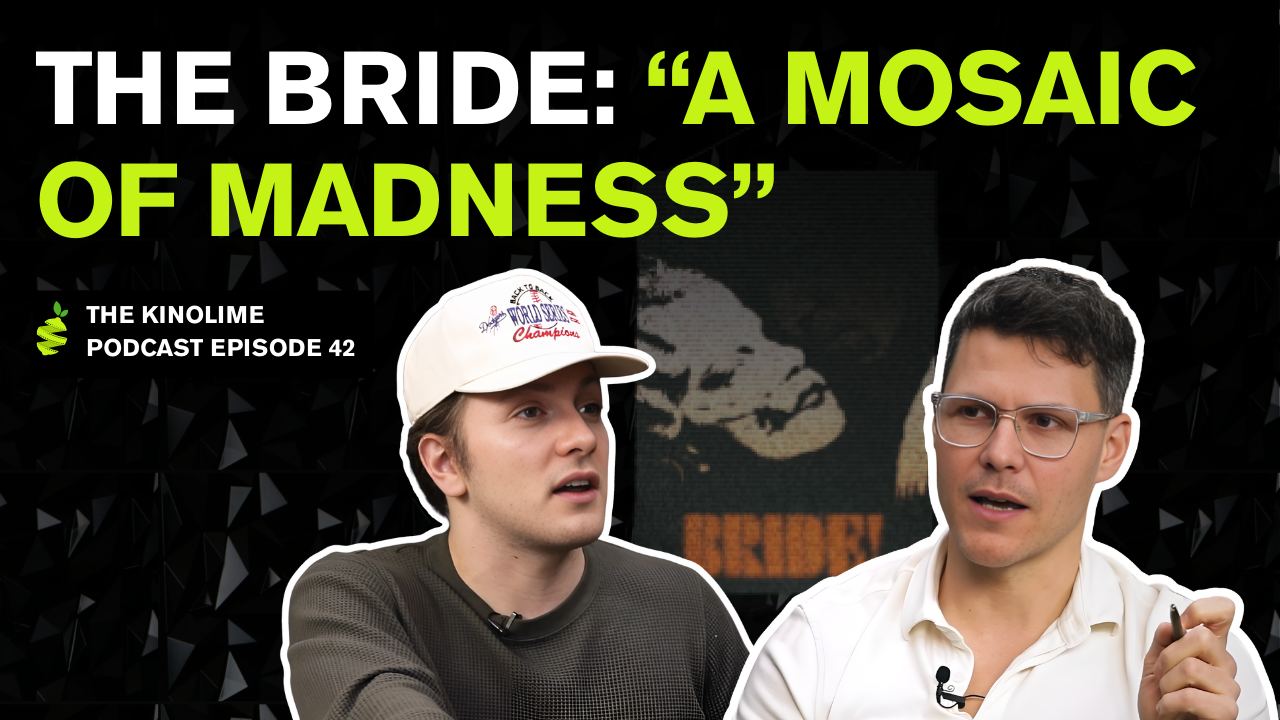
John and Danny break down The Bride!, Maggie Gyllenhaal’s bold, messy, original swing at reinventing Frankenstein, and ask the big screenwriting question behind it: why doesn’t it fully work? From character wants and missing plot engines to overloaded subplots and “and then” storytelling, this episode explores what ambitious films can teach writers when the execution falls short. It’s a lively conversation about big creative risks, broken story structure, and why original movies still deserve our support.
Full Transcript: Kinolime Podcast Episode 42: The Bride Movie Review: 3 Lessons on Character Choices and Story Structure
Participants
John Schramm - Head of Development, Kinolime
Danny Murray - Creative Executive, Kinolime
John: It’s always awkward, we always seem to start on camera two. But hey, welcome to the Kinolime Podcast. I’m John Schramm here at Kinolime.
Danny: Bring me in.
John: I’m pointing. Go ahead, do it. Say it.
Danny: I’m not doing it, man.
John: I’m pointing. Go ahead.
Danny: I’m not doing it, man.
John: It’s D. Murray.
Danny: There you go.
John: CE at Kinolime. And welcome, we’ve got an amazing show today. We’re here to talk about The Bride!!
Warner Bros. Box Office Streak Ends
John: Warner Bros. had a streak going, was it nine in a row? Ten in a row?
Danny: Yeah. Almost everything since Mickey 17, maybe, had been a number-one hit for WB. Big money, everything looked great.
John: Yeah, let’s get into that. I think it made around 18.9 worldwide. Domestically, maybe seven or eight. Super low.
Danny: Super low.
John: And look at the cast: Christian Bale, Jessie Buckley, who could very well win an Oscar soon, Jake Gyllenhaal, Penélope Cruz, Peter Sarsgaard. It’s a great cast. But it just didn’t hit the mark.
We looked at the IMDb rating, around a 6.0. Metacritic was around 55. CinemaScore was a C+. So beyond the “high art” conversation, audiences weren’t really loving it, and critics weren’t either.
Danny: It’s the kind of movie where, while I was watching it, I kept thinking of Megalopolis. I love that every maximalist swing possible is being attempted. None of it is really working, but I love that someone is trying.
Big Swings vs. Cohesive Storytelling
Danny: It feels like the movie has something to say. I just don’t know what that is.
John: And this kind of ends Warner Bros.’ streak. But let’s talk about the bigger picture.
Danny: I really hope this isn’t the last hurrah of the “massive swing” movie. Because if you contextualize what this is, it’s exactly the kind of movie Hollywood usually doesn’t want to make, and a textbook example of why. But it’s also the kind of movie that should get made.
John: This is an original film. It was filmed here in the States. I heard around 500 New York businesses were involved. It used tax credits. Creatively and economically, this is the kind of swing we should celebrate.
Danny: Exactly. And this is why Pam Abdy and Mike De Luca almost got fired, or at least that was the rumbling in Zaslav’s camp before Sinners. This is the kind of thing they were backing.
You give Maggie Gyllenhaal, a great actress who made one critically acclaimed movie during COVID for a few million dollars, 80 million to make her feminist, musical, Mary Shelley-inspired Frankenstein riff and tell her, “Go for it.”
John: And we see this all the time. The ideas are there. The ambition is there. But it’s so hard to turn all of that into a cohesive film.
Like Joker: Folie à Deux. Huge swing. Musical sequel. Did not work.
So yes, The Bride! has big ideas. But D, what stood out to you as the main issue?
Tone, Structure, and “Mosaic of Madness”
Danny: The biggest issue for me was tone. I kept asking: What is this movie trying to be? What is it trying to say? And how does one scene connect to the next?
I couldn’t tell if it wanted to be Natural Born Killers, Bonnie and Clyde, or a classic Frankenstein story. It just felt all over the place.
And that sounds exciting on paper. But after two hours of that, with no grounding in character, it starts to feel like you’re watching a mosaic of madness.
John: “Ooh, mosaic of madness.” That’s a cool band name.
Danny: Exactly. Honestly, that should’ve been the film’s name.
John: Mosaic of Madness. I’m writing that down.
Why the Premise Didn’t Land
John: For me, the larger problem is that this is period horror, which is incredibly difficult to pull off, but also awesome when it works. Nosferatu is a great example. No huge Hollywood star, but it delivers exactly on the tone and promise of the premise.
With The Bride!, I remember seeing the trailer and just thinking… nothing really grabbed me.
So from the outside looking in, the biggest issue is: who is this movie for? Is it for young feminist moviegoers? Hardcore horror fans? Prestige drama audiences? I don’t know.
You shouldn’t make a movie for an audience in a cynical way, but if you’re wondering why the box office was so low, that question matters.
Is Christian Bale still enough of a star? Jessie Buckley is still emerging as a household name. So from the start, I just kept asking: what is this thing? It’s a mosaic. And that’s fine, but if you’re going to be many things, at least do one of them really well. Punch through with one lane. And I don’t think it did.
Danny: I agree. And it really highlighted how hard it is to pull off “elevated horror”, whatever that even means.
This movie had every resource imaginable: top production design, top costume design, major department heads, incredible talent. Maggie had the dream team. But if you don’t have a story, your movie becomes The Bride!.
You had every ingredient for a fantastic film. But what happened? From the page, it just didn’t have the story.
Supporting Characters and Unnecessary Subplots
John: So let’s talk story. From a screenplay perspective, what worked for you, and what didn’t?
Danny: The most frustrating thing for me was the supporting cast. There were maybe five or six side characters spread across two or three B-stories, all just trailing behind our two leads.
You had the bumbling cops, the mad scientist, the other cop who slept with her, the crime family, Jake Gyllenhaal’s character, this whole ragtag group of people. But for the most part, they were just there to tell us what we had already seen.
Even by the climax, I never felt like their conflicts really came to a head in a meaningful way or meaningfully impacted the two leads.
John: And on top of that, I kept asking: are there any good male characters in this movie? That seemed to be part of the larger messaging issue.
Danny: Honestly, everyone’s shady.
John: You’re right. Everybody was shady. I’ll take that back.
But that’s another issue, if everyone is morally murky, that can work, but then what is the movie actually saying? Even Penélope Cruz’s character, who seemed like maybe the “good one,” ends up being underdeveloped. She’s basically sidelined until the story suddenly hands her a badge and says, “Now you’re the detective.”
Main Character, Want, and Plot Engine
John: And that leads to what I think is the biggest screenwriting lesson here:
Screenwriting Tip #1: Give your main character a clear want. That’s the plot engine.
One of the reasons the movie petered out for me is that I never really bought Frankenstein’s want. He wants a bride because he’s lonely, fine, but I didn’t fully buy it emotionally.
Then once she’s revived, what’s the want? What are we moving toward? What is the engine of the movie?
It doesn’t have to be “save the day” or “rob the bank.” But the characters need to be moving toward something. In Bonnie and Clyde, they’re moving. In a road movie, they’re moving. Here, it felt like: we go to a club, we dance, we smash some skulls, then we go on the run.
What did The Bride actually want?
Danny: The parts that really worked for me were the scenes between The Bride and Frankie Frankenstein, trying to figure out who they are now.
Those scenes were strong. The conflict often came from men objectifying her or trying to assault her. She’s objectified and discarded the whole movie, including by Frankenstein, who essentially created her for his own needs.
That’s actually a fascinating story. Without the Mary Shelley flashbacks and all the side characters, you could have had a really powerful movie about a monster who creates another monster for selfish reasons, then slowly realizes what that means as he watches the world use and abuse her.
That relationship could have been the whole movie. Instead, we kept cutting away to people I didn’t care about, talking about things I had already seen.
John: Exactly.
Screenwriting Tip #2: Cut unnecessary subplots and characters.
Strip it back to the core. What are you trying to say? Build from that. Put the two central characters together and let the magic happen.
Instead, you’ve got things like the Jake Gyllenhaal subplot — this Fred Astaire-type figure Frankenstein idolizes — but it doesn’t go anywhere. He shows up, there’s a dance, there’s chaos, then the movie moves on.
Danny: That was actually one of the few side characters I found interesting. Watching that performer lets Frankenstein feel human for a moment.
John: Sure, but then follow it through. If you include it, it has to matter.
Characters Must Make Choices
Danny: Another reason it’s so hard to say what the movie is about is that once The Bride comes back to life and the two leads are together, they mostly just run and react to the world.
They’re not making enough choices.
That’s why the climax felt so abrupt. I could hardly believe the movie was over, because for most of the runtime, they were just reacting.
I would have loved to see them form an actual worldview together. Set a real goal. Strive toward something. Maybe fail. Maybe discover themselves through that failure. Instead, they mostly just run.
John: That’s another key lesson.
Screenwriting Tip #3: Make your characters make choices.
Choices create plot. Choices let the story pivot. This is where the South Park “but, therefore” rule is so useful.
This movie felt like an “and then” movie.
And then this happened. And then that happened. And then they went here.
But there wasn’t enough “they do this, therefore that happens” or “they want this, but this gets in the way.”
That’s why it stutters. That’s why it peters out.
Why Individual Scenes Still Work
Danny: What’s frustrating is that if you shuffled the scenes and showed me any random one, I’d probably say, “That’s awesome.”
The movie is beautifully shot. Every frame is pristine. There are strong scenes here. There are moments where I really felt for these two characters.
And that’s why it’s frustrating. It feels like there’s a great movie buried inside this movie.
John: I’ve heard there were reshoots and multiple cuts. I also heard Maggie didn’t really use test-audience feedback on her first film, but did here. And I wonder if this became its own kind of Frankenstein monster in the edit.
I wasn’t in the room, so I don’t know. But if you take too many notes from too many people and implement all of them, your original vision gets lost.
That’s something I struggle with as a writer too, when to take a note. I love getting my scripts out to five or seven friends I really trust. I listen to every note. But ultimately, your gut has to tell you what belongs in the story and what doesn’t.
Because if you listen to everyone, you can end up with a film like this: original, visually impressive, full of ambition, but fragmented.
Final Thoughts and Audience Challenge
John: Look, I love the originality. I love the visuals. I love the swing.
Danny: And yes, the nepotism jokes write themselves.
John: Totally. It’s the Gyllenhaal family blank check. But hey, everyone gets their shot, and her first film was fantastic.
So go see The Bride!. We want to hear from you.
Danny: Seriously, how would you fix The Bride!?
John: Give us three things you would do to fix it. Drop them in the comments. Maybe we’ll do a little contest and give something away, a shoutout, something from Kinolime.
Because there is a great movie in here somewhere.
Danny: Find us the great version of The Bride!.
John: Hopefully you learned something from today’s three screenwriting tips, maybe four with the bonus.
And go support original movies.
Danny: Please do. Even if this one doesn’t fully work, there’s still something valuable in the swing.
John: Also, it opened against Hoppers, which sounds like Pixar is back.
Danny: My girlfriend’s seen it twice.
John: I want to see it, but now I’m like, I’m a grown man, I can’t go see Hoppers by myself.
Danny: I’ll go with you.
John: Is that even worse? Two grown men with no child at a midnight screening of a Pixar movie?
Danny: I love it.
John: I’m John Schramm from Kinolime.
Danny: Danny, from the same company, actually.
John: We’ll speak to you soon.
Danny: Thanks so much.