
Strong Action Lines: How to Write Clear Screenplay Description

Screenwriting lives in the liminal space between trying to be a medium of art in its own right while also being a blueprint for a different medium. This clash of intentions can lead some writers to overwrite their screenplays, specifically their action lines. Screenplays, by their nature of being the written word, intuitively feel like they should be literary. But the screenplays' most principal goal is to visually convey what this story will look like cinematically. This goal is why the formatting of screenplays is what we see today and it’s the key reason why action lines are so important to screenwriting.
Strong action lines in a screenplay prioritize clarity, rhythm, and visual storytelling. Readers and other industry professionals are looking for these qualities to deduce whether a screenplay is worth their time to read. Readers evaluate scripts quickly. With so many scripts to get through each week, every script can’t be given the time it perhaps deserves. And dense description slows reading. Action lines should communicate visual information efficiently in order to urge the reader to keep turning the page.
Ideal Length for Action Lines
The script writing medium has now established a clear-cut industry standard that all writers are expected to know and follow. Of course, established writers break rules all the time, but the transgressions are afforded to people that have their names known. For emerging screenwriters, learning the industry standard in how to write action lines in a screenplay is a must. Of the main screenwriting formatting tips for action lines, the most essential is to keep the action lines compact. The most common standard is between one to four lines per block. If the description needs more than that, it’s best to break the lines into readable blocks.
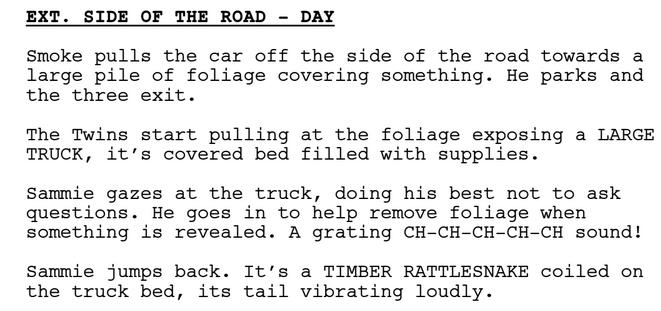
Excerpt from Sinners (2025)
Avoiding large paragraphs allows script readers to scan pages quickly and take in the information as quickly. The action lines are depicting what is happening on screen, and things can happen on screen very quickly. A general rule is that one script page equals one minute of screentime (depending upon the pacing of the story), so using a full page to detail the setting that the viewer will understand immediately can bog down the script.
The white space in the script (the space on the page containing no words) is a tool for a screenwriter whereas it is not a consideration for novelists. White space encourages readers drowning in scripts to turn the page and keep going. It’s a gentle nudge. And an extra nudge can be the tipping point to convince a reader to see your story through to the end. Every industry professional will tell you that as long as the writing is there, the opportunities will follow, but the reality is that readers may pass on scripts for many reasons that have little to do with the quality of the script.
Keeping this in the back of mind, it’s one of the reasons to maintain a maximum of four lines per block of action lines. A good place to break lines is when the focus shifts in the scene. Shorter paragraphs also create visual momentum which we will get to later in the rhythm section.
What to Leave In
Focus on the visual aspects of the scene. What is the viewer actually seeing? Writing Visuallyis the core concept of deciding what makes the cut during revisions. Characters’ actions, the visual environment, and emotion cues through behavior are the meat and potatoes of action lines.
Character Actions – what we see the characters physically do.
Sarah checks the door. Locked.
Visual Environment – the details of the environment that the audience sees on screen.
Rain pounds the empty highway.
Emotional Cues through Behavior – the actions the audience sees in lieu of stating emotions directly.
Max crushes the letter in his fist
If the camera can’t capture it, or the creatives can’t translate the line visually, reconsider including or rewording the description. It is also best not to misinterpret these suggestions simply as to make the screenplay as lean as possible. It is,moreover, that the screenplay should be prioritizing action, movement, and the audiovisual details of the scene. The destination for every screenplay is to become a film, and films are experiences visually and aurally.
What to Cut
Determining what to cut is often the first step in Revising a Screenplay. Many new writers overwrite because they includenon-visual information. Purple prose is a common criticism in the literary world (one I find often overused). For screenwriting, overwriting is analogous to purple prose, but it has more uniform merit where purple prose is very stylistically dependent. In screenwriting, the formatting is more concrete. Which isn’t to say that writers can’t play with words the same way novelists do, screenwriters are just using the tools of language to slightly different ends.
In novels, especially with first-person narrators, readers can go right into the internal thoughts of the characters without missing a beat. In film, these internal thoughts get lost in translation unless your story is utilizing voiceover, and even then, voiceovers are tricky beasts. Screenwriters show what the characters thoughts are by their actions and reactions, by what they say and what they leave unsaid.
Or, a creative workaround is found to showcase the thoughts visually if it enhances the themes of the story. In Annie Hall, the thoughts of Diane Keaton and Woody Allen’s characters appear above their heads during their conversation. The kicker is that their internal thoughts reveal to the audience that they are completely misjudging the situation and miscommunicating. Revealing what’s unsaid contrasts with what the characters are actually saying to enhance the theme of the scene, but it is done visually.
Here are four common examples of what can be cut or reworked:
Internal thoughts
Bad: John remembers the day his father left and wonders if he’ll ever forgive him.
Better: John stares at the old photo. Jaw tight.
Overly detailed description
Bad: A beautifully ornate Victorian desk made of mahogany with brass handles and delicate carvings.
Better: An antique mahogany desk.
Camera directions (unless essential)
Bad: The camera slowly pans toward the door.
Better: The door creaks open.
Novelistic writing
Bad: The night wraps around the city like a suffocating blanket.
Better: The city sleeps under heavy fog.
The Rhythm of the Page
Great action lines create reading momentum. Their pace evokes the pace of the scene visually. Perhaps even evoke the eventual edit in the reader's head. The two most important elements to strive for screenplay readability are the script's ability to be read quickly and visually. The rhythm of the action lines begets the pacing of the action displayed therein. Short lines heighten intense moments while longer lines let slower scenes breathe or build depending upon the situation. Your choice of words and line duration can enhance or impede the flow of the story and the reader's ability to connect to the character’s journey.
Short lines during intense moments accelerate pacing. One to five word lines can be read absorbed instantly by the reader mimicking how quickly it will be happening on screen.
Examples:
Glass shatters.
Someone screams.
The alarm blares.
Longer lines during slower scenes lets the pressure off the gas to be a low simmer. While still being concise, the slightly fuller lines create atmosphere and let the reader settle into the scene.
Example:
The restaurant hums with quiet conversation. Candlelight flickers across crowded tables.
The variation in lines will also help add white space to the script. As mentioned above, white space makes pages less intimidating and keeps readers moving. Readers often decide within 10 pages whether a script feels professional.
Examples from Professional Scripts
No Country for Old Men
The Coen Brothers useprecise but minimal descriptions. This style perfectly suits the foreboding nature of the film’s antagonist, Anton Chigurh. Take for example:
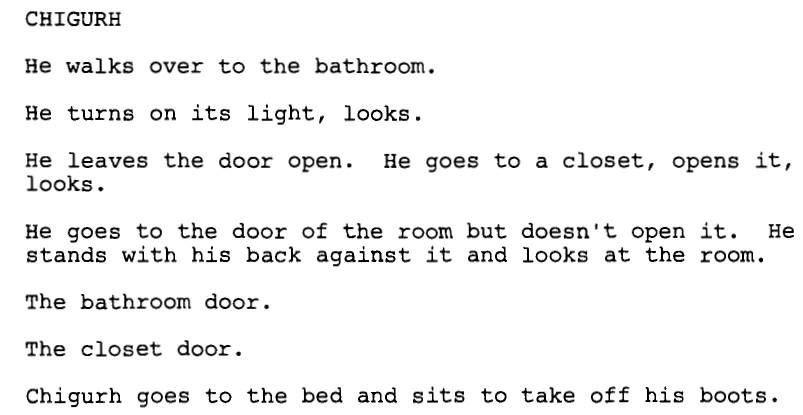
The clinical use of language lays bare the type of character Chigurh is. A man executing his directive, almost like a machine.
Alien
The script uses clear atmosphere without heavy prose. In this excerpt, we can see that while the script isn’t adhering to the maximum 4 lines per block, the action lines are written in such a way as to elicit striking imagery frenetically as the situation calls for with the first appearance of the facehugger. Sci-fi and fantasy descriptions have to balance illustrating foreign technologies, creatures, and landscapes while not overwhelming the screenplay with the minutiae of what will become set design or belong to another department. One idea for these stories is to keep a separate document detailing all the meticulous minutiae that can be helpful to department heads and the director when the script heads to pre-production.
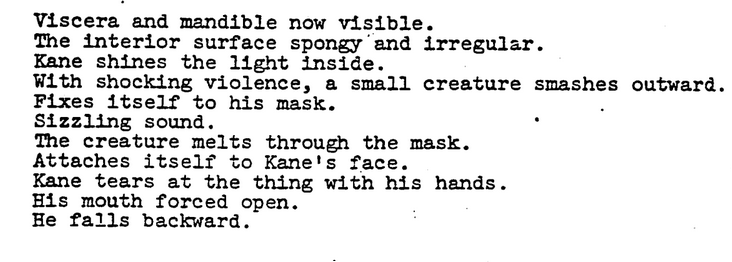
Action lines adapt to the type of story you’re trying to tell. The action lines of the best scripts balance clarity, mood, and pacing. And all three of these tug and pull from one another depending upon the story. An action movie will prefer direct language compared to the confounding language native to a mystery. Fully understanding what your story is saying and why it is saying it informs the style of writing necessary to tell that story.
Key Takeaways
Strong action lines should be:
Short (1–4 lines)
Visual
Action-focused
Easy to read
Free of novelistic prose
Questions to ask oneself when revising action lines:
Does this help the reader see the movie?
– If not, cut it.
Is the action line too long?
More than 3-4 lines?
Includes thoughts?
Includes unnecessary camera directions?
Includes unnecessary adjectives?
– If yes, revise.