What Black List & Nicholl Readers Look For In Screenwriting Competitions [Podcast]
What really happens to your script after you hit submit?
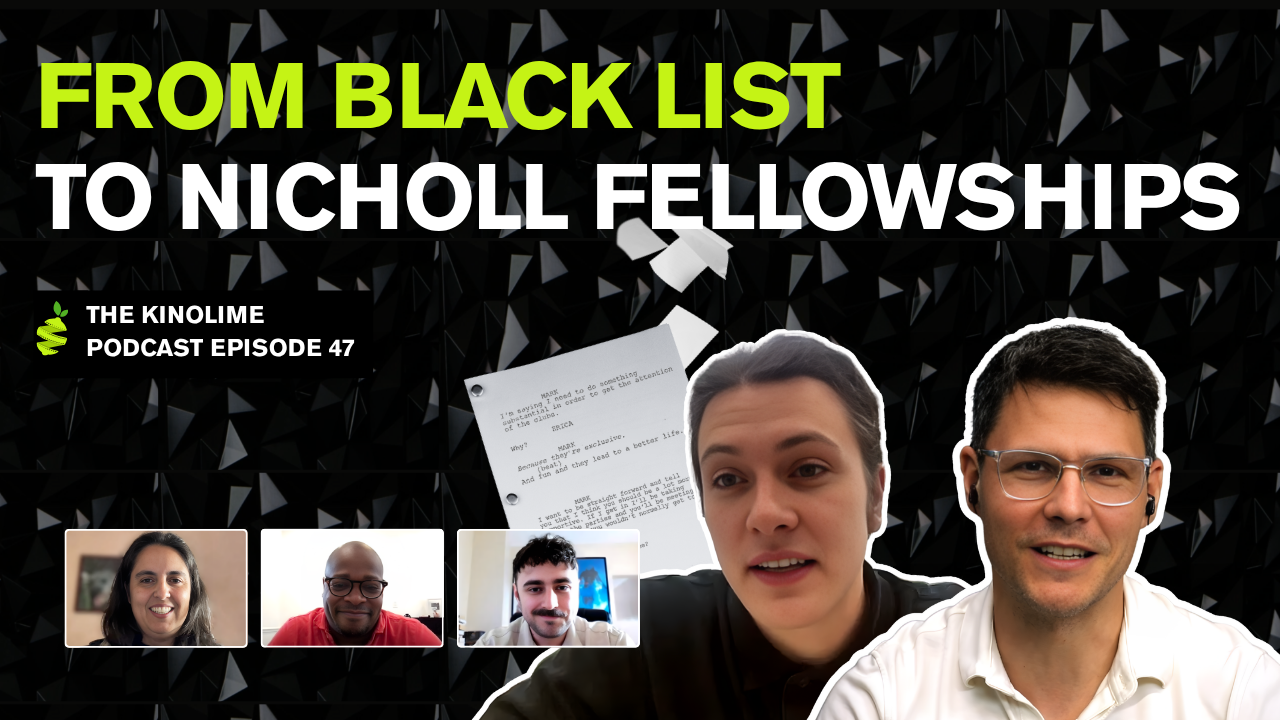
In this episode, John and Danny sit down with experienced readers Giulia Corda, Shom Shamapande, and Meara Owen-Griffiths to unpack the often-misunderstood role of the script reader, the first gatekeepers your screenplay will ever face. From competitions and agencies to production companies, they break down what readers actually look for, how quickly they form opinions, and why something as simple as formatting can make or break your chances.
But beyond the technicalities, the conversation digs into what truly separates scripts that get passed over from the ones that stay with you, character, clarity, and above all, feeling. Because in the end, it’s not just about writing something that works. It’s about writing something that moves people.
Full Transcript: Kinolime Podcast Episode 47: What Black List & Nicholl Readers Look For In Screenwriting Competitions
Participants
John Schramm - Head of Development, Kinolime
Danny Murray - Creative Executive, Kinolime
Meara Owen-Griffiths - Creative Executive, Kinolime
Giulia Corda - Story Analyst, The Black List
Shom Shamapande - former Nicholl Fellowships script reader and Howard University professor
The Importance of Format
Shom: For anyone, especially young writers trying to break into screenwriting, format has to be impeccable.
John: Everyone at home, first tip: get your format down. Get it right.
Shom: That’s my rule with my students. I don’t want to have a conversation about format. It’s not difficult, learn it and move on.
Who Actually Reads Your Script First
John: Readers can make or break careers. This is where your scripts live or die.
When you’re starting out, everyone thinks, “I need agents to read my work.” But who are the first people actually reading your screenplay? That’s the myth of the “infamous reader,” and today we’re pulling back the curtain.
We’ve got an incredible group here to talk about how they got started, what they look for, and how scripts are evaluated across competitions, agencies, and production companies.
Introductions
John: Danny Murray, how are you doing?
Danny: I’m great. Excited to ramble from a different corner of the office.
John: Coming in from Rome, Giulia Corda.
Giulia: Ciao everyone. Very excited to be here.
John: Next, Shom Shamapande.
Shom: Thanks, excited to talk.
John: And finally, Meara Owen-Griffiths, Kinolime’s Swiss Army knife.
Meara: Doing very well. Excited to talk about gatekeeping movies.
How Readers Get Started
Giulia’s Path
Giulia: I’m a screenwriter, story analyst, and reader with an MFA from USC. During workshops, we had to give notes, and I struggled at first, especially writing in my second language. But I made it a goal to improve.
I interned at an agency, started reading, and the agent liked my analysis. My first paid job was reading for the Sundance Writing Labs. I’ve also read for the Nicholl Fellowship, and during the pandemic I began reading for The Black List, which I still do.
Shom’s Path
Shom: I wasn’t classically trained. I started as a speechwriter at the United Nations, writing for Madeleine Albright and others. I also worked in advertising and on the Obama campaign.
Eventually, teaching at Duke Ellington School of the Arts and Howard University led to reading opportunities. I was recruited, people reached out and asked me to analyze scripts.
At its core, reading starts with understanding script coverage.
Meara’s Path
Meara: After film school in London, I struggled to break in, mostly running errands and occasionally reading scripts for short periods.
So I went freelance. I found clients on Reddit, built a base, and started giving coverage, cheaply at first, then gradually building up.
Eventually, I was doing the reading equivalent of ghostwriting, screening scripts for others. Then I entered the first Kinolime competition, came second, and have been reading for Kinolime ever since.
Danny’s Path
Danny: My first paid reading job was proofreading scripts for my uncle, a professional screenwriter who’s dyslexic.
After film school, I interned for a WGA writer and was asked to give coverage on her pilots. I was brutally honest and got fired within an hour.
After that, I worked various assistant jobs, eventually becoming a producer’s assistant and getting back into reading. Then I found my way to Kinolime, where I get to read constantly.
What a Script Reader Actually Does
John: In one sentence, what does a script reader do?
Giulia: A reader analyzes a script, highlighting strengths, weaknesses, and commercial potential—and provides actionable feedback to improve it.
Different companies require different formats. For example, The Black List focuses on strengths, weaknesses, and viability, while agents may just want a quick synopsis.
The Reading Process
First Impressions
Shom: I focus on the first 10–12 pages. I’m asking:
Am I engaged?
Do I want to keep reading?
Am I following the story?
I try to reach the inciting incident quickly. If I’m battling format, I’m already turned off.
John: Even Spielberg says story matters more than format, but when you’re reading hundreds of scripts, bad formatting kills momentum.
When Do You Form an Opinion?
Shom: By the end of the first act, I need to feel: “What happens next?” If I don’t, it’s not working.
If the first 25 pages are weak, the script usually is too.
Giulia: You often feel it early, but to form a full opinion, I wait until the midpoint. I’ve read scripts that start strong and fall apart later.
Meara: When something disappoints you, it’s easier to diagnose. When it’s just flat, it’s harder to say what’s wrong.
What Makes a Strong First Act
Giulia: For me, it’s:
A compelling protagonist
A fascinating problem
A sense of originality
Character matters slightly more than premise, though both are important.
Meara: I look for:
Motivation
Contradiction
Those tell me if the story has legs.
Also, loglines matter. If Act One doesn’t reflect the promise of the logline, that’s a major red flag.
Danny: The biggest issue I see is passive protagonists. Great premise, but no decisions being made.
What I want:
Strong premise
Characters making tough choices
The best scripts make me forget I’m reading.
What Gets a “Recommend”
Danny: At the core: How does it make me feel?
The best scripts:
Make me emotional
Pose a question I can’t answer
Stay with me
Shom: Make me feel something. That’s the job of any artist.
Also:
A strong hook
A world I haven’t experienced
If I can’t put it down, that’s a recommend.
Giulia: It’s the “meaning and magic.” Something intangible that stays with you.
Also:
Surprising yet inevitable twists
Emotional authenticity
Meara: A great script sets expectations in Act One, then satisfies and subverts them in Act Two.
The best ones:
Make you think you know where it’s going
Then surprise you
Common Mistakes Writers Make
Giulia:
Confusing ambiguity with confusion
Lack of clarity
Not knowing where the story is going
Shom:
Overcomplicating the story
Confusing complexity with quality
Simple storytelling is harder and better.
Meara:
Weak loglines
Stories that don’t match their premise
Your logline should represent the whole journey, not just a moment.
Danny:
Not thinking about the business side
Not writing with production in mind
Write to get your movie made.
What Writers Should Stop Worrying About
Danny: Stop chasing trends. By the time your script is made, the trend will be gone.
Giulia: Stop writing by rigid structure (“page 10 this must happen”). Story should feel natural, not mechanical.
What Makes a Script Instantly Stand Out
Giulia: Sometimes, it’s page one. Authentic emotion and voice.
Shom: A single line can hook you instantly. A strong concept that makes you lean forward.
Meara: I love openings that start in medias res, dropping you into the middle of something compelling.
Final Takeaway
John: Writers often focus too much on being “cinematic” instead of making us feel something.
Every genre, action, comedy, thriller, needs emotional weight.
Shom: Even comedy needs a soul.
John: At the end of the day, the real question is:
How do you want your audience to feel?