What Does a Literary Agent REALLY Look for in a Screenwriter? [Podcast]
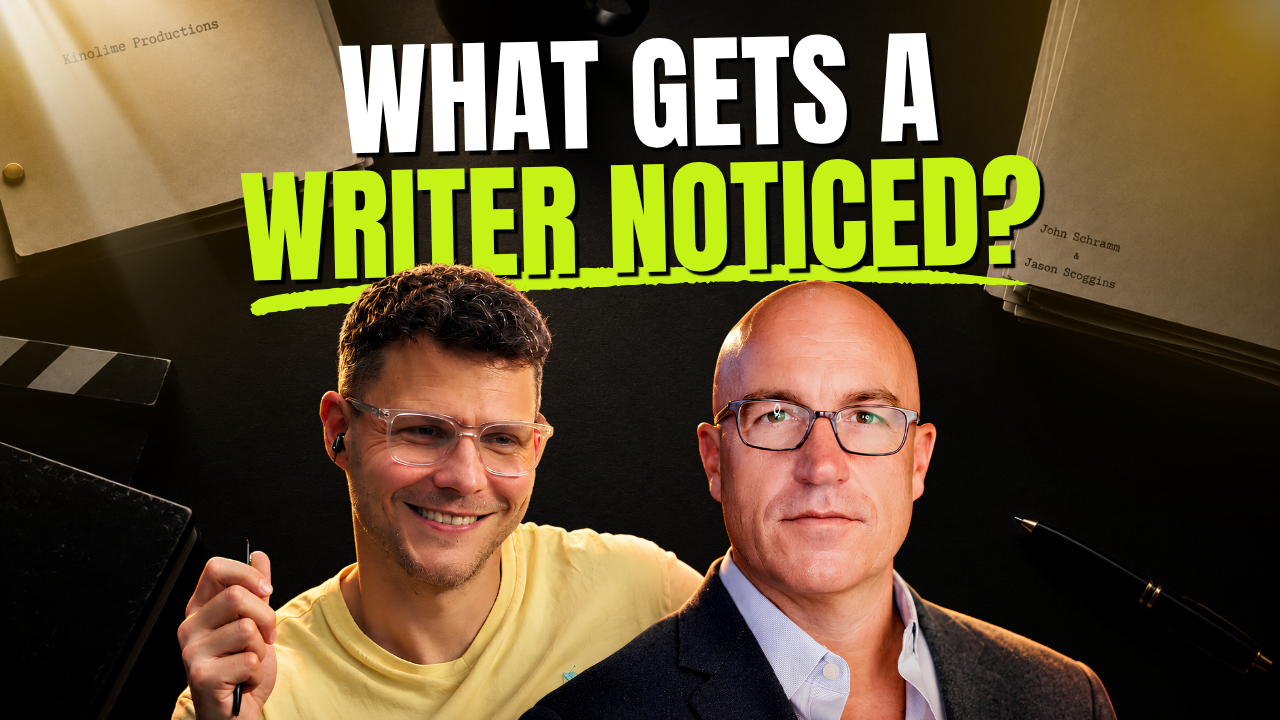
Jason Scoggins has spent the last two decades mastering the interior workings of the entertainment industry, from the desks of ICM during the golden age of television to the inner circle of independent film finance. As a literary agent, co-founder of multiple companies acquired by Slated, and now a consultant working with producers and family offices, Jason has developed what John calls "one of the most brilliant story minds" in the business.
In this episode, we dive deep into what separates writers who get noticed from those who don't, the real skills that agents look for when signing clients, and what it actually takes to get your screenplay made in today's market. Jason breaks down the myths around pitching, explains the business structures that control television development, and reveals the decision-making process behind which projects get greenlit.
Whether you're a screenwriter looking to break in, a producer navigating the financing landscape, or simply curious about how stories become films, Jason's fifteen years of industry experience offers a masterclass in both craft and commerce. He brings the kind of practical, grounded insights you can actually use, not the surface-level advice you've heard before.
Full Transcript: Kinolime Podcast Episode 58: What Does a Literary Agent REALLY Look for in a Screenwriter?
Participants
John Schramm - Head of Development, Kinolime
Jason Scoggins - Writer, Spec-Scout Founder
John: Hey, welcome to the Kinolime Podcast. I'm John Schramm, solo today, because the man that I'm about to speak to really could just be us two going back and forth with all the great knowledge he's about to bestow on us. Every time I speak to Jason—Jason Scoggins, by the way, we're gonna go into a litany of his titles and all the businesses he created. He's one of the most brilliant story minds I've met in the business. So you're in for a treat. Every time we speak on the phone, I always get my notebook out because I'm being taught, I'm being tutored by the master. Jason Skog is coming from the West Coast. Welcome to the Kinolime Podcast, my friend. Thank you so much for joining.
Jason: Thanks for having me. That's very kind. That's the best introduction I've ever had.
John: We're gonna record it. We'll send it to you, send it off to your friends when you do these other shows. Just be like, "Just play this, guys."
Jason: We'll get a clipping service. Anytime I show up, it'll be like someone looking up in the corner at the screen, you know.
John: I mean that sincerely. I've been around a bit. I've met a lot of people, and you've always been one of the more genuine students of not only screenwriting but the business itself. You carry yourself like a CEO—and you are a CEO—but you really just bring such a wealth of knowledge every time we speak. So it was only fitting that I'm like, "Hey, I gotta get Jason on the podcast." We may break this up into two podcasts because I just know you're gonna be spitting some knowledge. But for all those who don't know you, who are gonna know you, give us a quick little rundown of your resume, and then we're gonna go into your backstory first. But let's just hit them with the big stuff.
Career Overview
Jason: So if I was gonna do it in a CV style, what's the most important thing to know? Really, that's the most recent stuff, right? In the last ten years—and I'm not young, so my career spans a while—what I've been focused on is independent film finance, specifically with a tech and online bent. I co-founded a couple of companies that were acquired by Slated, which is an online platform that matches filmmakers and their projects with film financiers. My role there, after the two acquisitions that brought me to Slated, became to build an internal practice with several key colleagues who are still there, still running it. This involved matching those projects actively and introducing projects to investors. What that meant was creating something more or less from scratch inside Slated—understanding independent film finance from the inside out. I was there for eight years. I left in 2022.
Since then, I've been consulting. I had a long one-year engagement, and now I consult to producers and family offices, and also some companies outside the business because I have some experience with mergers and small-scale mergers and acquisitions from co-founding a couple of companies that had modest exits.
Prior to that, before Slated and before co-founding the companies that went into Slated, I got started by being an assistant at one of the big three talent agencies back in the day, became a TV lit agent. So I have that inside hardcore Hollywood experience baked into how I see the business and the world really. I left the business after a couple of years of being an agent. Being an agent does a really specific job, and I'm good at about half of it and not that great at the other half.
I went off and did some entrepreneurial stuff for several years, and then broke back into the business as a lit manager, representing screenwriters for film.
John: Your career's nuts. Lit manager, lit agent, Skog's Report, It's on the Grid, Slated. I mean, this guy is doing it all. But let's go back to where it all began. We're gonna go into act one here, for screenwriter terms. So an assistant—where were you an assistant at?
Early Career at ICM
Jason: I was born and raised in LA, and like I said, I'm not young. This was before how to get into the entertainment business was a relatively known thing. It was a relatively small business, meaning the entertainment business writ large, and I didn't have any friends or family in the business. So I did the classic thing after I graduated from UCLA. I did a bunch of informational interviews—just coffees. I knew one guy who knew a guy, and that led to a handful of coffees, and I got my resume walked in by one of those people to ICM. So that's the answer. I was the assistant to the head of worldwide television, a woman named Nancy Josephson. This was at the time when Friends had just finished its first season. Nancy represented Brett Coppin and Crane. She also represented Darren Starr when Melrose Place had ended, but Sex and the City was about to go. I was on the phone as an assistant at that time—back then, you listened to every single phone call. So I got to hear a lot of stuff about Sex and the City getting set up and going.
As an assistant, I started as her second, which meant sending everything in and out of the office physically. We still did that at the time. We literally had a giant room downstairs with a giant copier that would print screenplays and bind them, and then people running through the building with carts—literal messengers.
John: The good old days before PDFs were sent around. You had your hands on a lot of screenplays. So was part of your job reading them?
Jason: As I was thinking about what we might talk about today, reading is such an important point, whether you're a writer or a producer or an executive. And by reading, I mean reading everything you can get your hands on that's good. So yes, obviously, I had to read every pilot that Nancy's clients were writing. But that's actually a fairly small aperture when you think about it. What was much more useful, and became part of the job, was a couple of promotions later, I went from second assistant to first assistant—meaning everything on the phone, basically, and calendar. Then I got promoted off her desk to this interim thing where you're not an agent, but you're not answering one person's phone. It's called a departmental assistant.
And that was the point where I read everything and had access to everything. In fact, my job was to track everything, which will come up later. There were basically two full TV development cycles where every screenplay, every pilot script that gets delivered in the fall to the studios, finds its way into the agencies. Everybody who's getting paid to write for the studios has an agent, and the agents get a copy and circulate it internally. So two full development cycles—even before I became a TV lit agent, I left ICM and went to Gersh, which was smaller even then. But there was this period where I was reading around a hundred pilots. And this is the good stuff, right?
John: Yeah, but not the crap that wasn't rising to the top.
Jason: Right, exactly. Literally everything. And understanding what's available and guessing what's gonna get picked up and why is part of that job as a TV lit agent, and it's both a business reason and a student-of-the-business reason.
What Made Writers Stand Out
John: I'd love to put in on that. You're reading all these pilots and screenplays. You weren't the decision-maker yet, you weren't the one signing clients, but from your perspective, what was standing out? What were the pilots that were being picked up or the writers getting wrapped at the time, from your purview at the agency level in the mid-to-late 90s? What was it about the writing or the writers themselves that got in the door, that got their pilots picked up?
Jason: Okay, well, to answer this fairly narrowly, it's important to remember that the TV business usually gets kicked off by a pitch. It's not starting from a spec pilot script. So the writers are coming up with their ideas for a series, and they literally go in and pitch their idea for the series. Sometimes there's a package around it, meaning the writer goes in with a show runner if the writer is new. Or sometimes you develop specifically for an actor who has a deal somewhere, and you're developing for that actor, and the actor will be in the room for those pitches.
So basically, in June, July, and August, you have development season, and that's when the networks and studios are taking all of those pitches and they buy them—colloquially, they buy them, which is to say, we'll pay you to write the pilot script for this. The next couple of broad steps: the script gets delivered usually sometime between—there's year-round development that happens, but it's useful to think of it as seasonal. So in the summer, people are pitching, this stuff is getting picked up to script. They buy ten times as many scripts as they know they're going to order to pilot. Then the scripts get delivered to the studio or network. There's a little bit of a rewrite process, but it's really, really short. So basically by New Year's, the studios know how strong that crop of screenplays are. Then what they're doing is culling from, say, a hundred scripts down to twenty—twenty that are getting picked up to pilot, meaning they're gonna produce the pilot.
To your question, the thing that gets a project picked up from script to pilot and pilot to series is a combination of quality, but it's really about the business of television. They're literally trying to fill slots in a timeline for broadcast TV. That's the era that I grew up in. It's less about a schedule now where it's always on with streaming.
But if you distill that down to what it really means, they know what their needs are. They know what audience they have, what the audience is looking for. So sometimes what they want is a multi-camera half hour shot on a soundstage. Sometimes it's a single camera half hour that looks like Sex and the City. On the drama side, sometimes they want procedurals that are self-contained.
John: They know what they want and they're trying to have that ear for it. You said something interesting about the pitching, which I find fascinating. I don't see talent learning the skill sets of pitching. It's so simple now for a pitch deck with AI. We see it constantly—take my screenplay, throw it in. But there is something about being in the room and being able to excite the other side via your performance on pitching. How important of a skill set do you think that is? Or is it not as important anymore? Is it really about the words on the page?
Jason: Let's see the three elements you just mentioned: what you're saying in the room, what's on the page if you've written the script, and then the presentation or the deck. Of the three, the deck is the least important, in my personal opinion. If you talk to executives or producers, they might skew that a little bit. Let me give you an analogy. One of the things I'm working on right now, taking most of my professional time, is a startup called Felix. Essentially, it's an app that learns your taste so that it can recommend stuff you love. We're focusing on film and TV. So basically, what should I watch tonight or what should we watch tonight? Felix basically knows what your taste is within a couple of minutes—exactly the stuff you love, the stuff you loathe, and the stuff you merely like. That allows it to recommend something that's coming up.
So when you pitch a company to investors, you have a deck. In fact, they need the deck. They need to have something that they talk about internally. But nobody is investing just off the deck. They wanna look you in the eye, even if it's through a camera. And really, this is the essence of your question and the answer to it: there's no substitute for the energy. The word passion gets used too often, but the passion and energy and enthusiasm that you bring to the table for your company, your understanding of what you're doing, why, and where it can go—that analogy applies 100% apples to apples for pitching your show.
So there is no substitute for it. There's a bunch of caricatures, right? Like, "Picture, we open on blah, blah, blah." That's such a cliché, but also, if you think about it, the person is about to hear a story and they want to be told the story. They need to know what it is, why it's cool, how it's going to be good. All of those things. And they wanna see and feel the enthusiasm behind it. If you just send in a script and a deck, now they're looking at a piece of business. And there's a business side to everything in the entertainment business—hence the name. But it's also art. It's also like, I wanna be moved. I wanna connect with this character that you're going to introduce us to.
John: That's a great point. I know we get hung up on the words on the page, which is all about that because at the end of the day, they need to see the blueprint, right? Pitch decks are nice to have, of course, like Jason mentioned. Investors, producers, directors—they wanna put their fingers on something to see. But there is nothing that will replace the passion you give, the excitement, the enthusiasm from your lips out there. They wanna be told and taken on a journey of a story. So practice your pitching skills. Get in the mirror, in front of friends. Every time I have a story, if I have to flush it out or I'm stuck on something, I'll take a buddy out—whoever—I'll buy him a drink, and I'm just gonna pitch a story. Because I know the moments that are lulls, I know the moments I get excited, and I'll kind of weave my way through a story. So for all those at home, please, please, please practice your pitching.
The Path to Agent and What to Look For in Writers
John: You're an assistant over at ICM. Now, tell us about becoming the lit agent, right? And not just from the business side, but from the screenwriting side. You're a literary agent, right? You're looking for writers presumably as well as to sign. So I'd love to know how you made that jump from assistant to agent, and then, what were you looking for? What made you a great agent, and how can the writers at home learn from what you were looking for as an agent?
Jason: So I'll do that in the order you laid it out. You start off as an assistant. Back in the day, there were pretty clear delineations. I haven't been an assistant in a long time, but my understanding now is there's a lot of overlap—you might get promoted but still be answering somebody's phones. But at the time, that was less common. The steps were answering someone's phone, getting promoted to some sort of junior position like departmental assistant, which meant supporting everybody in the department but not having to set any calendar or answer the phone. You're circulating scripts, tracking scripts. That becomes a hallmark through my career later—understanding and collating all the information happening around town.
Let me link around that for a minute because it's part of what it means to be an agent. A big agency's hallmark is being able to assign a given agent to a particular territory. Territory means a studio, a large production company, a network, or all of the above. The job is to know what's available—what jobs are coming down the pike. Not just what they want to buy this season, but once scripts get ordered to pilot and pilots get ordered to series, the first job of the series is to hire a writing staff. Knowing what each show is looking to hire based on who was involved at the beginning and what slots they wanna fill—the way the agency knows that is to have an agent whose job is to know that, to call up the showrunners, to call up the executives, to gather all that information. At a big agency, that gets filtered to that role—the departmental assistant. It gets collated into a database, a grid.
Transitioning from that job to agent is a relatively small step.
In my case, I could have gotten promoted internally at ICM, except there was an impending writer strike, which was a bummer. Basically, it came down from the powers that be that nobody at my level was going to get promoted for at least another twelve months. It wasn't an explicit "feel free to leave," but it was definitely—people are reasonable, right? So everybody has reasonable expectations. I started looking around to see if other agencies were looking to hire baby agents, somebody coming off a departmental coordinator style desk to become an agent. There were a couple. I looked at a couple of management companies as well, but management companies weren't quite as prevalent at the time. I ended up at Gersh, which is a longstanding company—still around today, great reputation. It was relatively small, family run. Since then, they've taken in third-party capital and expanded. It's a much bigger business than it was, but they were looking to hire a baby agent. Smaller agencies don't have the farm team that large agencies do. At ICM, I think there were like 120 agents in the LA office. At Gersh, it might've been 30 or 35. So you just don't have a huge mail room—basically a bank of people trying to bubble their way up into the business. As a smaller agency, you're looking to hire from the big agencies. So that happened for me.
The job of the baby agent is partly what I told you—you get assigned a particular territory. Your job is to know everything happening within that territory, but it's also to sign and to service and sell. So you have this information-gathering component, but the core business of being an agent is signing new clients, servicing existing clients—whatever their needs are within the context of the business—and then selling them into opportunities you're aware of. On the TV business, because TV is really cyclical, it's much more structured than the movie business. On the TV side, there's hundreds of positions that have to get filled at a particular time. So it's this really, really busy time called staffing season.
John: So when you were looking to sign clients—signing writers—what were you looking for?
Jason: The best way to describe it is I'm looking for someone who has demonstrated the ability to do the work. So that if I put them up for a job, not only do they have a great writing sample—and there's a reason they're in the room in the first place—but the next script they write is also going to be good. Their ability to take notes and improve the script, whether it's from me, their manager, a producer they're working with, or whatever—that's an element of it. And also their ability to connect, to build rapport in the room. Because on a writing staff, it's a job, right? You're gonna be in a building, often in a room with colleagues for hours and hours on end. A lot of remote stuff is happening now, but the core of the job is to be a good colleague and to be able to grind and deliver a script, deliver notes, to do the job on a consistent basis. So the core answer is: this is somebody who I feel confident is going to be able to do the job. It's all of those components—writing, rewriting, and connecting with people.
John: That's something I struggled with early in my career. I was one of those writers that took a few notes, but I was always stubborn. Like, "This is my work. If it was a rewrite job for something I didn't even write—I was hired to come in and model some work"—I was always so stubborn. That's a hard lesson to learn: you're an employee. At the end of the day, you're being paid to do work, and you gotta take the notes from the producer, whether you disagree with them or not. If they're saying, "Hey, I want to put this in there," you can make an argument, but at the end of the day, if they still don't want to do it, you gotta do it. And that's something that hurt me getting work years ago because I was that pain in the ass. So for all you writers out there, do exactly the opposite of what I did. If you're so fortunate and lucky to be in front of an agent, a manager, you have option material, someone's looking at your work, who's maybe done stuff before and you're starting out—please, please, please be collaborative. Work together. Do the notes. Do the job. Do the work. Because I love that you really honed in on that: you were looking not only for talent, but for someone who's going to do the work. I think that's something that gets overlooked.
Jason: Yes, I mean, again, it's a business. It's another cliché, but it is a business. It's not just art for art's sake. There's a—anyway, we could go down a rabbit hole around the business side versus the art side. But I just wanna double click on something about that. It is a balance, right? Like you don't just want somebody who's gonna roll over and say, "Okay, whatever you say." That's not the situation. But there's this idea of the note behind the note. So if you have a draft—whether it's a feature, a pilot, or even an episode of a show you're on—and you're gonna get notes, five different people have eight different opinions. There's no getting around that. But the North Star is: let's make it good. When somebody gives you a note, one of the skills you develop over time is to understand the drive of the note behind the note.
John: What are they really saying?
Jason: Yeah, I mean, and often a good producer or a good executive giving notes will tell you the reason for the note. Like, "I'm just not feeling what I'm supposed to feel in this scene based on this dialogue, based on this character. That character doesn't feel authentic to himself in this moment." Being able to have a conversation about why that might be true is part of the skill. So the note behind the note is shorthand for teasing out: well, what do you want that's not here? And then you also have to bring your own taste and your own skills to the table, saying, "I understand why you want that, but it's gonna undermine this thing that happens later. The payoff will be better if we don't tip our hand now."
And then, to what you said a second ago, being willing to be overridden by whoever is the authority on the project at that moment. Sometimes—and the really complicated one is—when it's an executive note that conflicts with the showrunner's note. Your boss is the showrunner. You might get fired if you don't do it. It's a rock and a hard place situation. But ultimately, you gotta remember who you work for, what the job is, and deliver. And let the people who have more power protect you as best they can.
What Makes Great Writers Stand Out
John: Let's hop into the art side for a second. Purely from the art side of writing, what is something you saw that stood out? What patterns in the best writers—forget about them doing the work, just strictly talent on the page. What was something that you really gravitated towards? What made this crop of writers do very well? Is there something that you could distill for writers looking to get an edge?
Jason: Well, there are so many elements, right? Later in my career, we might touch on it. I developed a company called Specskout with a couple of partners. The essence was to build a repeatable coverage analysis—a screenplay analysis company using coverage. So with a scoring system, on a scale of one to a hundred, you have a sense of whether it's really, really working, really, really not working, or somewhere in the middle—and the middle is the complicated one.
So I'm gonna tack back to your question. What makes for a good screenplay is not just one thing or even three. In fact, the system we built focuses on ten different elements of good writing: structure, character, dialogue, tone, premise, et cetera. But also overall: did I like it? In some cases, it's appropriate to ask: would I go see this movie?
When you say what am I looking for on the page—was it voice, was it command of structure—it's all of the above. But actually, where I was going in my head just now was: it's all important. Some are less important, right? Some people get really hung up on punctuation and spacing and whether it looks okay on the page. Those are not unimportant, but they're not the most important part. In the Specskout rubric, we put that under craft. The wordsmithing is really, really important because you wanna grab somebody. If it's clear that you're using an AI tool to just get some stuff down to have the beats of your story, I mean, it's a bit of a turn-off. So you can't ignore craft. Craft is really important.
But what's the most important part? The three biggest ones are structure, character, and dialogue. But the one that's tricky—and I think this is the core answer to your question, what do I look for?—I look for a command of tone. The way I think about tone is: are you executing your intention for what I'm supposed to feel from this script with mastery? So if it's a comedy, is it funny? If it's a horror project, is it scary? Tone is probably the thing that elevates it.
John: Something I also—I'm gonna piggyback because I agree. I think in our competitions, we read thousands of screenplays. Tone is the hardest part. Because there are things like—not to disparage Denis Villeneuve, but I'm not a huge fan of his work. I find his movies visually beautiful, the composition is there, whatever, all that stuff. But I can't get behind his tone. I find Dune to be so monotone. Does that make sense? So there are writers or filmmakers that can take you on that journey, genre agnostic, right? There is a feeling you're supposed to feel in a film, whether horror or comedy. Zeroing in on tone—for everyone at home—like thinking about what Jason said about tone, it's not so much your structure. Dialogue obviously can help, but like tone, it gives us the ability to follow your feeling of what you want us to feel. Because we'll buy in. That's how I watch a movie—I'm bought in on tone. I saw "Obsession" recently, pitch-perfect tone. Made me feel what I'm supposed to feel in all the horrible moments. That's the reason I think it's successful: because the tone is perfect in that film.
Jason: Yeah, well, that's the thing that elevates a particular piece of writing from something that's good and competent to something that sings—that connects to me. And if I connect to it, getting back to being an agent, if this piece of material connects to me that way, then I can feel confident that when I send it out to a producer or an executive, they may not feel the same way, but at least I know that it lands for me. So it is by definition good, right? Just because it's good doesn't mean it's gonna sell. Just because you're a good writer doesn't mean you're right for a particular project. But what I'm looking for is something that is going to be the opposite of embarrassing, right? I'm not gonna send a crappy piece of material out and expect somebody to respect me. The next day, after they're sitting in bed with a stack of twenty things next to them, they open the page and ten pages in, there's like, "Jason wasted my time." So it's about that connection to the work.
I will say this is really specific to original material. So when you think about television, the spec script as a writing sample was the de facto way you got hired. On the TV side, you'd write a spec episode of a given television program. You'd never send a spec Friends script into Friends—I'm not gonna send somebody a spec Friends script in. I might send a spec Seinfeld or a spec Mad About You, or whatever the shows were at the time.
The Skog's Report and It's on the Grid
John: But speaking of spec, I wanna get into Spec Scout. So let's go. You're an agent, then manager. Give us the transition from manager to Spec Scout or the Skog's Report. Which one was which?
Jason: Well, Skog's Report was first. Let me give you the bullets. Okay, so I'm a TV lit agent. I'm doing it for a couple of years, signing, selling, and servicing. The selling part was the stuff that just—like, you have to really, really want to be that person, or you have to have sales baked into your bones.
John: Right, exactly.
Jason: I can sell something that I get excited about. So I wasn't incompetent at it, but it was the part that felt like work. As I was at Gersh, I went to a little company called Writers and Artists, which has since been rolled up into something else. But what I realized at the time was I didn't really wanna be an agent. I loved identifying new voices, helping them make their material better. I love the data and the information gathering and the sharing. But that one element made that role feel like work. So I had an opportunity to go do something entrepreneurial and sort of gloss over that period. I spent five or six years outside the business. But once the entertainment business gets into your system, it's like impossible to get out, right? It's like mRNA floating through your bloodstream forever. So for good or for ill.
I'd even moved away out of LA. So I moved back to LA, broke back into the business, and one of the few ways you can do it entrepreneurially is to hang out a shingle as a manager. I had a day job. I was doing other things. But it was terrible timing. This is the answer to the question about getting to Specskout and Skog's Report.
My timing was impeccable because I came back in 2006, just getting my feet under me, and then the writer strike hits in 2007. That's the long one—one hundred and thirteen days. That bleeds into the following year. Then the actors were talking about striking. So there was this period of eighteen months where there was basically no business to be had. And then the great recession happened. So there was this period where basically the whole business was seized up.
Once we got out of the writer strike and it was clear the actors were not going to strike, there was a general sense of like, what is even happening in the business right now? One of the questions people asked was: who's buying what? How much is getting bought? Are the buyers back buying feature screenplays, which was the area I was focusing on?
I was a manager and so knowing who's getting it done for their clients as an agent is part of that. I ended up writing a newsletter about that. The idea was to capture all the information about the spec market—which is not a real thing. It's more of a virtual thing. How many scripts are getting taken to market on a weekly basis? Of those, what's selling? Of the stuff that's selling, who's selling it? What is it, meaning genre? Also the log lines. Who are those writers? So tracking that information was something happening inside agencies. Obviously, my agency background informed me.
What I realized was this is a set of data being captured inside big companies, but not outside those companies. So I decided, well, I'm just gonna—this is before Substack—this is around 2009, 2010. Long story short, I answered a question on a tracking board. "Hey, does anybody know what's been happening?" And I had it literally in a spreadsheet. So I totaled everything up, wrote a little article about it, and shared it with the group.
To say it went viral is self-aggrandizing, but it got circulated around by email. I started getting phone calls saying, "Wow, this is really cool, Jason. Great job. Please keep it up." I ended up doing a twice-monthly thing: "Here's what happened last month," and then mid-month, "Here's the totals year to date." I ended up doing that for five or six years, from roughly 2009, 2010, all the way through 2015, by which time I had gotten to Slated.
What I realized about the Skog's Report was the information was very valuable to people, but also they wouldn't pay for it. There was just no way to monetize it. Substack didn't exist. Even saying "Pay me seven bucks a month to say thank you for this cool thing I'm delivering" wasn't an option at the time. But I did realize that data was really important and understanding the landscape was important. So I founded a company kind of simultaneously. It was called It's on the Grid. The idea was to basically build a subscription database that people could have always-on access to spec script information, but also open writing assignments, open directing assignments—basically, what's happening on the list.
John: The Google Maps of your writing career.
Jason: Exactly, the Google Maps of your writing career. So why was it important for you to understand the ecosystem at that time? And how did you believe that information would help writers navigate the industry more strategically?
Jason: Well, it's a great question. I wasn't building it for writers at the time. It ended up being really interesting to writers. And I do think that as a group, writers should be aware of how the business works and the different pieces of it. But mostly I was doing that for producers and executives and managers and agents at smaller agencies that didn't have access to the grids that I used to create when I was at ICM. Those grids would be like two hundred pages. They'd list all the different pieces of information about a given project. Every week a new version would come out. It was a pain in the ass. It wasn't digital. It was literally two hundred pages of paper. So building that was really intended for a professional audience.
Writers started to access it, which is fine. I can't remember what I charged—something like ten bucks a month or something. I got enough people to pay for it and be interested in it to sustain it, and then sold the company. But to your point, why does it matter? Well, it's all well and good to write a screenplay that meets your own needs, and that's great. Keep doing that. But you can't make money just writing for your own benefit—at least not at the time. There are ways to do it now, but less so on the screenplay side. This is a blueprint for a movie or a TV show, not a novel. So knowing who's buying what and what their needs are, seeing patterns around who's getting it done and who's not getting it done—you can see a manager or an agent who sells a script one year and never sells another one. That says something. Maybe their clients aren't bringing it. Maybe they have some stuff going on in their personal lives. Maybe they don't have access at the top of the business. During that span, there was something like a dozen agents and managers who would consistently sell and break new writers into the business.
John: And you can see it happening. You don't know where you're going if you're entering this field. It's good to know. So for the writers out there, knowing the business too—not saying write to the market because there's something called the odd-lot theory in investing. If horror is hot right now, everyone's in with horror screenplays, but what's the next big thing? Is it gonna be rom-com? So kind of knowing maybe where the pattern's going, which obviously, you're an analytical guy. So you sell It's on the Grid. Now let's talk about Spec Scout briefly. I wanna get into Slated, but this is a good place to go.
Spec Scout and Screenplay Scoring
Jason: Here's the genesis for what became Spec Scout. What I noticed is, in any given week, there could be anywhere from fifteen to thirty screenplays that get sent to market by agents and managers. And by the market, I mean to producers as well as straight into studios. When you do that with features, with movies, what you're doing is trying to find a champion who will walk it into a studio they have a relationship with. So it's this whole process we could go into. But what I noticed is they're just—if you think about the numbers for a second, let's say it's thirty per week. What ends up happening is something like five hundred screenplays would get taken to market through the course of a given year, right? There are these fallow periods where nobody takes out anything and other times where there's like a flood of new material. The problem was—well, there are bunch of problems. But one of the problems is most of that stuff is not worthy. It sucks. These are professional writers and professional screenplays getting taken to market by professionals, right? We're talking about the good stuff, but even within the good stuff, most of it is not good enough.
A downstream effect is a screenplay gets sent out to like thirty people. It might get read by two, three hundred people in a given week or two. Think about the amount of time and energy wasted by all those people reading the same crappy script. So it just used to bug me. And by the way, I did it from time to time, right? Not everything hits that mark where the tone is singing perfectly. But also you have business constraints. If you don't take a piece of material that your client thinks is ready, if you don't do the job, they'll fire you and go find someone who is going to, right? So you get to this natural point where the writer is like, "I'm done doing rewrites. Let's see what the market thinks." That's a reasonable thing to do. Sometimes it works, sometimes it doesn't. But there's this thing where a lot of people's time is wasted. And I came up with this idea that what makes a good script is a relatively known thing. We know the elements that go into making a good script—great character, dialogue, tone, craft, originality, premise, logic. There's like ten that we ended up doing at Specskout. And what I wondered and ended up building with a couple of partners was a way to quantify how good a screenplay is, right? So if you could have a score, we could have a whole conversation about whether you can quantify art. My thesis is yes, even though it makes me feel a little weird to say it that way.
Within screenplay writing, if you just think about Rotten Tomatoes, right? Thumbs up, thumbs down—it's not the most nuanced thing. But "did I like it, did I not?" That is quantification of a movie or series. If you get everybody aggregated together—how many thumbs up versus thumbs down—you end up with a percentage. That already existed. What I wondered was: is there a version of this that's more precise and a better way to do it for screenplays in particular?
What we ended up coming up with was a script score on a hundred-point scale. The way we did that at Specskout was to hire a bunch of readers, have them write coverage—traditional coverage—but give them a really specific set of questions to answer for each of those areas. Answer the same questions. I don't care if you don't have the same opinion. The whole point is to harness the subjective nature of reading something, right? And then we came up with a rating system and figured out a repeatable, satisfying way to convert those ratings into a hundred-point score.
That ended up being a really successful thing in a variety of ways. On this hundred-point score, basically eighty-plus is like Academy Award level writing. Below seventy, there's something fundamentally wrong—maybe sometimes more than one fundamental thing. The nuanced areas are from seventy to eighty. And the goal is not to tell you you're a bad writer. The goal is also not even to say this is a bad draft. The goal is to identify the areas of strengths and weaknesses. The key was having three readers read the same script, answer the same questions, and then compare the responses. If you have three readers saying this is really good, you don't have to worry—it's working. If you have two or all three readers saying this thing is a problem for me, that's worth paying attention to. And that was a repeatable thing that we saw over and over, over the course of many years. We launched that company in 2013, right around the same time the Blacklist came out. Franklin was doing something totally different, but we launched within a few months of the Blacklist launching.
John: Spec Scout then sold into Slated.
Jason: Right, so one sentence on that. That scoring system for screenplays on a hundred-point scale dovetailed perfectly with what Steph Paterno and his small team at Slated were doing at the time. He was trying to come up with a score for movies, basically for film financiers to understand the strengths of a given movie project—the track record of the team, the quality of the material. That's why he bought Spec Scout. Once I started talking to Steph, I could see he would need the financial score, but it would take some time to build it. So I harnessed a couple of guys to basically whip up something that could work, and Slated ended up purchasing that too. We didn't even start a bank account. We basically said, "Okay Steph, we'll continue to build this, but you should just go ahead and acquire us with stock, and we'll do it inside of Slated and totally tailor it to what Slated needs as opposed to trying to turn it into a product that other companies can use."
John: And that's how you and I met at Slated. Because, not to—you mentioned eighty being Academy Award worthy. I have a screenplay on Slated that has an eighty score. I found it very useful when I got that score, and that's how we met. So I submitted it years ago, but this is the ten areas that Slated analyzes. And this is what we do internally here at Kino Lime as well. Ron, our wonderful editor, will have some graphics. It's premise, originality, dialogue, structure, character, logic, conflict, tone, pacing, and craft. You get an aggregated score. And voilà, you can assess your screenplay. Which is interesting because I think there's a lot of debate about assessing screenplay now, obviously with the advent of AI, sort of taking these roadmaps and what makes a great screenplay and spitting out coverage. Some of the coverage is actually surprisingly pretty interesting. I tried your recent coverage service, which we'll get into a little bit later, and I thought, "Hey, I got one good note out of it, probably maybe two. Then it's worth it."
Jason: Good.
Advice for Screenwriters: Don't Be Boring, Don't Be Confusing
John: But now you're at Slated. And so now you're really on the analytical side of story, which I really want to hunker down and stay here for a few minutes. I want to give our readers or viewers at home who are writers this ten-point analysis roadmap. What is it that you learned from your time at Slated, and now you're on the analytical side of trying to analyze story? What are some tips? What are some things you can share that writers could take home and really hone on? Because tone is just one of ten, right?
Jason: Let me start by saying I don't have something completely novel that anybody has never heard before, right? If you're a student of screenwriting, you're going to have read all the books, right? I've read a lot of the standard ones—Save the Cat. There's probably half a dozen that I haven't paid attention to in the past several years just because I've shifted focus more to the tech side of things. So there's nothing new here, right? What makes a good story, what makes a good screenplay hasn't changed all that much, if at all, over the past fifty years.
But what does matter? Well, there are some things that really, really matter. One is: don't be boring. That's an easy, pithy little thing, but it's actually pretty complicated to get right. What's boring is something that is exactly the same—a total ripoff of something we've seen before, right? "I've already seen that movie" is the thing you hear in rooms all the time.
But there are ways to do the same, but different, right? Just to meander on a tangent for a minute, there aren't that many different stories. Classically, depending on who you talk to, there are like seven different templates. And then everything else is variations on a theme.
So you don't have to reinvent or come up with something totally brand new. Periodically, I hear people say some version of, "It's a totally brand new genre." And I internally roll my eyes because that's just not a thing. It's not possible. We've got basically drama and comedy and then variations on those. And the way we thought about it internally at Slated is there's only like six or seven core genres. And actually sticking to one of those genres is important. Here's another thing: don't be confusing. I love that. What is this? Don't be confusing. If I don't know what this thing is, I don't have a framework in order to assess it, right? If you think about it, there's another version of this whole theme. You gotta hook the reader on page one and sustain that at least through the first ten pages. Because if you don't, they're gonna put it down because they have a stack of twenty other scripts metaphorically speaking.
John: And that's just the realistic view of the business. It's hard. I have a writer who is a mentor to me who is like, "Oh, you know, slow burns, old movies are great." And I get that. I totally get it. From a purely fun reading standpoint, I wanna read a great one hundred twenty page screenplay. But that's not the reality we live in. Matt Damon was talking about doing his movie with Netflix, and how they needed something on like five minutes eight seconds. You know, there's an algorithm now that you wanna know the rule—not necessarily have to follow it, but you do. You don't wanna be boring. That doesn't necessarily mean you have to throw a bomb on page two, but like hook us with something. Don't be boring with your words. Don't be boring with your setup. You know, there's a way to do it interestingly, which I love.
Jason: And it doesn't have to be formulaic, but like I said, all of these stories have already been written before, right? There's a reason Save the Cat is a tried and true method for storytelling. And to what you're saying, don't be boring in the first ten pages. I mean, it's why it's called Save the Cat. You open your screenplay, you put the cat in the tree, and you have the hero get the cat out of the tree, right? We learn a ton about who that character is through the process of getting the cat out of the tree metaphorically speaking.
John: Exactly. I think Art Sorkin said, you know, get the cat up the tree, throw rocks at the cat, and then they'd have the cat come down. Or you go in the tree, throw some rocks at someone.
Jason: Yeah, someone's throwing rocks at you while you're getting a cat out of the tree.
What Investors Really Look For
John: But now I wanna talk about the finance side because you have the script score, right? Or let's say you're able to, I mean, I can personally attest, I'm here on the Slated website, I think I'm ranked sixth out of all the screenplays by script score alone. So it's not so much about the script score in a way. It's good to have, but what are investors looking for for those filmmakers out there? For those writers that are like, "Hey, I have a 75 and up. I have a good enough screenplay that should be made." It's not always about the best writing. So what is it? What is it from the investor standpoint, because you've been dealing with investors, that they're looking for in a story that they wanna invest in?
Jason: Well, first of all, they don't invest in stories. They invest in pieces of business. So to your question, what is an investor looking for? It's strictly a business proposition. Let me actually take it half a step back. There are three reasons an investor invests in a movie. Steph Paterno at Slated came up with this. Patronage—meaning they want to support a particular artist. It may well be a screenwriter, right? Someone has taken a cotton to you and says, "I wanna get your movie made, tell people you have the money." And then some of you are also the producer, by the way. But anyway, leaving that aside, right? So patronage, they wanna support the artistic endeavor. Profit, so they wanna make money from it. They're expecting to get a return. And then the third one is producing. This doesn't apply to all investors, but a lot of investors wanna be really, really close to the process. And they fancy themselves producers. They wanna be on set. They wanna see how it's done. The reason they're doing it is they've fallen in love with the idea of making a movie. Or they've done it before and they want credit and fees. Also, you want the thing to make money and you want it to be good, right? It depends on the investor. But those are the three P's, right?
So back to your question. What are they looking for? It's gotta have great material, but that's table stakes, right? You don't even start unless the script is good. But here are the questions. Jay Burnley, my former colleague who's running Slated now, he came up with this. They just have a couple of quick questions. Who's in it? So literally, who's on screen, who's on the poster matters. Who's making it? That applies primarily to the filmmaker, right? The authorial voice. It's not always an auteur, but the director knows exactly what this movie is and has a plan to bring that story to life, right? But also the producers. So who's around the director to make sure they make their days, bring the thing in on time and on budget. So who's in it? Who's making it? Who's selling it?
Because if the movie doesn't get sold to a distributor—to distributors worldwide, right? Whether it's a single buyer or they do the foreign-sales thing at Cannes, selling it to territories and bringing it back and getting somebody to buy it for domestic. So who's selling it matters. And there are good sellers and bad sellers. And then what are the numbers? What are the numbers is more of a spreadsheet-y type of analysis, but basically, does the financing plan pencil out, right?
So let me put it this way just to illustrate it. If you have a three-million-dollar horror movie, there are a bunch of different ways to finance your film, but the three big buckets are equity—I'm just gonna write a check and finance the whole movie and you go make it. You can offset my risk associated with that by selling territories, right? You basically literally sell—it's called pre-sales, but they're literally contracts. So you have a buyer who says, "When you deliver this movie to me, I will give you X dollars for it." And in the meantime, here's ten percent as a deposit, right? You can take those contracts to a bank and borrow against the contracts. That offsets the risk. So instead of three million for this movie, let's say I sell a million dollars' worth of foreign pre-sales. In round numbers, right? There's a discount, but anyway, that's really in the weeds.
Then the third one is tax incentives. We call it soft money. If you make your movie in, say, Georgia, Georgia will give you some of the money you spend in Georgia back. You can get somewhere between twenty and forty percent—in Canada, it's like forty percent of your spend. But roughly, the rule of thumb is what you're shooting for is a third, a third, a third across those things.
So back to your question. What are the numbers? What's the budget? What's the equity risk? Therefore, what's the worst-case scenario for me financially? And then you bring in the other pieces, right? Who's selling it? Do I trust that they're gonna get those foreign sales done? Who's making it? Can I trust that you're not gonna go over and suddenly I have to find somebody to give another five hundred thousand to protect my three-million-dollar investment because you can't finish post, in which case you can't deliver?
How to Get Your Screenplay Made
John: It's a piece of business. This is where you shine though. And we're gonna have a second podcast with you because this is the finance side I wanna really get into. But I do wanna ask—this will be my final question because we're running over and you're amazing. So, okay, I got a screenplay. I'm a writer. Here's my great screenplay. How the fuck am I gonna make this thing, you know what I mean? In today's world, right? You're Jason Skog. What advice are you giving to them? They have their good screenplay. They have their eighty or eighty-five on Slated. What are they doing with this thing? Let's say it's a three-million-dollar horror.
Jason: Okay, so essentially there are only a couple of different paths, right? So the semi-passive path is: "I wanna find a manager or an agent and have them go do all the work to get this thing made. I just wanna write. I just wanna be a screenwriter. My job is to make that thing as good as it can be. And then do it again and do it again and do it again." So that your reps have a quiver full of arrows that they can shoot on your behalf to create your career. And in that case, you're not getting that movie made. Somebody else is.
You should probably do that as well as the other things. If you're serious about writing, you should take it seriously. It's definitely a marathon. Also, one of the things I was thinking about: if you don't wanna see this through, if you're just in this for a one-off situation, this isn't a business. It's just a hobby. And that's totally, totally fine. But if you wanna treat it as a career, you have to treat it like a business. So finding a team to back you—meaning a manager or an agent or both, and a lawyer for that matter—there are a lot of different ways to do that, right? But back to your core question, as AI tools come more and more online and get more and more robust, you actually need fewer of them to actually get a movie made. I was at this conference a couple of weeks ago called AI on the Lot. There was a really interesting short. It looked great. Leave the story aside, it looked really great. And I asked the guy who had financed it, "What tool did the director use?" And the guy rolled his eyes and said, "Literally fourteen different tools, right?" So the point is you can't just hit a button and out comes a short, let alone a movie, right? But the tools are going that direction.
So this gets back to your question: how do I get my movie made? Well, if you want to, you can put your producer hat on and think about it like you are starting this up from scratch. So think about what do you need? The first thing you need is a director or another producer who can sort of widen the aperture so that you can connect to the people that can get your movie made. So it's those two pieces I would say: how do I use Slated? How do I think about bringing this project into existence? Connect with the producer who's done it before and connect with a filmmaker who you have confidence in. Let's call it their voice as a director matches the piece of material. They know exactly what they would do with it and are passionate about it. This is where passion actually does apply. You want this director to be convincing producers, executives, actors, financiers that they are going to melt into a little puddle if they can't get this movie made. Come on this journey with me. It's gonna be fucking awesome. You need that energy from the filmmaker as well as bringing it from yourself. So that's probably the key. It's either you're not getting involved in trying to get it made, but if you are, connect with a producer and connect with a filmmaker. Better yet, if you have a financier who's like, "Yeah, I'll write you a check, go get it done." Now you're like, "Hey, let's make a movie together, let's put on a show. I'd like to hire you to produce this movie." That's a different kind of conversation.
John: I think the biggest point maybe you're missing is, go to kinolime.com where we have a screenplay competition. No, I'm not even kidding. We're gonna finance your movie, we're gonna produce it. Get your screenplay at that high score. Call Mr. Skog, he'll give you some great advice.
But no, I mean, get your screenplay into—that's what we're doing. We found the value in great untapped screenplays out there that are not circulating within the ecosystem. There's a ton of outliers just hanging out. They couldn't penetrate into that 1% that you were talking about earlier—about agents, reps and lawyers sending it all around. No, these are some great stories out there. Not to plug Kino Lime, but yeah, that's an avenue that we're trying and we're building out that way to get movies made.
Jason: Well, let me just double click on one thing you've said, which is Kino Lime as not a gatekeeper, but sort of the key holder, if you will. You asked earlier, so I'm gonna connect a couple of dots to what we talked about over the past hour. What am I looking for in a piece of material? Well, that begs the question: how did I find the piece of material in the first place?
I find it, sometimes. There are query letters, and sometimes lightning strikes, but I never signed anybody off a query letter. It was always a recommendation or a referral from somebody I trusted. And so who do I trust? Producers, executives, other writers, but also screenplay competitions. And so Kino Lime is doing a service. It's one of the few third-party referral systems that are viable. And the reputation that Kino Lime has developed and will continue to develop is a really important signal, right? If you win a competition like Kino Lime's, then people will pay attention. And you can say, "Hey, I placed in the top five within the Kino Lime theme."
The subtext there is: this script that I wanna send you is not a waste of your time. It's a really, really valuable signal that you guys took.
John: So we're gonna end there because it's a perfect way to end. Jason, we're gonna have you on again. You don't have a choice because we're gonna get to the finance and all the great stuff. You're such a breath of knowledge. So thank you so much for coming on and giving us your time today.
Jason: That's my pleasure. Thanks for having me, John.
John: If you got something out of today's podcast, please share it with your filmmaking and screenwriting community and hit subscribe. It genuinely helps us keep making these. We need them and we'll see you in the next one.