Warner Bros History In 30 Minutes and What Screenwriters Can Learn [Podcast]
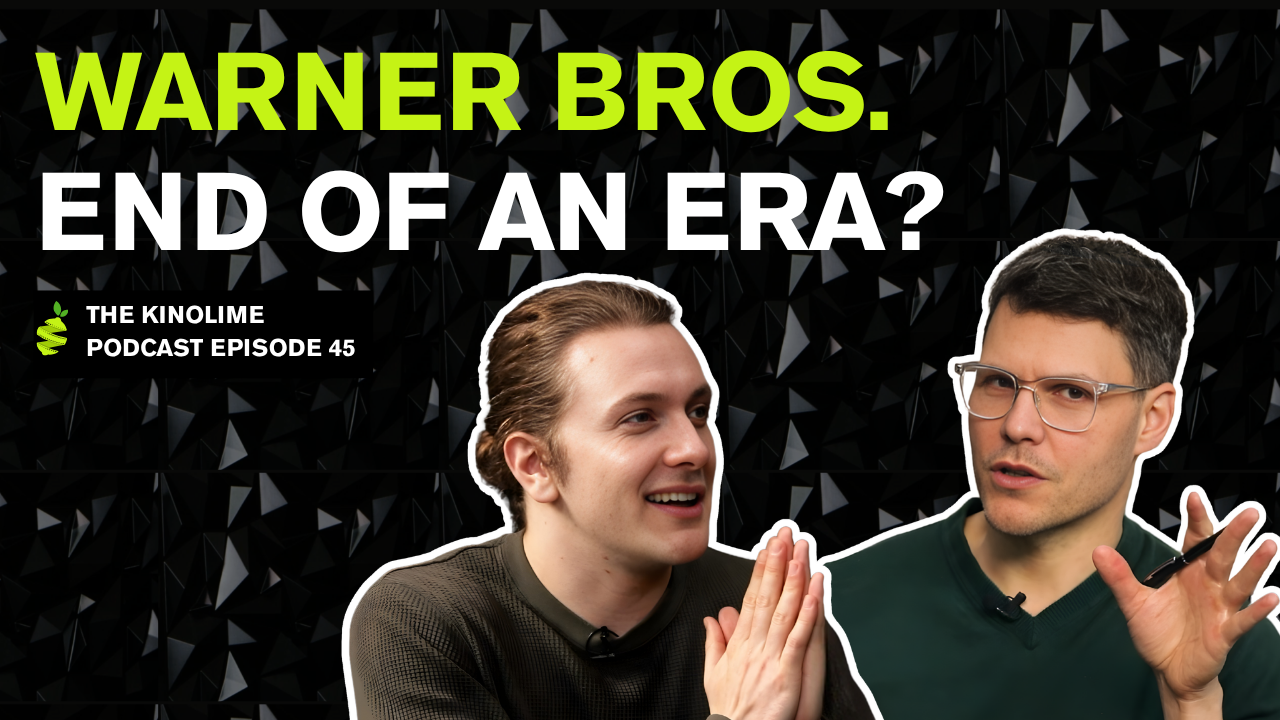
This week on the Kinolime Podcast, John and Danny take a passionate look at the legacy of Warner Bros., the studio they see as one of the greatest in film history. Framed as both a swan song and a celebration, the episode explores Warner’s remarkable rise, the films that defined its identity, and the creative risks that helped shape modern cinema.
From Casablanca and The Exorcist to Goodfellas, The Matrix, and The Dark Knight, they walk through the studio’s most influential eras, reflect on the filmmakers who made Warner a home for bold storytelling, and discuss what its changing future could mean for the movie industry. They also share ten Warner Bros. screenplays every screenwriter should read and make a heartfelt case for why original films, artistic ambition, and the theatrical experience still matter.
Full Transcript: Kinolime Podcast Episode 45: Warner Bros History In 30 Minutes and What Screenwriters Can Learnt
Participants
John Schramm - Head of Development, Kinolime
Danny Murray - Creative Executive, Kinolime
Warner Bros., Media Mergers, and the Future of Movies
John: Warner lost its identity once before, and now it feels like it could lose it again. They may keep the Warner Bros. name, but what if they turn it into something like “Ellison Tech Bro Productions” or something?
Danny: Pretty much. They’re going to be making Call of Duty: The Movie. That’s what we’ve got coming down the pipe. No more of anything else. Just movies, movies, movies. Three hundred a year, thanks to Larry and David.
Danny: Was it St. Patrick’s Day?
John: I’m colorblind, for everyone at home, so I didn’t even realize it.
Danny: I don’t believe that. I’ve played Uno with you. You’ve won.
John: That is a lie. Total lie.
John: I actually have a funny story about how I found out I was colorblind. In kindergarten, we played color bingo. Purple square, yellow circle, that kind of thing. I never won. Then one day I thought I finally did. I ran up to my teacher so excited and said, “Look, I won.” And she said, “John, you got every single one wrong.” That’s how I found out.
John: Anyway, we’re post-Oscars, there’s a lot going on, and today we had a really fun podcast idea. Actually, it was Danny’s idea, and of course it’s Danny’s favorite topic.
Danny: Media consolidation.
John: Exactly. We’re talking about Warner Bros., Paramount, and what all of this could mean. Danny called this episode a swan song. I’m calling it a eulogy. To me, Warner Bros. is the greatest studio ever. No question.
John: Hopefully things won’t change too much, but Danny, for everyone at home, update us on the current situation with Warner Bros. and Paramount.
The Current State of Warner Bros.
Danny: I keep thinking about Sunday and the Oscars. Warner had all of these great original films in the conversation. Big, bold, original work. Auteur-driven movies. The kind of stuff everyone says they want more of.
Danny: And as I was watching all of that, I kept thinking there’s almost no way this same team is still going to be here in a year if this merger goes through. There are still a lot of steps before anything is finalized. There’s EU regulation, the FCC, states trying to block it where they can. But realistically, it feels like it’s going through.
Danny: If it does, David Ellison comes in, and based on what we’re hearing, there’s probably going to be a major house-cleaning. The creative mandates are likely going to change. Fewer movies, more IP-driven projects, safer bets. The kind of shift that makes anyone who loves original filmmaking feel sick.
Danny: It’s a strange moment in the business. I was thinking a lot about where the industry stands, and in some ways it feels similar to the 1940s or 1950s. There’s upheaval. There’s a new dominant medium. What YouTube, Meta, and social media are doing to film and television may be the biggest shift since television itself, maybe even bigger, because it’s a completely different distribution model with an enormous market share.
Danny: So we don’t really know where things are headed. But looking back at Warner’s history might tell us something about where the industry is going.
The Origins of Warner Bros.
John: There are some great books out there on Warner Bros. history. I’d recommend reading up on it if you’re interested.
John: Warner Bros. was started by Polish Jewish immigrants. They came from a scrappy, hustler background. Jack Warner used to talk about getting into fights growing up. You can feel that sensibility later in the kinds of films Warner became known for: gangster pictures, gritty dramas, stories with edge.
John: They started from the bottom. They ran nickelodeons, those early movie theaters, and that’s where they learned every part of the business from the ground up. That hands-on experience is what built the company.
John: Then they started taking swings. One of their early big hits was My Four Years in Germany, which was based on a recent political book. Even back then, they were making films with political bite.
John: And of course, Warner changed film history with The Jazz Singer. That shift from silent films to talkies changed everything. If that hadn’t happened, we’d still be looking at each other and relying on title cards.
Danny: Honestly, I kind of wish that were still the case. We’d just move our mouths and then little lines of dialogue would pop up underneath. It would be great.
John: We should try that.
Warner’s Identity and Its Legacy
John: Another thing that stood out to me is that Warner also took care of silent-era actors during the transition. They kept people on payroll and tried to help them. For all the toughness, there was also heart there.
John: That’s the foundation of who Warner was, both as a studio and as a philosophy. And when you go through their filmography, you start to realize just how staggering it is. This is the greatest movie studio ever.
Danny: It really is. And that’s why it’s always been so coveted. Since the 1960s, Warner has been bought and merged over and over again. Everyone who acquires it wants a piece of that legacy.
Danny: You saw it with Zaslav after the Discovery merger. He literally sits behind Jack Warner’s desk. These people romanticize Warner’s history. They want the prestige, the legacy, the mythology.
Danny: But there’s probably never been a worse business decision than trying to acquire Warner Bros. Every new owner thinks they’re inheriting this miracle institution, and almost every time it falls apart.
The 1930s and 1940s: Warner Finds Its Voice
John: Warner’s identity really took shape in the 1930s and 1940s. This is the era of Casablanca, The Maltese Falcon, and other defining films.
John: They were making gritty, adult-driven films at a time when that wasn’t the norm. They owned noir. They specialized in sharp dialogue, cynical characters, and crime stories. For that era, they were genuinely edgy.
Danny: And what I love is that it wasn’t all hardboiled noir. There were also the comedies. Howard Hawks, Cary Grant, those snappy, oddball films. Warner could do that too.
Danny: That’s what made the studio so special. There wasn’t really a corner of the American cinematic landscape where Warner couldn’t make a great movie.
John: Exactly. But their willingness to take real political stances was also huge. They were the most openly anti-Nazi studio in Hollywood. They made Confessions of a Nazi Spy at a time when most studios wouldn’t go near that kind of material. That took guts.
The 1950s and 1960s: Transition and Expansion
John: The 1950s and 1960s feel like a transitional era, maybe even one of Warner’s strongest periods. You’ve got North by Northwest, The Searchers, A Streetcar Named Desire, Rebel Without a Cause. Incredible films.
Danny: It really is a second golden age. The studio system was changing, television was becoming a major threat, and the studios had to adapt.
Danny: What you see with Warner is scale. They were making movies that felt big enough to justify the theatrical experience. It’s the same conversation people are having now: if audiences can just stay home, what kind of film gets them into a theater?
John: Right, and at the same time the old system was collapsing. Warner responded by backing bold filmmakers and big voices.
John: Then you move into films like 2001: A Space Odyssey, Bonnie and Clyde, Cool Hand Luke, Bullitt, The Wild Bunch. They were taking huge risks.
John: But then something sad happened. In 1967, the company was sold to Seven Arts. For a while it wasn’t even Warner Bros. anymore. It lost its name, and in a sense, its identity.
Danny: Which is exactly why this moment feels so eerie. We’ve seen this before. The name stays, but the soul changes.
The 1970s: New Hollywood and Serious Filmmaking
John: The 1970s are unbelievable. The Exorcist, Dog Day Afternoon, Superman, One Flew Over the Cuckoo’s Nest, All the President’s Men. Warner was taking real risks on filmmakers.
Danny: That era is incredible. Blazing Saddles, Kubrick, all of it. Warner became synonymous with serious filmmaking.
John: Exactly. This is where the studio’s identity really sharpened. In screenwriting terms, it’s like the midpoint of the story. The wants, the motives, the character of the studio all become more defined. Warner knew what it was.
Danny: And really, when you look at Warner’s history, what you’re mostly seeing is the history of where the best talent wanted to go.
John: Yes. That’s the story. The best filmmakers kept ending up there.
The 1980s and 1990s: Range, Prestige, and Cultural Power
John: In the 1980s you’ve got Full Metal Jacket and Blade Runner. Then the 1990s just explode: Goodfellas, The Matrix, Dumb and Dumber, The Shawshank Redemption, Friday, The Mask, Austin Powers, The Wedding Singer, Rush Hour, Unforgiven.
John: That range is insane. From Friday to The Matrix to Unforgiven. How does one studio take that many creative swings?
Danny: That’s why people like Mike De Luca and Pam Abdy matter so much. The coolest parts of Warner’s history are about taking chances on auteurs, political thrillers, unusual big releases, and ambitious films that other places might not touch.
Danny: What made this last Oscar season feel special was that it reminded people what Warner can be at its best. And that’s why the idea of losing that feels so brutal.
Warner’s Logo and Image
John: Another thing I love about Warner is how much care they put into their logo and image. I remember the old WB intros as a kid, and then later the way they adapted the logo for films like The Matrix or The Dark Knight.
John: They turned the studio logo into part of the experience. It became something you looked forward to. Like the Fox fanfare or the Star Wars opening crawl, Warner made the intro itself feel iconic.
John: That attention to design and identity mattered. They understood what a Warner Bros. movie should feel like before the movie even started.
The 2000s: IP, Prestige, and Big Swings
John: In the 2000s, you have Harry Potter, The Dark Knight, The Hangover, Ocean’s Eleven, The Departed, Pan’s Labyrinth, Best in Show, Letters from Iwo Jima, A History of Violence, Mystic River.
John: Again, gritty dramas, massive franchises, prestige filmmakers, comedy, fantasy. They gave filmmakers room to spread their wings.
Danny: And of course, this is also the era when the value of Warner’s IP becomes impossible to ignore. Harry Potter and Batman alone are worth fortunes. That’s a huge part of why the company became so attractive to buyers.
Danny: But the scary thing is that once those IPs become the center of gravity, you start to wonder whether there will still be a place for the rest of what Warner has always represented: the freedom, the range, the absence of a rigid mandate.
Five Warner Bros. Films That Changed Cinema
John: If I had to pick five Warner films that changed cinema, I’d start with The Jazz Singer. That’s obvious. It moved the whole industry into the sound era.
John: Then Casablanca, because it reshaped what character-driven storytelling could look like.
John: Third, The Exorcist. It fused serious filmmaking with horror in a way that changed the genre forever. It’s still one of the scariest films ever made, but it’s also about faith, doubt, and philosophy.
Danny: It’s from 1973, I think.
John: Right, early ’70s.
John: Fourth, Goodfellas. It reinvented the gangster film. The narration, the structure, the energy, the style. It broke the mold.
Danny: I usually hate narration in movies, but Goodfellas uses it brilliantly. It’s so smart about how it breaks the rules.
John: And fifth, yes, I’m saying it: The Dark Knight. Roll your eyes all you want, but it changed the game for superhero movies. It made them more philosophical, more serious, more ambitious. Read that screenplay. It’s fantastic.
Danny: It wasn’t even the grittiest Batman movie of that decade.
John: It didn’t need to be. It was spectacle with ideas.
Ten Warner Bros. Screenplays Every Screenwriter Should Read
John: Before we wrap up, I always like to give people homework. So here are the Warner Bros. screenplays every screenwriter should read.
John: First, Casablanca. It may be the greatest example of a perfect character arc ever written.
John: Second, The Maltese Falcon. If you want to write detective noir, study that script.
John: Third, Chinatown. It’s often called one of the greatest screenplays ever written.
John: Fourth, The Exorcist. A near-perfect horror script that also wrestles with philosophy.
John: Fifth, Goodfellas. A masterclass in structure and voice.
John: Sixth, Unforgiven. One of the great modern western screenplays.
John: Seventh, The Matrix. Obviously one of the most influential sci-fi scripts ever written.
John: Eighth, The Dark Knight. A sophisticated blockbuster script that’s absolutely worth reading.
John: Ninth, Blade Runner. Even if it’s not your favorite film, it’s a powerful example of atmosphere-driven storytelling.
John: And then I couldn’t stop at ten, so here are four more: Dog Day Afternoon, Network, Mad Max: Fury Road, and The Departed.
Danny: I can’t really argue with any of that. When you look at Warner’s history, you’re basically looking at the history of great movies.
A Plea for the Future of Warner Bros.
Danny: So, Dave and Larry, if you’re listening: please just keep Mike and Pam in charge. You say you’re going to make thirty movies a year. You probably won’t. Maybe twenty. You’re going to cut people, gut the business, destroy release windows, and flood everything with AI slop. I’m terrified.
Danny: But please, before you throw a grenade into the last movie theater on Earth, make a few great original movies. Buy some original films. Distribute them. Give people a reason to care.
Danny: Actually, you know what? I’ve changed my mind. Vertically integrate the whole thing. Own every theater, every platform, every camera, every movie. Force cinema onto the world. Make three hundred movies a year. And I want to be employed on all of them.
John: That was beautiful. I’m moved.
John: But seriously, when I think of the Warner logo, I think about seeing The Matrix in a theater for the first time as a teenager and being completely blown away. I just want that to continue.
John: I understand profit matters. But movies matter too. People care about them. They help people get through life. They help people understand themselves and the world.
John: I love books, but people still connect deeply to movies. So keep the spirit alive. Keep the creativity alive. Give people a chance to make original work. Not everything has to be arthouse cinema, but please don’t make everything IP-driven.
Danny: As Timothée Chalamet would say, what matters is preserving the spirit of movies for everyone. Film is the working person’s art form. So if you’re a truck driver or a construction worker, get off your phone, go to the movies, and enjoy it.
John: Warner Bros., we hope you stick around. We love you. To the best studio ever.
Danny: Best studio ever. Keep watching movies. Keep making movies.
John: We’re out.